


Court Orders Fresh Assessment in Income Tax Dispute Over Creditor Confirmations





Full News
Court Orders Fresh Assessment in Income Tax Dispute Over Creditor Confirmations
Court Orders Fresh Assessment in Income Tax Dispute Over Creditor Confirmations
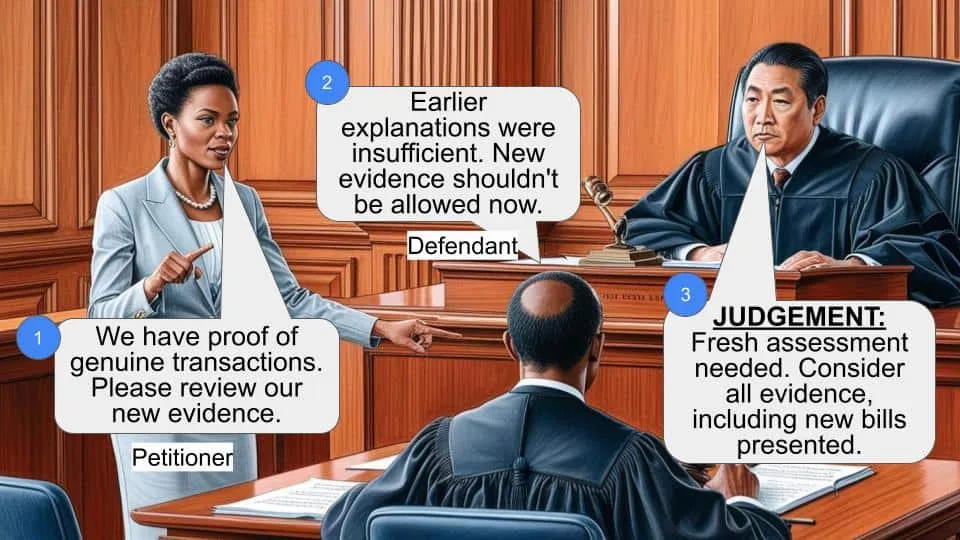
It's about a company that makes electromagnetic equipment for testing vibrations. They got into a tussle with the tax department over some creditor confirmations. The tax folks didn't buy their explanation for about Rs.1.38 lakhs worth of transactions. The company fought this all the way up to the High Court, which eventually said, "Hold up, let's take another look at this."
Get the full picture - access the original judgement of the court order here
Case Name:
Crescent Control Pvt. Ltd. Vs Assistant Commissioner of Income Tax (High Court of Uttarakhand)
Income Tax Appeal No.5 of 2013
Date: 7th August 2020
Key Takeaways:
1. The court emphasized the importance of considering all available evidence in tax assessments.
2. Even small amounts (like Rs.1.38 lakhs here) can be worth fighting for in tax disputes.
3. Higher courts can intervene and order reassessments if they feel lower authorities missed crucial evidence.
Issue:
The main question here is: Did the appellant (Crescent Control Pvt. Ltd.) satisfactorily prove the genuineness of certain creditors as required under Section 68 (of Income Tax Act, 1961)?
Facts:
1. Crescent Control Pvt. Ltd. filed their tax return on November 30, 2006, for the 2005-06 financial year.
2. The tax department issued a notice under Section 143(2) (of Income Tax Act, 1961), asking for details on creditors with balances over Rs.50,000.
3. The company provided the info, but the tax officer wasn't satisfied with confirmations for four creditors, totaling Rs.1,38,452.
4. This amount was added to the company's income, resulting in a tax demand of Rs.72,999.
5. The company appealed this decision, first to the Commissioner of Income Tax, then to the Income Tax Appellate Tribunal. Both appeals were dismissed.
6. Finally, they took it to the High Court.
Arguments:
The company's lawyer, Mr. P.R. Mullick, argued:
1. The tax officer made a mistake in disallowing these transactions.
2. They had enough evidence to show the purchases were genuine.
3. They even produced bills for all four disputed accounts in court.
The tax department's lawyer countered:
1. The company failed to satisfy the authorities about the genuineness of these transactions earlier.
2. They shouldn't be allowed to argue differently now.
Key Legal Precedents:
Interestingly, this judgment doesn't cite any specific legal precedents. Instead, it focuses on the interpretation and application of Section 68 (of Income Tax Act, 1961), which deals with unexplained cash credits.
Judgement:
The High Court decided:
1. The tax officer should have considered all the material produced, including the bills presented in court.
2. It's not clear if these bills were shown to the tax officer earlier.
3. If they were, the officer might have reached a different conclusion.
4. So, they're sending the case back to the tax officer to take a fresh look.
5. The officer should consider these four bills and any other material the company provides.
6. After that, they should pass a new assessment order.
FAQs:
1. Q: What does this mean for Crescent Control Pvt. Ltd.?
A: They get another chance to prove their case to the tax officer. It's not a win yet, but it's definitely not a loss.
2. Q: Why did the High Court intervene?
A: They felt that some crucial evidence (the bills) might not have been properly considered in the earlier assessments.
3. Q: Does this set a precedent for other tax cases?
A: While it's not a landmark judgment, it does emphasize the importance of tax authorities considering all available evidence before making decisions.
4. Q: What's the significance of Section 68 (of Income Tax Act, 1961)?
A: It puts the burden on the taxpayer to explain the nature and source of any unexplained cash credits in their books.
5. Q: Could the tax department still reject these transactions?
A: Yes, but they'll need to consider all the evidence and provide clear reasons if they do.

1. The appellant is a manufacturer of electromagnetic equipment used for environmental testing of vibrations. It filed an income tax return on 30.11.2006 for the financial year 2005 – 06 along with audited balance sheet and statement of accounts. A notice was issued under section 143(2) (of Income Tax Act, 1961), 1961. Thereafter, the appellant was directed to furnish certain details with regard to balance confirmation of creditors with closing balance above Rs. 50,000/-. The same was complied with. However, the balance confirmation in respect of M/s B.K. Vinod & Co. Pvt. Ltd, Delhi for an amount of Rs. 48,690/-, M/s Chuni Lal Keval Krishna, Delhi for an amount of Rs. 24,960/-, M/s S.K. Engg. Works, Ghaziabad for an amount of Rs. 23,142/- and M/s S.R. Electricals, Delhi for an amount of Rs. 42,178/-, aggregating to Rs. 1,38,452/-, were disallowed, under section 68 (of Income Tax Act, 1961). After making additions to the income for Rs. 1,38,452/-, a demand notice for Rs. 72,999/- was issued to the appellant. Aggrieved by the same, the appellant filed a first appeal before the Commissioner of Income Tax and the same was dismissed. Thereafter, the appellant filed a second appeal under Section 253 (of Income Tax Act, 1961) before the Income Tax Appellate Tribunal. The second appeal was also dismissed. Hence, the instant appeal.
2. The appeal was admitted on 20.03.2013 on the question – whether the appellant has discharged the obligation to satisfy the genuineness of the creditors in terms of section 68 (of Income Tax Act, 1961).
3. Shri P.R. Mullick, learned counsel for the appellant contends that the assessing officer has committed an error in disallowing the same. Sufficient material existed in order to indicate that all the purchases were genuine. Even otherwise, the genuineness of the transactions has not been disputed. In support whereof he relies on the bills so far as these four accounts are concerned which have been produced herein. They pertain to M/s B.K. Vinod & Co. Pvt. Ltd, Delhi for an amount of Rs. 48,690/-, M/s Chuni Lal Keval Krishna, Delhi for an amount of Rs. 24,960/-, M/s S.K. Engg. Works, Ghaziabad for an amount of Rs. 23,142/- and M/s S.R. Electricals, Delhi for an amount of Rs. 42,178/-. He also placed reliance on the ledger accounts to indicate that all the material have been produced. The genuineness of the transactions has also been proved.
4. The same is disputed by learned counsel for the revenue. He submits that the appellant having failed to satisfy the authority with regard to the genuineness of the transactions cannot now contend to the contrary.
5. However, on considering the contentions, we are of the view that the assessing officer should have considered the material produced before him, which have also been enclosed herein. On a specific question being asked to the learned counsel for the revenue - whether the bills referred to hereinabove have been produced before the assessing officer, it is submitted that he does not have complete information with regard to the same.
6. On considering these four bills, we are of the view that if the same were placed for consideration before the assessing officer, then he may have come to a different conclusion than what he has arrived at. We also do not notice that the assessing officer has referred to any of these bills, as produced by the appellant. Hence, we are of the view that it would be just and appropriate to direct the assessing officer to reconsider the matter afresh by considering these four bills, which are produced herein by the appellant as well as the material already placed before the assessing officer for consideration.
7. Hence, for all these reasons, the appeal is allowed. The order dated 28.09.2012 passed by the Income Tax Appellate Tribunal, New Delhi in ITA No. 2614/Del/2012 (AY 2006-07) is set aside. The matter is remanded back to the assessing officer to reconsider the matter afresh, in the light of the aforesaid four bills produced herein and thereafter, pass a fresh assessment order, in accordance with law.
(N.S.Dhanik, J.) (Ravi Malimath, ACJ.)
07.08.2020
×
Similar Ripples
Questions
Court Orders Fresh Assessment in Income Tax Dispute Over Creditor Confirmations
Write your CommentSimilar Posts
Generic
- Reportdata/6195.pdf
