


Court Orders Fresh Assessment in Tax Dispute, Emphasizing Fair Opportunity for …





Full News
Court Orders Fresh Assessment in Tax Dispute, Emphasizing Fair Opportunity for Assessee
Court Orders Fresh Assessment in Tax Dispute, Emphasizing Fair Opportunity for Assessee
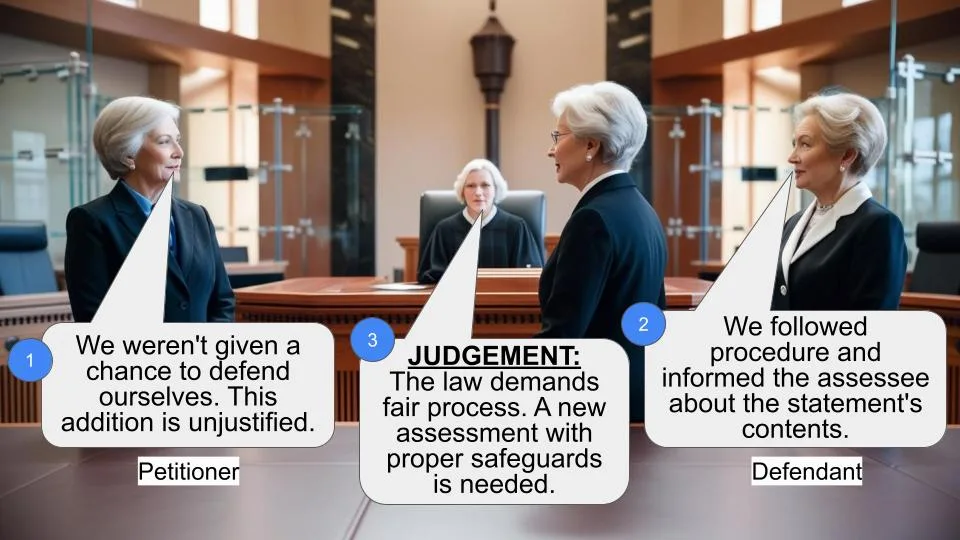
We're looking at a case where the Income Tax Department (the Revenue) wasn't happy with a decision made by the Income Tax Appellate Tribunal (ITAT). The ITAT had agreed with deleting a hefty sum of Rs. 1,01,00,000 from the assessee's (taxpayer's) income. The main issue? The assessee wasn't given a fair chance to defend themselves. In the end, the court decided to give the case another go, but this time with proper procedures in place.
Get the full picture - access the original judgement of the court order here
Case Name:
Commissioner of Income Tax vs. Dev Dutt Prasad Raj Kumar Garg
(High court of Delhi)
Delhi:13 September 2012
Key Takeaways:
1. Proper opportunity to the assessee is crucial in tax proceedings.
2. The court emphasized the importance of following due process.
3. Even if there are irregularities, completely quashing proceedings isn't always the best solution.
4. The case highlights the balance between tax authority powers and taxpayer rights.
Issue:
Did the Income Tax Appellate Tribunal (ITAT) make a mistake by upholding the deletion of Rs. 1,01,00,000 from the assessee's income on the grounds that the assessee wasn't given a proper chance to defend themselves?
Facts:
Alright, let's break this down:
1. This all started with the assessment year 2001-2002.
2. The tax department decided to reopen the assessment under Section 147 (of Income Tax Act, 1961).
3. Why? Because they raided the premises of a guy named B.M. Gupta.
4. During the reassessment, they found an entry with the number '177' against a sum of Rs. 1,01,00,000.
5. The tax officer tried to link this amount to our assessee.
6. The officer also referred to statements from Ram Avtar Singhal (a Chartered Accountant) and B.M. Gupta.
7. Based on all this, they decided to add back Rs. 1.01 crores to the assessee's income under Section 69A (of Income Tax Act, 1961).
Arguments:
The Assessee's Side:
- They weren't allowed to cross-examine B.M. Gupta.
- They weren't given a copy of Gupta's statement despite asking for it multiple times.
- They denied having any financial dealings with B.M. Gupta.
The Revenue's Side:
- They claimed they had informed the assessee about the contents of the statement.
- They believed the information from DCIT-19, New Delhi, was enough to make the addition.
Key Legal Precedents:
1. Dhakeswari Cotton Mills Ltd. v. Commissioner of Income-tax, West Bengal (26 ITR 775)
- This Supreme Court case was cited to support the idea of remanding the case for proper procedure.
2. ITO v. M. Pirai Choodi (2011) 334 ITR 262 (SC)
- This case suggested that completely quashing assessment orders isn't always necessary; sometimes, directing the Assessing Officer to grant an opportunity for cross-examination is sufficient.
Judgement:
The court decided:
1. The Assessing Officer didn't properly discuss the assessee's arguments or clearly connect the '177' entry to the assessee.
2. The assessee wasn't given a fair chance to deal with the evidence against them.
3. Instead of just agreeing with the CIT(A)'s order, the ITAT should have sent the case back to fix the procedural mistakes.
4. The court directed the Assessing Officer to look at the whole matter again, but this time:
- Give the assessee all the relevant materials they have.
- Allow the assessee to cross-examine any witnesses the officer wants to rely on.
The appeal was allowed, and the ITAT's judgment was set aside to this extent.
FAQs:
1. Q: What was the main issue in this case?
A: The main issue was whether the assessee was given a fair opportunity to defend themselves in the tax proceedings.
2. Q: Why didn't the court simply uphold the deletion of the Rs. 1.01 crore addition?
A: While the court agreed that proper procedure wasn't followed, it believed that completely canceling the assessment wasn't the right solution. Instead, it opted for a fresh assessment with proper safeguards.
3. Q: What's the significance of allowing cross-examination in tax cases?
A: Cross-examination allows the assessee to question witnesses and challenge evidence, ensuring a fair process and helping to uncover the truth.
4. Q: Does this mean the assessee won't have to pay the additional tax?
A: Not necessarily. The case will be reassessed, and the outcome will depend on the fresh proceedings where the assessee will have a fair chance to present their case.
5. Q: What lesson can tax authorities learn from this case?
A: It emphasizes the importance of following due process, giving assessees a fair opportunity to defend themselves, and properly connecting evidence to assessees before making additions to their income.

1. The Revenue claims to be aggrieved by the order of ITAT passed in ITA No.1522/DEL/2010 and ITA No.2727/DEL/2010. The question of law sought to be urged is whether the Tribunal fell into the error in upholding the deletion of Rs.1,01,00,000/- under Section 69A (of Income Tax Act, 1961) on the ground that appropriate opportunity had been denied to the assessee.
2. The brief facts are that the assessment in respect of AY 2001-2002 was sought to re-opened under Section 147 (of Income Tax Act, 1961) on account of a raid carried out in the premises of one Sh. B.M. Gupta. After reopening of the assessment and during the course of proceedings that AO relied upon an entry which cited a numeral ‘177’ against which a sum of Rs.1,01,00,000/-, was shown and sought to be connected with the assessee. The reassessment order also referred to a statement made by one Sh. Ram Avtar Singhal, Chartered Accountant and also the statement of Sh. B.M. Gupta as well as certain documents. On the basis of these, it was held that a sum of Rs.1.01 crores ought to be added back under Section 69A (of Income Tax Act, 1961) and brought to tax. The assessee’s appeal was accepted primarily on the ground of denial of proper opportunity by the Appellate Commissioner. The assessee and the Revenue felt aggrieved as far as question of validity of reassessment was concerned on the merits of reassessment order. The Tribunal rejected both the appeals. The assessee has not questioned the reopening of the assessment under Section 147 (of Income Tax Act, 1961)-148. The Tribunal’s reasoning as far as it upholds the Appellate Commissioner’s order vis-à-vis deletion of a sum of Rs.1.01 crores is as follows:-
“10. Learned counsel for the assessee, on the other hand, contends that neither the said Shri Brij Mohan Gupta was allowed to be cross- examined nor a copy of his statement was given despite several requests. The AO’s contention to the effect that the contents of the statement were made known to the assessee, is not a compliance of mandatory requirement to provide the assessee incriminating material to defend its case. CIT(A) has categorically held that:
(i) Complete statement of Brij Mohan Gupta was never given.
(ii) No adverse observations were made by AO on remand report called upon by the CIT(A).
(iii) Beyond the belief of presumption on the information supplied by the DCIT-19, New Delhi, no further inquiry or investigation was carried out by the AO to sustain this addition.
(iv) Cross-examination of Shri Brij Mohan Gupta was never allowed despite CIT(A)’s direction and remand of the matter.
(v) The assessee firm had strongly denied having any financial transaction with Mr. Brij Mohan Gupta.
10.1. In view of these findings, CIT(A) has rightly held that the addition made by the AO, without any corroborative evidence, what- so-ever, was unjustified.”
3. We have heard counsel for the parties. In the recent decision reported as ITO v. M. Pirai Choodi, (2011) 334 ITR 262 (SC), the supreme Court held as follows:-
We are of the view that the High Court should not have set aside the entire assessment order. At the highest, the High Court should have directed the Assessing Officer to grant an opportunity to the assessee to cross-examine the concerned witness. Be that as it may, we are of the view that, even on this particular aspect, the assessee could have gone in appeal to the Commissioner of Income-tax (Appeals). The assessee has failed to avail of the statutory remedy. In the circumstances, we are of the view that the High Court should not have quashed the assessment proceedings vide the impugned order.”
4. In the present case, the AO has referred to certain materials. A close reading of the assessment order discloses that neither has the contentions of the assessee been discussed nor any attempt made to connect entry 177 with the assessee. It is also apparent from the Appellate Commissioner’s order that these matter were not put to the assessee. Consequently, there cannot be two opinions of the fact that assessee was denied proper opportunity to deal with the materials sought to be relied upon. However, in view of the ruling of the Supreme Court in Dhakeswari Cotton Mills Ltd. V. Commissioner of Income-tax, West Bengal v. CIT, 26 ITR 775 (SC,) this Court is of the opinion that the Tribunal ought not to have merely upheld the CIT (Appeal)’s order but should have remanded the proceeding to correct the irregularities which crept in during the reassessment proceedings. Accordingly, we direct the AO to consider the entire matter afresh after giving all the necessary materials in his possession which deemed are adverse, to the assessee and also after further affording an opportunity for cross-examination of such witnesses as he seeks to rely upon, to the assessee.
5. The appeal is allowed and the Tribunal’s impugned judgment is set aside to the extent, the appeal is accordingly allowed.
S. RAVINDRA BHAT
(JUDGE)
R.V. EASWAR
(JUDGE)
SEPTEMBER 13, 2012
×
Similar Ripples
Questions
Court Orders Fresh Assessment in Tax Dispute, Emphasizing Fair Opportunity for Assessee
Write your CommentSimilar Posts

Generic
- Reportdata/5451.pdf
