


Court Orders Fresh Look at Power Company's Depreciation Claims





Full News
Court Orders Fresh Look at Power Company's Depreciation Claims
Court Orders Fresh Look at Power Company's Depreciation Claims
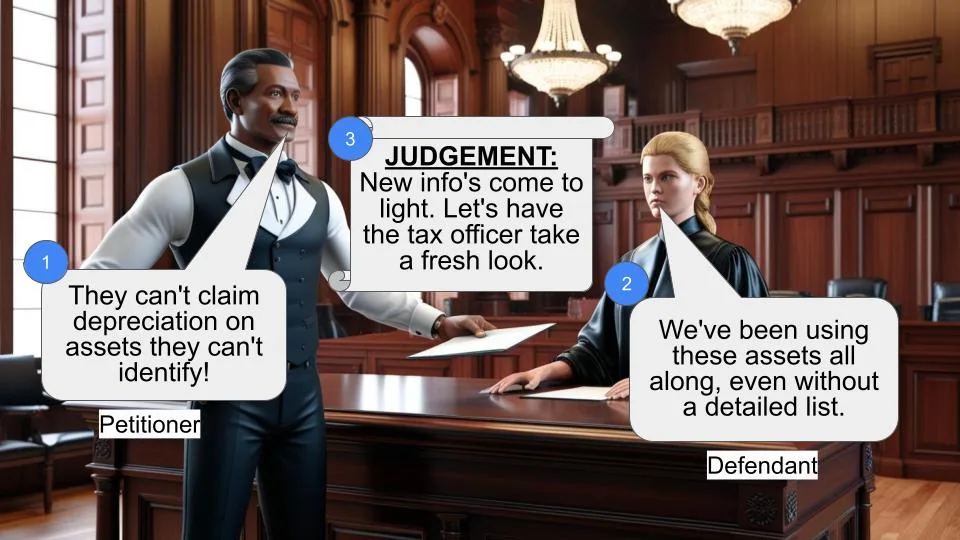
This case where the Income Tax Department is challenging depreciation claims made by a power distribution company called Poorvanchal Vidyut Vitran Nigam Ltd. (PVVNL). The main issue was about depreciation on assets transferred to PVVNL under a 2003 scheme. The court decided to send the case back to the tax authorities for a fresh look, considering some new information that's come to light.
Get the full picture - access the original judgement of the court order here
Case Name:
Commissioner of Income Tax Vs M/s Poorvanchal Vidyut Vitran Nigam Ltd.(High Court of Allahabad)
Income Tax Appeal No.251 of 2013
Date: 17 October 2019
Key Takeaways:
1. The court recognized the complexity of asset transfers in power sector restructuring.
2. It emphasized the importance of proper asset identification for depreciation claims.
3. The judgment shows that tax assessments can be revisited when new relevant information becomes available.
Issue:
The main question here is: Was the Income Tax Appellate Tribunal right in allowing PVVNL to claim depreciation on fixed assets acquired through the 2003 transfer scheme, even though these assets weren't fully identified or their ownership wasn't completely transferred at the time?
Facts:
Alright, let's break this down:
1. Back in 1999, Uttar Pradesh started reforming its power sector.
2. The old UP State Electricity Board was split into three companies in 2000.
3. In 2003, after a new Electricity Act came in, they further divided things up. PVVNL was one of four new distribution companies created.
4. PVVNL got some assets transferred to it, but the details of these assets weren't clear right away.
5. PVVNL claimed depreciation on these assets in its tax returns for several years (2007-08 to 2012-13).
6. The tax department wasn't happy about this and disallowed these claims.
7. PVVNL appealed, and both the CIT(A) and the Tribunal sided with them.
8. The tax department then took the case to the High Court.
Arguments:
The tax department said:
- "Hey, you can't claim depreciation on assets you can't identify or prove you're using!"
- They pointed out that PVVNL only got a detailed asset list in 2015, so how could they claim depreciation before that?
PVVNL argued:
- "Look, we've been using these assets all along, even if we didn't have an itemized list."
- They said the CIT(A) and Tribunal had already allowed their claims for previous years, so why change now?
Key Legal Precedents:
The judgment doesn't mention any specific legal precedents. Instead, it focuses on Section 32 (of Income Tax Act, 1961), which deals with depreciation claims. The court considered how this section should be applied in the context of large-scale asset transfers in the power sector.
Judgement:
The court didn't fully side with either party. Instead, it said:
- "Okay, we've got new information now. PVVNL got a detailed asset report in December 2015."
- "Let's send this back to the tax officer to take a fresh look."
- The court gave the tax officer three months to review the new information and make a decision.
FAQs:
Q1: Does this mean PVVNL won the case?
A1: Not exactly. The court didn't decide in favor of either side. It's more like a "let's take another look" decision.
Q2: Why didn't the court just make a final decision?
A2: The court felt that with the new asset information from 2015, it was best to let the tax authorities examine the details first.
Q3: What happens next?
A3: The tax officer will review the new asset information and make a fresh decision about PVVNL's depreciation claims.
Q4: Could this case affect other power companies?
A4: Possibly! It shows that courts are willing to consider the complexities of asset transfers in the power sector when looking at tax issues.
Q5: How long will it take to resolve this issue now?
A5: The court gave the tax officer three months to make a new decision, but if either party disagrees with that decision, we might see more appeals.

1. All these appeals filed under Section 260-A (of Income Tax Act, 1961) arise out of orders dated 1.5.2013, passed by the Income Tax Appellate Tribunal (hereinafter called as “ITAT”), Allahabad Bench, Allahabad in Income Tax Appeal Nos.228/Alld/2011, 229/Alld/2011, 272/Alld/2012, for the assessment years 2007-08, 2008-09, 2009-10 and orders dated 21.3.2016 passed by the Income Tax Appellate Tribunal, Allahabad (Circuit Bench at Varanasi) in Income Tax Appeal Nos.356/Alld/2014, 498/Alld/2015 and 499/Alld/2015 for the assessment years 2010-11, 2011-12 and 2012-13.
2. Issue in all these appeals under challenge are same, hence are being decided by a common order, treating appeal no.251 of 2013, for the assessment year 2007-08, as the leading appeal.
3. All the appeals are filed on the same question of law, which read as under:
“Whether the Income Tax Appellate Tribunal is justified in law and facts in holding that the assessee was entitled to claim depreciation on the fixed assets acquired on transfer scheme 2003 which was not yet finalized/ascertained on the fact that the actual assets are not identifiable and not being used as well as their full title have not been transferred to the assessee ?”
4. Brief facts of the case are, that U.P. Electricity Regulatory Commission (in short “UPERC”) was formed under the provisions of U.P. Electricity Reforms Act, 1999 by Government of U.P., as a first step for reforming and restructuring the power sector in the State.
5. The erstwhile U.P. State Electricity Board (in short “UPSEB”) was unbundled into three distinct legal and separate entities through the First Reforms Transfer Scheme, dated 14.1.2000, which are as under:
(i) U.P. Power Corporation Ltd. (in short “UPPCL”), vested with the function of transmission and distribution of power within the State.
(ii) U.P.Rajya Vidyut Utpadan Nigam Ltd. (in short “UPRVUNL”), vested with the function of Thermal generation within the State.
(iii) U.P.Jal Vidyut Nigam Ltd. (in short “UPJVNL”), vested with the function of Hydro generation within the State.
6. By another Transfer Scheme dated 15.1.2000, the assets liabilities and personnel of Kanpur Electricity Supply Authority (in short “KESA” ) under UPSEB were transferred to Kanpur Electricity Supply Company Ltd. (in short “KESCO”), a Company registered under the Companies Act, 1956.
7. After the enactment of Electricity Act, 2003, UPPCL, which was responsible for transmission and distribution of electricity was further divided and four new distribution Companies (hereinafter collectively referred to as “distribution licensees”) were created under the U.P. Transfer of Distribution Undertaking Scheme,2003 (in short called as “Transfer Scheme, 2003”), vide notification no.2740-PA-1-2003-24-14P- 2003, dated 12.8.2003, issued by the State Government to undertake distribution and supply of electricity in the areas under their respective Zones specified in the Scheme:
(i) Dakshinanchal Vidyut Vitran Nigam Ltd. (Agra Discom or DVVNL)
(ii) Madhanchal Vidyut Vitran Nigam Ltd. ( Lucknow Discom or MVVNL)
(iii) Paschimanchal Vidyut Vitran Nigam Ltd. (Meerut Discom or PVVNL)
(iv) Purvanchal Vidyut Vitran Nigam Ltd. ( Varanasi Discom or PVVNL)
8. The said notification was issued in pursuance of Section 131(4) of Electricity Act, 2003 and Section 23(4) (of Income Tax Act, 1961) of the U.P. Electricity Reforms Act, 1999.
9. Pursuant to the formation of the said four Companies, all the assets and liability as per the Scheme was transferred, which included the fixed assets. After transfer of assets and liabilities, these Companies started utilizing the same in power generation and revenue generated was disclosed in the return filed by it in regular course. However, as break up of assets value and itemwise was not provided in the Scheme, as such for PUVNL, one Ms Batliboy & Co. was entrusted with task for physical verification of assets and determination of the same.
10. As the report was awaited and the returned had fallen due, assessee had charged depreciation at a common rate of 7.84% on the method prescribed by the Government under Electricity Supply Act, 1948 on the gross fixed assets transferred to the Company as per the Transfer Scheme, 2003.
11. While making the assessment for the assessment year 2004-05 the assessing officer disallowed the depreciation claimed by the respondent- assessee on the assets transferred to it under the U.P. Transfer of Distribution Undertaking Scheme, 2003.
12. CIT(A), however, considering the fact allowed the appeal of the respondent-assessee, which was affirmed by the Tribunal. The order of the Tribunal was challenged by the Department before this Court.
13. Present dispute relates to the assessment years 2007-08, 2008-09, 2009-10, 2010-11, 2011-12 and 2012-13. In all these years the assessing authority had disallowed the depreciation claimed by the assessee on the assets transferred to it pursuant to the Scheme of 2003.
14. Sri Gaurav Mahajan, learned counsel appearing for the Department submitted that Section 32 (of Income Tax Act, 1961) provides for depreciation in respect of building, machinery, plant or furniture, being tangible assets. He relied upon sub-section 1(ii) (of Income Tax Act, 1961) of Section 32 (of Income Tax Act, 1961),which provides that depreciation shall be granted only when the assessee owned, wholly or partly and used for the purpose of business or profession that the deduction shall be allowed. According to the appellant the respondent-assessee came into effect from 12.8.2003 and claimed depreciation to the tune of Rs.87,01,38,609/- out of which Rs.17,45,76,911/- has been claimed for assets acquired after the Transfer Scheme, 2003 as mentioned in the depreciation schedule.
15. While remaining depreciation of Rs.69,55,61,698/- has been claimed on the balance assets acquired on the Transfer Scheme, 2003. He further submitted that A.O. had rightly allowed the claim of depreciation on the assets acquired after the Transfer Scheme, 2003 came into force while it disallowed the claim of the respondent-assessee on the assets transferred under the Scheme as the same was not yet finalized and identifiable and, therefore, not being used as well. He also submitted that the assessing officer had also disallowed the claim of depreciation claimed by the assessee for the previous assessment years also.
16. Lastly, it was contended that the assets acquired under the Transfer Scheme, 2003 came to be identifiable in the assessment year 2016-17, as such, the matter needs to be remitted back to the assessing authority to look into the claim of depreciation in respect of assets so acquired.
17. Per contra, Sri Ashsih Bansal, learned counsel appearing for the respondent-assessee submitted that the A.O. had wrongly disallowed the claim of depreciation, as the C.I.T. (Appeal) and Tribunal had granted the claim of depreciation to the assessee for the relevant years in question as well as for the previous assessment years, as such the arguments of the Department has no legs to stand. However, he candidly admitted the fact,that the task for determination of itemwise opening balance of assets and liabilities had been completed and the reports had been submitted by auditor/agency to the assessee, the same have been brought by the counsel for the assessee before the Court in his written submission,which is dated 4.12.2015. The relevant extract of the letter dated 4.12.2015 are extracted here as under :
Opening Balances of Acoounting Units vested in Purvanchal Vidyut Vitran Nigam Limited, Varanasi as on 12.08.2003”
18. Sri Bansal lastly submitted that in case the court is of different view, then the matter be remanded to A.O. for limited purpose, only for verification of the said record for allowing depreciation to the assessee as per law.
19. Having heard learned counsel for the parties and from perusal of the records, it is not in dispute that the UPPCL was divided into four new distribution Companies under the Transfer Scheme, 2003 by Government notification dated 12.8.2003. The respondent-assessee is one of the four distribution Companies. It is further not in dispute that the Transfer Scheme, 2003 provided for the assets, which included the fixed assets, but no break up of assets values and itemwise was provided in the Transfer Scheme, 2003, as such the respondent-assessee had appointed an auditor to make itemwise opening balance of the assets and liabilities,which according to the respondent-assessee themselves was submitted by the auditors to them on 4.12.2015.
20. The contention of the counsel for the Department regarding the depreciation, which has been disallowed by the assessing officer on the balance assets acquired on the date of Transfer Scheme, 2003, as the assets was was not identifiable at the relevant point of time, needs consideration.
21. In the light of the fact that the auditors themselves had submitted report to the respondent-assessee on 4.12.2015 and the assets so acquired under the Transfer Scheme, 2003 came to be identifiable only in the assessment year 2016-17. The said fact has also not been denied by the counsel for the respondent-assessee.
22. In view of the above, we are of the considered opinion that the matter needs to be examined afresh for the claim of depreciation by the assessing officer, in the light of the auditor’s report providing itemwise accounting of assets and liabilities on 4.12.2015. Thus, the matter is remitted back to the assessing authority to reconsider and verify the records and pass fresh order, as far as claim of depreciation on the assets claimed by the respondent-assessee, pursuant to the Scheme of 2003.
23. We hope and trust that the aforesaid exercise will be carried out by the assessing officer within three months from the date of production of a certified copy of this order, with the aforesaid directions all the appeal stands disposed off.
Dated:- 17.10.2019
×
Similar Ripples
Questions
Court Orders Fresh Look at Power Company's Depreciation Claims
Write your CommentSimilar Posts


Generic
- Reportdata/4630.pdf
