


Full News
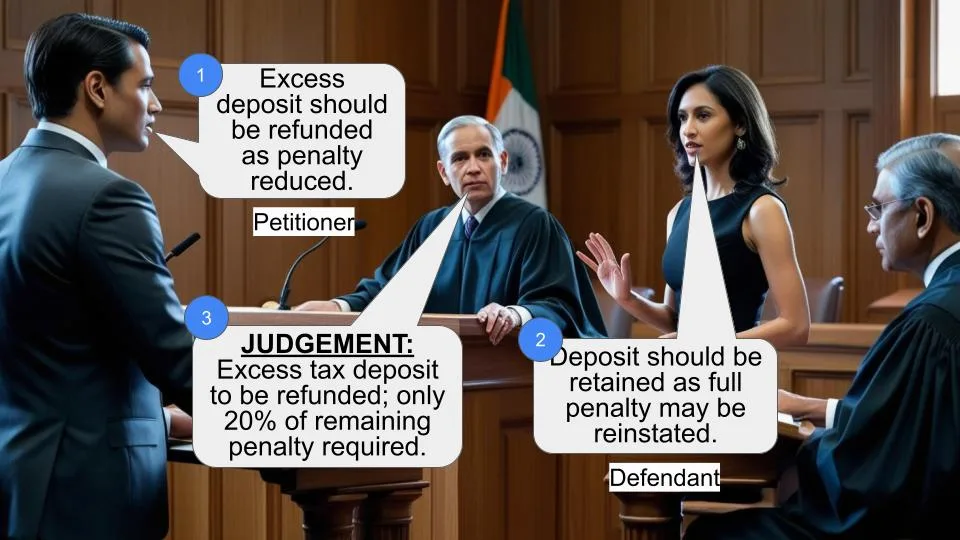
Court Orders Refund of Excess Tax Deposit in Penalty Dispute Case
Court Orders Refund of Excess Tax Deposit in Penalty Dispute Case
This case involves Tata Teleservices Limited challenging orders by tax authorities that required a 20% deposit of a substantial penalty demand. The Delhi High Court ruled in favor of the petitioner, directing the refund of excess deposited amount beyond the required 20% of the remaining penalty demand.
Get the full picture - access the original judgement of the court order here
Case Name:
Tata Teleservices Limited vs Principal Commissioner of Income Tax & Anr. (High Court of Delhi)
W.P.(C) 4790/2018 & CM APPL. 24395/2018
Date: 19th November 2020
Key Takeaways
1. The court prioritized fairness by ordering the refund of excess deposit.
2. Pending appeals can impact the calculation of required deposits.
3. The court demonstrated a practical approach to tax disputes, considering recent developments in the case.
Issue
Should the tax authorities retain the entire amount deposited by the petitioner when part of the penalty demand has been dropped, and the required deposit is now less than the amount already paid?
Facts
1. Tata Teleservices Limited filed writ petitions challenging orders that required a 20% deposit of a Rs.293,28,50,153/- penalty demand for assessment years 2006-07 to 2010-11.
2. The court initially ordered the petitioner to deposit Rs.10 crores in two equal installments of Rs.5 crores each by June 29, 2018.
3. During the proceedings, penalty amounts for assessment years 2009-10, 2010-11, and 2011-12 were dropped.
4. The remaining penalty amount for AY 2006-07, 2007-08, and 2008-09 totaled Rs.8,55,17,078/-.
Arguments
Petitioner's Arguments:
1. The quantum appeal is still pending before the Income Tax Appellate Tribunal.
2. The additions made in the assessment proceedings are debatable.
3. The primary addition relates to expenditure treated as capital expenditure.
4. The petitioner is a loss-making company, and paying 20% of the penalty would have serious consequences.
Respondent's Arguments:
1. Appeals on merit (quantum) are pending before the ITAT, and if decided in favor of the Revenue, demand would arise again.
2. They acknowledged that certain penalty amounts had been dropped.
Key Legal Precedents
The petitioner relied on the judgment of the Supreme Court in Commissioner of Income Tax, Ahmedabad v. Reliance Petroproducts (P) Ltd., [2010] 189 Taxman 322 (SC).
Judgement
1. The court determined that the maximum amount the petitioners could be directed to deposit would be 20% of the remaining demand, which is Rs.1,71,03,416/-.
2. The court ordered the release of the excess amount of Rs.8,28,96,584/- to the petitioners within four weeks, finding no reasonable ground for the revenue to hold this excess amount.
3. The writ petitions and pending applications were disposed of with these directions.
FAQs
Q1: Why did the court order a refund of the excess amount?
A: The court found that due to dropped penalties for certain assessment years, the required 20% deposit was now significantly less than the amount already paid by the petitioner. Retaining the excess amount was deemed unreasonable.
Q2: Does this judgment mean the entire tax dispute is resolved?
A: No, this judgment only addresses the immediate issue of the deposit amount. The main appeals on the merits of the case are still pending before the Income Tax Appellate Tribunal.
Q3: What impact does this judgment have on similar cases?
A: While each case is unique, this judgment suggests that courts may take a practical approach in tax disputes, considering recent developments and ensuring that taxpayers don't overpay deposits during ongoing proceedings.
Q4: Can the tax authorities still pursue the full penalty amount in the future?
A: Yes, if the pending appeals on merit are decided in favor of the Revenue, there's a possibility that the full demand could be reinstated. However, for now, only the reduced amount is under consideration.
Q5: What does this mean for Tata Teleservices Limited?
A: The company will receive a significant refund of Rs.8,28,96,584/-, which could help its financial position, especially given that it was described as a loss-making company in the proceedings.

1. The petitions have been heard by way of video conferencing.
2. Present writ petitions have been filed challenging orders issued by respondents whereby the penalty demand of Rs.293,28,50,153/- for the assessment years 2006-07, 2007-08, 2008-09, 2009-10 and 2010-11 were stayed subject to payment of 20% of the said amount. Petitioner also sought to restrain the respondents from initiating recovery of any demand of penalty imposed on the petitioner for the relevant assessment years.
3. On 01st“Learned counsel for the petitioner submits that the quantum appeal is still pending before the Income Tax Appellate Tribunal. Secondly, the additions made in the assessment proceedings subject matter of the penalty orders are debatable. Primary addition relates to the expenditure incurred, which has been treated as capital expenditure. He has relied on the judgment of the Supreme Court in Commissioner of Income Tax, Ahmedabad v. Reliance Petroproducts (P) Ltd., [2010] 189 Taxman 322 (SC). The petitioner/assessee, it is stated, is a loss-making company and directions passed to pay 20% of the penalty in instalments would have grave and serious consequences, as early decisions and adjudication is not in the hands of the petitioner alone. Subject to the petitioner depositing Rs.I0,00,00,000/- in two equal instalments of Rs.5,00,00,000/- on or before 29 June, 2018, this Court had passed the following order:-
Relist on 11th Pendency of this writ petition would not be a ground to September, 2018.
seek the adjournments before Commissioner of Income Tax (Appeals) and the Income Tax Appellate Tribunal in the proceedings pending before them. It will be open for the petitioner and the Revenue to make a request for early disposal of the proceedings.
Dasti under signature of the Court Master.”
4. In pursuance to the aforesaid order, the petitioner deposited Rs.10 crores with the Income Tax Department.
5. Learned counsel for the petitioner points out that during the pendency of the present proceedings and subsequent to the order dated 01st June, 2018 and 31st July, 2018, respectively, there would be
stay of recovery by coercive steps till the next date of hearing. The deposit would be made with the Income Tax Department. We clarify that the application for stay has not been decided, and remains pending.
6. He states that what remains before the Commissioner of Income Tax (Appeals) is the appeals for AY 2006-07, 2007-08 and 2008-09 and the total cumulative penalty amount for these years is Rs.8,55,17,078/- and 20% of the same works out to Rs.1,71,03,416/- only. He emphasizes that in view of the aforesaid development, the balance amount i.e. Rs.8,28,96,584/- should be refunded to the petitioner. June, 2018, the entire penalty amounts for assessment years 2009-10, 2010-11 and 2011-12 have been dropped and consequential appeal effect orders have been passed.
7. Learned counsel for the respondents states that the appeals on merit (quantum) are pending before the ITAT and if the same is decided in favour of the Revenue, demand would once again arise.
8. He further admits that the penalty of Rs.72,87,99,676/- imposed with respect to the assessment year 2011-12 vide order dated 31st March, 2019 has been deleted vide order dated 05th February, 2020 passed by the Commissioner of Income Tax (Appeals).
9. Having heard learned counsel for the parties, this Court is of the opinion that even if the present writ petition(s) are dismissed at this stage, the maximum amount that the petitioners can be directed to deposit pursuant to the impugned orders and circulars issued by the CBDT would be 20% of the remaining demand which can only be Rs.1,71,03,416/-.
10. Keeping in view the aforesaid factual scenario, this Court is of the view that there is no reasonable ground for the revenue to hold the excess amount i.e. Rs.8,28,96,584/- and the same is directed to be released to the petitioners within four weeks.
11. With the aforesaid directions, present writ petitions and pending applications stand disposed of.
12. The order be uploaded on the website forthwith. Copy of the order be also forwarded to the learned counsel through e-mail.
MANMOHAN, J
SANJEEV NARULA, J
NOVEMBER 17, 2020
×
Similar Ripples
Questions
Court Orders Refund of Excess Tax Deposit in Penalty Dispute Case
Write your CommentSimilar Posts

Generic
- Reportdata/6344.pdf
