


Court Overturns Tax Officer's Decision, Orders Proper Interest Calculation for …




Full News
Court Overturns Tax Officer's Decision, Orders Proper Interest Calculation for Tata Communications
Court Overturns Tax Officer's Decision, Orders Proper Interest Calculation for Tata Communications
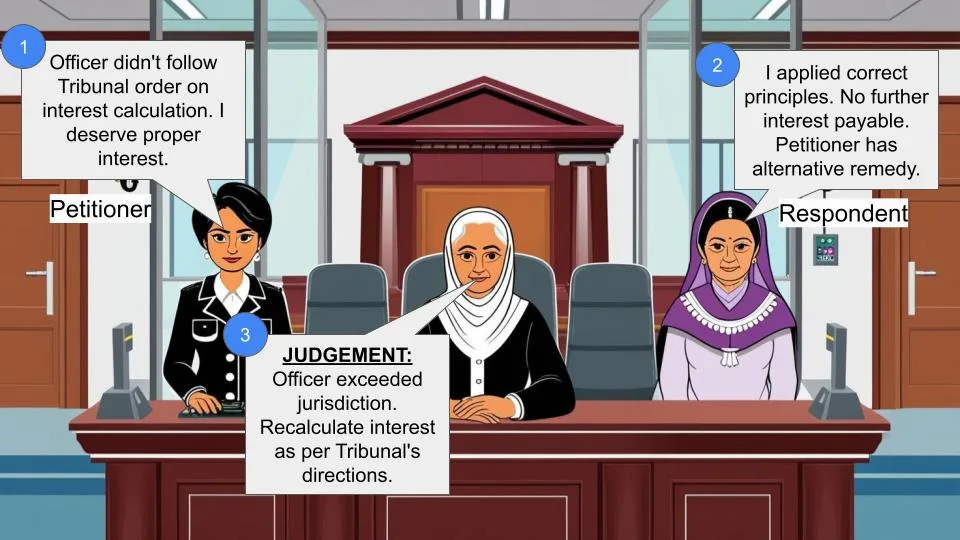
The Bombay High Court ruled in favor of Tata Communications Limited, setting aside an order by the Assessing Officer regarding the calculation of interest on tax refunds. The court directed the officer to recalculate the interest as per the principles laid down by the Delhi High Court in a previous case.
Get the full picture - access the original judgement of the court order here.
Case Name:
Tata Communications Limited vs Deputy Commissioner of Income Tax and Ors. (High Court of Bombay)
Writ Petition No.1033 of 2019
Key Takeaways:
1. The Assessing Officer exceeded his jurisdiction by not following the Tribunal's directions.
2. The court emphasized the importance of following higher court precedents in tax matters.
3. The availability of an alternative remedy doesn't always bar the High Court from exercising its jurisdiction under Article 226 of the Constitution.
Issue:
Did the Assessing Officer correctly calculate the interest payable under Section 244A (of Income Tax Act, 1961), as per the directions given by the Income Tax Appellate Tribunal?
Facts:
1. Tata Communications Limited, a public limited company, had a claim for tax refund from the Income Tax Department.
2. The Income Tax Appellate Tribunal had directed the Assessing Officer to compute and pay interest under Section 244A (of Income Tax Act, 1961).
3. The Tribunal's order was based on the principles laid down by the Supreme Court in CIT vs. H.E.G. Limited and further expanded by the Delhi High Court in India Trade Promotion Organisation vs. CIT.
Arguments:
Petitioner (Tata Communications Limited):
- The Assessing Officer exceeded his jurisdiction by not following the Tribunal's directions.
- The officer shouldn't have distinguished or indirectly held that the Tribunal's directions were not in consonance with law.
Respondent (Income Tax Department):
- The petition should not be entertained due to the availability of an alternative remedy (appeal to the Appellate Commissioner).
- The Assessing Officer applied correct principles of law and concluded that no further interest was payable.
Key Legal Precedents:
1. CIT vs. H.E.G. Limited (324 ITR 331)
2. India Trade Promotion Organisation vs. CIT (361 ITR 646)
Judgement:
1. The court set aside the Assessing Officer's order dated 15th November, 2018.
2. The Assessing Officer was directed to compute the interest payable under Section 244A (of Income Tax Act, 1961) by applying the principles laid down by the Delhi High Court in the India Trade Promotion Organisation case.
3. The recalculation should be done within six weeks from the receipt of the court order.
4. The court clarified that the Department could still pursue its Income Tax Appeal against the Tribunal's order, and any interest paid would be subject to the outcome of that appeal
FAQs:
Q1: Why did the court intervene despite the availability of an alternative remedy?
A1: The court found the Assessing Officer's order to be palpably bad in law and exceeding its jurisdiction. Relegating the petitioner to an appeal would have been futile and caused undue hardship.
Q2: What was the main issue with the Assessing Officer's order?
A2: The Assessing Officer exceeded his jurisdiction by not following the Tribunal's directions and attempting to distinguish the Delhi High Court's decision, which he was supposed to apply.
Q3: What principle did the court emphasize regarding the calculation of interest?
A3: The court emphasized that interest under Section 244A (of Income Tax Act, 1961) should be calculated on the entire amount due and payable, not just on the principal tax due, ignoring the interest component.
Q4: Does this judgment finally settle the matter of interest calculation for Tata Communications?
A4: Not necessarily. The court clarified that the Department could still pursue its appeal against the Tribunal's order, and any interest paid would be subject to the outcome of that appeal.
Q5: What is the significance of this judgment for other taxpayers?
A5: This judgment reinforces the principle that lower authorities must follow the directions of higher tribunals and courts, and cannot independently reinterpret or distinguish binding precedents.

1. Heard learned counsel for the parties for final disposal of the petition. Petitioner has challenged an order dated 15th November, 2018 passed by the Assessing Officer-respondent No.1, copy of which is produced at annexure-P to the petition.
2. The petition arises in following background. Petitioner is a public limited company regularly assessed to tax. The petitioner would have a claim refund from the Department which may comprise of tax deducted at source or out of the refund claims arising out of the orders of assessment. The refunds would also carry interest. For the assessment year 1994-95, the question of correct computation of interest payable under section 244A (of Income Tax Act, 1961) (“the Act” for short) on the petitioner’s claim of refund reached the Income Tax Appellate Tribunal (“Tribunal” for short). The Tribunal by an order dated 16th June, 2017 gave certain directions to the Assessing Officer to compute and pay such interest. Relevant portion of this order reads as under:-
“4. Under this issue the contention of the assessee is that the interest u/s.244A (of Income Tax Act, 1961) was not properly calculated and refunded in accordance with law settled in by the Hon’ble Supreme Court in case titled as CIT Vs. H.E.G. Ltd. 324 ITR 331 and Hon’ble Delhi High Court in case titled as India Trade Promotion Organization Vs. CIT 361 ITR 646. Therefore necessary direction should be given in this regard. However, on the other hand learned Departmental Representative has refuted the said contention. The contention of the assessee is that the interest u/s 244A (of Income Tax Act, 1961) on refund issued was not granted in accordance with law. Therefore, the same is required to be granted in view of the law settled by the Hon’ble Supreme Court in case titled as CIT VS. H.E.G. Ltd. 324 ITR 331 and Hon’ble Delhi High Court in case titled as India Trade Promotion Organization Vs. CIT 361 ITR 646. Since the interest is payable on the refund no doubt the same is liable to be payable in view of the law settled by the Hon’ble Supreme Court in case titled as CIT Vs. H.E.G. Ltd. 324 ITR 331 and Hon’ble Delhi High Court in case titled as India Trade Promotion Organization Vs. CIT 361 ITR 646. Therefore, in the said circumstances we set aside the finding of the CIT (A) on this issue and direct the Assessing Officer to calculate the interest u/s 244 (of Income Tax Act, 1961) A of the Act on refund payable to the assessee in view of the law settled in Hon’ble Supreme Court in case titled as CIT Vs. H.E.G.Ltd. 324 ITR 331 and Hon’ble Delhi High Court in case titled as India Trade Promotion Organization Vs. CIT 361 ITR 646. Accordingly, this issue is even decided in favour of the assessee against the revenue.
5. In the result, the appeal filed by the assessee is hereby ordered to be decided for statistical purpose.”
3. Pursuant to this order of the Tribunal thus, the Assessing Officer was required to pay interest to the petitioner in terms of the law laid down by Supreme Court in case of CIT Vs. H.E.G. Limited1 and has further followed and expanded by Delhi High Court in case of India Trade Promotion Organisation Vs. CIT1 .
4. The Assessing Officer passed his impugned order pursuant to such directions of the Tribunal. In such order he did not agree with the contention of the assessee that interest as per the said decision of the Delhi High Court in case of India Trade Promotion Organization (supra) was outstanding and payable. He referred to the relevant portion of the judgment of the High Court and presented his understanding of the working of the interest as per the said judgment. He compared this with the assessee’s computation of interest payable. He held that the assessee’s computation of interest is not consistent with the decision of the Delhi High Court. He referred to a decision of the Income Tax Appellate Tribunal in which the formula propounded by him was accepted. Relevant portion of the impugned order reads as under:-
“2.3 Thus, the working suggested by the assessee is not consistent with Hon’ble Delhi High Court’s decision. The assessee’s contention that refund has to be first adjusted totally against the total interest refund due and thereafter against the tax refund due is unfounded and there is no specific section or provision in the Income Tax Act, 1961 for the same. The example considered by Hon’ble High Court clearly shows that this is not implied from the same. The assessee’s contention will lead to granting of interest on interest.
2.4 In the case of the assessee involved here, whenever any part refund was issued to the assessee it was clearly bifurcated into the Principal component and the corresponding interest u/s 244A (of Income Tax Act, 1961). The interest component (which was due and payable on the principal paid) is not withheld and is issued whenever the corresponding principal is issued. So, the situation that interest which should have been refunded but is not paid does not arise. Therefore, facts and circumstances of the case are different from the case of India Trade Promotion Organisation (supra) considered by Hon’ble Delhi High Court. After issue of any part refund, principal part refunded is adjusted against the total principal outstanding and any subsequent interest u/s 244A (of Income Tax Act, 1961) is computed on the balance principal outstanding. This working also ensures that interest component is not withheld indefinitely and whenever any principal amount is paid the corresponding interest is also paid.
2.6 Accordingly, the above principle was adopted in granting interest to the assessee u/s 244A (of Income Tax Act, 1961) of Rs.283,71,61,850/- in the order passed u/s 154 (of Income Tax Act, 1961) dated 23.07.2012 for A.Y. 1994-95 and the assessee is not entitled for any further interest u/s 244A (of Income Tax Act, 1961).
3. Total income of the assessee remains unchanged at Rs.281,13,70,604/-. Give credit for the taxes paid, if any, after due verification. Charge interest as per law and as discussed above and directed by CIT (A). Issue Demand Notice /Refund accordingly.”
5. Learned counsel for the petitioner submitted that the Assessing Officer has exceeded his jurisdiction. He was directed by the Tribunal to apply the decision of the Delhi High Court in case of India Trade Promotion Organisation (supra) and grant interest to the assessee under Section 244A (of Income Tax Act, 1961). It was not open for the Assessing Officer to distinguish the said judgment or indirectly hold that the directions issued by the Tribunal were not in consonance with law. In any case, it is held by the Delhi High Court in case of India Trade Promotion Organisation (supra) relying and referring to the decision of the Supreme Court in case of H.E.G. Limited (supra) that interest under Section 244A (of Income Tax Act, 1961) would be available on the entire amount which is due and payable not only on the principal tax due ignoring the interest component comprised in such outstanding amount.
6. On the other hand, learned counsel for the Department contended that this petition should not be entertained on the ground of availability of the alternative remedy. Against the impugned order passed by the Assessing Officer appeal is maintainable before the Appellate Commissioner. On merits he submitted that the Assessing Officer has applied correct principles of law and come to the conclusion that no further interest is payable to the petitioner.
7. In the present case, the Tribunal has already examined the question of interest payable to the petitioner under Section 244A (of Income Tax Act, 1961). The decision of the Tribunal lays down certain parameters for payment of such interest. We have reproduced the relevant portion of the order of the Tribunal. As per this order the Assessing Officer was required to compute the interest under section 244A (of Income Tax Act, 1961) following the principles laid down by the Delhi High Court in case of India Trade Promotion Organisation (supra). It was not open for the Assessing Officer thereafter to dissect the ratio of the decision of the Delhi High court in case of India Trade Promotion Organisation and came to the conclusion that further interest under Section 244A (of Income Tax Act, 1961) is not payable. His role was limited to giving effect to the directions of the Tribunal. The question whether the interest is or is not payable was already decided by the Tribunal. Undoubtedly, if the Department had any legal dispute with the decision of the Tribunal, it was always open to the Department to challenge the same in accordance with law. The Department has infact exercised such option by first filing an application for rectification before the Tribunal and when such rectification application came to be dismissed, by filing income tax appeal before the High Court. We are informed such appeal is pending.
8. At any rate, the limited role of the Assessing Officer was to implement the directions of the Tribunal. In the process, in our opinion, he exceeded his brief virtually coming to the conclusion that the Tribunal was not justified in issuing such directions and distinguishing the ratio of the decision of the Delhi High Court in case of India Trade Promotion Organisation (supra).
9. In view of such position, we would not relegate the petitioner to alternate remedy. Availability of appeal is not an absolute bar on the High Court exercising its jurisdiction under Article 226 of the Constitution. When we find that the order passed by the Assessing Officer is palpably bad in law and exceeds its jurisdiction, relegating a litigant to appeal remedy will be wholly futile and in facts of the present case also lead to undue hardship.
10. Under the circumstances, impugned order dated 15th November, 2018 is set aside. The Assessing Officer is directed to compute the interest payable to the petitioner under section 244A (of Income Tax Act, 1961) by applying the principles laid down by the Delhi High court in case of India Trade Promotion Organisation as directed by the Tribunal. This shall be done within a period of six weeks from the date of copy of the receipt of this order. Before closing we clarify that nothing stated in this order shall prejudice the Department in pursuing to its Income Tax Appeal assessment order passed by the Tribunal and interest which would be paid shall be subject to outcome of such appeal.
11. Petition disposed of accordingly.
(S.J.KATHAWALLA, J.) (AKIL KURESHI, J.)
×
Similar Ripples
Questions
Court Overturns Tax Officer's Decision, Orders Proper Interest Calculation for Tata Communications
Write your CommentSimilar Posts

Generic
- Reportdata/3981.pdf
