Court Orders Refund of Surcharge and Turnover Tax, Rejects Income Tax Departmen…


Full News
Court Orders Refund of Surcharge and Turnover Tax, Rejects Income Tax Department’s Adjustment Attempt
Court Orders Refund of Surcharge and Turnover Tax, Rejects Income Tax Department’s Adjustment Attempt
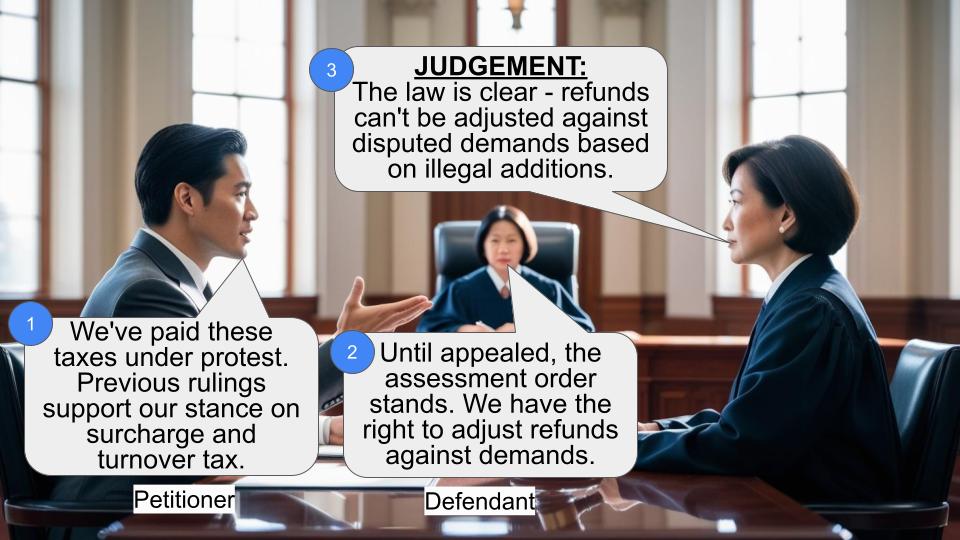
This case involves the Kerala State Beverages Corporation, a government undertaking, challenging the Income Tax Department’s decision to adjust refunds due to the company against a disputed tax demand. The High Court ruled in favor of the company, ordering the tax department to refund the amount immediately.
Get the full picture - access the original judgement of the court order here
Case Name
Kerala State Beverages (M&M) Corporation Ltd. Vs Joint Commissioner of Income Tax & Others (High Court of Kerala)
WA. No. 1335 of 2016 and WP(C).18723/2016
Date: 29th August 2016
Key Takeaways
- The court ruled that surcharge and turnover tax paid by the assessee cannot be added to their total income for tax calculation.
- The Income Tax Department cannot adjust refunds against disputed tax demands, especially when higher authorities have ruled in favor of the assessee.
- The judgment emphasizes the importance of following appellate orders and not making adjustments based on potentially illegal assessments.
Issue
Can the Income Tax Department adjust refunds due to an assessee against a disputed tax demand when higher authorities have already ruled in favor of the assessee on similar issues for previous years?
Facts
- The Kerala State Beverages Corporation is an assessee under the Income Tax Act.
- For assessment years 2007-2008 to 2011-2012, the department added surcharge and turnover tax to the company’s total income.
- The Income Tax Appellate Tribunal (ITAT) and the High Court ruled in favor of the company for these years, deleting these additions.
- For the assessment year 2012-2013, the department made a similar addition in the assessment order (Ext.P1).
- The department proposed to adjust the refunds due for 2007-2008 to 2011-2012 against the demand for 2012-2013.
- The company challenged this adjustment through a writ petition, which was initially dismissed by a single judge.
Arguments
Assessee’s Arguments:
- The addition in the 2012-2013 assessment is illegal based on previous judgments.
- Adjustment under Section 245 (of Income Tax Act, 1961) can only be made after determining the refund amount under Section 240 (of Income Tax Act, 1961).
Department’s Arguments:
- Until the assessment order is varied on appeal, the department can invoke Section 245 (of Income Tax Act, 1961) for adjustment.
- Technical breaches don’t invalidate notices issued by the department (citing Sections 292B and 292BB).
Key Legal Precedents
- ITA No.68 of 2015 and connected cases: The High Court confirmed the ITAT’s order deleting the additions of surcharge and turnover tax for previous years.
Judgment
- The court set aside the single judge’s order and Ext.P2 (the adjustment notice).
- The court directed the first respondent (Income Tax Department) to refund the amount mentioned in Ext.P2 to the assessee immediately.
- The court held that the total income of the assessee couldn’t be determined by adding surcharge and turnover tax.
- The addition in the 2012-2013 assessment (Ext.P1) was deemed illegal.
- The department was not entitled to adjust the refundable amount against the disputed demand.
FAQs
Q: Why did the court rule in favor of the Kerala State Beverages Corporation?
A: The court ruled in their favor because previous judgments had already established that surcharge and turnover tax shouldn’t be added to the company’s total income. The tax department’s attempt to adjust refunds against a disputed demand based on a similar (likely illegal) addition was therefore rejected.
Q: What does this judgment mean for other taxpayers?
A: This judgment reinforces the principle that tax authorities should respect decisions made by appellate bodies and higher courts. It also emphasizes that refunds shouldn’t be adjusted against disputed demands, especially when similar issues have been decided in the taxpayer’s favor for previous years.
Q: What are Sections 240 and 245 of the Income Tax Act?
A: Section 240 (of Income Tax Act, 1961) deals with the refund of excess payments, while Section 245 (of Income Tax Act, 1961) allows the tax department to adjust refunds against outstanding tax liabilities. The judgment suggests that proper determination of refunds under Section 240 (of Income Tax Act, 1961) should precede any adjustment under Section 245 (of Income Tax Act, 1961).
Q: Can the Income Tax Department appeal this decision?
A: While the judgment doesn’t mention the possibility of an appeal, the department generally has the right to appeal to a higher court if they believe there’s a substantial question of law involved.
Q: How does this case impact the interpretation of surcharge and turnover tax in income tax assessments?
A: This case reinforces the view that surcharge and turnover tax paid by an assessee should not be added to their total income for income tax purposes. It sets a precedent that could be applied in similar cases across India.

1. In this appeal, after we had dictated judgment dated 22.8.2016, counsel for the respondents sought for an opportunity to make further submissions. Thereupon this case was posted for spoken to and was heard today. Accordingly, this judgment is rendered.
2. Heard the learned counsel for the appellant and the learned standing counsel appearing for the respondents.
3. This writ appeal is filed against the judgment of the learned single judge in WPC No.18723 of 2016. The writ petition having been dismissed, this appeal is filed.
4. Briefly stated the facts of the case are that the appellant, a Government of Kerala undertaking, is an assessee under the Income Tax Act. Ext.P1 is an order of assessment passed against the assessee for the assessment year 2012- 2013 where the total income was determined by adding surcharge on sales tax under the Kerala General Sales Tax Act and turn over tax levied under the Kerala Surcharge on Taxes Act, 1957.
5. In so far as the assessments for the assessment years 2007-2008 to 2011-2012 are concerned, the assessee's total income in those years was determined by making similar additions. In those cases following the orders of the Income Tax Appellate Tribunal and the Commissioner of Income Tax (Appeals), additions were deleted and substantial amounts had become refundable. Immediately after Ext.P1 order of assessment was passed, the appellant was issued Ext.P2 dated 3.2.2015 informing that a total amount of Rs.223,57,34,050/- have been determined to be refunded on giving effect to the orders of the CIT(A) pertaining to the assessment years 2007- 2008 to 2011-2012 and that it was proposed to adjust the refund amount against the demand of tax due under Ext.P1 for the assessment year 2012-2013. Ext.P2 itself makes it clear that the said intimation was given to the appellant under Section 245 (of Income Tax Act, 1961).
6. Subsequently the appellant received Ext.P10A to P10E dated 6.2.2015, issued under Section 240 (of Income Tax Act, 1961) determining the amount due for refund for each of the assessment years, viz. 2007-2008 to 2011-2012. It was at that stage, the assessee filed the writ petition contending that only after determining the refund amount due under Section 240 (of Income Tax Act, 1961), adjustment as per Ext.P2 under Section 245 (of Income Tax Act, 1961) is permissible. The learned Single Judge, making reference to the provisions of Section 245 (of Income Tax Act, 1961) dismissed the writ petition. It is this judgment which is challenged before us.
7. The learned counsel for the appellant contended that having regard to the judgment of this Court in ITA No.68 of 2015 and connected cases, whereby final orders passed by the Tribunal confirming the deletion of surcharge and turn over tax paid by the assessee were upheld, the addition made in Ext.P1 assessment order is patently illegal and, therefore, no adjustment could have been made by the department towards a non-existing liability. He also contended that having regard to the scheme of the provisions of Sections 240 and 245, except after determining the amount under Section 240 (of Income Tax Act, 1961) as is done by Exts.P10A to P10E, adjustment under Section 245 (of Income Tax Act, 1961) as per Ext.P2 could have been made. Therefore, according to the learned counsel, the learned single judge erred in dismissing the writ petition.
8. The learned counsel for the revenue contended that even in spite of the orders of the Tribunal and the judgment of this Court concerning the assessment years 2007-2008 to 2011-2012, and irrespective of the correctness of the additions made in Ext.P1, until the assessment order is varied in appeal, the department was entitled to invoke its power under Section 245 (of Income Tax Act, 1961) and to adjust the amounts due for refund for the assessment years 2007-2008 to 2011-2012. He also referred to us Section 292B (of Income Tax Act, 1961) and Section 292BB (of Income Tax Act, 1961) and contended that a technical breach would not invalidate the notices issued by the department.
9. We have considered the submissions made. According to us, irrespective of the controversy concerning Sections 240 and 245, the appellant is entitled to succeed. Admittedly, for the assessment years 2007-2008 to 2011-2012, the turn over of surcharge and turn over tax paid by the assessee were added to their total income and tax was levied on that basis. The correctness of that issue was decided by the Tribunal in the assessee's favour for one of the assessment years. That order was followed by the Commissioner of Income Tax (Appeals) before whom the appeals concerning the remaining years were pending at that time. The revenue carried those matters also before the Tribunal and the Tribunal followed its earlier order and upheld the order passed by the First Appellate Authority. All these orders were challenged by the revenue before this Court. This Court confirmed the order passed by the Tribunal in the judgment in ITA No.68 of 2015 and connected cases. As on date, there is no appeal against those judgments.
10. This, therefore, means that the total income of the assessee could not have been determined by adding the surcharge and turn over tax paid by the assessee. If that be so, not only that the assessee was entitled to have the amounts found to be refundable in Exts.P2 and P10 series refunded to it, but also the addition of the surcharge and turn over tax to the total income in Ext.P1 assessment order for the year 2012- 2013 is also illegal. Therefore, despite the fact that an appeal filed against Ext.P1 is pending consideration of the Commissioner of Income Tax (Appeals), as of now, the department is not entitled to adjust the amount refundable to the assessee consequent to the orders passed by the Commissioner of Income Tax Appellate Tribunal and this Court.
For these reasons, we are inclined to set aside the judgment under appeal and also Ext.P2 and direct the first respondent to refund the amount mentioned in Ext.P2 to the assessee forthwith.
The writ appeal is allowed as above.
Sd/- Antony Dominic, Judge
sd/- Dama Seshadri Naidu, Judge
P.S.TO JUDGE
×