


Court Orders Release of Seized Cash to Rightful Owner Despite Procedural Hurdles


Full News
Court Orders Release of Seized Cash to Rightful Owner Despite Procedural Hurdles
Court Orders Release of Seized Cash to Rightful Owner Despite Procedural Hurdles
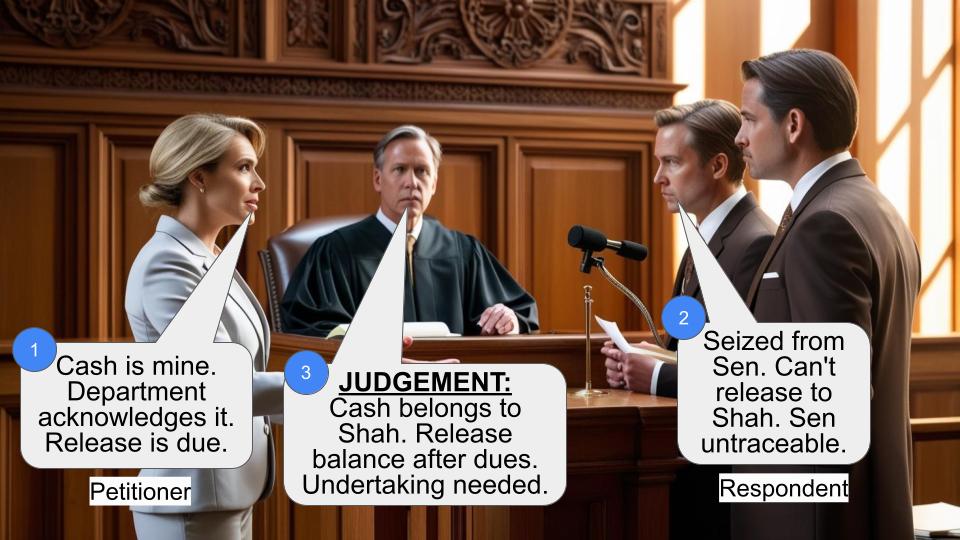
This case involves Hemal Dilipbhai Shah (the petitioner) seeking the release of seized cash from the Income Tax Department. The cash was initially seized from Vinod Sen but was later determined to belong to Shah. The court ruled in favor of Shah, ordering the release of the balance amount after adjusting for tax dues.
Get the full picture - access the original judgement of the court order here
Case Name:
Hemal Dilip Bhai Shah Vs Assistant Commissioner of Income Tax (High Court of Gujarat)
Special Civil Application No. 8508 of 2014
Date: 3rd May 2016
Key Takeaways:
1. The court prioritized substantive rights over procedural technicalities.
2. The judgment emphasizes the importance of considering actual ownership of seized assets, not just the person from whom they were seized.
3. The court found a practical solution to address the department's concerns while still ensuring justice for the petitioner.
Issue:
Should the Income Tax Department release the seized cash to Hemal Dilipbhai Shah, even though it was initially seized from Vinod Sen?
Facts:
1. On February 16, 2012, Rs.26,00,000 in cash was seized from Vinod Sen by the Ernakulam police.
2. Vinod Sen stated that the cash belonged to Hemal D. Shah of Surat.
3. Shah confirmed this in his statement on March 7, 2012.
4. Shah filed a tax return for 2012-13, declaring the cash as unexplained income.
5. After assessment and penalty proceedings, Shah's tax liability was determined to be Rs.8,84,040.
6. Shah requested the release of the remaining amount (Rs. 15,84,020 plus interest).
7. The Income Tax Department refused, citing that the cash was seized from Vinod Sen.
Arguments:
Petitioner (Shah):
- The cash belongs to him, as admitted by both Vinod Sen and himself.
- The department has accepted this fact in assessment proceedings.
- The department's refusal to release the balance is arbitrary and against Section 132B(3) (of Income Tax Act, 1961).
Respondent (Income Tax Department):
- As per Section 132B(1)(i) (of Income Tax Act, 1961) and 132B(3), seized assets can only be adjusted against or released to the person from whom they were seized (Vinod Sen).
- Vinod Sen is untraceable, and his assessment under Section 153A (of Income Tax Act, 1961) is pending.
- If the amount is paid to Shah and Vinod Sen later stakes a claim, the department would be in a precarious situation.
Key Legal Precedents:
The court relied on the case of Rajinder Kumar Verma v. Union of India, (2009) 181 Taxmann 215 (P&H). This case held that Section 132B(3) (of Income Tax Act, 1961) cannot be applied when there's no dispute about the title of seized assets, as it's intended for cases with disputed or absent title.
Judgement:
1. The court ruled in favor of Shah, ordering the release of the balance amount after adjusting for tax dues.
2. The court agreed with the Punjab & Haryana High Court's decision in Rajinder Kumar Verma v. Union of India.
3. To address the department's concerns, the court directed Shah to file an undertaking to indemnify the department if Vinod Sen stakes a claim in the future.
FAQs:
1. Q: Why did the court rule in favor of Shah?
A: The court prioritized the undisputed ownership of the cash over procedural technicalities.
2. Q: What is the significance of Section 132B (of Income Tax Act, 1961) in this case?
A: This section deals with the application of seized assets, but the court found it shouldn't apply when ownership is not in dispute.
3. Q: How did the court address the Income Tax Department's concerns?
A: The court required Shah to file an undertaking to indemnify the department if Vinod Sen claims the money in the future.
4. Q: What precedent does this case set?
A: It reinforces that substantive rights should not be defeated by procedural provisions, especially when ownership is clear.
5. Q: Could this decision impact similar cases in the future?
A: Yes, it may encourage courts to look beyond strict procedural interpretations when dealing with seized assets, focusing more on actual ownership.

1. By this petition under Article 226 of the Constitution of India, the petitioner seeks a direction to the respondent to release the cash of the petitioner amounting to Rs.15,84,020/- with interest forthwith.
2. The petitioner who is assessed in the capacity of an individual derives income from salary and interest. On 16th February, 2012, Rs.26,00,000/- in cash came to be seized by the Department from one Vinod Shankarlal Sen, a resident of Raipur (Rajasthan) under section 132A (of Income Tax Act, 1961) (hereinafter referred to as the “Act”). In his statement recorded on oath, Shri Vinod Sen stated that the cash did not belong to him but belonged to the assessee – Shri Hemal D. Shah of Surat. Such statement of Shri Vinod Sen was also confirmed by the petitioner vide his statement dated 7th March, 2012. The petitioner filed return of income for assessment year 2012-13 on 30th July, 2012 declaring total income of Rs.27,52,100/- including the income declared of Rs.21,73,000/- on account of unexplained cash. The petitioner filed an application dated 14th June, 2012 to the Jurisdictional Assessing Officer to adjust the tax liability from the seized amount. On 21st October, 2013, the assessment order came to be passed under section 143(3) (of Income Tax Act, 1961) wherein the petitioner was assessed at a total income of Rs.31,79,100/- against the returned income of Rs.27,52,100/-. A penalty order dated 1st November, 2013 was also passed levying penalty on additions made amounting to Rs.1,31,940/-. On request made by the petitioner for rectification, an order dated 4th November, 2013 came to be passed under section 154 (of Income Tax Act, 1961) revising the total demand in quantum proceedings to Rs.8,84,040/-. Thereafter, the petitioner made an application to the Assessing Officer which was received by him on 2nd December, 2013 for release of the seized amount along with interest after adjusting the demand. By a communication dated 17th December, 2013, the Assessing Officer informed the petitioner that the Department is not in a position to issue the refund until completion of the assessment of Shri Vinod Sen. The petitioner made two more representations dated 31st December, 2013 and 31st January, 2014 to the Assessing Officer requesting that the cash be released. However, since there was no response thereto, the petitioner has filed the present petition seeking release of the amount of Rs.15,84,020/- with interest.
3. Mr. Hardik Vora, learned advocate for the petitioner submitted that the approach adopted by the respondent is arbitrary, inasmuch as, the respondent cannot withhold the excess cash after adjusting the tax liability once assessment and penalty proceedings are completed and the liability is determined. It was submitted that the liability has already been discharged which has been accepted by the respondent in the order under section 154 (of Income Tax Act, 1961) and hence, the excess cash of Rs.15,84,020/- must be returned forthwith in view of the provisions of section 132B(3) (of Income Tax Act, 1961). It was, accordingly, urged that the petition deserves to be allowed by granting the relief as prayed for therein. In support of his submissions, the learned advocate placed reliance upon the decision of the Punjab & Haryana High Court in the case of Rajinder Kumar Verma v. Union of India, (2009) 181 Taxmann 215 (P&H), for the proposition that where there is no dispute that the seized articles belonged to the petitioner and in fact, in the order passed by the Income Tax Officer itself, this fact has been acknowledged, and that even the person from whom the articles were seized took the same stand, in such a situation when there is no dispute about the title of the petitioner to the seized goods, the provisions of section 132B(3) (of Income Tax Act, 1961) cannot be applied. The court held that a procedural provision cannot defeat the substantive rights of a person and that the said provision was intended to apply in case of a dispute of title or absence of title and not where the title of the party is undisputed. It was submitted that the above decision would be squarely applicable to the facts of the present case, inasmuch as there is no dispute about the ownership of the seized cash, and hence, the respondents are not justified in not returning the same to the petitioner.
4. On the other hand, Mr. M.R. Bhatt, Senior Advocate, learned counsel for the respondent placed reliance upon the averments made in the affidavit-in-reply filed on behalf of the respondent wherein the stand of the respondent is that the cash of Rs.26,00,000/- was seized by the Ernakulam police authorities on 16th February, 2012 from Shri Vinod Sen. This cash was handed over to the income-tax authorities on the strength of a requisition under section 132A (of Income Tax Act, 1961) issued by the Director of Income Tax (Investigation), Kochi from Shri Vinod Sen. On the basis of the statement of Shri Vinod Sen during the proceedings under section 132A (of Income Tax Act, 1961) attributing the ownership of the goods to the petitioner and the admission of the petitioner to that effect, proceedings under section 153C (of Income Tax Act, 1961) had been carried out in the case of the petitioner and a demand of Rs.8,81,010/- has been raised in the case of the petitioner, which has remained unpaid as on date. It was submitted that at this stage, as per the provisions of section 132B(1)(i) (of Income Tax Act, 1961), only the existing liability of the “searched person” (from whom cash has been seized) as defined in the section can be recovered from the seized assets. The petitioner admittedly is not “such person” from whose custody the assets were seized and hence, no recovery of the tax dues of the petitioner can be made out of the seized assets. It was submitted that release of the assets after adjusting the dues is also to be made in accordance with the proviso to section 132B(3) (of Income Tax Act, 1961) which clearly states that the assets which remain have to be made over “to the person from whose custody the assets were seized”. It was reiterated that the cash was seized from the custody of Shri Vinod Sen and not the petitioner and, therefore, the requisitioned assets (cash) can be adjusted or released only in favour of Shri Vinod Sen as per the provisions of the Act and that the Act does not give any discretion to the income tax authorities to deal with the seized/requisitioned assets in any other manner.
4.1 It was further submitted that efforts have been made to trace Shri Vinod Sen, who, since the date of the seizure, is not traceable and that his stated address with the Ernakulam Police is also not found to be the correct address. It was submitted that a request letter dated 3rd April, 2013 was sent by the Commissioner of Income Tax, Central, Ahmedabad to the Commissioner of Income Tax, Ajmer for centralizing the case of Shri Vinod Sen with Central Circle – 2, Surat. However, upon verification by the field office of Bhilwara region, it was reported that no such village exists in the Bhilwara district and hence, they were unable to trace Shri Vinod Sen. It was submitted that the petitioner was requested to provide details of Shri Vinod Sen’s whereabouts so that pending proceedings under section 153A (of Income Tax Act, 1961) could be completed; however, the petitioner has failed to produce any details, in the absence of which, the Department is not in a position to carry out and finalise the proceedings under section 153A (of Income Tax Act, 1961) in the case of Shri Vinod Sen. It was contended that the assertion of the petitioner that Vinod Sen is a third person who has no relation to the cash cannot be accepted and that in terms of section 132B (of Income Tax Act, 1961), Shri Vinod Sen is the first person having a legal right to refund of the seized amount and that if the amount is paid to the petitioner, in the event Shri Vinod Sen stakes claim to the seized amount, the Department would be put in a very precarious situation. It was, accordingly, urged that the petitioner has no locus standi to request for release of the seized assets and the petition being devoid of merits, deserves to be dismissed.
5. From the facts noted hereinabove including the averments made in the affidavit-in-reply filed by the respondent, it is evident that it is an admitted position that the person from whom the cash of Rs.26,00,000/- was seized namely, Shri Vinod Sen has, in his statement recorded during the proceedings under section 132A (of Income Tax Act, 1961), stated that the cash belonged to the petitioner. The petitioner had also during the course of proceedings under section 153C (of Income Tax Act, 1961) admitted that the cash belonged to him and had also disclosed such amount in the return filed by him. Therefore, the petitioner’s ownership of the seized assets is not in dispute, inasmuch as, even the person from whom the cash had been seized has admitted that the same belonged to the petitioner. As noted hereinabove, the petitioner in the application for release of the seized assets (cash) has requested the respondent to adjust the pending dues against the cash and to refund the balance amount with interest thereon. The request made by the petitioner is not acceded to by the respondent by placing reliance upon the provisions of sub-section (3) of section 132B (of Income Tax Act, 1961) which provides that any assets or proceeds thereof which remained after the liability referred to in clause (1) of sub-section (2) is discharged, shall be forthwith made over or paid to the persons from whose custody the assets were seized. The respondent has also placed reliance upon the provisions of clause (i) of sub-section (1) of section 132B (of Income Tax Act, 1961) to submit that the existing liability under the Act and the amount of liability determined on completion of assessment under section 153A (of Income Tax Act, 1961) etc. can be recovered out of such assets only from the person from whom such assets are seized. However, the record of the case reveals that on an application for rectification made by the petitioner under section 154 (of Income Tax Act, 1961), the respondent has accepted the contention of the petitioner that the seized cash amount of Rs.26,00,000/- was not considered while computing the tax liability. Accordingly, by an order dated 4th November, 2013 made under section 154 (of Income Tax Act, 1961), the Assistant Commissioner of Income Tax has allowed credit of Rs.8,84,040/- to the petitioner for the purpose of computing interest under section 234B (of Income Tax Act, 1961) considering an amount of Rs.8,84,040/- (from the seized amount of Rs.26,00,000/-) as paid under section 140A (of Income Tax Act, 1961) on 30th July, 2012 as return of income filed by the assessee for the year under consideration on 30th July, 2012. Interest under section 234B (of Income Tax Act, 1961) was charged on tax of Rs.8,29,902/- from 1st April, 2012 to 30th July, 2012 which came to Rs.33,196/- in place of Rs.1,32,620/- as charged in the order under section 143(3) (of Income Tax Act, 1961). Thus, the respondents have themselves treated the cash amount of Rs.26,00,000/- as belonging to the petitioner and have adjusted the same against the demand raised against the petitioner. Therefore, the averments made in the affidavit-in-reply to the effect that the demand of Rs.8,81,010/- remains unpaid as on date does not appear to be correct, inasmuch as, credit of such amount has been given to the petitioner out of the cash seized.
6. Apart from the fact that the Department has also accepted the contention of the petitioner in the assessment proceedings, the facts as emerging from the record clearly reveal that in proceedings under section 132A (of Income Tax Act, 1961), Shri Vinod Sen from whom the cash had been seized had clearly stated that the same belonged to the petitioner and the petitioner had also in proceedings under section 153C (of Income Tax Act, 1961) admitted the same. The Department has also treated the cash as belonging to the petitioner, however, in the present petition, a contrary stand has been taken to the effect that the cash having been requisitioned from Shri Vinod Sen can be released only in his favour and that the cash so seized can be adjusted only against the dues of Shri Vinod Sen.
7. At this juncture, reference may be made to the decision of the Punjab & Haryana High Court in the case of Rajinder Kumar Verma v. Union of India (supra), wherein the court was dealing with a case involving a similar set of facts where there was no dispute that the seized articles belonged to the petitioner and in fact, the Income Tax Officer had also acknowledged such fact in the order passed by him and the person from whom the articles were seized took the same stand. The court held that in these circumstances, the provisions of sub-section 132B(3) (of Income Tax Act, 1961) cannot be applied as the same was intended to apply in case where there was a dispute of title or absence of title and not where title was undisputed. This court is in agreement with the view adopted by the Punjab & Haryana High Court in the above decision, which also squarely covers the controversy in issue.
8. In the facts of the present case also, it is not in dispute that the seized articles (cash) belong to the petitioner, who has also disclosed the unexplained cash of Rs.21,73,000/- for taxation in the year under consideration, and in fact, the respondent, in the assessment proceedings, has also accepted such fact and has given credit of Rs.8,84,040/- to the petitioner against the seized amount. The person from whom the cash had been seized namely, Shri Vinod Sen has also admitted that such cash belongs to the petitioner. Evidently therefore, there is no dispute as regards the title of the seized assets (cash). The respondent is, therefore, not justified in not releasing the balance amount to the petitioner on the ground that the cash had been seized from Shri Vinod Sen. Nonetheless, since the respondent has voiced an apprehension that the cash having been seized from Shri Vinod Sen, in case Shri Vinod Sen stakes a claim to the seized amount, the Department would be put in a precarious situation, the court is of the view that the said apprehension can be allayed by calling upon the petitioner to file an undertaking to the effect that in case Shri Vinod Sen stakes such claim, the petitioner would indemnify the Department.
9. For the foregoing reasons, the petition succeeds and is accordingly allowed. The respondent is directed to forthwith refund the balance amount after adjusting the tax dues of the petitioner with interest (if any) in accordance with law subject to the petitioner filing an undertaking before this court that in the event Shri Vinod Sen stakes a claim to the seized amount, the petitioner should indemnify the Department in respect thereof. Rule is made absolute accordingly, with no order as to costs.
Direct Service is permitted.
( Harsha Devani, J. )
( G.R. Udhwani, J. )
×
Similar Ripples
Questions
Court Orders Release of Seized Cash to Rightful Owner Despite Procedural Hurdles
Write your CommentSimilar Posts
Generic
- Reportdata/2864.pdf
