


Court Orders Release of Seized Gold Ornaments in Exchange for Cash Deposit


Full News
Court Orders Release of Seized Gold Ornaments in Exchange for Cash Deposit
Court Orders Release of Seized Gold Ornaments in Exchange for Cash Deposit
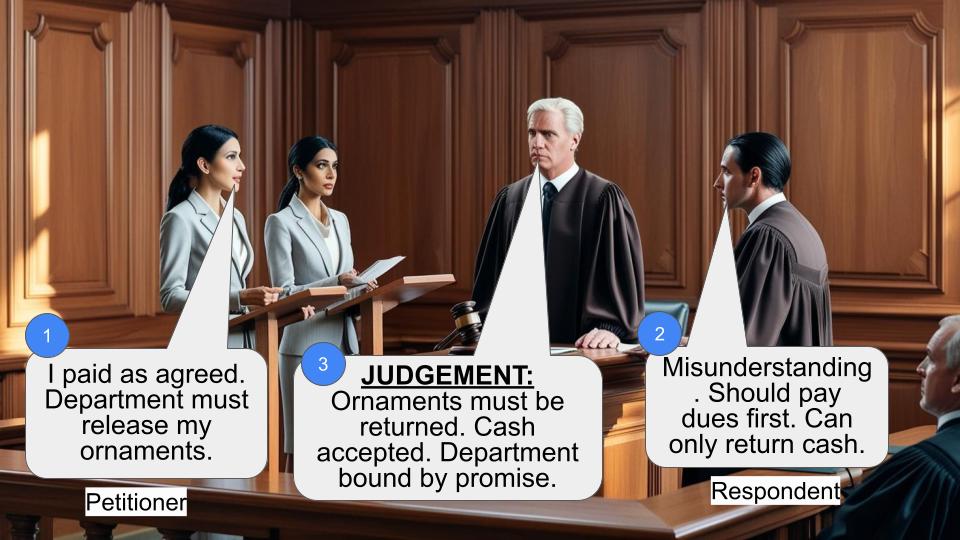
This case involves Kalpesh Laxminarayan Thakkar (the petitioner) and the Deputy Commissioner of Income Tax (the respondent). The dispute centered around the release of gold ornaments seized during an income tax raid in 1996. The court ultimately ordered the Income Tax Department to release the seized ornaments to the petitioner after he had deposited an equivalent cash amount.
Get the full picture - access the original judgement of the court order here
Case Name:
Kalpesh Laxmi Narayan Thakkar Vs Deputy Commissioner of Income Tax & Another (High Court of Gujarat)
Special Civil Application No. 6822 of 2016
Date: 5th May 2016
Key Takeaways:
1. The court upheld the principle of replacing seized assets with cash, as per the CBDT circular.
2. Misunderstandings within government departments don't absolve them of promises made to citizens.
3. The court prioritized practical solutions that benefit both the taxpayer and the revenue department.
Issue:
Should the Income Tax Department be directed to release the seized gold ornaments to the petitioner after he deposited an equivalent cash amount, despite the Department's claim of a misunderstanding in the initial agreement?
Facts:
1. On August 1, 1996, the petitioner's premises were searched under section 132 (of Income Tax Act, 1961), and gold ornaments were seized .
2. In March 2014, the petitioner requested the release of the ornaments in exchange for an equivalent cash amount .
3. On December 23, 2015, the Deputy Commissioner asked the petitioner to pay Rs.22,40,101 (as per a government-approved valuer's report) to release the jewelry .
4. The petitioner paid this amount on February 10, 2016 .
5. Despite the payment, the Income Tax Department did not release the ornaments, claiming there was a misunderstanding in the initial agreement .
Arguments:
Petitioner's Arguments:
1. The Department should honor its written promise to release the ornaments upon payment.
2. The petitioner paid the amount after due consultation with the authorities.
3. The CBDT circular dated January 21, 2009, supports the release of seized assets in exchange for cash.
Respondents' Arguments:
1. There was a misunderstanding of the Commissioner's instructions.
2. The original instruction was for the assessee to pay outstanding dues first, then consider release.
3. At best, they could return the cash deposited by the petitioner.
Key Legal Precedents:
The court referred to the CBDT Circular F. No.286/6/2008-IT(Inv.II) dated January 21, 2009, particularly clause 3(e), which allows for the release of seized assets in exchange for an equivalent amount of cash.
Judgement:
1. The court allowed the petition and directed the respondents to hand over the seized ornaments to the petitioner as soon as possible .
2. The court reasoned that retaining the cash and releasing the ornaments would benefit the revenue department, as it would recover at least part of the petitioner's dues.
3. The court noted that although the steps were taken based on a misunderstanding, no prejudice would be caused to the revenue if the ornaments were released and the equivalent amount was appropriated towards the outstanding dues.
FAQs:
1. Q: Why did the court decide in favor of the petitioner?
A: The court prioritized a practical solution that benefited both parties, considering the CBDT circular and the fact that the petitioner had already paid the equivalent cash amount.
2. Q: What impact does this judgment have on similar cases?
A: It reinforces the principle that government departments should honor their commitments to citizens, even if made due to internal misunderstandings.
3. Q: Does this mean all seized assets can be exchanged for cash?
A: Not necessarily. The judgment refers to a specific CBDT circular that allows for such exchanges under certain conditions.
4. Q: What happens to the cash deposited by the petitioner?
A: The court suggested that the amount be appropriated towards the petitioner's outstanding tax dues.
5. Q: Did the court address the issue of the petitioner's cooperation with tax authorities?
A: Yes, the court expressed hope that the petitioner would extend full cooperation to the Department in recovering outstanding dues.

1. Rule. Mrs. Mauna Bhatt, learned senior standing counsel waives service of notice of rule on behalf of the respondents.
2. Having regard to the controversy involved in the matter which lies in a very narrow compass and with the consent of the learned counsel for the respective parties, the matter was taken up for final hearing.
3. By this petition under Article 226 of the Constitution of India, the petitioner seeks a direction to the respondents herein to forthwith release the seized ornaments of the petitioner.
3.1 On 1st August, 1996, the petitioner who is an income-tax assessee, came to be searched under section 132 (of Income Tax Act, 1961) (hereinafter referred to as “the Act”) and gold ornaments came to be seized by the raiding party from the petitioner. Thereafter, the petitioner, by a letter dated 10th March, 2014, addressed to the Commissioner of Income Tax-3, Ahmedabad stated that during the course of search proceedings on 1st August, 1996, gold ornaments as per attached annexures were seized and requested him to release the same on payment of an equivalent amount. At the relevant time, the petitioner’s jurisdiction was with the Assistant Commissioner of Income Tax, Circle-7, Ahmedabad, who was under the Commissioner of Income Tax-III. It is the case of the petitioner that after a period of about one year and nine months, the petitioner received a letter dated 23rd December, 2015 from the first respondent to whom jurisdiction over the petitioner had been transferred wherein it was stated thus:-
“You had made request for release of seized gold jewellery against the same you have agreed to pay the equivalent amount of seized gold jewellery. As per Govt. Approved Valuer’s report dated 22/12/2015 the present value of the seized jewellery is Rs.22,40,101/-. The copy of the valuation report of the registered valuer is enclosed herewith. Therefore, you are requested to pay the above amount on or before 31/12/2015, so that your seized gold jewellery is released.”
The above letter was received by the petitioner on 31st December, 2015. A copy of the valuation report dated 23rd December, 2015 was also enclosed therewith. In view of the fact that the above letter asking for payment of Rs.22,40,101/- was received on 31st December, 2015, the petitioner asked for extension of time up to 20th January, 2016 which came to be accepted by the first respondent. The petitioner, therefore, by a letter dated 6th January, 2016 put that fact on record and requested the first respondent to issue a challan so that the petitioner could make arrangement of funds. The office of the first respondent handed down a duly filled in challan to the petitioner on 9th February, 2016, whereupon the petitioner paid Rs.22,40,101/- to the Income Tax Department by depositing such amount in ICICI Bank Limited on 10th February, 2016. It is further the case of the petitioner that by way of abundant caution, before making payment, he addressed a letter dated 19th January, 2016 to the Principal Commissioner of Income Tax-5, Ahmedabad, the second respondent herein, narrating the above facts and requesting him to grant approval for release of the seized jewellery. It is the case of the petitioner that he and his Chartered Accountant - Shri Keyur B. Thakkar met the second respondent, who asked the petitioner to go ahead and make the payment and the ornaments would be released. Accordingly, the petitioner made the payment after receiving the challan from the first respondent.
3.2 On 10th February, 2016, after making the payment as stated above, the petitioner addressed a letter to the first respondent informing him that he had deposited Rs.22,40,101/- on 10th February, 2016 in the ICICI Bank being equivalent value of the seized gold jewellery and enclosed the original challan of payment with the letter and requested the first respondent to release the said gold ornaments as promised by him in letter dated 23rd December, 2015. The first respondent did not respond to the said letter. Thereafter, the petitioner and his Chartered Accountant met the first and second respondent more than once requesting them to release the ornaments but to no avail. It is in these circumstances that the petitioner has filed the present petition seeking release of the seized ornaments forthwith.
4. Mr. J.P. Shah, learned advocate for the petitioner submitted that it was after duly ascertaining with the respondent authorities that the petitioner had deposited an amount of Rs.22,40,101/- for release of the seized gold jewellery. It was submitted that it is not possible to comprehend as to why the Department is not prepared to honour the written word given by one of its officers who is a Deputy Commissioner of Income Tax in consultation with the Commissioner, despite the fact that the petitioner has already paid the moneys in accordance with the promise. It was further submitted that some time in the past, the Departmental officers had thought of auctioning these ornaments so as to recover its dues from the petitioner but then wiser counsel prevailed upon them and it was decided that instead of auctioning the ornaments, the petitioner may be called upon to pay the market price of the ornaments which would save the hassles of the Departmental officers and it is in this background that the petitioner had addressed a letter dated 10th March, 2014 to the Commissioner.
4.1 It was pointed out that the Department, after the petitioner having paid the amount in terms of the valuation made by the approved valuer, has now adopted a stand that it was under a mistake that the petitioner was called upon to pay such amount for return of the seized ornaments. The attention of the court was invited to the circular dated 21st January, 2009 issued by the Central Board of Direct Taxes regarding release of seized assets other than cash. Referring to clause (e) of para 3 of the said circular, it was submitted that it is the policy of the Board to return the seized assets in exchange of an equivalent amount of cash. It was submitted that even otherwise, it being the policy of the respondents to return the seized ornaments in exchange of an equivalent amount of cash, the respondents are required to be directed to release the ornaments forthwith and abide by the promise made to the petitioner.
5. Opposing the petition, Mrs. Mauna Bhatt, learned senior standing counsel for the respondents invited the attention of the court to the letter dated 9th September, 2014 of the Income Tax Officer conveying the decision of the Commissioner of Income Tax, Ahmedabad-3 to the Additional Commissioner of Income Tax, Range-7 to point out that what was approved by the Commissioner was that the assessee should pay the outstanding dues first after which release can be considered. It was submitted that on account of some misunderstanding on the part of the Additional Commissioner, he, under communication dated 12th September, 2014, had informed the Deputy Commissioner of Income Tax to take necessary action for release of the seized gold ornaments against payment of equivalent amount. It was submitted that it is in view of such misunderstanding that the petitioner was called upon to make payment of Rs.22,40,000/- (rounded off). It was submitted that, therefore, the respondents should not be held to the promise made to the petitioner and that at best, the cash which has been paid by the petitioner can be returned to him.
6. Thus, the facts reveal that pursuant to the application dated 10th March, 2014 made by the petitioner for return of the seized ornaments, the Commissioner of Income Tax, Ahmedabad-III conveyed that:
“ i. Assessee can be informed that he has to pay outstanding dues first, then release can be considered Ii The value of jewellery should be ascertained afresh by a Government approved valuer at the time of release.”
However, such instructions were misconstrued by the Additional Commissioner of Income Tax, Range-7, Ahmedabad who by a communication dated 12th September, 2014 informed the Deputy Commissioner of Income Tax to take necessary action for release of the seized gold ornaments against payment of equivalent amount in case of the petitioner as directed by CIT-III. Accordingly, the Department got the seized ornaments valued by a Government approved valuer and as per the report of the Government approved valuer, the value of the ornaments was Rs.22,40,101/-. By a communication dated 23rd December, 2015, the Deputy Commissioner informed the petitioner to pay such amount on or before 31st December, 2015 so that his seized jewellery could be released. Since such letter was received on 31st December, 2015, the petitioner sought some more time to pay such amount till 20th January, 2016 and ultimately, deposited such amount on 10th February, 2016. However, thereafter, there is no response from the respondents and the seized ornaments have still not been released. The stand of the respondents, as stated in the affidavit-in-reply filed on their behalf as well as, as canvassed before this court, is that there was a misunderstanding on the part of the Additional Commissioner in informing the Deputy Commissioner to take necessary action for release of the seized ornaments against payment of equivalent amount. On a reading of the instructions conveyed by the Commissioner of Income Tax-III, it does appear that there is some misunderstanding on the part of the respondents as regards the decision of the Commissioner of Income Tax-III. Nonetheless, the position as on date is that pursuant to a representation made by the respondents, albeit on a misunderstanding, the seized ornaments have been valued by the Department and the petitioner has deposited an equivalent amount with the respondents. Since the petitioner has deposited the amount of Rs.20,40,101/- pursuant to a promise made by the Department to release such ornaments, if the respondents are not in a position to return the ornaments, they are duty bound to return the amount so deposited by the petitioner.
7. The question that now arises for consideration is as to whether the Department should be directed to return the amount deposited by the petitioner or to release the ornaments.
8. In this regard, it may be germane to refer to the Circular F. No.286/6/2008-IT(Inv.II) dated 21st January, 2009 issued by the Central Board of Direct Taxes on the subject of “Release of seized assets other than cash” and more particularly, to clause 3(e) thereof which reads thus:-
“(e) The Board is also aware of the fact that some assessees have great attachment to the seized assets and are willing to exchange such seized assets for an equivalent amount of cash. The replacement of the seized assets with cash also makes it easier for the Department to adjust this cash against the tax liability. Hence, it has been decided that the seized assets can also be released at any time, with the approval of the Commissioner of Income-tax or the Chief Commissioner of Income-tax provided that :
(i) the assessee accepts unconditionally the ownership of the seized assets and also the valuation of the seized assets, determined at the time of search and seizure operation;
(ii) makes a request in writing requesting release of seized assets against equivalent amount of cash to be provided by him;
(iii) pays to the Commissioner of Income-tax a draft of an amount equal to the value of the seized assets; and
(iv) agrees in writing that the amount may be deposited in the PD account and may be used for adjustment against tax liability in accordance with the provisions of section 132B (of Income Tax Act, 1961). Such amount should be deposited in the P.D. account and dealt in the manner laid out in Board Instruction No.11 of 2006.”
9. In the context of such instructions, it may be noted that the petitioner has duly made an application to the Commissioner for release of the ornaments. Pursuant thereto, the seized ornaments have been got valued through the Government approved valuer and it is not the case of the Department that the valuation made by the approved valuer at the instance of the Department is not proper. The ornaments have been lying with the Department since 1996, however, till date, no steps have been taken to auction them to recover the outstanding dues, which lends support to the submission advanced by the learned counsel for the petitioner that the Department thought it wiser to call upon the petitioner to pay the market price of the ornaments instead of auctioning the same. It can, therefore, be safely presumed that auctioning the seized ornaments does not appear to be a very feasible option to the Department. In these circumstances, when the circular dated 21st January, 2009 provides that replacement of the seized assets with cash makes it easier for the Department to adjust the cash against the tax liability and also provides for release of ornaments subject to payment of the price as per the valuation of the assets, it would be in the interest of the revenue to retain the amount and release the ornaments, inasmuch as, at least to that extent, the dues of the petitioner would stand recovered. Otherwise, the ornaments would keep lying in distraint with the Department without getting any revenue therefrom. Thus, though the above referred steps have been taken by the respondents on a misunderstanding of the instructions of the Commissioner of Income Tax-III, no prejudice would be caused to the revenue if the ornaments are released and the equivalent amount paid by the petitioner is appropriated towards the outstanding dues of the petitioner.
10. In the light of the above discussion, the petition succeeds and is accordingly allowed. The respondents are directed to forthwith hand over the seized ornaments to the petitioner as expeditiously as possible. A grievance has been raised by the Department that the petitioner is not duly cooperating with the revenue authorities in recovery of the outstanding dues. It is hoped and expected that the petitioner will extend full cooperation to the Department in this regard. Rule is made absolute accordingly with no order as to costs.
( Harsha Devani, J. )
( G.R. Udhwani, J. )
×
Similar Ripples
Questions
Court Orders Release of Seized Gold Ornaments in Exchange for Cash Deposit
Write your CommentSimilar Posts

Generic
- Reportdata/2855.pdf
