


Court Orders Tribunal to Answer Legal Questions in Income Tax Case Despite Asse…


Full News
Court Orders Tribunal to Answer Legal Questions in Income Tax Case Despite Assessee's Death
Court Orders Tribunal to Answer Legal Questions in Income Tax Case Despite Assessee's Death
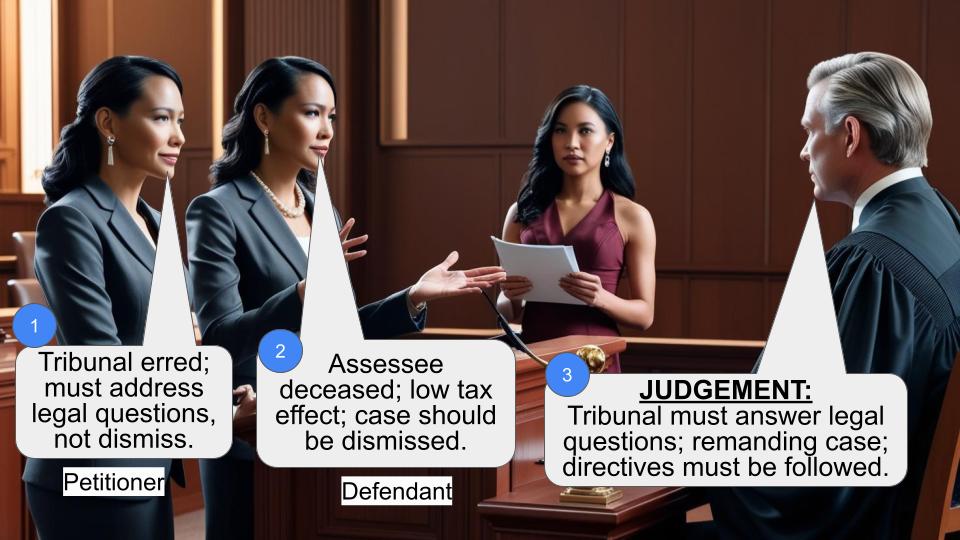
This interesting case where the Income Tax Department (the Revenue) made an assessment against a businesswoman who was exporting seafood products. She challenged this assessment, but unfortunately passed away during the legal proceedings. The case went through various stages, including the High Court and the Income Tax Appellate Tribunal. The main issue was that the Tribunal didn't answer specific legal questions as directed by the High Court. In the end, the High Court stepped in again to set things straight.
Get the full picture - access the original judgement of the court order here
Case Name:
Commissioner of Income Tax vs. Khairunnisa Ebrahim and Another (High Court of Kerala)
ITA. No. 178 of 2010
Date: 25th May 2016
Key Takeaways:
- The High Court emphasized the importance of following its directives, especially when it comes to answering specific legal questions.
- The case highlights the complexities that can arise when an assessee passes away during ongoing tax proceedings.
- The Court clarified that certain tax instructions are only applicable prospectively, not retroactively.
- The judgment underscores the need for tribunals to address the core legal issues rather than dismissing cases on technical grounds.
Issue:
The main question here is: Should the Income Tax Appellate Tribunal have answered the specific legal questions as directed by the High Court, despite the assessee’s death and the low tax effect of the case?
Facts:
- The assessee (who’s no longer with us) owned a business that processed and exported seafood products.
- For the 1979-1980 assessment year, the Income Tax Department added ₹10,7,371 to her taxable income.
- She challenged this assessment, kicking off a long legal journey.
- The case went up to the High Court, which then sent it back to the Tribunal with specific questions to answer.
- Sadly, the assessee passed away on May 4, 2008, during these proceedings.
- The Tribunal, instead of answering the legal questions, dismissed the case citing low tax effect and the assessee’s death.
Arguments:
The Revenue (that’s the tax department) argued:
- The High Court had clearly instructed the Tribunal to answer specific legal questions.
- The Tribunal shouldn’t have dismissed the case on technical grounds.
- Answering these questions is crucial for the Revenue to take further steps.
The assessee’s side (though they weren’t present):
- The tax effect was below the prescribed limit for appeals.
- The original assessee had passed away, and legal representatives couldn’t be brought on record despite notices.
Key Legal Precedents:
- Commissioner of Income Tax v. South Travancore Distilleries and Allied Products: This case, decided by the same High Court, emphasized that the Tribunal should answer the referred legal questions.
- The Court also referenced a Board Instruction stating that appeals shouldn’t be filed if the tax effect is below certain monetary limits. However, they clarified that this instruction only applies to appeals filed on or after July 10, 2014 .
Judgement:
The High Court decided to:
- Set aside the Tribunal’s order (Annexure C).
- Remand the case back to the Appellate Tribunal.
- Reiterate that the Tribunal must answer the legal questions listed in paragraph 1 of Annexure C order.
- No order was made on costs .
FAQs:
Q: What happens now that the original assessee has passed away?
A: The case will continue, but it’s been challenging to bring the legal representatives on record. The Tribunal will need to address this when answering the legal questions.
Q: Why didn’t the Tribunal answer the questions in the first place?
A: They focused on the low tax effect and the assessee’s death instead of addressing the core legal issues as directed by the High Court.
Q: Does the low tax effect matter in this case?
A: While it’s a consideration, the Court clarified that the instruction about not filing appeals for low tax effects only applies prospectively from July 10, 2014.
Q: What’s the significance of this judgment?
A: It emphasizes that lower courts and tribunals should follow higher court directives, especially when it comes to addressing specific legal questions.
Q: Will this case set a precedent for future tax cases?
A: It might, particularly in situations where an assessee passes away during proceedings or when tribunals are tempted to dismiss cases on technical grounds rather than addressing core legal issues.

1. The assessee, who is no more, was the proprietress of a concern engaged in the business of processing and exporting see-food products. For the assessment year 1979-1980, the Revenue made an assessment under Section 143(3) (of Income Tax Act, 1961) r/w Section 144B (of Income Tax Act, 1961) making an addition of ₹ 10,7,371/-. Questioning the said assessment, she initiated judicial proceedings. Eventually, a learned Division Bench of this Court, per one of us: Antony Dominic, J, in Commissioner of Income Tax v. South Travancore Distilleries and Allied Products (involving other appeals as well) remitted the matter to the Tribunal clarifying that the questions of law are to be answered by the Tribunal.
2. As a matter of subsequent developments, it has to be placed on record that the assessee died and at no stage could her legal heirs be served with notice, though they had been duly brought on record.
3. Eventually, the Appellate Tribunal, through Annexure C order, having extracted the questions of law required to be answered as has been directed by this Court, has eventually held as follows:
“2. We have heard the ld. Counsel for the assessee and Id. Departmental Representative. After considering the rival submissions, as rightly pointed out by the Id. Counsel for the assessee, the tax effect is below the prescribed limit in this case. Therefore, we dismiss the appeal of the Revenue in view of the tax effect.
3. Further, in this case, the original assessee died on 04.05.2008 and the Department could not bring the legal representatives on record by way of amended Form 36 in spite of sufficient service of notices. The order sheet will go to show that there were so many adjournments but nothing comes out to bring the legal representatives on record. Moreover, it is submitted that the assessee is no more. therefore, on this count also, the appeal filed by the Revenue is liable to be dismissed and accordingly, is dismissed. the appeal filed by the Revenue is dismissed only with reference to the Questions 1 and which was remanded back to the Tribunal for fresh disposal.’’
4. In the above factual drop, the learned Senior Counsel for the Revenue has strenuously contended that this Court, in a very elaborate judgment, has, in the first place, declined to answer the questions of law referred to it; in fact, it has remanded the matter to the Appellate Tribunal with a clear observation that the Tribunal ought to render a finding on the questions of law.
5. According to the learned Senior Counsel, the Tribunal, instead, has chosen to close the matter on technicalities. He singularly contends that answering the questions referred to in Annexure C is quite essential for the Revenue to take further steps.
6. Heard the learned counsel on both sides, apart from perusing the record.
7. We do find considerable force in the contentions of the learned Senior Counsel: This Court in South Travancore Distilleries and Allied Products (supra) has emphatically held that the questions of law referred to had to be answered by the appellate Tribunal. Indeed, contrary to the directive, the Tribunal has observed that the tax effect is below the prescribed rate and that there was no representation for the legal representatives despite sufficient service of notices.
8. In this context, it is important to note that this Court in South Travancore Distilleries and Allied Products (supra) has already observed that the direction of the Board is that "henceforth" appeal shall not be filed in cases where the tax effect does not exceed the monetary limits prescribed in the Instruction. Evidently, therefore, the operation of the Instruction is only prospective. This position is made further clear, it is further observed, in Clause 11 of the Instruction, which clarified that the Instruction will apply to appeals filed on or after 10th of July 2014 only.
9. This Court, eventually, disposed of the matter with the following direction:
“Since the question raised in these appeals are exactly similar, following the precedent in ITA Nos. 95/10 and 168/10, the orders passed by the Commissioner (Appeals) and the Tribunal for the assessment years 1991-1992, 1992-1993, 1994-1995, 1995-1996, 1996-1997 and 2002-2003 are set aside and the matters will stand remitted to the Assessing Officer to decide the matters afresh in the manner as directed in the judgment in ITA Nos. 95/10 and 168/10, after giving opportunity to the assessee and if necessary, after calling for particulars or clarification from the Kerala State Beverages Corporation Limited.”
10. In the facts and circumstances, apart from setting aside Annexure C order, we further remand the matter to the Appellate Tribunal reiterating our stand: The learned Tribunal ought to answer the questions of law incorporated in paragraph 1 of Annexure C order.
With the above observations, this appeal is disposed of. No order on costs.
ANTONY DOMINIC, JUDGE.
DAMA SESHADRI NAIDU, JUDGE.
×
Similar Ripples
Questions
Court Orders Tribunal to Answer Legal Questions in Income Tax Case Despite Assessee's Death
Write your CommentSimilar Posts


Generic
- Reportdata/2819.pdf
