


High Court Dismisses Writ Petition Challenging Income Tax Assessment and Penalt…







Full News
High Court Dismisses Writ Petition Challenging Income Tax Assessment and Penalty Orders
High Court Dismisses Writ Petition Challenging Income Tax Assessment and Penalty Orders
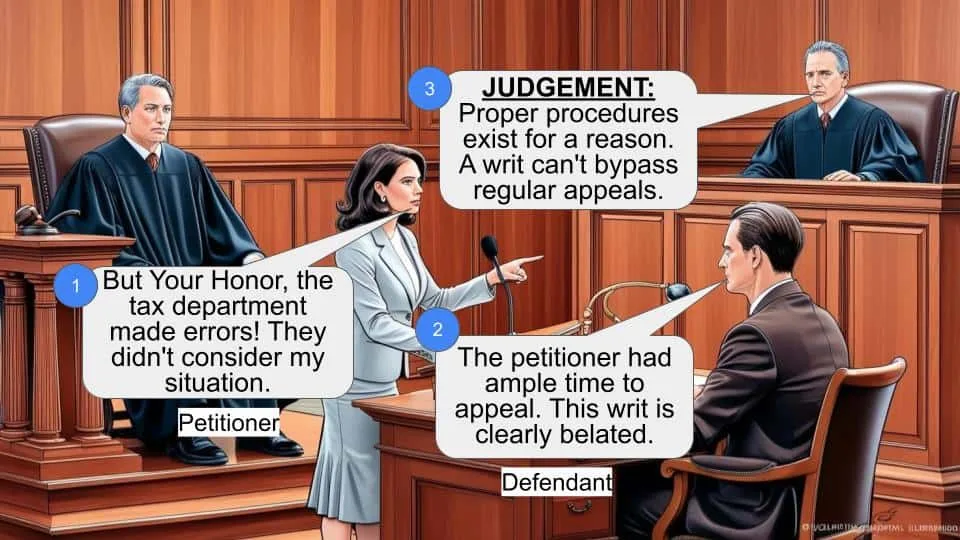
A businessman named M.M. Shajahan filed a writ petition in the High Court. He was challenging some orders from the Income Tax Department, including an assessment order, a penalty order, and a revision order. The court, however, didn't buy his arguments and dismissed the petition. Let's break it down further.
Get the full picture - access the original judgement of the court order here
Case Name:
M.M. Shajahan Vs Principal Commissioner of Income Tax and Anr. (High Court of Kerala)
WP(C).No.13048 OF 2020(E)
Date: 1st July 2020
Key Takeaways:
1. The court emphasized the importance of following proper legal procedures and timelines.
2. Writ petitions can't be used as a shortcut to bypass regular appeal processes, especially when they're time-barred.
3. The High Court won't act as an appellate court to re-examine the merits of an assessment order.
Issue:
The main question here was: Should the High Court intervene and quash the Income Tax Department's orders through a writ petition when the petitioner had failed to file a timely appeal through the regular channels?
Facts:
- M.M. Shajahan was running a coir business and a petrol pump in Thiruvananthapuram.
- For the 2009-10 assessment year, he filed a tax return declaring an income of ₹1,80,780 and paid ₹3,790 in taxes.
- The Income Tax Department later issued a notice under Section 148 (of Income Tax Act, 1961), thinking he hadn't filed a return.
- Without giving Shajahan a chance to respond, they completed an ex-parte assessment under Section 144 (of Income Tax Act, 1961), estimating his income at ₹2,11,12,903 and demanding ₹1,21,54,240 in taxes.
- Instead of filing an appeal, Shajahan filed a revision petition, which was eventually rejected.
- He then approached the High Court, which initially directed him to appear before the tax officer.
- The revision petition was dismissed again, and penalty proceedings were initiated.
- Shajahan then filed this writ petition challenging various orders from the tax department.
Arguments:
Shajahan's side:
- The tax department made errors in assessment, like including a bank account that wasn't his.
- They didn't consider his business withdrawals when calculating his income.
- He was hospitalized and couldn't take timely action.
- The revision order didn't address his main arguments.
Tax Department's side:
- The petition is too late (belated).
- Shajahan should have used the regular appeal process within the time limit.
Key Legal Precedents:
The judgment doesn't explicitly mention any specific case laws. However, it refers to settled law that allows the High Court to intervene under Article 226 of the Constitution when an order is illegal or without jurisdiction, or when principles of natural justice are violated.
Judgement:
The court sided with the tax department here. It said:
- The writ petition can't be used to bypass the regular appeal process, especially when it's filed so late.
- The High Court isn't supposed to act like an appellate court and re-examine the assessment order's merits.
- There was no apparent illegality or lack of jurisdiction in the tax department's orders.
- The petition was dismissed for lack of merit.
FAQs:
1. Q: Why didn't the court accept Shajahan's arguments?
A: The court felt that Shajahan was trying to use a writ petition to bypass the regular appeal process, which he should have used earlier.
2. Q: Could Shajahan have done anything differently?
A: Yes, he could have filed a timely appeal with the Commissioner of Appeals instead of waiting and filing a writ petition.
3. Q: Does this mean the High Court never intervenes in tax matters?
A: Not at all! The court can intervene if there's a clear violation of law or natural justice principles. In this case, they didn't see such issues.
4. Q: What's the main lesson from this case?
A: It's crucial to follow proper legal procedures and timelines in tax disputes. Writ petitions aren't a shortcut to bypass regular appeal processes.
5. Q: Can Shajahan still challenge the tax assessment?
A: Based on this judgment, it seems his options are limited now. He might need to consult a tax lawyer for any remaining possibilities.

The petitioner has approached this Court seeking the following reliefs:
"i. To call for the records leading to the issues of Exts.P2 and P6 orders passed by the 1st respondent by rejecting the Revision Petition without adverting to the merits of the case and the orders Ext.P7 imposing penalty u/s 271(1)(c) (of Income Tax Act, 1961) and the order Ext.P8 issued u/s 154(4) (of Income Tax Act, 1961) and quash the same by the issue of Writ of Certiorari or any other appropriate Writ order or direction.
ii. To issue of a Writ of Mandamus or any other appropriate Writ, order or direction, directing the respondents to refrain from enforcing the illegal Assessment Order Ext.P1 and the demand pursuant thereto and the order imposing penalty vide Ext.P7 and the revised order Ext.P8 issued un/s 154(4), pending disposal of W.P.(C).
iii. To stay all proceedings for recovery of the demand pursuant to the Assessment Order Ext.P1, Penalty order Ext.P7 and the revised order un/s 154(4) as per Ext.P8, for the Assessment Year 2009-10, pending disposal of the Writ Petition (Civil)."
2. The facts leading to filing of the writ petition are that the petitioner was doing coir business and running a Petrol Pump in Thiruvananthapuram. A return of income for the Assessment Year 2009-10 on 5.3.2011, declaring total income at Rs.1,80,780/- was filed. The Income tax of Rs.3,790/- was also remitted as per the return. The 2nd respondent issued a notice under Section 148 (of Income Tax Act, 1961) on 6.6.2013 by observing that the assessee seem to have not filed the return of income for the assessment year. The cash deposited in the Bank accounts are reflected in the cash book ,ledger and are also subjected to audit of accounts at the close of the year. However, without affording an opportunity and without issuing preassessment notice, the 2nd respondent completed the assessment ex-parte u/s 144 (of Income Tax Act, 1961) estimating the income of Rs.2,11,12,903/- and raised a demand of Rs.1,21,54,240/- vide Ext.P1 dated 11.3.2015. The petitioner being unaware of the remedy of appeal, the Chartered Accountant advised a Revision Petition, which was acknowledged on 2.2.2016.
3. Learned counsel appearing on behalf of the petitioner submits that the revision petition was posted for hearing on 17.3.2017. The order was passed by the 1st respondent under Section 264 (of Income Tax Act, 1961), it is observed that the petitioner was given an opportunity to be heard on 10.3.2017. But the petitioner could not appear due to reasons beyond control. Against the rejection order of revision petition the petitioner approached this Court vide W.P.(C) No.23492 of 2017, which was disposed vide order 17.7.2017 and the petitioner was directed to appear before the Officer on 22.8.2017, on which date, the date of hearing shall be communicated and the matter shall be concluded subject to the condition of payment of cost of Rs.10,000/-.
4. Pursuant to the above judgment, the petitioner submitted a representation on 17.10.2017 with reference to the judgment and also remitted Rs.10,000/- as directed by this Hon'ble Court. The 1st respondent issued a notice dated 17.11.2017 to appear before the 1st respondent on 23.11.2017 for hearing as evidenced by Ext.P5. The aforementioned revision petition was dismissed vide order dated 24.11.2017, Ext.P6. Perusal of the order would also demonstrate that the 1st respondent did not even refer to these grounds before attributing frivolous conduct to the part of the petitioner. In fact the order suffer from pulpable error as one of the bank accounts in South Indian Bank bearing No. 0273053000003369 did not belong to the petitioner.
Therefore the addition of Rs.1,27,13,782/- is totally without any application of mind. The addition of entire credit in the bank account has been noticed without considering the withdrawal from the bank account. In fact assessee was hospitalized for more than two months due to illness and was disabled to take remedial steps. Transactions in the bank accounts pertaining to the two business is totally different. Petitioner is also saddled with the demand of income tax of Rs.1,48,65,180/- as evidenced from rectification order dated 31.3.2018 issued under Section 154(4) (of Income Tax Act, 1961) and imposition of penalty under Section 271(1)(c) (of Income Tax Act, 1961) as evidenced from Exts.P7 and P8 and urging this Court for setting aside the order.
5. Learned counsel for the respondent raises the objection qua maintainability of petition to be belated , also qua availability of the remedy ought to have been availed within the prescribed period of limitation.
6. I have heard the learned counsel for the parties and appraised the paper book and of the view that there is no force and merit in the submissions. The entire focus of the pleadings reflects challenge to the impugned order Ext.P6 dated 24.11.2017 issued under Section 264 (of Income Tax Act, 1961) but no explanation has come forth as to how and in what manner delay occurred in laying challenge by filing an appeal before the Commissioner of Appeals. There could have been a force in the argument had the impugned order not disclosed the compliance of principle of natural justice or apparently appeared to be not only illegal but without jurisdiction. It is settled law that in such circumstances, the doors of this Court under Article 226 of the Constitution of India by exercising the power of review are always open. However, in the instant case, for the sake of repetiton just to circumvent the procedure of appeal, which prima facie is time barred; writ petition in the year 2020 has been filed. This Court cannot assume a role of an appellate court and examine the veracity and legality of an order of assessment on merits.
As an upshot of findings, I do not find any illegality and the writ petition is devoid of merits and is accordingly dismissed.
Sd/-
AMIT RAWAL
JUDGE
×
Similar Ripples
Questions
High Court Dismisses Writ Petition Challenging Income Tax Assessment and Penalty Orders
Write your CommentSimilar Posts
Generic
- Reportdata/6232.pdf
