


Court Overturns Tax Addition, Clarifies Burden of Proof in Cash Credit Cases


Full News
Court Overturns Tax Addition, Clarifies Burden of Proof in Cash Credit Cases
Court Overturns Tax Addition, Clarifies Burden of Proof in Cash Credit Cases
This case involves an appeal by Gaurav Triyugi Singh (the assessee) against an order by the Income Tax Appellate Tribunal. The main issue was the addition of Rs. 14 lakhs to the assessee's income under section 68 (of Income Tax Act, 1961). The Bombay High Court ultimately ruled in favor of the assessee, setting aside the Tribunal's decision.
Get the full picture - access the original judgement of the court order here
Case Name:
Gaurav Triyugi Singh vs Income Tax Officer (High Court of Bombay)
Income Tax Appeal No.1750 of 2017
Date: 22nd January 2020
Key Takeaways:
1. The court clarified that an assessee is only required to explain the source of credit, not the source of the source.
2. The three requirements for explaining cash credits under section 68 (of Income Tax Act, 1961) are: identity of the creditor, genuineness of the transaction, and credit-worthiness of the creditor.
3. Once the assessee discharges their initial burden, the onus shifts to the revenue department to disprove the explanation.
Issue:
Was the Income Tax Appellate Tribunal justified in upholding the addition of Rs.14 lakhs to the assessee's income under section 68 (of Income Tax Act, 1961), despite the assessee discharging the initial onus laid upon him?
Facts:
1. The assessee, Gaurav Triyugi Singh, filed a return of income disclosing a total income of Rs.17,04,320 for the assessment year 2010-11.
2. During assessment, it was found that the assessee had taken an unsecured loan of Rs.17,04,320 from Smt. Savitri Thakur.
3. The Assessing Officer added Rs.17 lakhs to the assessee's income under section 68 (of Income Tax Act, 1961) as unexplained cash credit.
4. On appeal, the Tribunal partially allowed relief, reducing the addition to Rs.14 lakhs.
5. The disputed amount of Rs.14 lakhs was transferred to Smt. Savitri Thakur's account in three installments, claimed to be gifts from her brother and sister.
Arguments:
Assessee's argument:
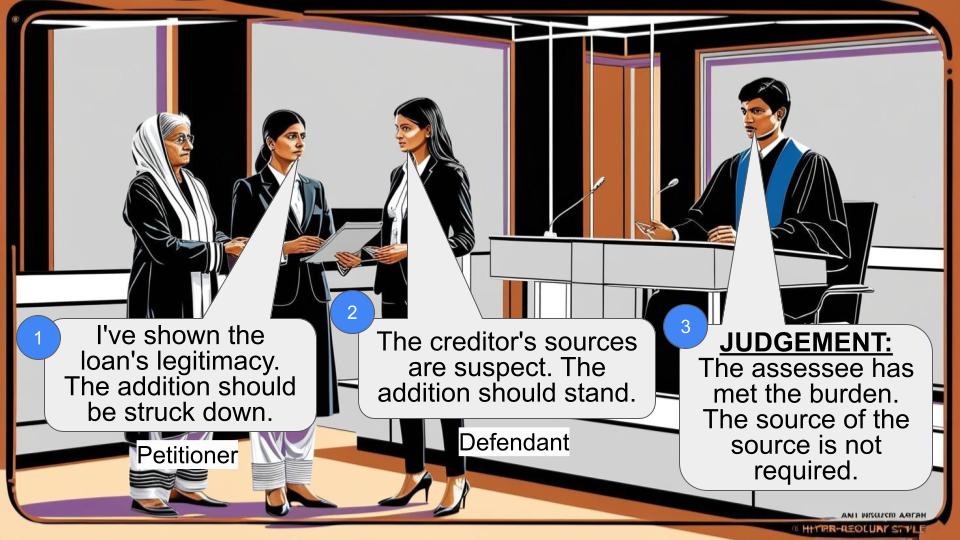
- The loan was genuine, and the identity, creditworthiness, and genuineness of the transaction were established.
- The assessee had discharged the initial onus required under section 68 (of Income Tax Act, 1961).
Revenue's argument:
- The sources of the funds (Shri Rajendra Bahadur Singh and Smt. Sarojini Thakur) were suspect.
- The creditor had no regular source of income to justify the advancement of credit.
Key Legal Precedents:
1. Principal Commissioner of Income Tax vs. Veedhata Tower Pvt. Ltd., (2018) 403 ITR 415 (Bom):
This case established that an assessee is only required to explain the source of the credit, not the source of the source.
Judgement:
The Bombay High Court allowed the appeal in favor of the assessee. The court held that:
1. The assessee had discharged the onus required under section 68 (of Income Tax Act, 1961) by explaining the identity of the creditor, genuineness of the transaction, and creditworthiness of the creditor.
2. The assessee was not required to explain the sources of the money provided by the creditor (i.e., the sources of the source).
3. The Tribunal was not justified in sustaining the addition of Rs. 14 lakhs to the assessee's income under section 68 (of Income Tax Act, 1961).
FAQs:
Q1: What is section 68 (of Income Tax Act, 1961)?
A1: Section 68 (of Income Tax Act, 1961) allows the Assessing Officer to add unexplained cash credits to an assessee's income if the assessee fails to satisfactorily explain the nature and source of such credits.
Q2: What are the three requirements an assessee must satisfy under section 68 (of Income Tax Act, 1961)?
A2: The assessee must explain (i) the identity of the creditor, (ii) the genuineness of the transaction, and (iii) the credit-worthiness of the creditor.
Q3: Does an assessee need to explain the source of the source?
A3: No, the court clarified that an assessee is only required to explain the source of the credit, not the source of the source.
Q4: What happens after the assessee discharges their initial burden?
A4: Once the assessee discharges their initial burden, the onus shifts to the revenue department to disprove the explanation provided by the assessee.
Q5: How might this judgment impact future cash credit cases?
A5: This judgment may make it easier for assessees to defend against additions under section 68 (of Income Tax Act, 1961), as long as they can satisfactorily explain the immediate source of the credit, without having to trace it back further.

1. Heard Mr. D. V. Gandhi, learned counsel for the Appellant; and Mr. Sham Walve, learned standing counsel Revenue for the Respondent.
2. Considering the subject matter of the appeal, we are of the view that the same can be disposed of at this stage itself. Consequently, notice is made returnable forthwith and by consent of the parties, appeal is taken up for final disposal.
3. This Appeal has been preferred by the assessee under section 260-A (of Income Tax Act, 1961), 1961, assailing the legality and correctness of the order dated 11.05.2017 passed by the Income Tax Appellate Tribunal, Mumbai Bench “G”, Mumbai (Tribunal) in Income Tax Appeal No. 6160/Mum/2016 for the assessment year 2010-11.
4. Short point for consideration in this Appeal is the addition of a sum of Rs. 14 lakhs to the income of the assessee by the Assessing Officer under section 68 (of Income Tax Act, 1961) (briefly, “the Act” hereinafter), as modified by the Tribunal.
5. Assessee is an individual and for the assessment year under consideration, he filed return of income disclosing total income of Rs. 17,04,320.00. During the assessment proceedings, Assessing Officer found that assessee had taken unsecured loan from amongst others Smt. Savitri Thakur for an amount of Rs. 17,04,320/-. Assessee was asked to submit loan confirmation as well as copy of the returns of income and bank statements of Smt. Savitri Thakur. Though those were submitted, Assessing Officer was not satisfied and took the view that genuineness of the loan was not established by the assessee; besides credit worthiness of Smt. Savitri Thakur was found to be suspect. Consequently, the aforesaid amount of Rs. 17 lakhs was added back to the total income of the assessee under section 68 (of Income Tax Act, 1961) as unexplained cash credit vide the assessment order dated 22.03.2013.
6. As against the above, assessee preferred appeal before the Commissioner of Income Tax (Appeals)-42, Mumbai. By order dated 04.07.2016, the Appellate Authority upheld and confirmed the order of the Assessing Officer.
7. Assessee carried the matter further in appeal before the Tribunal. Out of Rs. 17 lakhs loan given by Smt. Savitri Thakur to the assessee, Tribunal held that loan amount of Rs. 3 lakhs was properly explained as assessee had proved genuineness of the transaction, creditworthiness and identity of the creditor. However, regarding the balance amount of Rs. 14 lakhs, Tribunal held that source of the said amount was full of doubts and explanation provided by the assessee could not be accepted. Accordingly addition of Rs. 14 lakhs was upheld while deleting the addition of Rs. 3 lakhs vide the order dated 11.05.2017.
8. Aggrieved, present appeal has been preferred.
9. Though a number of questions have been proposed by the Appellant as substantial questions of law, we find that the following question covers the controversy in question, which is as under : Whether on the facts and in the circumstances of the case and in law, the Tribunal was justified in upholding the addition in respect of unsecured loan of Rs. 14,00,000/- under section 68 (of Income Tax Act, 1961), inspite of the fact that the initial onus laid down on the Appellant was duly discharged ?.
10. Submissions made have been considered.
11. Regarding Smt. Savitri Thakur, it is seen that she had issued cheque payment of Rs. 14 lakhs dated 21.07.2009 to the Appellant. Prior to the issuance of the cheques, this amount was credited into the bank account of Smt. Savitri Thakur maintained in the State Bank of India, Rae Baraeli Branch. There were three transfers of Rs. 5 lakhs, Rs. 5 lakhs and Rs. 4 lakhs into the above account of Smt. Savitri Thakur before issue of cheques by her to the assessee. Smt. Savitri Thakur claimed that these amounts were received by her as gifts from one Shri Rajendra Bahadur Singh and Smt. Sarojini Thakur. Shri Rajendra Bahadur Singh is the brother of Smt. Savitri Thakur and Smt. Sarojini Thakur is the sister of Smt Savitri Thakur. Shri Rajendra Bahadur Singh had gifted Rs. 5 lakhs to Smt. Savitri Thakur and Smt. Sarojini Thakur had gifted to Rs. 5 lakhs and Rs. 4 lakhs to Smt. Savitri Thakur. Result of verification and remarks by the Department in respect of Shri Rajendra Bahadur Singh is as under :
“The donor had retired in 2003 and claims to earn tuition income of Rs. 1.5 Lacs p.a. and this money has been claimed to have been hoarded and kept in cash by him over several years and he claims that out of this accumulation he deposited a sum of Rs. 5,00,000/- in cash in his bank account with SBI Rae Baraeli on 20.07.2009 and it was transferred to Savitri Thakur on 20.07.2009. The donor has not filed any income tax return.”
11.1. Similarly in respect of Smt. Sarojini Thakur, result of verification and remarks by the Department is as under :
“This donor has ostensibly retired from service in 2007 and she has deposited cash of Rs. 9,00,000/- in her bank with SBI, Rae Baraeli on 18.07.2009 before issuing two cheques to Savitri Thakur. She has not filed any return of income admittedly from A.Y. 2008-09. She also claims to receive agricultural income of Rs. 1.5 lacs p.a. which is claimed to be kept in cash with her since several years.”
12. At this stage, it would be apposite to advert to section 68 (of Income Tax Act, 1961), relevant portion of which reads as under :
“68. Where any sum is found credited in the books of an assessee maintained from any previous year, and the assessee offers no explanation about the nature and source thereof or the explanation offered by him is not, in the opinion of the Assessing Officer, satisfactory, the sum so credited may be charged to income -tax as the income of the assessee of that previous year. .............”
12.1. From a reading of section 68 (of Income Tax Act, 1961), as extracted above, it is seen that if an amount is credited in the books of an assessee maintained from any previous year and the assessee offers no explanation about the nature and source thereof or the explanation offered by him is not, in the opinion of the Assessing Officer, satisfactory, the sum so credited may be charged to income tax, as the income of the assessee of the relevant previous year.
13. Section 68 (of Income Tax Act, 1961) has received considerable attention of the courts. It has been held that it is necessary for an assessee to prove prima facie the transaction which results in a cash credit in his books of account. Such proof would include proof of identity of the creditor, capacity of such creditor to advance the money and lastly, genuineness of the transaction. Thus, in order to establish receipt of credit in cash, as per requirement of section 68 (of Income Tax Act, 1961), the assessee has to explain or satisfy three conditions, namely : (i) identity of the creditor; (ii) genuineness of the transaction; and (iii) credit-worthiness of the creditor.
14. In Principal Commissioner of Income Tax vs. Veedhata Tower Pvt. Ltd., (2018) 403 ITR 415 (Bom), this court has held that assessee is only required to explain the source of the credit. There is no requirement under the law to explain the source of the source. In the instant case, there is no dispute as to the identity of the creditor. There is also no dispute about the genuineness of the transaction. That apart, the creditor has explained as to how the credit was given to the assessee. Thus assessee had discharged the onus which was on him as per the requirement of section 68 (of Income Tax Act, 1961). What the Assessing Officer held was that sources of the source were suspect i.e., he suspected the two sources Shri Rajendra Bahadur Singh and Smt. Sarojini Thakur of the source Smt. Savitri Thakur.
15. In view of discharge of burden by the assessee, burden shifted to the revenue; but revenue could not prove or bring any material to impeach the source of the credit. Though Mr. Walve, learned standing counsel, has pointed out that the creditor had no regular source of income to justify the advancement of the credit to the assessee, we are of the view that the assessee had discharged the onus which was on him to explain the three requirements, as noted above. It was not required for the assessee to explain the sources of the source. In other words, he was not required to explain the sources of the money provided by the creditor Smt. Savitri Thakur i.e. Shri Rajendra Bahadur Singh and Smt. Sarojini Thakur.
16. Considering the above, we are of the view that the Tribunal was not justified in sustaining the addition of Rs. 14 lakhs to the total income of the assessee as undisclosed cash credit under section 68 (of Income Tax Act, 1961).
17. Consequently, finding of the Tribunal to the above extent is set aside. The question framed is answered in favour of the assessee and against the Revenue.
18. Appeal is accordingly allowed but with no order as to cost.
(MILIND N. JADHAV, J.) (UJJAL BHUYAN, J.)
×
Questions
Court Overturns Tax Addition, Clarifies Burden of Proof in Cash Credit Cases
Write your CommentSimilar Posts
Generic
- Reportdata/6103.pdf
