


Court Partially Allows Appeal in Oswal Agro Mills Ltd. vs Commissioner of Incom…



Full News
Court Partially Allows Appeal in Oswal Agro Mills Ltd. vs Commissioner of Income Tax
Court Partially Allows Appeal in Oswal Agro Mills Ltd. vs Commissioner of Income Tax
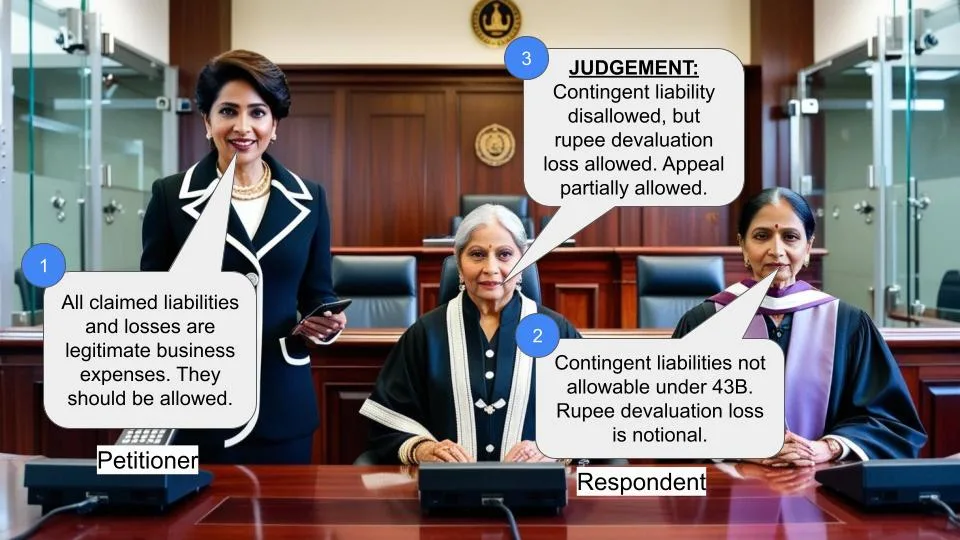
In the case of Oswal Agro Mills Ltd. vs Commissioner of Income Tax, the High Court addressed three key issues related to tax deductions claimed by the assessee. The court upheld the disallowance of certain liabilities as contingent and not allowable under Section 43B (of Income Tax Act, 1961), but allowed the deduction for losses incurred due to the devaluation of the rupee.
Get the full picture - access the original judgement of the court order here.
Case Name:
Oswal Agro Mills Ltd. vs Commissioner of Income Tax (High Court of Delhi)
ITA 42/2000
Key Takeaways
- The court upheld the disallowance of ₹1,60,33,064/- as it was deemed a contingent liability and not allowable under Section 43B (of Income Tax Act, 1961).
- The court allowed the deduction of ₹1,19,07,989/- for losses incurred due to the devaluation of the rupee, following the precedent set by the Supreme Court in CIT vs. Woodword Governor India Pvt. Ltd.
- The appeal was partially allowed, with the court ruling in favor of the assessee on the third issue but against them on the first two issues.
Issue
Whether the Income Tax Appellate Tribunal was correct in disallowing certain liabilities and losses claimed by the assessee under Section 43B (of Income Tax Act, 1961)?
Facts
Oswal Agro Mills Ltd. is involved in manufacturing and trading various products, including industrial hard oils and edible oils. The company entered into agreements with overseas processors for the purchase of imported materials. The Revenue disallowed a sum of ₹1,60,33,064/- on the grounds that it was not permissible under Section 43B (of Income Tax Act, 1961). The assessee appealed to the High Court after the Income Tax Appellate Tribunal upheld the Revenue's contentions.
Arguments
- Assessee's Argument:
The liabilities and losses claimed were legitimate business expenses and should be allowed as deductions under the Income Tax Act.
- Revenue's Argument:
The liabilities were contingent and not ascertained, making them non-deductible under Section 43B (of Income Tax Act, 1961). The loss due to the devaluation of the rupee was also disallowed as it was considered notional.
Key Legal Precedents
- Kedarnath Jute Manufacturing Co. Ltd. v. CIT:
This Supreme Court case established that contingent liabilities are not allowable as deductions.
- Calcutta Co. Ltd. v. CIT:
Another Supreme Court case reinforcing the principle that only ascertained liabilities can be deducted.
- Bharat Earth Movers v. CIT:
This case further clarified the nature of allowable deductions under the Income Tax Act.
- CIT vs. Woodword Governor India Pvt. Ltd.:
This Supreme Court ruling allowed the deduction of losses incurred due to the devaluation of the rupee.
Judgement
The High Court ruled that the disallowance of ₹1,60,33,064/- was correct as it was a contingent liability and not allowable under Section 43B (of Income Tax Act, 1961). However, the court allowed the deduction of ₹1,19,07,989/- for losses incurred due to the devaluation of the rupee, following the precedent set by the Supreme Court in CIT vs. Woodword Governor India Pvt. Ltd. The appeal was thus partially allowed.
FAQs
Q1: What was the main issue in this case?
A1: The main issue was whether certain liabilities and losses claimed by the assessee were allowable as deductions under Section 43B (of Income Tax Act, 1961).
Q2: What did the court decide about the ₹1,60,33,064/- liability?
A2: The court upheld the disallowance of this amount, ruling it as a contingent liability and not allowable under Section 43B (of Income Tax Act, 1961).
Q3: Was the loss due to the devaluation of the rupee allowed as a deduction?A3: Yes, the court allowed the deduction of ₹1,19,07,989/- for losses incurred due to the devaluation of the rupee.
Q4: What legal precedents did the court rely on?
A4: The court relied on several Supreme Court cases, including Kedarnath Jute Manufacturing Co. Ltd. v. CIT, Calcutta Co. Ltd. v. CIT, Bharat Earth Movers v. CIT, and CIT vs. Woodword Governor India Pvt. Ltd.
Q5: What was the final outcome of the appeal?
A5: The appeal was partially allowed, with the court ruling in favor of the assessee on the third issue but against them on the first two issues.

1. The following questions of law were framed in the present appeal by order dated 12.05.2000.
(i) Whether the Income Tax Appellate Tribunal is correct in law and on facts in upholding this disallowance of an amount of ₹1, 60, 00,064/-, being a contractual trading liability incurred in the nature of additional cost of material, holding the same to be a liability contingent on the happening of an event and thus not an allowable deduction while computing the income for the instant assessment year?
(ii) Whether the Income Tax Appellant Tribunal is correct in law and on facts in holding that the liability of ₹1,60,33,064/- claimed by the appellant was not allowable under Section 43B (of Income Tax Act, 1961).
(iii) Whether the Income Tax Appellate Tribunal is correct in law and on facts in upholding the disallowance of a sum of ₹1,19,07,989/- being the loss incurred on account of devaluation of rupee against the US Dollars, holding the same to be a fictitious and notional loss?
2. The assessee is manufacturing and trading industrial hard oils, edible oils, marine products, emergency lighting units and soaps etc and entered into an agreement with one overseas processors Shahji International Pvt. Ltd. and Oswal Soap and Allied Industrial Pvt. Ltd. for purchase of imported Palm Sterline Fatty Acid. These agreements with the said importers were identically worded. The imported material was to be purchased by the assessee and the CIF price, custom duty, clearance charges etc., and 3% of the total cost. In terms of Clause 11 any liability arising after sale of imported materials in respect of customs, excise, penalty, sales tax etc., was payable by the assessee/appellant and was to be included as landed cost of imported material. The Revenue for the relevant years had disallowed sum of ₹1,60,33,064/- on the ground that this was not permissible under Section 43B (of Income Tax Act, 1961).
3. The matter was carried out before Income Tax Appellate Tribunal (ITAT) which upheld the revenue’s contentions. It is under these circumstances that the assessee appealed to this Court. The first two questions pertain to the applicability of Section 43B (of Income Tax Act, 1961) and the permissibility of the deduction claimed under the circumstances of the case.
4. At the outset, the learned counsel for the parties submitted that the question does not survive in view of the judgment titled as Oswal Agro Mills Ltd. vs. Commissioner of Income Tax ITA No.41/2000 decided on 07.02.2014. This Court had discussed the relevant case law on the subject and especially relied upon the judgment of the Supreme Court in Kedarnath Jute Manufacturing Co. Ltd. v. CIT: (1971)82 ITR 363 (SC), Calcutta Co.ltd. v. CIT: (1959) 37 ITR 1 (SC) and the judgment reported as Bharat Earth Movers v. CIT: (2000) 245 ITR 428 (SC). It is held that the amount is not an ascertained liability. The Court held that such liability is contingent upon an uncertain fact and, therefore, deduction claimed by the assessee was not permissible in view of Section 43B (of Income Tax Act, 1961). This Court is governed by the said precedent and accordingly answers question Nos. 1 and 2 in the affirmative and against the assessee.
5. The third question i.e. disallowance in respect of sum of ₹ 1,19,07,989/- being a loss incurred on account of devaluation of Rupee is governed by the ruling of this Court in CIT vs. Woodword Governor India Pvt. Ltd. (2009) 312 ITR 254 (SC). In accordance with the ruling of the Supreme Court in that judgment the loss incurred is clearly admissible and the disallowance made by the Revenue was not justified. The question has to be again answered in the affirmative, but in favour of the assessee.
6. In view of the above, and for the foregoing reasons, the appeal is partly allowed.
S. RAVINDRA BHAT
(JUDGE)
R.K.GAUBA
(JUDGE)
JANUARY 12, 2015
×
Questions
Court Partially Allows Appeal in Oswal Agro Mills Ltd. vs Commissioner of Income Tax
Write your CommentSimilar Posts
Generic
- Reportdata/4137.pdf
