


Court Quashes Income Tax Reassessment, Citing Full Disclosure by Assessee


Full News

Court Quashes Income Tax Reassessment, Citing Full Disclosure by Assessee
Court Quashes Income Tax Reassessment, Citing Full Disclosure by Assessee
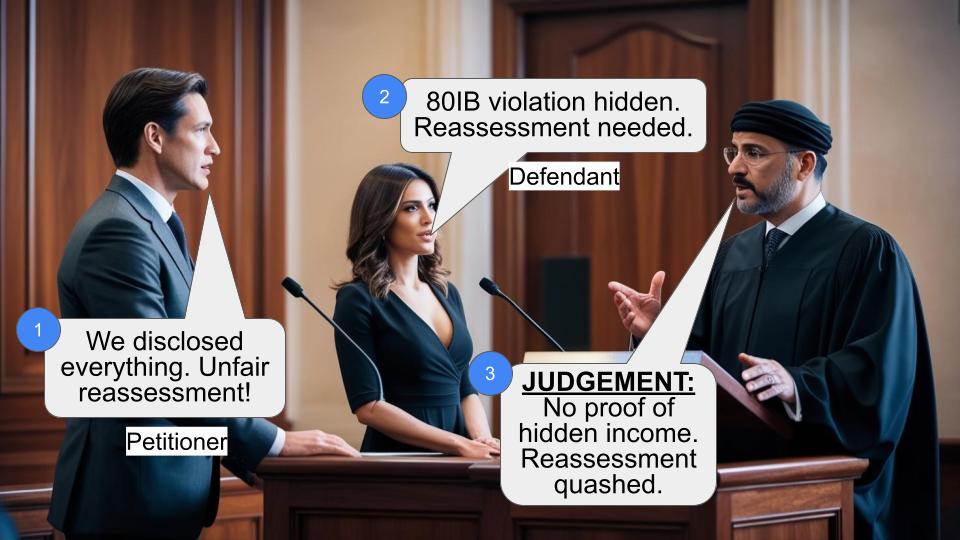
This case involves a dispute between NIBA INDIA & ANR. (the assessee) and the Assistant Commissioner of Income Tax regarding the reopening of concluded tax assessments for the years 1977-78 and 1978-79. The court ruled in favor of the assessee, quashing the reassessment notices issued under Section 148 (of Income Tax Act, 1961), as there were no valid reasons to believe that income had escaped assessment.
Get the full picture - access the original judgement of the court order here
Case Name:
Niba India & Anr. Vs Smt. Arti Handa, Assistant Commissioner of Income Tax & Ors. (High Court of Bombay)
Writ Petition No.1942 of 1990
Date: 9th January 2008
Key Takeaways:
1. Full disclosure of material facts by the assessee prevents reassessment.
2. The Assessing Officer's awareness of an issue during the original assessment precludes reopening.
3. Mere generation of scrap during manufacturing is not sufficient grounds for reassessment.
4. Courts may consider similar judgments for sister concerns in related matters.
Issue:
Was there a valid reason to believe that income had escaped assessment, warranting the reopening of concluded assessments under Section 148 (of Income Tax Act, 1961) for the years 1977-78 and 1978-79?
Facts:
1. The Income Tax Department issued notices dated March 30, 1989, under Section 148 (of Income Tax Act, 1961) to reopen assessments for 1977-78 and 1978-79.
2. Search operations were conducted on the assessee's premises and related group companies.
3. Statements from directors/partners were recorded under Section 132(4) (of Income Tax Act, 1961).
4. The department claimed that brass scrap (about 45% of total brass consumption) and plastic powder scrap (about 12% of plastic powder consumption) were generated during manufacturing.
5. The assessee had not shown any value of scrap either by way of sale or in stock for the assessment year 1977-78.
6. The department also alleged suppression of refill sales due to the efficiency of the manufacturing machines.
Arguments:
Assessee's arguments:
1. The accounting method for scrap revenue was to show it when finally sold, which was accepted by the Income Tax Appellate Tribunal (ITAT).
2. All material facts were available to the Assessing Officer during the original assessment.
3. Similar circumstances in a sister concern's case led to the court holding that there were no reasons to believe for reopening the assessment.
Department's arguments:
1. Relied on the statement of Mr. B.G. Sanghvi, claiming he attempted to sell scrap and show bogus purchases.
Key Legal Precedents:
1. Sanghvi Swiss Refills Private Limited Vs. Smt. Arti Handa, Assistant Commissioner of Income Tax and another, (2006) 284 ITR 427 (Bom) -
The court held that there were no reasons to believe for reopening the assessment in similar circumstances.
2. Writ Petition No. 608 of 1990 decided on 23.10.2007 -
The court noted that there was no unequivocal statement or material to hold the percentage of scrap generated.
Judgement:
The court ruled in favor of the assessee, quashing the reassessment notices. Key points of the judgment include:
1. There was no failure on the part of the assessee to disclose all material facts voluntarily and truly.
2. The issue of scrap generation during manufacturing was before the Assessing Officer during the original assessment under Section 143(3) (of Income Tax Act, 1961).
3. The ITAT had accepted the assessee's method of accounting for scrap sales.
4. Although a stock register for scrap was not maintained, this information was available to the Assessing Officer during the original assessment.
5. The court found no valid reasons to believe that income had escaped assessment, warranting the reopening of the concluded assessment.
FAQs:
Q1: What was the main reason for quashing the reassessment notices?
A1: The court found that the assessee had disclosed all material facts, and the Assessing Officer was aware of the scrap issue during the original assessment.
Q2: How did the court view the lack of a stock register for scrap?
A2: The court acknowledged that while a stock register was not maintained, this information was available to the Assessing Officer during the original assessment under Section 143(3) (of Income Tax Act, 1961).
Q3: What role did the ITAT's decision play in this case?
A3: The ITAT's acceptance of the assessee's method of accounting for scrap sales strengthened the assessee's position in this case.
Q4: How did previous judgments influence this decision?
A4: The court considered similar judgments, particularly the Sanghvi Swiss Refills case, which dealt with comparable circumstances and supported the assessee's position.
Q5: What is the significance of this judgment for taxpayers?
A5: This judgment emphasizes the importance of full disclosure during original assessments and limits the tax department's ability to reopen assessments without substantial new evidence.

The Petitioners by the present Petition have challenged the notices issued under Section 148 (of Income Tax Act, 1961) for reopening of assessment for the assessment years 1977-78 and 1978-79. The Notices are dated 30th March, 1989. The reasons for rassessment have been annexed to the reply filed by the respondents as on annexures to the affidavit of Mr. Y.S. Sonawane.
It is recorded therein that the search operations were carried out in the concerns belonging to the Petitioner and the group companies and the employees were examined. Their statements were also recorded under Section 132(4) (of Income Tax Act, 1961). From the said statement it is set out that it was noticed that the brass scrap and plastic powder scarp generated in the manufacturing process is of significant quantity and value. On the basis of the observations made from the manufacturing process carried out by the Search party and from the statements of directors/partners, who were examined, it was noticed that the brass scrap is about 45% of the total consumption of brass item - wire rod and strips and plastic scrap can be as much as 12% of the consumption of plastic powder and that for the assessment year 1977-78, the assessee had not shown any value of scrap either by way of sale of in stock. There was suppression of profits by non-disclosure of scrap. It was also mentioned that the Petitioners were using very sophisticated machine for the consumption of stainless steel balls and the efficiency of the machine is such that not a single ball is wasted in the manufacturing process.
Thus there was suppression of sale of refills.
. It is the contention of the Petitioner that in so far as scrap is concerned, accounting method followed by them is by showing the Revenue generated from the scrap at the time the assessee finally sold and this has been accepted by ITAT. Reference for that purpose is made to the order dated 29.6.2005 in I.T.A. No.1529/Mum/96 and 83/Mum/97 in the case of Asst. Commissioner of Income Tax Vs. M/s. Nibs India. It is also set out that there were no reasons to believe, as all the material was available with the Assessing Officer when the original assessment was made. In similar circumstances in respect of similar scrap this court in a Petition filed by sister concern has held that there were no reasons to believe for reopening of the assessment. For that purpose reliance is placed in the judgment in Sanghavi Swiss Refills Private Limited Vs. Smt. Arti Handa, Asst. Commissioner of Income Tax and another, (2006) 284 ITR 427 (Bom). Our attention is also invited to the judgment in respect of another sister concern Sanghavi Swiss Refills Private Limited for different assessment years in Writ Petition No. 608 of 1990 decided on 23.10.2007. It is pointed out that this court noted that in the statement recorded nowhere is there any unequivocal statement or material to hold the percentage of scrap generated. It is therefore, submitted that considering that in respect of similar issue this court has already taken a view, that merely because there was scrap, is no reason to reopen the assessment. The notice therefore, served under Section 148 (of Income Tax Act, 1961) has to be quashed and set aside.
. On behalf of the respondents, reply has been filed by Mr.Y.S. Sonawane. The only material relied upon is the statement of Mr.B.G. Sanghvi wherein it is purported that he has made attempt to sell the scrap and shown bogus purchase. The said statement was placed before us for our consideration.
. We are concerned with the reasons given for reopening the concluded assessment on the facts of the present case. As rightly pointed out by the learned Bench of this court in Sanghvi Swiss Refills Pvt. Ltd. Vs. Smt. Arti Handa, Assistant Commissioner of Income Tax and another (2006) 284 ITR 427 (Bom) that there was no failure on the part of the assessee to disclose voluntarily and truely all material facts and the issue that scrap was generated during the manufacturing process was before the Assessing Officer. In the case of Petitioner itself, the ITAT has accepted the manner in which the scrap generated was disposed of and the Tribunal has accepted the material of accounts when the scrap was finally sold. It is no doubt true that the stock register of the scrap generated was not maintained. But this information was available to the Assessing Officer when the assessment was made under Section 143(3) (of Income Tax Act, 1961).
. Even otherwise, this matter is pending in this court since the year 1990 and interim relief was granted which is pending till date.
. We are therefore, of the opinion that as there were no reasons to believe warranting the reopening of the concluded assessment, consequently the Petition will have to be allowed. Rule made absolute in terms of Prayer Clauses (b) and (d). There shall be no order as to costs.
(R.S. MOHITE, J.) (F.I.REBELLO, J.)
×
Similar Ripples
Questions
Court Quashes Income Tax Reassessment, Citing Full Disclosure by Assessee
Write your CommentSimilar Posts


Generic
- Reportdata/5032.pdf
