


Court Quashes Income Tax Reassessment Notice, Citing Full Disclosure and No New…




Full News

Court Quashes Income Tax Reassessment Notice, Citing Full Disclosure and No New Facts
Court Quashes Income Tax Reassessment Notice, Citing Full Disclosure and No New Facts
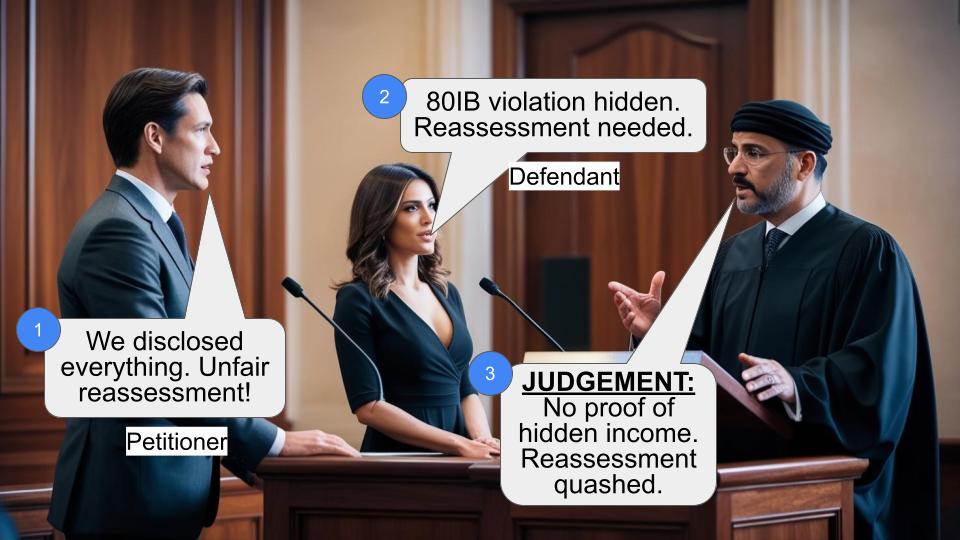
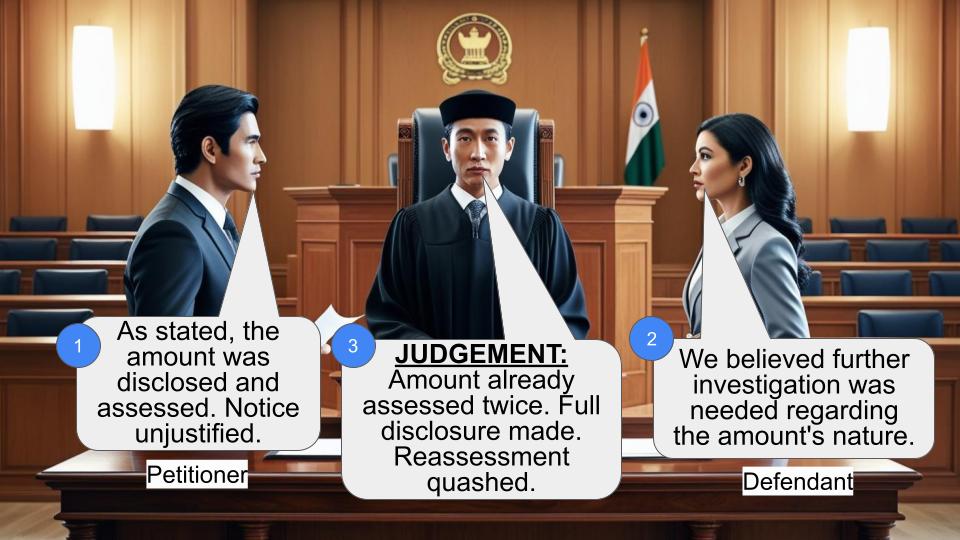
This case involves Lalit Bagai (the petitioner) challenging a notice issued by the Income Tax Department to reopen his assessment for the 2007-08 assessment year. The Delhi High Court ruled in favor of the petitioner, setting aside the reassessment notice and the order rejecting the petitioner's objections. The court found that the reasons for reopening the assessment were based on information already disclosed and considered during the original assessment.
Get the full picture - access the original judgement of the court order here
Case Name:
Lalit Bagai vs Deputy Commissioner of Income Tax (High Court of Bombay)
W.P.(C) 5054/2014 and CM No. 10078/2014 Date: 5th December 2014
Key Takeaways:
1. Reassessment notices issued after four years require proof of failure to disclose material facts fully and truly.
2. Attempting to reopen an assessment based on previously disclosed and considered information is not permissible.
3. The court emphasized the importance of full disclosure during the original assessment process.
Issue
Was the Income Tax Department justified in issuing a notice under Section 148 (of Income Tax Act, 1961), to reopen the assessment for the year 2007-08, more than four years after the end of the relevant assessment year?
Facts:
1. The original assessment for Lalit Bagai for the 2007-08 assessment year was completed on March 30, 2008, under Section 143(3) (of Income Tax Act, 1961).
2. On March 26, 2014, the Income Tax Department issued a notice under Section 148 (of Income Tax Act, 1961) to reopen the assessment.
3. The notice was issued beyond four years from the end of the relevant assessment year.
4. The reasons for reopening included discrepancies in reported receipts and alleged non-deduction of tax on certain payments.
5. The petitioner filed objections on May 2, 2014, which were rejected by the Assessing Officer on May 9, 2014.
Arguments:
Petitioner's Arguments:
1. All material particulars were fully and truly disclosed during the original assessment.
2. The reopening was based on a mere change of opinion, which is not permissible under law.
Department's Arguments:
1. The assessee had not shown receipts in the Profit & Loss account of Rs. 18,95,45,672/- which appeared in Form 16A.
2. The assessee had not deducted tax on a payment of Rs.5,80,70,078/-, potentially attracting provisions of Section 40(a)(ia) (of Income Tax Act, 1961).
Key Legal Precedents:
While no specific case laws were cited in the judgment, the court relied on established principles regarding reassessment under Section 147 (of Income Tax Act, 1961), particularly the proviso that requires failure to disclose material facts fully and truly for reassessments beyond four years.
Judgement:
The Delhi High Court ruled in favor of the petitioner, setting aside the reassessment notice and the order rejecting the petitioner's objections. The court's reasoning was:
1. The discrepancy in receipts was already addressed during the original assessment, with a full reconciliation provided by the petitioner's chartered accountants.
2. The payments alleged to be subject to TDS were made to the petitioner's own employees and not covered under Section 40(a)(ia) (of Income Tax Act, 1961).
3. All facts were fully and truly disclosed during the original assessment, and attempting to reopen based on the same information amounted to a change of opinion, which is not permissible in law.
FAQs:
1. Q: What is the significance of the four-year period mentioned in the case?
A: After four years from the end of the assessment year, the tax department can only reopen assessments if there's evidence that the assessee failed to fully disclose material facts.
2. Q: Why was the reopening notice considered invalid in this case?
A: The court found that all relevant information had been fully disclosed during the original assessment, and the tax department was attempting to change its opinion based on the same information.
3. Q: What is meant by "change of opinion" in this context?
A: It refers to the tax department trying to reassess based on the same facts that were already considered in the original assessment, which is not allowed under law.
4. Q: How does this judgment impact taxpayers?
A: It reinforces the importance of full disclosure during original assessments and protects taxpayers from repeated scrutiny based on previously disclosed information.
5. Q: What sections of the Income Tax Act were key in this case?
A: Sections 147 and 148 (related to reassessment) and Section 40(a)(ia) (of Income Tax Act, 1961) (related to disallowance of certain expenses) were central to this case.

1. This writ petition is directed against the notice dated 26.03.2014 issued under Section 148 (of Income Tax Act, 1961) seeking to reopen the assessment for the assessment year 2007-08. It is obvious that the notice has been issued beyond four years from the end of the relevant assessment year. Therefore, the learned counsel for the petitioner has urged that the proviso to Section 147 (of Income Tax Act, 1961) would be applicable. The said proviso requires, inter alia, the following conditions to be fulfilled before the assessment can be reopened beyond the said period of four years:-
(a) the assessee has failed to fully and truly disclose all material particulars necessary for his assessment; and
(b) because of such failure income has escaped assessment.
2. According to the learned counsel for the petitioner, there is no failure on the part of the assessee / petitioner in disclosing all the material particulars. Furthermore, it is contended that the reopening is premised on a mere change of opinion which is also not permissible.
3. Alongwith the notice dated 26.03.2014, the recorded reasons for reopening the assessment were supplied to the petitioner. The said reasons were as under:-
“REASONS FOR REOPENING THE CASE U/S 147 (of Income Tax Act, 1961)
The assessment in this case was completed u/s 143(3) (of Income Tax Act, 1961) on 30.3.2008 at an income of Rs 1,58,73,600/-. On examination, it is found that the assessee has not shown receipts in Profit & Loss account of Rs 18,95,45,672/-. Which appear in form 16A of the relevant previous year, thereby showing less income. It is pertinent to note here that similar issue came before undersigned for A.Y. 2006-07. During the course of assessment u/s 143(3) (of Income Tax Act, 1961)/147. It was observed that no TDS was deducted on the payment of Rs 5,27,52,272/- and difference in contract receipt could not be reconciled by the assessee. Further on perusal of records for the relevant previous year, it is also seen that the assessee has not deducted any tax on Rs 5,80,70,078/- payment. Therefore, the provisions of Section u/s 40(a)(ia) (of Income Tax Act, 1961) attract on the above mentioned amount. The assessee neither at time of Assessment proceedings nor at the time of filing of returns of income disclosed the above mentioned facts.
In view of these facts and after due application of mind, I have reason to believe that income chargeable to tax has escaped assessment for the A.Y. 2007-08 for the reason of failure on the part of the assessee to disclose fully and truly all mentioned facts necessary for his assessment. Therefore, the case is fit for reopening the assessment u/s 147 (of Income Tax Act, 1961)/148 of IT Act. The prior sanction of CIT is required before issue of notice u/s 148 (of Income Tax Act, 1961) as per provision of Section 151(1) (of Income Tax Act, 1961).
File is submitted for kind approval of the CIT-XII, New Delhi in the aforesaid case before reopening the case u/s 147 (of Income Tax Act, 1961).”
The petitioner filed objections on 02.05.2014 which were considered and rejected by the Assessing Officer by an order dated 09.05.2014. The petitioner is aggrieved by the said notice dated 26.03.2014 and the rejection order dated 09.05.2014.
4. The learned counsel for the department / revenue defended the action taken by the Assessing Officer. She reiterates the stand taken in the counter affidavit and submits that this is a fit case for reopening of assessment.
5. Having considered the arguments advanced by the counsel for the parties, it is evident that the recorded reasons disclose two points which have purportedly led to the issuance of the impugned notice. The first point was that on examination of the records it was found that the assessee had not shown receipts in the Profit and Loss Account to the extent of Rs 18,95,45,672/- which had appeared in the 16A Forms that were submitted by the assessee for the relevant previous year. In other words, there was a problem of reconciliation between the receipts in the Profit and Loss Account and the income as evident from the 16A Forms submitted by the assessee. Insofar as this issue is concerned, the learned counsel for the petitioner drew our attention to a document at page 35 of the paper book which was issued by the petitioner’s Chartered Accountants to the Assessing Officer during the course of the original assessment under section 143(3) (of Income Tax Act, 1961) in respect of the assessment year 2007- 08. The said letter reads as under:-
―SATINDER SAINI & CO. Chartered. Accountants
514, Suneja Tower – I, District Centre, Janakpuri, New
Delhi-58, Tele-Fax-25511904, Phone – 25612574,
20060558
E-Mail:sainisk@ssc-india.com The Asstt. Commissioner of Income Tax
Circle 38(1),
New Delhi. DearSir, Ref: Mr Lalit Bagai — Assessment Year 2007-08 With due respect it is stated that your goodself asked to file certain details for which we have instructed by our client to submit as under:
Copy of Creditors Account: Complete copy of account specifically asked for by your honour along with the confirmations of balances from the parties are enclosed. Reason for Difference in gross receipt: Your good self asked to prepare a reconciliation explaining the difference in the amount as per TDS certificates and the amount shown as turnover in the profit and loss account. In this regard we explain that the amount shown in the TDS certificates are inclusive of all taxes like Service Tax, Works Contract Tax, VAT/ CST whereas the amount taken as turnover in the profit and loss account is exclusive of all taxes. The taxes appearing on the bills are accounted as liability and hence appears in the balance, if remains payable. Further in case there is some recovery on account of freight / Octroi etc that will be credited to the respective expense head and not included in the turnover. This accounting procedure is followed by the assessee for last many years and there is no change in that. The party deducts TDS on the gross value of the bill. Hence there will always be a difference if one will compare the turnover of profit and loss account with the amount credited as shown in the TDS certificates / details. Secondly, assesee booked its turnover as soon it raises the bills whereas the party mostly book its expenses after certification / passing of bills. TDS is being deducted at the time of credit or payment whichever is earlier. Accordingly there are certain amounts / bills which the assesee accounted for in the last year as turnover whereas since these bills were certified/ paid off in the current financial year hence the party booked its expenses in the current year. After taking into the account the effect of all above assesee calculate the gross turnover for the purpose of comparison as follows:
Turnover as per Profit and Loss account Rs 27,19,15,817/=
Add : Amount of Service Tax Rs 1,90,48,930/ =
Add : Amonut of VAT / CST / W.CT Rs 92,76,580/=
Add : Income accounted in earlier year Rs 2,51,72,403/=
Add : Maintenance Contract Rs 6,60,000/=
Add : Recovery of Expenses Rs 9,18,556/ =
Total Rs 32,69,92,286/=
We hope your honour will find the above in order and oblige.
Thanking You Your's Faithfully For Satinder Saini & Co .
Chartered Accountants (S K Saini)”
It is evident from the above extract that the very same difference which is sought to be made the subject matter of the reasons for initiating an action of reassessment was in contemplation of the Assessing Officer at the time of the original assessment and a full reply had been given by the petitioner’s Chartered Accounts reconciling the differences pointed out by the Assessing Officer. Thereafter, the Assessing Officer in the assessment order dated 30.03.2008 had not made any additions after, apparently, being fully satisfied by the reply submitted on behalf of the petitioner / assessee. It is, therefore, clear that the attempt to reopen the assessment on this ground would be nothing but an attempt at changing the earlier opinion, which is not permissible in law. In any event all these facts had been fully and truly disclosed before the Assessing Officer at the time of the original assessment.
6. The second point raised in the recorded reasons was that the assessee had not deducted any tax on a payment of Rs 5,80,70,078/- and, therefore, the provisions of section 40(a)(ia) (of Income Tax Act, 1961) would get attracted and deductions would not be available to the assessee. Insofar as this aspect is concerned, the learned counsel for the petitioner pointed out that the payments were made to its own employees and were not of the nature of payments covered under section 40(a)(ia) (of Income Tax Act, 1961) of the said Act. The learned counsel for the petitioner states that even the assessment order would reveal that these payments were made to its own employees inasmuch as he had produced the muster roll and the Assessing Officer at the time of the original assessment had even made an ad-hoc deduction of Rs 4 lakhs. On this ground also we find that the reopening of the assessment order could not have been directed inasmuch as the nature of the payments by themselves indicate that the same could not be covered under section 40(a)(ia) (of Income Tax Act, 1961) of the said Act. There was, therefore, no basis for seeking reopening of the assessment insofar as assessment year 2007-08 was concerned. No other reasons have been indicated in the recorded reasons.
7. As a result, the impugned notice dated 26.03.2014 and the impugned order dated 09.05.2014 are set aside. The writ petition is allowed as above. There shall be no order as to costs.
BADAR DURREZ AHMED, J
DECEMBER 05, 2014 SIDDHARTH MRIDUL, J
×
Similar Ripples
Questions
Court Quashes Income Tax Reassessment Notice, Citing Full Disclosure and No New Facts
Write your CommentSimilar Posts

Generic
- Reportdata/4269.pdf
