


Court Quashes Purchase Order: Natural Justice Violated in Property Valuation Ca…



Full News
Court Quashes Purchase Order: Natural Justice Violated in Property Valuation Case
Court Quashes Purchase Order: Natural Justice Violated in Property Valuation Case
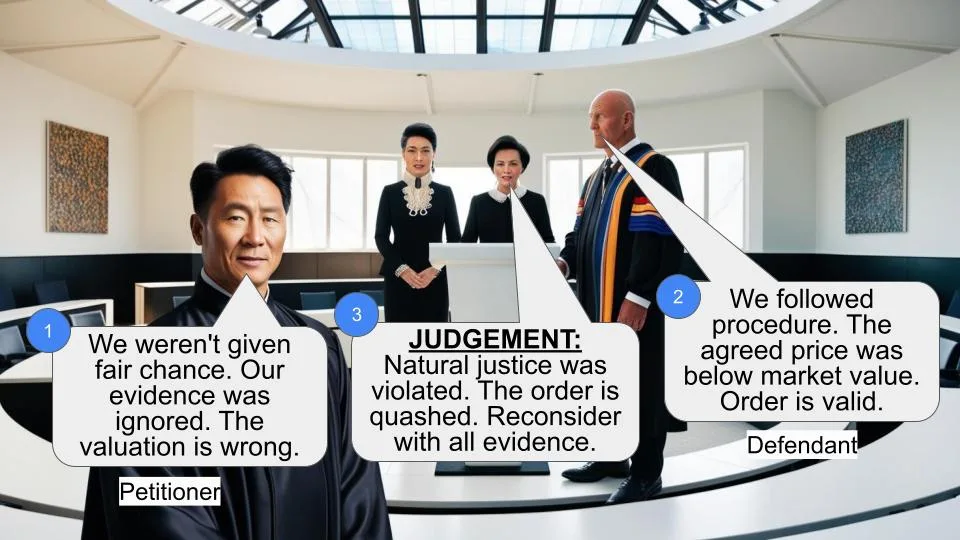
This case involves a dispute between Manubhai Sakarchand Shah & Anr. (petitioners) and S. K. Lal & Ors. (respondents) regarding the valuation and purchase of a flat in Mumbai. The Appropriate Authority had ordered the purchase of the flat by the Central Government, but the court quashed this order due to violations of natural justice principles and non-application of mind.
Get the full picture - access the original judgement of the court order here
Case Name:
Manubhai Sakarchand Shah & Anr. Vs S.K. Lal & Ors. (High Court of Bombay)
Writ Petition No.527 of 1993
Date: 29th October 2007
Key Takeaways:
1. Valuation reports and sale instances must be shared with the assessee when requested.
2. Authorities must consider all evidence, including those provided by the assessee.
3. Fair market value determination requires a thorough analysis of all relevant sale instances.
4. Orders resulting in civil consequences require fair opportunity for the affected party to present their case.
Issue:
Did the Appropriate Authority's order for the purchase of the petitioners' flat violate principles of natural justice and suffer from non-application of mind?
Facts:
1. The petitioners entered into an agreement to purchase a flat in Enterprise Apartment, Mumbai, for Rs.12,98,000 on September 17, 1986.
2. They filed an application with the Competent Authority under Chapter XX-A and another with the Appropriate Authority under Chapter XX-C.
3. The Appropriate Authority ordered the purchase of the flat by the Central Government on December 12, 1986.
4. After legal challenges, the matter was remanded to the Appropriate Authority, which issued a show cause notice on December 30, 1992.
5. The Appropriate Authority passed the impugned order on February 18, 1993, directing the purchase of the flat for Rs.12,98,000.
Arguments:
Petitioners:
1. The valuation report and sale instances relied upon by the Authority were not shared with them.
2. The sale instances used by the Authority were not comparable to their property.
3. Their own valuation report and sale instances were not properly considered.
4. The fair market value was not correctly determined.
Respondents:
1. The order was valid based on the sale instances relied upon.
2. The consideration agreed by the petitioners was less than the market value.
Key Legal Precedents:
1. C.B. Gautam vs. Union of India:
This case was cited regarding the remand of the matter to the Appropriate Authority.
2. The judgment also refers to provisions under Chapter XX-A and Chapter XX-C of the Income Tax Act, though specific sections are not mentioned in the provided text.
Judgement:
The court quashed the Appropriate Authority's order, ruling in favor of the petitioners. The reasons for this decision were:
1. Failure to provide the valuation report and sale instances to the petitioners violated principles of natural justice.
2. The Authority failed to properly consider the petitioners' objections and sale instances.
3. The fair market value was not properly determined.
4. The order suffered from non-application of mind.
FAQs:
Q1: Why was the Appropriate Authority's order quashed?
A1: The order was quashed due to violations of natural justice principles and non-application of mind in determining the fair market value.
Q2: What should the Appropriate Authority have done differently?
A2: They should have shared the valuation report and sale instances with the petitioners, considered the petitioners' evidence, and thoroughly analyzed all relevant sale instances to determine fair market value.
Q3: What is the significance of this judgment?
A3: It emphasizes the importance of transparency and fair play in property valuation cases, especially when government authorities are involved in purchasing private property.
Q4: Does this judgment mean the petitioners get to keep their flat?
A4: The judgment doesn't explicitly state this, but by quashing the purchase order, it appears the petitioners would retain ownership of the flat.
Q5: What are the broader implications of this case?
A5: This case sets a precedent for how government authorities should handle property valuation cases, emphasizing the need for transparency and thorough consideration of all evidence.

1. The petitioner entered into an agreement for sale of flat No.1 on the 12th Floor of a building known as Enterprise Apartment, Forjett Hill Road, Tardeo with one Pramod S. Shah and A.S. Shah on 17th September, 1986 for aggregate consideration of Rs.12,98,000/-. From the averments it is seen that initially a sum of Rs.25,000/- was paid and before 1st October, 1986 a further sum of Rs.2,25,000/- was also paid to the Transferor. The petitioners filed an application in Form No.37EE with the Competent Authority. The Competent Authority issued notice under Section 269D(1) (of Income Tax Act, 1961) asking the parties to show cause as to why the order of acquisition not be passed. The Competent Authority also issued a notice of initiation of acquisition proceedings. The fair market value was fixed at Rs.1,600/- per sq.ft. The Competent Authority cited two sale instances, one of a flat situated at Gold Coin Building at Tardeo and the other a flat situated in a building known as Wallace Apartment at Sleater Road. The petitioners filed objection and also enclosed a report dated 17th November, 1987 of a registered valuer, pointing out as to how the sale instances cited by the Competent Authority were not comparable. On 31st October, 1988 the Competent Authority passed an order recording satisfaction that it was not a fit case for continuing the proceedings initiated pursuant to the notice under Section 269D(1) (of Income Tax Act, 1961).
2.As the provisions of Chapter XX-C came into force in respect of transfer of property situated at Mumbai on 1st October, 1986 the petitioners also filed an application in Form 37-1 on 14th October, 1986 before the Appropriate Authority. On 12th December, 1986 the Appropriate Authority passed an order under Section 269UD(1) (of Income Tax Act, 1961) directing purchase of the flat for a consideration of Rs.12,90,000/-. It is the case of the petitioners that they were not given an opportunity of being heard nor any reason in support of the order wase made available. The petitioners along with the Transferor filed Writ Petition challenging the validity of the order dated 12th December, 1986 as well as the constitutional validity of Chapter XX-C which petition was numbered as Writ Petition No.3560 of 1993. The petition was admitted and an interim order was granted by this Court. The petition was disposed of on 16th December, 1992 pursuant to the decision of the Supreme Court in C.B. Gautam vs. Union of India. The matter was remanded to the Appropriate Authority to decide the issue afresh.
3.On 30th December, 1992 the Appropriate Authority issued a show cause notice to the petitioners as to why the order of purchase in terms of Section 269UD(1) (of Income Tax Act, 1961) ought not to be made. Along with the show cause notice the copy of the reasons recorded by the Appropriate Authority on 12th December, 1986 in support of the order that was passed was also made available. In the reasons recorded it was stated that the rate at which the petitioners had agreed to purchase the flat at Rs.1000/- per sq.ft. is low having regard to the sale instances. Three sale instances were cited (1) Building known as Windcliffee at Peddar Road, (2) Building known as Ocean Crest at B.D. Road and (3) building known as Vastu at Maulana Gaffar Road, Worli. The petitioners filed a reply to the show cause notice on 8th February, 1993 and made their submissions as to why no order ought to be passed. Apart from the legal objections as to why Chapter XX-C was not applicable they also submitted a report of the registered valuer wherein the valuer had analysed the various comparative sale instances. A fourth sale instance of a flat in the building Enterprise itself was cited and the rates at which those flats have been sold.
The flat in Enterprise was sold in May, 1985. the impugned order under Section 269UD(1) (of Income Tax Act, 1961) came to be passed on 18th February, 1993. The Appropriate Authority directed to purchase the flat by the Central Government for Rs.12,98,000/-. The Authority came to the conclusion that it was Chapter XX-C that would be attracted. Consequently the Competent Authority held that the rate of Rs.1,200/- per sq.ft. at which the petitioners had agreed to purchase the property was very low. In respect of the contention urged on behalf of the petitioners that the valuation report prepared by the Revenue should be made available the same was answered by holding that it was not necessary to furnish detailed valuation report obtained in the petitioners case as well as to give material in so far as the sale instances of comparative cases relied upon by the Appropriate Authority. For the aforesaid reasons the Appropriate Authority rejected the contention and passed the impugned order. That is the subject matter of the present petition.
4.At the hearing of this petition on behalf of the petitioners it is submitted that they are not raising the issue as to the applicability of Chapter XX-C and they proceed on the presumption that Chapter XX-C would be attracted. It is submitted that considering the provisions of Chapter XX-C itself the impugned order must fail for the following reasons:-
.Firstly it is submitted that the show cause notice was issued based on a valuation report prepared by Revenue, when asked for was not made available to the petitioners.
.Secondly, it is submitted that the sale instances relied upon by the Appropriate Authority when asked for ought to have been made available to the petitioners herein.
.The submission in respect of these two points is that the petitioners herein ought to have been given an opportunity to file an effective reply to the show cause notice and the reasons given by the Appropriate Authority. In the absence of the same, it is submitted that the order suffers from violation of principles of natural justice and fair play and consequently the order on this count is liable to be quashed and set aside.
It is next submitted that the Appropriate Authority relied upon the sale instances in respect of the localities which were not comparable vis-a-vis the locality of the flat which was agreed to be purchased by the petitioner. It is also submitted that the sale instance relied upon by the petitioners herein in the same building was rejected as it was not proximate to the agreement for sale.
.It is lastly submitted that the fair market value had not been worked out. The fair market value considering the judgment of the Supreme Court in Gautam’s case had to be worked out, considering that notice can be issued only in the event the sale consideration is 50% of the fair market value.
5.On the other hand on behalf of the Respondents their learned Counsel submits that there is no infirmity with the order passed by the Appropriate Authority. It is submitted that considering the sale instances relied upon it would be apparent that the value was more than the value at which the petitioner had agreed to purchase the flat. At any rate considering the market value the consideration at which the petitioners had agreed to purchased at Rs.1,200/- per sq. would be less. It is, therefore, submitted that even if the valuation report was not made available to the petitioner, the impugned order is not liable to be set aside.
This petition was admitted by this Court in the year 1993 and by an order dated 9th March, 1993 status quo was ordered. Pursuant to that order the petitioners who were put in possession continue to be in possession of the property.
6.In the first instance once the petitioners had asked for the valuation report, it ought not to have been summarily rejected on the ground that the reasons have been disclosed to the petitioners. The valuation report is a valuable document in as much as, it is that report based upon which the show cause notice was issued considering the fair market value. That document would be necessary to enable the petitioners to show cause as to why the report ought not to have been considered. Secondly, the sale instances relied upon by the Appropriate Authority also ought to have been made available, to enable the petitioners to deal with the sale instances to point out that in terms of location, infrastructure and other facilities why those sale instances were not comparative and could be taken into consideration. This is not mere idle formality. Ultimately the impugned order visits the petitioner with civil consequences. In these circumstances a fair opportunity must be made available to the petitioners before an order resulting in civil consequences could have been passed. In our opinion in the absence of making available the valuation report and the sale instances there has been failure to comply with the principles of natural justice and fair play and on this ground alone the impugned order is liable to be set aside.
7.We may also consider as to whether the Appropriate Authority was right in holding that the purchase price between the petitioners and their Transferors was below the fair market value. The Appropriate Authority relied upon three sale instances (1) a Flat in Building known as Windcliffee at Peddar Road, (2) Building known as Ocean Crest at B.D. Road and (3) building known as Vastu at Maulana Gaffar Road, Worli Sea Face. The flat is situated at Forgett Street. The valuation report of the petitioners was also available to the Appropriate Authority. The Appropriate Authority was also given sale instances by the petitioners in the same building. Merely because the last sale instance in the building was of May, 1985 by itself could not have been the reason to reject the sake sale instance. The Competent Authority under Chapter XX-A had accepted those sale instances. In our opinion while considering the fair market value it was incumbent on the Appropriate Authority to have dealt with the objections raised by the petitioners as to why the sale instances relied upon by the petitioners were not comparable. In the absence of such exercise vis-a-vis the sale instances cited by the petitioners and the valuation report it would not be possible to arrive at a fair market value. In the instant case the fair market value has not been determined. Reliance is also placed on the comparative sale instances.
In our opinion the order also suffers from vice of non-application of mind. On that count also the impugned order is liable to be set aside.
9.For the aforesaid reasons we are clearly of the opinion that the petition must succeed. In the light of that Rule made absolute in terms of prayer clause (a). In the circumstances of the case there shall be no order as to costs.
(J.P. DEVADHAR, J.) (F.I. REBELLO, J)
×
Questions
Court Quashes Purchase Order: Natural Justice Violated in Property Valuation Case
Write your CommentSimilar Posts

Generic
- Reportdata/5221.pdf
