Court Quashes Reassessment Notice, Citing Lack of Independent Opinion by Tax Of…



Full News
Court Quashes Reassessment Notice, Citing Lack of Independent Opinion by Tax Officer
Court Quashes Reassessment Notice, Citing Lack of Independent Opinion by Tax Officer
This case involves Harikishan Sunderlal Virmani (the petitioner) challenging a reassessment notice issued by the Income Tax Department for the Assessment Year 2009-2010. The High Court ruled in favor of the petitioner, quashing the reassessment proceedings due to lack of proper jurisdiction and independent opinion formation by the Assessing Officer.
Get the full picture - access the original judgement of the court order here
Case Name:
Harikishan Sunderlal Virmani Vs Deputy Commissioner of Income Tax (High Court of Gujarat)
Special Civil Application No. 16204 of 2016
Date: 20th December 2016
Key Takeaways:
1. Reassessment beyond four years requires proof of failure to disclose material facts by the assessee.
2. Assessing Officers must form an independent opinion before initiating reassessment proceedings.
3. Relying solely on information from external sources without independent verification is not sufficient for reassessment.
4. The court emphasized the importance of following proper procedures in tax reassessment cases.
Issue:
Was the Income Tax Department's decision to reopen the assessment for A.Y. 2009-2010 beyond the four-year period legally valid and justified?
Facts:
1. The petitioner filed an income tax return for A.Y. 2009-2010 on 30/9/2010, declaring a total income of Rs.2,09,39,600/-, later revised to Rs.2,23,30,910/- .
2. The return was selected for scrutiny, and an assessment order was passed under section 143(3) (of Income Tax Act, 1961) on 30/11/2010 .
3. On 31/3/2016, the Assessing Officer issued a notice under section 148 (of Income Tax Act, 1961) to reopen the assessment, alleging that income had escaped assessment .
4. The reopening was based on information received from the Principal Director of Income Tax (Investigation), Ahmedabad, regarding possible irregularities in share trading transactions .
Arguments:
Petitioner's arguments:
1. The reopening notice was bad in law and without jurisdiction .
2. The reasons for reopening were ambiguous and vague .
3. The reopening was based solely on information from the investigation wing without independent verification .
Revenue's arguments:
1. The reopening was based on specific information received from the Principal Director of Income Tax (Investigation).
2. Proper procedures were followed, including obtaining approval from the competent authority.
Key Legal Precedents:
The court relied on the decision of the Division Bench of the Gujarat High Court in the case of Varshaben Sanatbhai Patel Versus Income Tax Officer, reported in (2015) 64 Taxmann.com 179 (Gujarat).
Judgement:
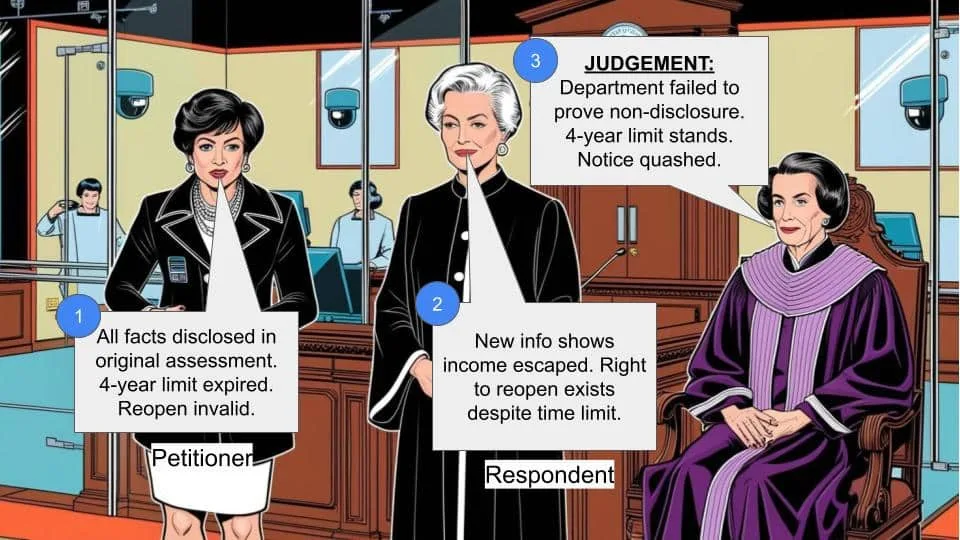
1. The court ruled in favor of the petitioner, quashing the reassessment notice and proceedings.
2. The court found that the Assessing Officer did not form an independent opinion based on the material on record.
3. The reasons recorded for reopening did not allege any failure on the part of the assessee to disclose material facts.
4. The court held that reopening beyond four years without establishing failure to disclose material facts is contrary to the provisions of section 147 (of Income Tax Act, 1961).
FAQs:
1. Q: Why was the reassessment notice quashed?
A: The notice was quashed because the Assessing Officer failed to form an independent opinion and relied solely on information from external sources without proper verification.
2. Q: What is the significance of the four-year period in this case?
A: Reassessment beyond four years requires proof that the assessee failed to disclose material facts fully and truly, which was not established in this case.
3. Q: Can tax authorities reopen assessments based on information from other departments?
A: While they can use such information, they must independently verify and form their own opinion before initiating reassessment proceedings.
4. Q: What is the Lavenshtein Distance Analysis mentioned in the case?
A: It's a method used to analyze the genuineness of client code modifications in share trading transactions. However, the court found its application insufficient for reopening the assessment.
5. Q: What lesson can tax authorities learn from this judgment?
A: Tax authorities should ensure they form an independent opinion based on available materials and not rely solely on information from external sources when initiating reassessment proceedings.

1.00. By way of this petition under Article 226 of the Constitution of India, the petitioner has prayed for appropriate writ, order and/or direction to quash and set aside the impugned notice issued by the respondent, issued under section 148 (of Income Tax Act, 1961) (hereinafter referred to as “the Act” for short), by which the assessment for the A.Y. 2009-2010 is sought to be reopened in exercise of the powers under section 147 (of Income Tax Act, 1961).
2.00. That the petitioner assessee filed its return of income for the Assessment year 2009-2010 on 30/9/2010 declaring total income at Rs.2,09,39,600/- which was subsequently revised to Rs.2,23,30,910/-. Thereafter, the return was selected for scrutiny and notice under section 143(2) (of Income Tax Act, 1961) was issued. Further notice under section 142(1) (of Income Tax Act, 1961) along with the questionnaire was also issued to the petitioner - assessee.
2.01. It is the case on behalf of the petitioner that during the course of the assessment proceedings, all relevant papers as well as computation of income was duly provided by the petitioner to the A.O. That thereafter the A.O. passed the assessment order under section 143(3) (of Income Tax Act, 1961) on 30/11/2010. That thereafter, the petitioner - assessee has been served with the impugned notice under section 148 (of Income Tax Act, 1961) dated 31/3/2016 by which the A.O. has sought to reopen the assessment for the A.Y. 2009-2010 alleging inter- alia that the income chargeable to tax for the A.Y. 2009-2010 has escaped assessment within the meaning of section 147 (of Income Tax Act, 1961).
2.02. That vide communication dated 11/7/2016 the assessee requested to provide copy of the reasons recorded prior to issuance of the impugned notice. That the respondent supplied copy of the reasons recorded by letter dated 13/7/2016. On receipt of the reasons recorded for reassessment, the assessee vide letter dated 26/7/2016 raised various objections on merits and requested the respondent to drop the reassessment proceedings.
2.03. That vide order dated 16/8/2016, the respondent disposed of the objections by observing that the objections raised by the petitioner - assessee are found to be not acceptable and rejected the same in totality. Hence, the petitioner has preferred the present petition under Article 226 of the Constitution of India challenging the impugned notice under section 148 (of Income Tax Act, 1961) as well as the impugned reassessment proceedings.
3.00. Mr.Soparkar, learned advocate appearing on behalf of the petitioner has vehemently submitted that the impugned notice under section 148 (of Income Tax Act, 1961) and reopening of the assessment for the A.Y. 2009-2010 is bad in law and without jurisdiction.
3.01. Mr.Soparkar, learned advocate appearing on behalf of the petitioner has further submitted that even the reasons of reopening are ambiguous and vague inasmuch as it does not reveal any income escaped much less due to any failure on the part of the petitioner truly and fully disclose all material facts. It is submitted that the respondent has adopted Lavenshtein Distance Analysis or digit edit analysis utility, both of which are foreign to the Income Tax Act, 1961, to suggest that the distance of variation in case of the petitioner as per Lavenshtein Distance Analysis comes at 3 and in the opinion of the respondent if the distance is 1 then the mistake is genuine but if the same is 4 or 5 then it cannot be a genuine mistake but a deliberate change. It is submitted that therefore, even as per the opinion of the respondent himself, the case of the petitioner where distance is 3, does not fall within the distance of 4 and 5 and yet the respondent seeks to reopen the completed assessment.
3.02. Mr.Soparkar, learned advocate appearing on behalf of the petitioner has further submitted that the respondent has merely adopted some statistical measure to hold that the modification by the broker is beyond the permissible measure without there being any failure on the part of the petitioner to truly and fully disclose any material facts.
3.03. Mr.Soparkar, learned advocate appearing on behalf of the petitioner has further submitted that the impugned reopening is only to carry out verification based on the information received from the investigation wing. It is submitted that the respondent has no reason to believe that the income has escaped assessment. It is submitted that as per the catena of decisions of the Hon'ble Supreme Court and this Court, merely to carry out verification by making fishy and roving inquiry, reassessment proceedings are not permissible.
3.04. Mr.Soparkar, learned advocate appearing on behalf of the petitioner has further submitted that there is no independent forming of the opinion by the A.O. and/or any reason to believe by the A.O. that any income has escaped assessment. It is submitted that solely on the basis of information received by the investigation wing, impugned reassessment proceedings have been initiated. It is submitted that therefore, the impugned reassessment proceedings can be said to be on borrowed satisfaction of the investigation wing, which is not permissible.
3.05. In support of his above submission, Mr.Soparkar, learned advocate appearing on behalf of the petitioner has heavily relied upon the decision of the Division Bench of this Court in the case of Varshaben Sanatbhai Patel Versus Income Tax Officer, reported in (2015) 64 Taxmann.com 179 (Gujarat).
Making above submissions and relying upon above decision, it is requested to allow the present petition and quash and set aside the impugned reassessment proceedings.
4.00. Mr.Sudhir Mehta, learned advocate appearing on behalf of the revenue has opposed the present petition. It is vehemently submitted by Mr.Mehta, learned advocate appearing on behalf of the revenue that the A.O. received information from the Principal Director of Income Tax (Investigation), Ahmedabad vide confidential letter dated 8/3/2016, wherein it was informed that the assessee carried out share trading through broker, Guinness Securities Limited and the client code of the assessee with the aforesaid broker was WW/2647. It is submitted that to examine the genuineness of the modification of the client’s code in case of the assessee, by applying Lavenshtein Distance Analysis or digit edit analysis utility, in those cases where the assessee is original client and the transactions were carried out from the assessee’s client code, then subsequently client code was modified to other client and the total and the total reduction in income due to CCM was to the tune of Rs.1,19,848/-. It is submitted that after receiving specific information and forming satisfaction for reopening of the case, and after getting approval from the competent authority, notice under section 148 (of Income Tax Act, 1961) has been issued. It is submitted that therefore, reopening of the case has been made after following procedure as required under the Income Tax Act. It is submitted that therefore, the impugned reopening proceedings are in consonance with the provision of section 148 (of Income Tax Act, 1961) read with section 148 (of Income Tax Act, 1961). Therefore, it is requested to dismiss the present petition.
5.00. Heard the learned advocates appearing on behalf of the respective parties at length.
5.01. At the outset, it is required to be noted that the impugned notice under section 148 (of Income Tax Act, 1961) to reopen the assessment in exercise of the power under section 147 (of Income Tax Act, 1961), has been issued beyond the period of four years. Therefore, considering the proviso to section 147 (of Income Tax Act, 1961), unless and until it is found that there was a failure on the part of the assessee in not disclosing truly and fully relevant material for assessment, reopening beyond four years is not permissible. It also cannot be disputed that even to reopen the proceedings, there must be satisfaction of the A.O. and the A.O. himself, on the basis of the material before him is required to form an opinion that the income has escaped assessment due to failure on the part of the assessee in not disclosing truly and fully material necessary for the assessment.
5.02. The reasons recorded to reopen the assessment are as under :-
“2. Reasons for reopening of the assessment – A.Y. 2009 reg.
Assessee had e-filed his return of income for the Asstt. Year 2009-2010 on 30.09.2010 declaring therein total income of Rs.2,09,39,600/-. Subsequently, the case was selected in CASS within the meaning of section 143(3) (of Income Tax Act, 1961). Assessment proceedings was completed u/s. 143(3) (of Income Tax Act, 1961) on 30/11/2010 determining the assessed income at Rs.2,09,60,910/-.
2. Thereafter, information has been received from the Principal Director of Income Tax (Investigation), Ahmedabad vide confidential letter No.PDIT (Inv)/AHD/CCM/Dissemination/15-16 dated 08.03.2016. On perusal fo the data supplied by the office of the Pr. Director of Income Tax (Investigation), Ahmedabad it is noticed that assessee carried out share trading through the broker, Guiness securities Limited. And as per the guidelines of the SEBI the client code of the assessee with the aforesaid broker was WW/2647. In order to verify the genuineness of the modification of client code in the case of the assessee, by applying Lavenshtein Distance Analysis or digit edit analysis utility, in those cases where the assessee is original client and transactions were carried out from assessee’s client code then subsequently client code was modified to other client the details of such case are as under :-
OC OCC MC MCC Distance as per Lavenshtein Distance Analysis.
Net reduction in income due to CCM
Harikishan Sunderlal Virmani
WW/2647 Binay R. Chaturvedi
WW/2108 3 Rs.1,19,848/-
In order to verify the genuineness of the error, the Lavenshtein Distance analysis or digit edit analysis utility is also provided by the investigation Wing. This utility gives a clear indication as to whether the code is wrongly typed or is completely replaced. If the number of digits changed from original code to modified code is 1, then it can be reasonably argued that the OCC (Original Client Code) may have been typed wrongly by mistake. Similarly, if the number of digits changed is more say 4 or 5,it cannot be genuine mistake buyt a deliberate change. To this extent, Levenshtein Distance Analysis or digit edit analysis act as a clear indicator for genuineness in client code modification. In short, the longer the distance (i.e. number of digits changed), the lesser the chance of genuineness.
3. Hence, the editing of client code above it is termed as deliberate change and establishes the non-genuineness and contrived nature of the code change.
4. In view of the above facts, I have reason to believe that the income to the extent of Rs.1,19,848/- has escaped assessment, which required to brought under tax. Therefore, this case is a fit case for initiating the proceeding u/s. 147 (of Income Tax Act, 1961).”
5.03. Thus from the reasons recorded, the reopening of the assessment is on the information / data supplied by the office of the Principal Director of Income Tax (Investigation), Ahmedabad and the information received from the Principal Director of Income Tax (Investigation), Ahmedabad vide his confidential letter dated 8/3/2016. From the information received, it appears that though the client code of the assessee with the broker - Guinness Securities Limited was WW/2647, modified client code was found to be WW/2108 and therefore, to verify the genuineness of the modification of the client code, by applying Lavenshtein Distance Analysis or digit edit analysis utility, distance was found to be 3 and therefore, it is believed that the code is not wrongly typed and it is termed as deliberate change and establishing non- genuineness and contrived nature of the code change. From the reasons recorded, it does not appear that verification of the material on record there is independent formation of opinion by the A.O. and that any income has escaped assessment due to any failure on the part of the assessee in not disclosing truly and correct facts / material necessary for assessment. From the reasons recorded, it appears that the impugned reopening proceedings are on the borrowed satisfaction. No independent opinion is formed. On the plain reading of the reasons recorded what emerges is that the A.O. on considering the information received from the Principal Director of Income Tax (Investigation), Ahmedabad, reassessment proceedings have been initiated on the ground that the income escaped assessment. However, there is no assertion regarding the basis on which material on record, he has come to such conclusion. Therefore, the material on the basis of which the A.O. seeks to assume the jurisdiction under section 147 (of Income Tax Act, 1961) if the Act is the information received from the external source viz. the Principal Director of Income Tax (Investigation), Ahmedabad. It cannot be disputed that on the basis of the information received from another agency, there cannot be any reassessment proceedings. However, after considering the information / material received from other source, A.O. is required to consider the material on record in case of the assessee and thereafter is required to form an independent opinion on the basis of the material on record that the income has escaped assessment. Without forming such an opinion, solely and mechanically relying upon the information received from other source, there cannot be any reassessment for the verification.
5.04. At this stage it is required to be noted that even in the reasons recorded, there is no allegation that there was any failure on the part of the assessee in not disclosing truly and fully material facts necessary for assessment. Under the circumstances, the assumption of the jurisdiction to reopen the assessment beyond the period of four years in exercise of powers under section 147 (of Income Tax Act, 1961) is bad in law and contrary to the provisions of section 147 (of Income Tax Act, 1961). Under the circumstances, on the aforesaid ground alone, the impugned reassessment proceedings deserve to be quashed and set aside.
5.05. In view of the above and for the reasons stated above, present petition succeeds. The impugned notice issued under section 148 (of Income Tax Act, 1961) and reopening of the proceedings for A.Y. 2009-2010 cannot sustain and the same deserves to be quashed and set aside and are hereby quashed and set aside. Rule is made absolute accordingly. In the facts and circumstances of the case, there shall be no order as to costs.
Sd/-
(M.R. SHAH, J.)
Sd/-
(B.N. KARIA, J.)
×