


Court Quashes Reassessment Notice Issued Beyond 4-Year Limit, Upholds Taxpayer'…


Full News

Court Quashes Reassessment Notice Issued Beyond 4-Year Limit, Upholds Taxpayer's Deduction Claim
Court Quashes Reassessment Notice Issued Beyond 4-Year Limit, Upholds Taxpayer's Deduction Claim
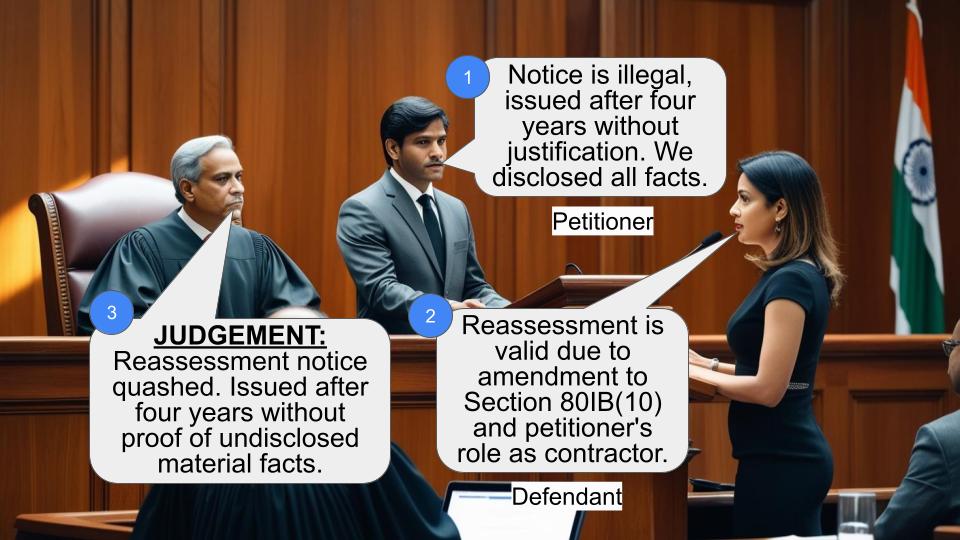
In this case, Jalaram Developers challenged a notice issued by the Income Tax Officer to reopen their assessment for the 2003-04 tax year. The High Court ruled in favor of Jalaram Developers, quashing the reassessment notice as it was issued beyond the four-year limitation period and lacked sufficient grounds for reopening.
Get the full picture - access the original judgement of the court order here
Case Name:
Jalaram Developers vs Income Tax Officer and Another (High Court of Gujarat)
Special Civil Application No. 1517 of 2010
Date: 9th June 2016
Key Takeaways
1. Reassessment notices issued beyond the four-year limitation period are invalid unless specific conditions are met.
2. Tax authorities must provide clear reasons for reopening assessments, especially when challenging previously allowed deductions.
3. The court emphasized the importance of adhering to statutory time limits in tax proceedings.
Issue
Can the Income Tax Department issue a notice under section 148 (of Income Tax Act, 1961) to reopen an assessment beyond the four-year limitation period when no new material facts have come to light?
Facts
1. Jalaram Developers filed their income tax return for the assessment year 2003-04 on 27.10.2003, declaring nil income after claiming a deduction under section 80IB (of Income Tax Act, 1961).
2. The Income Tax Department conducted a scrutiny assessment under section 143(3) (of Income Tax Act, 1961) and issued an order on 18.1.2005, accepting the nil income declaration.
3. On 10.8.2009, more than four years after the end of the assessment year, the Income Tax Officer issued a notice under section 148 (of Income Tax Act, 1961) to reopen the assessment.
4. The tax officer's reasons for reopening included suspicions about abnormally high profits compared to other builders and possible diversion of undisclosed income.
Arguments
Petitioner (Jalaram Developers):
1. The notice was issued beyond the four-year limitation period specified in section 149 (of Income Tax Act, 1961).
2. The original assessment had already considered and allowed the deduction under section 80IB(10) (of Income Tax Act, 1961).
3. No new reasons were provided to justify why the earlier assessment was incorrect.
Respondent (Income Tax Department):
1. The reopening was based on material collected by the Assessing Officer.
2. The abnormally high profits declared by the assessee warranted further investigation.
3. The reopening was in accordance with the provisions of the Income Tax Act.
Key Legal Precedents
While no specific case laws were cited in the judgment, the court relied heavily on the interpretation of sections 147, 148, and 149 of the Income Tax Act, 1961. These sections deal with the power to reopen assessments and the time limits for issuing such notices.
Judgment
1. The High Court ruled in favor of Jalaram Developers, quashing the reassessment notice dated 10.8.2009 and the preliminary order dated 30.11.2010.
2. The court held that the notice was issued beyond the four-year limitation period specified in section 149 (of Income Tax Act, 1961).
3. The court also noted that the tax department failed to provide sufficient reasons to claim that the earlier Assessing Officer had wrongly allowed the deduction.
FAQs
1. Q: What was the main reason for the court's decision?
A: The main reason was that the reassessment notice was issued beyond the four-year limitation period specified in section 149 (of Income Tax Act, 1961).
2. Q: Can the tax department never reopen assessments after four years?
A: While the general rule is four years, there are exceptions. The department can reopen assessments beyond four years in cases of income escaping assessment due to failure to disclose material facts or in cases of fraud.
3. Q: What impact does this judgment have on taxpayers?
A: This judgment reinforces the importance of statutory time limits and provides protection to taxpayers against arbitrary reopening of assessments after a considerable time has passed.
4. Q: Did the court comment on the merits of the deduction claimed by Jalaram Developers?
A: No, the court didn't delve into the merits of the deduction. It focused on the procedural aspect of issuing the reassessment notice beyond the time limit.
5. Q: What should taxpayers do if they receive a reassessment notice beyond the four-year period?
A: Taxpayers should carefully examine the notice, check the applicable time limits, and consider seeking professional legal advice to determine the validity of the notice.

1. By way of the present petition, the petitioner has challenged the notice dated 10.8.2009 issued by the respondents at Annexure-D to the petition whereby the respondents seek to reopen the assessment for assessment year 2003-04 for the reasons which are recorded as under:
“The return of income was filed on 30.9.2004 declaring total income at Rs. Nil after claiming deduction under section 80IB (of Income Tax Act, 1961) of Rs.19,78,578/-. The assessment was finalized under section 143(3) (of Income Tax Act, 1961) at income as returned.
The assessee firm is engaged in development and construction. It is noticed that profits shown by the assessee in comparison to other builders (who are involved in the construction of similar housing projects but not availing the benefit of deduction under section 80IB (of Income Tax Act, 1961)) is very high. The abnormal rate of profit declared by the assessee appears to be influenced by the 100% deduction available under section 80IB (of Income Tax Act, 1961). Further, the declaration of income in excess of the actual earnings from construction business also indicates to the possibility of diversion of income from undisclosed sources being brought into the books of accounts without payment of due taxes on such income. In view of these facts, I have reason to believe that income chargeable to tax has escaped assessment.
Therefore, in order to assess/re-assess the income of the firm, notice under section 148 (of Income Tax Act, 1961) is hereby issued for A.Y. 2004-05. The notice is being issued after obtaining the satisfaction/permission of the Addl. CIT, Vapi Range, Vapi.”
2. The learned counsel for the petitioner submits that the petitioner filed its return of income along with relevant documents on 27.10.2003. After issuing notice under section 143(2) of the Income Tax Act, 1961, scrutiny assessment was framed under section 143(3) (of Income Tax Act, 1961) vide order dated 18.1.2005 determining total income at Nil after allowing the claim of deduction under section 80 (of Income Tax Act, 1961) IB of the Act. Now the respondent seeks to reopen the assessment by issuing notice under section 148 (of Income Tax Act, 1961) read with section 147 of the Income Tax Act, 1961.
3. The learned counsel for the petitioner has contended that the notice issued under section 148 of the Income Tax Act, 1961 for reopening of the assessment by the respondent is bad in law for the reasons that reopening exercise undertaken by the authority is beyond the period of four years from the date of assessment. For assessment year 2003-04, the period will be over by 31.3.2008 and the notice issued under section 148 of the Income Tax Act, 1961 after 31.3.2008 is bad in law. Even otherwise, the Assessing Officer has considered the claim under section 80IB(10) (of Income Tax Act, 1961) and recorded his satisfaction that since all the conditions laid down in the provisions of section 80IB(10) (of Income Tax Act, 1961) have been fulfilled by the assessee, it is eligible for the deduction under section 80IB (of Income Tax Act, 1961) at 100% of profit shown during the year i.e. Rs. 59,26,427/-. No reasons are assigned that the claim which has been allowed by the earlier Assessing Officer is bad in law. The learned counsel for the petitioner has, therefore, contended that the notice under section 148 (of Income Tax Act, 1961) issued by the authority is bad in law.
4. Learned counsel for the respondents Mr. Mehta has supported the case of the department and contended that the exercise of reopening the assessment under section 148 (of Income Tax Act, 1961) is in accordance with the provisions of the I.T. Act. The Assessing Officer has recorded reasons for reopening of the assessment. The Assessing Officer has supplied to the assessee the reasons for reopening the assessment on the basis of material collected by him. He has stated that the profits shown by the assessee in comparison to other builders is very high and the abnormal rate of profit declared by the assessee appears to be influenced by 100% deduction available under section 80IB (of Income Tax Act, 1961). In that view of the matter, the learned counsel for the respondent has contended that no interference is called for with the issuance of notice under section 148 (of Income Tax Act, 1961) for reopening of the assessment.
5. Learned counsel for the petitioner has taken us through the rejoinder affidavit and pointed out the fact that for assessment years 2002-03, 2005-06 and 2008-09 no reopening was done by the respondents even though identical claims were made. Therefore, the notice issued by the respondent authorities for reopening of the assessment for the year under consideration is bad in law and requires to be set aside.
6. We have heard learned counsel Mr. Patel for the petitioner and learned counsel Mr. Mehta for the respondent authorities. We have gone through the reasons recorded at page No. 36 of the petition. We have also gone through the assessment order at page 29 where the Assessing Officer has recorded that “since all the conditions laid down in the provisions of section 80IB(10) of the Income Tax Act, 1961 have been fulfilled by the assessee, it is eligible for the deduction under section 80IB (of Income Tax Act, 1961) at 100% of profit shown during the year i.e. Rs. 59,26,427/-.” The Assessing Officer has issued the notice under section 148 (of Income Tax Act, 1961) on 10.8.2009. Section 149 (of Income Tax Act, 1961) reads as under:
“sec. 149(1) (of Income Tax Act, 1961) – No notice under section 148 (of Income Tax Act, 1961) shall be issued for the relevant assessment year -
(a) if four years have elapsed from the end of the relevant assessment year, unless the case falls under clause (b) or clause (c)”
7. As per the said section, for reopening of the assessment, notice should be issued within a period of four years from the end of the assessment. In the present case, we notice that the Assessing Officer has issued notice under section 148 (of Income Tax Act, 1961) on 10.8.2009 which is beyond the period of four years from the end of the assessment year. Even otherwise, no reasons are assigned by the respondent authority to claim that the earlier Assessing Officer has wrongly allowed the claim of the assessee. In that view of the matter, the petition deserves to be allowed and is allowed accordingly. Notice issued under section 148 of the Income Tax Act, 1961 dated 10.8.2009 and the preliminary order dated 30.11.2010 for proceeding and completing the reassessment proceedings are hereby quashed and set aside. Rule is made absolute with no order as to costs.
(K.S.JHAVERI, J.)
(G.R.UDHWANI, J.)
×
Questions
Court Quashes Reassessment Notice Issued Beyond 4-Year Limit, Upholds Taxpayer's Deduction Claim
Write your CommentSimilar Posts


Generic
- Reportdata/2785.pdf
