


"Court Quashes Tax Commissioner's Order for Failure to Examine Records"


Full News
"Court Quashes Tax Commissioner's Order for Failure to Examine Records"
"Court Quashes Tax Commissioner's Order for Failure to Examine Records"
The High Court dismissed an appeal by the Commissioner of Income Tax against an Income Tax Appellate Tribunal order. The Tribunal had set aside the Commissioner's order under Section 263 (of Income Tax Act, 1961), citing non-application of mind. The court upheld the Tribunal's decision, agreeing that the Commissioner failed to examine records before issuing notice and passing orders.
Get the full picture - access the original judgement of the court order here.
Case Name:
Commissioner of Income Tax Vs Sahara India Mutual Benefit Col Ltd (High Court of Allahabad)
Income Tax Appeal Defective No.112 of 2000
Key Takeaways:
1. Commissioners must examine records before issuing notices under Section 263 (of Income Tax Act, 1961).
2. Failure to comply with Section 263 (of Income Tax Act, 1961) conditions renders both notice and order invalid.
3. The doctrine of merger applies when an issue has been decided in a previous appellate order.
Issue:
Was the Income Tax Appellate Tribunal justified in quashing the Commissioner's order under Section 263 (of Income Tax Act, 1961) on grounds of non-application of mind?
Facts:
- The case pertains to the assessment year 1994-1995.
- An assessment was made under Section 144 (of Income Tax Act, 1961) on 27.3.1997.
- The assessing officer allowed provisions of interest at 12% for two schemes (GFDA and GGF).
- The assessee appealed, and some claims were allowed on 1.1.1999.
- On 22.2.1999, the Commissioner issued a notice under Section 263 (of Income Tax Act, 1961).
- The Commissioner set aside the assessment order on 22.3.1999.
- The assessee appealed to the Income Tax Tribunal, which quashed the Commissioner's order.
Arguments:
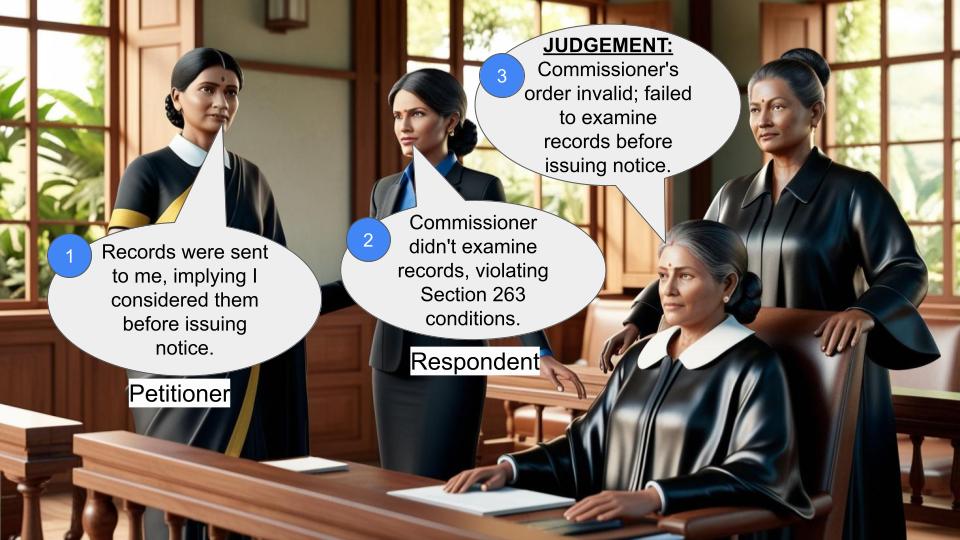
- The department argued that records were sent to the Commissioner, implying they were considered.
- The assessee contended that the Commissioner failed to examine records before issuing the notice.
Key Legal Precedents:
1. Commissioner of Income Tax Vs. Bhagat Shyam and Company {[1991] 188 ITR 608 (All)}
2. Commissioner of Income Tax Vs. Kashi Nath & Company {[1988] 170 ITR 28 (All)}
Judgement:
The High Court dismissed the appeal, upholding the Tribunal's decision. It ruled that:
1. The Commissioner failed to examine records before issuing notice under Section 263 (of Income Tax Act, 1961).
2. Failure to comply with Section 263 (of Income Tax Act, 1961) conditions renders both notice and order invalid.
3. The doctrine of merger applied as the interest issue was decided in a previous appellate order.
FAQs:
Q1: What is Section 263 (of Income Tax Act, 1961)?
A1: It gives the Commissioner power to revise orders prejudicial to the interests of revenue.
Q2: Why was the Commissioner's order quashed?
A2: Because the Commissioner failed to examine records before issuing notice and passing orders.
Q3: What is the doctrine of merger in this context?
A3: It means that when an issue has been decided in a previous appellate order, it becomes final for that assessment year.
Q4: What are the key requirements for a valid order under Section 263 (of Income Tax Act, 1961)?
A4: The Commissioner must examine records, give the assessee an opportunity for hearing, and then pass the order.
Q5: Can the Commissioner issue a Section 263 (of Income Tax Act, 1961) notice without examining records?
A5: No, examination of records is a mandatory prerequisite for issuing a Section 263 (of Income Tax Act, 1961) notice.

Heard learned counsel for the department, Sri Praveen Kumar and Sri S.D. Singh, Senior counsel assisted by Ms. Archi Agrawal, learned counsel for the assessee.
This appeal under section 260A (of Income Tax Act, 1961) has been filed against an order passed by the tribunal on 23.5.2000 in Income Tax Appeal No. 509 of 1999 for the assessment year 1994-1995.
By way of this appeal, the appellant seeks dismissal of the order dated 23.5.2000 passed by the Income Tax Tribunal by which the tribunal has set aside the order of the Commissioner of Income Tax dated 22.3.1999 on the grounds of non-application of mind while exercising his powers under Section 263 (of Income Tax Act, 1961) (in short 'the Act'). The questions of law sought to be answered are as hereunder:-
"1.) Whether on the facts and in the circumstances of the case the Hon'ble Income Tax Appellate Tribunal was justified in law in quashing the order under Section 263 (of Income Tax Act, 1961) dated 22.2.1999 on the grounds of non application of the mind?
2.) Whether on the facts and in the circumstances of the case the Hon'ble Income Tax Appellate Tribunal was justified in law in holding that the Commissioner of Income Tax could not have exercised his powers under section 263 (of Income Tax Act, 1961) as the Commissioner of Income Tax (Appeals) had decided that issue, although, the issue of interest set aside by the Commissioner of Income Tax (Appeals) was quite different from the issue of adhoc/interest considered by the Commissioner of Income Tax under Section 263 (of Income Tax Act, 1961)?"
Briefly stated facts of the case are that an assessment was made under Section 144 (of Income Tax Act, 1961) and completed by the assessing officer in the case of the assessee on 27.3.1997. The assessing officer had allowed provisions of the interest payable at the rate of 12% in respect to the Golden fixed Deposit Account Scheme (GFDA) and Golden Growth Fund Scheme (GGF).
Aggrieved the assessee filed an appeal which was decided on 1.1.1999 by which some of the claims were made by the assessee, were allowed while certain were disallowed taking the interest rate of two schemes as aforesaid to be at 12%. On 22.2.1999, the Commissioner of Income Tax issued a notice under Section 263 (of Income Tax Act, 1961) to the assessee which reads as hereunder:-
"It is ascertained that you have provided interest on historical average basis periodically on the current deposits as well as old balance of deposits without actually crediting the corresponding interest to the individual account of the depositors. You have also claimed interest on the defaulted and lapsed accounts and on the unclaimed matured accounts, on which interest is not payable after the date of default maturity. Thus, the liability claimed by you towards interest payable on such deposits was contingent and unascertained and therefore not allowable under the provisions of the Income Tax Act, 1961. The assessment order passed under Section 144 (of Income Tax Act, 1961) in the assessment year 1994-1995 by the ACIT, Central Circle-I, Lucknow is, therefore, erroneous and prejudicial to the interest of revenue.
I, therefore, propose to invoke provisions of section 263 (of Income Tax Act, 1961) and issue suitable directions to the assessing officers to allow only that amount of interest for which the lability if ascertained and determinate instead of the total claim made by you and so allowed.
An opportunity is, therefore, allowed to you to offer your comment.... Attend my office on 9.3.1999 or sent your written submissions...."
In response to the said notice, the authorized representatives of the assessee attended on 15.3.1999 and filed written submissions and the matter was heard.
The Commissioner of Income Tax (Central) held that the assessing officer did not investigate the issues relating to claim of interest at the rate of 12% in respect of the above mentioned two schemes and allowed the same without proper enquiry. He, accordingly, vide his order under Section 263 (of Income Tax Act, 1961) dated 22.3.1999 set aside the assessment order dated 27.3.1997 with a direction to the assessing officer to investigate the issue of allowability the interest at the rate of 12% on the above mentioned two schemes and to decide the issue afresh after providing a reasonable opportunity of being heard to the assessee.
The assessee being aggrieved by this order approached the Income Tax Tribunal which has quashed the order under Section 263 (of Income Tax Act, 1961) by holding that the Commissioner of Income Tax has not examined the assessment records before coming to the satisfaction for issuing a notice under Section 263 (of Income Tax Act, 1961).
In so far as the first question referred to above is concerned, learned counsel for the revenue has sought to argue that the order passed under Section 263 (of Income Tax Act, 1961) by the Commissioner was justified on the grounds that the record had been sent by the department to the authority and, therefore, it may be presumed that the same was considered. However, this very argument was made before the tribunal also and the tribunal records in Para 6.3 and 6.4 which are hereunder:-
"6.3 If the revenue's stand till 16th December, 1999 on the one hand and the stand taken as per letter dated 15th December, 1999 furnished on 16th December, 1999 and the Photo Copy of a loose sheet claiming the same to be an acknowledgement for return of assessee's assessment records for assessment year 1994-1995 by the Commissioner on 17.3.1999, on the other hand, is considered, then every prudent man will come to one and the only conclusion that there was something wrong in the stand taken by the revenue i.e., Either the stand taken prior to 16th December, 1999 was correct or the stand taken thereafter was correct and to decide the issue, we have once again to consider the nature of the proceedings and the documents maintained for such proceedings.
6.4 It is well known and settled principle of law that the proceedings under Section 263 (of Income Tax Act, 1961) before the Commissioner are quasi judicial and as per the law every authority, while conducting quasi judicial proceeding, has to maintain a proper and complete record of the proceedings. If such record is not maintained, then it smacks of something wrong with the working of such an authority. The proceedings relating to the quasi-judicial functions are not one's private affairs-such as going to the market and not keeping the record of enquiries or bargains carried out with the shopkeepers. Non- keeping of such records clearly leads to presume that the authority concerned has either not carried on such functions or has proceeded without having met with the mandatory pre- requisite conditions."
Thus, the tribunal categorically records the finding that in fact no record was examined by the Commissioner prior to the issuance of the notice under Section 263 (of Income Tax Act, 1961) before 22.2.1999. As said earlier, learned counsel for the department has sought to argue that the record was sent but the tribunal is unable to take a clear stand whether the record which was sent at a later date was ever considered or not. No part of the record of the case reflects that the record was indeed examined by the Commissioner before the issuance of the notice under Section 263 (of Income Tax Act, 1961) or even before the passing of the order under Section 263 (of Income Tax Act, 1961). It is well settled that in order to maintain an order under Section 263 (of Income Tax Act, 1961), the Commissioner must examine the record and thereafter also give to the assessee an opportunity of hearing and then only shall pass an order.
Failure to comply with the conditions as mentioned in Section 263 (of Income Tax Act, 1961) would render the very notice bad as well as the order bad. The conclusion of the tribunal drawn on this aspect of the matter that the Commissioner has failed to apply his mind before the issuance of the notice and the passing of the order under Section 263 (of Income Tax Act, 1961) is, therefore, correct and thus question No. 1, is decided in favour of the assessee and against the department.
In so far as the second question is concerned, the Tribunal by discussing this issue has also examined the matter and has relied upon doctrine of merger whereby it is saying that the issue relating to interest had already become final between the parties for the assessment year in question, in the appellate order passed by the Commissioner of Income Tax in the order dated 1.1.1999. The second question, therefore, is also answered in favour of the assessee and against the department.
During the course of argument, learned counsel for the respondent-assessee has drawn the attention of this Court in the case of Commissioner of Income Tax Vs. Bhagat Shyam and Company reported in {[1991] 188 ITR 608 (All)} wherein also this Court while examining the powers of Commissioner under Section 263 (of Income Tax Act, 1961), came to the conclusion that it is necessary that the Commissioner must apply his mind to the material placed before him and satisfy himself that it is a fit case where he ought to exercise his revisional power. Then alone he may issue a show cause notice and, that too after affording an opportunity of hearing to the affected parties and then shall pass final orders.
Learned counsel also drawn the attention of this Court to the decision in another case of Commissioner of Income Tax Vs. Kashi Nath & Company reported in {[1988] 170 ITR 28 (All)} wherein this Court while considering the quasi- judicial nature of the powers of the Commissioner under Section 263 (of Income Tax Act, 1961) opined that the Commissioner must give reasons for his conclusions that any assessment order is prejudicial to the interest of the revenue, if the order does not supply the reasons then any such order would be vitiated.
In this particular case, there is no allegation that the rate of interest which was being applied by the assessee was in any way causing any prejudice or loss to the revenue because what had been claimed by the assessee was the lowest rate of interest as provided in both the schemes. In view of the above, both the question Nos. 1 and 2 are decided and answered in favour of the assessee and against the department. The other issues are answered in favour of the assessee, which have not been put to challenge in this appeal.
The appeal is dismissed, as above.
Order Date :- 19.10.2016
×
Questions
"Court Quashes Tax Commissioner's Order for Failure to Examine Records"
Write your CommentSimilar Posts

Generic
- Reportdata/11471-HC.pdf
