Court quashes tax orders, directs rehearing in Section 179 (of Income Tax Act, …



Full News
Court quashes tax orders, directs rehearing in Section 179 (of Income Tax Act, 1961) and 230 (of Income Tax Act, 1961) proceedings
Court quashes tax orders, directs rehearing in Section 179 (of Income Tax Act, 1961) and 230 (of Income Tax A…
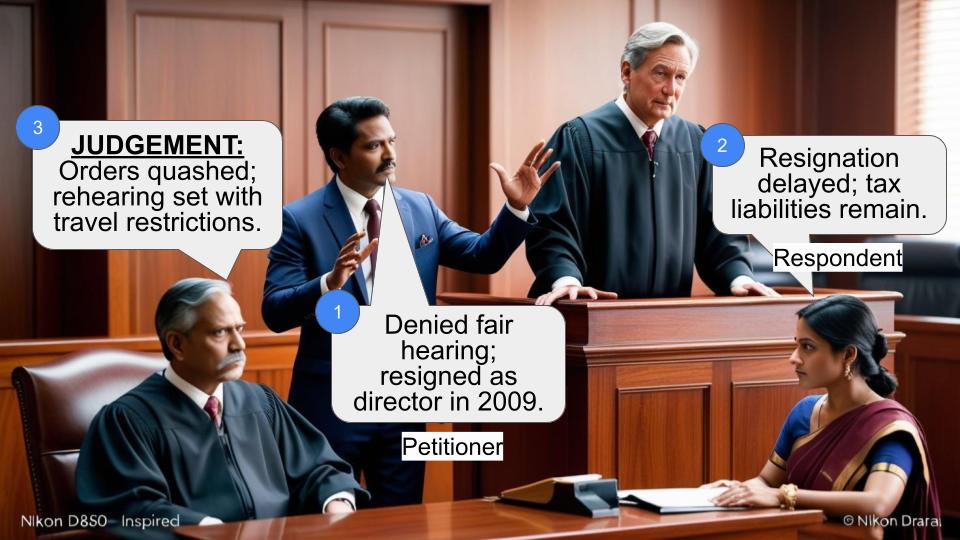
This case involves Mailakkattu Varghese Uthup, who appealed against tax orders issued under Sections 179 (of Income Tax Act, 1961) and 230 (of Income Tax Act, 1961). The High Court quashed these orders and directed a rehearing, citing procedural issues and the need for a fair hearing. The court set specific timelines for the rehearing process while maintaining travel restrictions on the appellant.
Get the full picture - access the original judgement of the court order here
Case Name:
Mailakkattu Varghese Uthup Vs Principal Commissioner of Income Tax & Others (High Court of Kerala)
W.A.No.1180 of 2018
Date: 25th June 2018
Key Takeaways:
1. The court emphasized the importance of proper procedure and fair hearings in tax proceedings.
2. Orders under Sections 179 (of Income Tax Act, 1961) and 230 (of Income Tax Act, 1961) can be quashed if the assessee wasn't given a proper hearing.
3. The court can set specific timelines for rehearing tax cases to ensure timely resolution.
4. Travel restrictions can be maintained during rehearing processes to prevent potential flight risks.
Issue:
Should the orders issued under Sections 179 (of Income Tax Act, 1961) and 230 (of Income Tax Act, 1961) be quashed, and should the appellant be given a rehearing?
Facts:
1. Mailakkattu Varghese Uthup, the appellant, had a red corner notice issued against him through Interpol.
2. He returned to India and was arrested at Cochin International Airport.
3. The appellant was on bail in a criminal case booked by the Central Investigation Bureau.
4. He was issued an order under Section 179 (of Income Tax Act, 1961) on 14.08.2017 and another under Section 230 (of Income Tax Act, 1961) on 05.03.2018.
5. The appellant claimed he had resigned from the directorship of the company in question in 2009.
6. The Income Tax Department recovered about Rs. 4.86 crores in liquid cash from the company premises during a raid.
Arguments:
Appellant's arguments:
1. The order under Section 179 (of Income Tax Act, 1961) wasn't served to him as he was in judicial custody.
2. He had resigned from the company's directorship in 2009.
3. The demand for tax years 2009-10 to 2015-16 had been stayed on payment of 20% of the demand.
Department's arguments:
1. The appellant's resignation in 2009 was only intimated to the Registrar of Companies in 2011, suggesting it might be an afterthought.
2. Even if the resignation was in 2009, there's still a huge liability for 2009-10 and 2010-11 when he was admittedly a director.
3. There's more than Rs.24 crores due as tax and penalty for those years. Key Legal Precedents:
1. I.T.O. v. Mrs. A. Sattler [(1973) 92 ITR 576]: The appellant cited this case to argue against restrictive orders under Section 230 (of Income Tax Act, 1961) when there's no subsisting tax demand.
2. Pratibha Garg v. Commissioner of Income Tax [(2014) 264 CTR 520 (All.)]: This case was mentioned but its specific application wasn't detailed in the judgment.
Judgement:
1. The High Court quashed the orders under Sections 179 (of Income Tax Act, 1961) and 230 (of Income Tax Act, 1961).
2. The court directed a rehearing of the case within specific timelines.
3. The appellant was ordered to appear before the 2nd respondent on 29.06.2018 for fresh notices under Sections 179 (of Income Tax Act, 1961) and 230 (of Income Tax Act, 1961).
4. The court maintained the travel restriction on the appellant until fresh orders are passed.
5. The court instructed the officer to consider whether the attached properties would be sufficient to satisfy the demands against the appellant.
FAQs:
1. Q: What were the main reasons for quashing the original orders?
A: The main reasons were that the appellant wasn't given a proper hearing, and he was in judicial custody when some proceedings were initiated.
2. Q: Does this judgment mean the appellant is free from all tax liabilities?
A: No, the judgment only quashes the previous orders and directs a rehearing. The appellant's tax liabilities will be reassessed in the new proceedings.
3. Q: Can the appellant travel abroad now?
A: No, the court maintained the travel restrictions until fresh orders are passed after the rehearing.
4. Q: What role does the Registrar of Companies play in this case?
A: The Registrar of Companies is required to provide all necessary assistance and furnish documents of the private limited company in which the appellant was a director.
5. Q: What happens if the appellant doesn't appear for the rehearing?
A: The judgment doesn't specify consequences for non-appearance, but it's in the appellant's best interest to comply with the court's directions for a fair reassessment of his case.

The appellant is a person against whom a red corner notice was issued through Interpol, upon which he returned to India and was arrested from the Cochin International Airport by the investigating agency. The appellant is on bail in the criminal case booked by the Central Investigation Bureau. The bail conditions provided for surrender of the Passport and restriction in leaving India. Later, the appellant was before the Sessions Court for waiving the conditions, which was allowed. Consequently the Passport was released by the Sessions Court and the appellant had gone abroad and returned within the time stipulated. Again the appellant on alleged renal complaint, which has to be treated in Abu Dhabi (at which place he has a valid insurance), approached the High Court with an application for relaxation of the conditions. This Court by Exhibit P5 granted a relaxation of six months insofar as the restriction was concerned and relegated the appellant to the Sessions Court. The learned Sessions Judge, by Exhibit P7 permitted the appellant to leave the country for 45 days. Exhibit P7 was dated 15.03.2018.
2. The appellant then was confronted with Exhibit P8 order dated 05.03.2018 under Section 230 (of Income Tax Act, 1961) [for brevity “IT Act”]. The appellant had already been issued with an order at Exhibit P13 dated 14.08.2017 under Section 179 (of Income Tax Act, 1961). The order at Exhibit P8 was issued in view of the outstanding liability of the appellant in his individual capacity for the assessment years 2009-10 to 2015-16. The total liability came to Rs.22,66,713/-. The appellant submits that the said demand has been stayed, as seen from the endorsements in Exhibit P11 and P19; on payment of 20% of the demand. The tax and penalty as demanded for the assessment years 2009-10 to 2015-16 having been stayed, there is no demand subsisting on the appellant which alone could enable the officer to act under Section 230 (of Income Tax Act, 1961), is the submission of the learned Senior Counsel.
3. With respect to Exhibit P13 order, though it was issued on 14.08.2017, it was not served on the appellant. The appellant on coming to India on 29.03.2017, was apprehended from the Airport and was in judicial custody when proceedings under Section 179 (of Income Tax Act, 1961) was initiated. The appellant had absolutely no notice of the same. The learned Senior Counsel would point out that the demand under Section 179 (of Income Tax Act, 1961), as seen from Exhibit P13, is with respect to a Company in which the appellant was a Director. The appellant had resigned from the Directorship in the year 2009 itself and the same is evidenced by the documents before the Registrar of Companies.
4. The learned Standing Counsel for the Department points out that the criminal case also originated from a raid conducted by the Income Tax Department in the premises of the Company. About Rs.4.86 crores was recovered in liquid cash from the premises at the time of raid. Notices were issued to the Directors of the Company and the proceedings were finalized for assessment, on which tax and penalty is due to the Revenue. There has been no challenge made to the assessment or penalty orders passed against the Company. In the case of the Company, as is seen from Exhibit P13 order, after adjustment of the amounts recovered as cash from the premises of the Company, there are still huge amounts due as tax and penalty for the years 2009-10 to 2015-16, coming to almost Rs.400 crores. It is also submitted that the resignation of the appellant made in the year 2009, is an argument set up to get over the liability as has been imposed on the Company. It is pointed out that the resignation in the year 2009 was intimated to the Registrar of Companies only in the year 2011 by an officer authorized in the year 2011 to file such returns. The same was an afterthought and cannot be relied on to relieve the appellant of the liability as against the Private Limited Company. Yet again, it is pointed out that even assuming for argument sake that the appellant had resigned in the year 2009, even then there is huge liability for the years 2009-10 and 2010-11 when the appellant was admittedly a Director of the Company. There is more than Rs.24 crores due as tax and penalty for the said years after adjustment of the liquid cash recovered from the premises of the Company. With respect to the order under Section 230 (of Income Tax Act, 1961), the same is sought to be sustained on the basis of the words employed in the Section, which does not necessarily speak of a valid demand existing. An order could be issued even when a tax liability may be imposed on the assessee.
5. The learned Senior Counsel for the appellant relies on the decision in I.T.O. v. Mrs.A.Sattler [(1973) 92 ITR 576] to contend that there could be no restrictive orders passed, under Section 230 (of Income Tax Act, 1961) when there is no subsisting demand for tax from the assessee. It is also contended that the instructions issued by the Central Board of Director Taxes (CBDT), for Tax Clearance Certificate under Section 230 (of Income Tax Act, 1961), speaks of such certificates being insisted upon only in the context of there being direct tax arrears exceeding Rs.10 lakhs outstanding against an assessee which has not been stayed by any other authority. It is also pointed out that 'tax due' for the purpose of Section 179 (of Income Tax Act, 1961) includes penalty, since the Explanation under Section 179 (of Income Tax Act, 1961) was brought in only in the year 2013. For the assessment year prior to that, the provision under Section 179 (of Income Tax Act, 1961) would have to be taken as it existed then. The learned Senior Counsel also places before us a decision of the High Court of Allahabad in Pratibha Garg v. Commissioner of Income Tax [(2014) 264 CTR 520 (All.)] to further buttress this point.
6. At the outset, whether the Explanation brought under Section 179 (of Income Tax Act, 1961) would apply to any recovery, for assessment years prior to its introduction, need not now be looked at, since even otherwise there is due as tax, more than 16 crores for the assessment year 2010-11 as against the Company as seen from Exhibit P13 order. It is the submission of the learned Senior Counsel that the appellant is a person who was once allowed to go abroad, who has returned promptly within the time stipulated and even now his intention is to get medical assistance from the country in which he has a valid insurance policy. However, we do not see anything produced to substantiate the claim that the insurance as taken out by the appellant from Abu Dhabi restricts indemnification only insofar as the medical treatment carried out within that country. The appellant requires travel abroad for the purpose of availing the benefit as per the insurance policy; the terms of which have not been revealed in the writ petition.
7. Mrs.A.Sattler, according to us has no application looking at the facts of the above case; which are quite distinct. Therein the assessee was the deceased husband of the respondent before the Supreme Court. After the death of the assessee, his wife wanted to go abroad to join her daughter, for which she applied for income-tax clearance certificate. The certificate was refused for reason of the arrears due from her late husband. The respondent moved the High Court which found that there was no valid assessment on the assessee. It was hence the Supreme Court affirmed the order of the High Court interfering with the order refusing tax clearance certificate.
8. As for the contention regarding the circular of the CBDT, it is to be noticed that one of the circumstances under which section 230(1A) (of Income Tax Act, 1961) was found to be possible of invocation, in the circular itself, was:
“where the person is involved in serious financial irregularities and his presence is necessary in investigation of cases under the Income-tax Act or the Wealth-tax Act and it is likely that a tax demand will be raised against him.”
The appellant squarely comes under the said contingency.
9. We would not go into the other issues raised before us, since we find that the learned Single Judge had remanded the matter to the officer who passed the orders under Sections 230 (of Income Tax Act, 1961) and 179 (of Income Tax Act, 1961). The learned Single Judge found that the appellant was not heard in both the said proceedings. The Department's argument that notice was issued but none turned up, was also noticed. The fact that the appellant was detained when Section 179 (of Income Tax Act, 1961) proceedings were initiated and proceeded with, was also taken note of. Considering all these circumstances, the order under Section 179 (of Income Tax Act, 1961) was quashed and the appellant was directed to be re-heard within a period six weeks. In the meanwhile, the proceedings under Section 230 (of Income Tax Act, 1961) were also directed to be done afresh. However, Exhibit P8 was not interfered with only to ensure that in the meanwhile the appellant does not go abroad and in the process take flight. The learned Single Judge also directed the officer to consider whether Exhibit P8 has to be sustained or varied on a review.
10. We are of the opinion that there could be no interference caused to the directions passed by the learned Single Judge. However, we notice that a time frame of six weeks has been granted for conclusion of the proceedings under Section 179 (of Income Tax Act, 1961) and further time of four weeks with respect to an order under Section 230 (of Income Tax Act, 1961). In such circumstances, we would issue specific orders fixing the time within which a notice has to be served, appearance has to be made and orders passed. We are also of the opinion that Exhibits P13 and P8 orders have to be quashed; but, however, with a restriction that the order not to travel outside India as is seen from Exhibit P8 shall continue till fresh orders are passed. It is so ordered. The appellant is directed to appear before the 2nd respondent on 29.06.2018, on which date he shall be issued with a fresh notice under Section 179 (of Income Tax Act, 1961) and under Section 230 (of Income Tax Act, 1961). The appellant shall file written objections, if required, and shall appear on 06.07.2018 for a hearing. The 2nd respondent would be entitled to fix another date of hearing, within one week itself, if he has any personal inconvenience. The matter shall be heard on the hearing date fixed by this Court or on the date fixed by the officer hearing the matter, and a written order passed within two weeks; both under Sections 179 (of Income Tax Act, 1961) and 230 (of Income Tax Act, 1961). We make it clear that by directing an order to be passed, we are not for a moment directing invocation of the provisions ie: of Sections 230 and 179. If the officer feels that the travel of the appellant need not be restricted, the officer would be entitled to say so, but on reasoning given. In passing an order, the officer should take note of the fact that properties of the appellant are attached. The officer would also, in adjudicating the issue of permitting the appellant's travel abroad, verify whether the properties already attached would be sufficient to satisfy the demands made against the appellant. The Registrar of Companies who has been impleaded as the additional respondent in the writ petition and appearing in the party array of the appeal shall provide all necessary assistance to the 2nd respondent and furnish documents if any of the private limited Company in which the appellant is said to be a Director.
With the above observations, the Writ Appeal would stand disposed of. It is made clear that the observations made in the aforesaid judgment need not regulate the adjudication by the 2nd respondent since they are only prima facie observations, and the appellant would be entitled to raise all his contentions before the 2nd respondent. Writ Appeal disposed off as above.
Sd/-
K.Vinod Chandran
Judge
Sd/-
Ashok Menon
Judge
×