


Court Rejects Automatic Invocation of Section 14A (of Income Tax Act, 1961), Em…


Full News
Court Rejects Automatic Invocation of Section 14A (of Income Tax Act, 1961), Emphasizes Need for AO's Satisfaction
Court Rejects Automatic Invocation of Section 14A (of Income Tax Act, 1961), Emphasizes Need for AO's Satisfa…
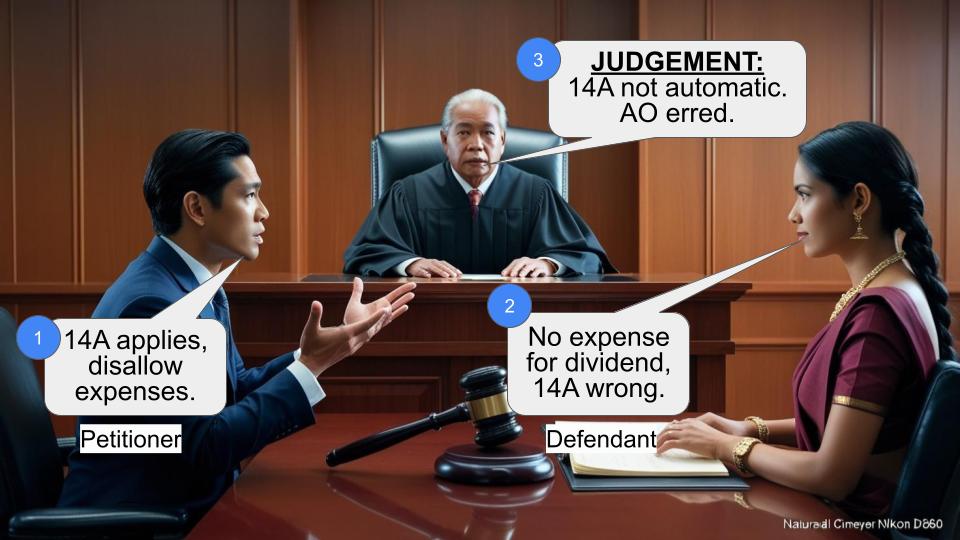
This case involves the Commissioner of Income Tax (CIT) appealing against I.P. Support Services India (P) Ltd. regarding the disallowance of expenses under Section 14A (of Income Tax Act, 1961). The High Court dismissed the appeal, affirming that the Assessing Officer (AO) cannot automatically invoke Section 14A (of Income Tax Act, 1961) without recording satisfaction about the assessee's claim.
Get the full picture - access the original judgement of the court order here
Case Name:
Commissioner of Income Tax Vs I.P. Support Services India (P) Ltd. (High Court of Delhi)
ITA 283/2014
Date: 24th September 2015
Key Takeaways:
1. Invocation of Section 14A (of Income Tax Act, 1961) is not automatic when dividend income is claimed as exempt.
2. The AO must record satisfaction regarding the correctness of the assessee's claim before applying Section 14A (of Income Tax Act, 1961).
3. The AO needs to provide cogent reasons for rejecting the assessee's claim about expenses related to exempt income.
Issue:
Did the Income Tax Appellate Tribunal (ITAT) err in affirming the deletion of disallowance made under Rule 8D (of Income Tax Rules, 1962) read with Section 14A (of Income Tax Act, 1961)?
Facts:
1. I.P. Support Services India (P) Ltd. is engaged in providing legal and other support services to law firms.
2. For the Assessment Year 2009-10, the company reported a total income of Rs.3,16,74,931/-.
3. The case was picked up for scrutiny, and a notice under Section 143(2) (of Income Tax Act, 1961) was issued on August 25, 2010.
4. The company had a dividend income of Rs.2,38,13,275/-.
5. The AO disallowed Rs.33,35,986/- under Section 14A (of Income Tax Act, 1961) read with Rule 8D (of Income Tax Rules, 1962), adding it to the company's total income.
6. The CIT(A) allowed the company's appeal, which was later upheld by the ITAT.
Arguments:
Assessee's Argument:
- No expenses were incurred for earning dividend income, so no disallowance should be made.
- The company had sufficient funds of Rs.83.13 crores and didn't resort to borrowing.
AO's Argument:
- Invocation of Section 14A (of Income Tax Act, 1961) is automatic when dividend income is claimed as exempt.
Key Legal Precedents:
1. Maxopp Investment (P) Ltd. v. CIT (2012) 347 ITR 272 (Del): This case established that the AO must record satisfaction after examining the accounts before invoking Section 14A (of Income Tax Act, 1961).
2. CIT v. Taikisha Engineering India Ltd. 370 ITR 338 (Del.): This case disapproved of an AO invoking Section 14A (of Income Tax Act, 1961) read with Rule 8D(2) (of Income Tax Rules, 1962) without recording satisfaction.
Judgement:
The High Court dismissed the appeal, finding that:
1. The AO erroneously assumed that invoking Section 14A (of Income Tax Act, 1961) was automatic when dividend income is claimed exempt.
2. The AO failed to record satisfaction regarding the correctness of the assessee's claim, which is a prerequisite for invoking Section 14A (of Income Tax Act, 1961).
3. The AO didn't provide cogent reasons for rejecting the assessee's claim about expenses related to exempt income.
FAQs:
1. Q: What is Section 14A (of Income Tax Act, 1961)?
A: Section 14A (of Income Tax Act, 1961) deals with the disallowance of expenses incurred in relation to income that doesn't form part of the total income under the Act.
2. Q: Can the AO automatically apply Section 14A (of Income Tax Act, 1961) when there's dividend income?
A: No, the AO cannot automatically apply Section 14A (of Income Tax Act, 1961). They must first record their satisfaction regarding the correctness of the assessee's claim.
3. Q: What should the AO do before invoking Section 14A (of Income Tax Act, 1961)?
A: The AO should examine the accounts, record their satisfaction (or dissatisfaction) with the assessee's claim, and provide cogent reasons if rejecting the claim.
4. Q: What is Rule 8D (of Income Tax Rules, 1962)?
A: Rule 8D (of Income Tax Rules, 1962) prescribes the method for determining the amount of expenditure in relation to income not includible in total income, as mentioned in Section 14A (of Income Tax Act, 1961).
5. Q: How does this judgment impact future cases?
A: This judgment reinforces the need for AOs to follow proper procedure before invoking Section 14A (of Income Tax Act, 1961), ensuring they can't make disallowances without sufficient justification.

1. The appeal by the Revenue is directed against the order dated 8th August, 2013 passed by the Income Tax Appellate Tribunal (‘ITAT’) in ITA No.524/Del/2013 for Assessment Year (‘AY’2009-10.
2. By order dated 24th August 2015, this Court issued notice in the present appeal, albeit, confined to question as to whether the ITAT erred in affirming the order of the Commissioner of Income Tax (Appeals) [CIT(A)] in deleting the disallowance on account of invoking Rule 8D (of Income Tax Rules, 1962) read with Section 14A (of Income Tax Act, 1961)?
3. Learned counsel for the Assessee has placed on record a copy of the order passed by the Assessing Officer (‘AO’) by pointing out that the copy at Annexure-I is not the correct copy.
4. The Assessee is a company engaged in the business of providing legal support and other support services to law firms. These services are specifically related to search of trade mark, patent and design out of the unique data base created and owned by the Assessee. The Assessee filed its return of income on 22nd September 2009 showing the total income at Rs. 3,16,74,931/-. The case of the Assessee was picked up for scrutiny and notice under Section 143(2) (of Income Tax Act, 1961) was issued and served on the Assessee on 25th August, 2010.
5. In the order dated 2nd December, 2011, the AO observed that the Assessee had a dividend income of Rs.2,38,13,275/-. The Assessee was asked to furnish an explanation as to why the expenses relevant to the earning of dividend should not be disallowed under Section 14A (of Income Tax Act, 1961). The Assessee’s representative submitted that as no expenses have been incurred for earning of dividend income, this was not a case for making any disallowance. The AO, inter alia, observed that “the invocation of Section 14A (of Income Tax Act, 1961) is automatic and comes into operation, without any exception, as soon as the dividend income is claimed as an exemption. The AO proceeded to disallow the amount of Rs.33,35,986/- under Section 14A (of Income Tax Act, 1961) read with Rule 8D (of Income Tax Rules, 1962) and added the said amount to the total income of the Assessee.
6. The CIT (A) allowed the appeal filed by the Assessee by an order dated 29th November, 2012 after recording a finding that the AO had failed to examine the contention of the Assessee that it had sufficient funds of Rs.83.13 crores and “no borrowing, for whatever purposes, was resorted to (no interest expenditure was incurred) and investments generating tax exempt income were done by using administrative machinery of PMS, who did not charge any fees.” It was further found by the CIT(A) that contrary to the decision of this Court in Maxopp Investment (P) Ltd. v. CIT (2012) 347 ITR 272 (Del), the AO had failed to record the AO’s satisfaction after examining the accounts which was requirement for invoking Section 14A (of Income Tax Act, 1961).
7. In the impugned order dated 8th August, 2013, while dismissing the Revenue’s appeal, the ITAT has additionally noted that the CIT (A) has followed the order of the ITAT for AY 2007-08.
8. Having heard the learned counsel for the parties, the Court finds that the AO has indeed proceeded on the erroneous premise that the invocation of Section 14A (of Income Tax Act, 1961) is automatic and comes into operation as soon as the dividend income is claimed exempt. In Maxopp Investment (P) Ltd. (supra) this Court held:
“30. Sub-section (2) of section 14A of the Income Tax Act, 1961 provides the manner in which the Assessing Officer is to determine the amount of expenditure incurred in relation to income which does not form part of the total income. However, if we examine the provision carefully, we would find that the Assessing Officer is required to determine the amount of such expenditure only if the Assessing Officer, having regard to the accounts of the assessee, is not satisfied with the correctness of the claim of the assessee in respect of such expenditure in relation to income which does not form part of the total income under the said Act. In other words, the requirement of the Assessing Officer embarking upon a determination of the amount of expenditure incurred in relation to exempt income would be triggered only if the Assessing Officer returns a finding that he is not satisfied with the correctness of the claim of the assessee in respect of such expenditure. Therefore, the condition precedent for the Assessing Officer entering upon a determination of the amount of the expenditure incurred in relation to exempt income is that the Assessing Officer must record that he is not satisfied with the correctness of the claim of the assessee in respect of such expenditure. Sub-section (3) is nothing but an offshoot of sub-section (2) of section 14A (of Income Tax Act, 1961). Sub-section (3) applies to cases where the assessee claims that no expenditure has been incurred in relation to income which does not form part of the total income under the said Act. In other words, sub-section (2) deals with cases where the assessee specifies a positive amount of expenditure in relation to income which does not form part of the total income under the said Act and sub- section (3) applies to cases where the assessee asserts that no expenditure had been incurred in relation to exempt income. In both cases, the Assessing Officer, if satisfied with the correctness of the claim of the assessee in respect of such expenditure or no expenditure, as the case may be, cannot embark upon a determination of the amount of expenditure in accordance with any prescribed method, as mentioned in sub-section (2) of section 14A of the Income Tax Act, 1961. It is only if the Assessing Officer is not satisfied with the correctness of the claim of the assessee, in both cases, that the Assessing Officer gets jurisdiction to determine the amount of expenditure incurred in relation to such income which does not form part of the total income under the said Act in accordance with the prescribed method. The prescribed method being the method stipulated in rule 8D of the said Rules. While rejecting the claim of the assessee with regard to the expenditure or no expenditure, as the case may be, in relation to exempt income, the Assessing Officer would have to indicate cogent reasons for the same.” (emphasis supplied)
9. In CIT v. Taikisha Engineering India Ltd. 370 ITR 338 (Del.), in similar circumstances, the Court disapproved of an AO invoking Section 14A (of Income Tax Act, 1961) read with Rule 8D(2) (of Income Tax Rules, 1962) without recording his satisfaction and noted that the recording of satisfaction as to why “the voluntary disallowance made by the assessee was unreasonable and unsatisfactory” is a mandatory requirement of the law.
10. No substantial question of law arises. The appeal is dismissed.
S.MURALIDHAR, J
VIBHU BAKHRU, J
SEPTEMBER 24, 2015
×
Similar Ripples
Questions
Court Rejects Automatic Invocation of Section 14A (of Income Tax Act, 1961), Emphasizes Need for AO's Satisfaction
Write your CommentSimilar Posts
Generic
- Reportdata/3422.pdf
