


Court Rejects Revenue's Appeal on Gross Profit Additions, Upholds Taxpayer's Po…






Full News
Court Rejects Revenue's Appeal on Gross Profit Additions, Upholds Taxpayer's Position
Court Rejects Revenue's Appeal on Gross Profit Additions, Upholds Taxpayer's Position
This case involves appeals by the Revenue Department against the orders of the Income Tax Appellate Tribunal (ITAT) in favor of the assessee, Lachman Dass Bhatia. The main issues were additions made to the assessee's income based on alleged low gross profit rates and Hawala transactions. The High Court dismissed the Revenue's appeals, upholding the ITAT's decision to delete the additions made by the Assessing Officer.
Case Name**: COMMISSIONER OF INCOME TAX VS LACHMAN DASS BHATIA
**Key Takeaways**:
1. Additions to gross profits should be based on valid, relevant material specific to the assessee.
2. Seized documents from unrelated parties cannot be used against an assessee without establishing a clear connection.
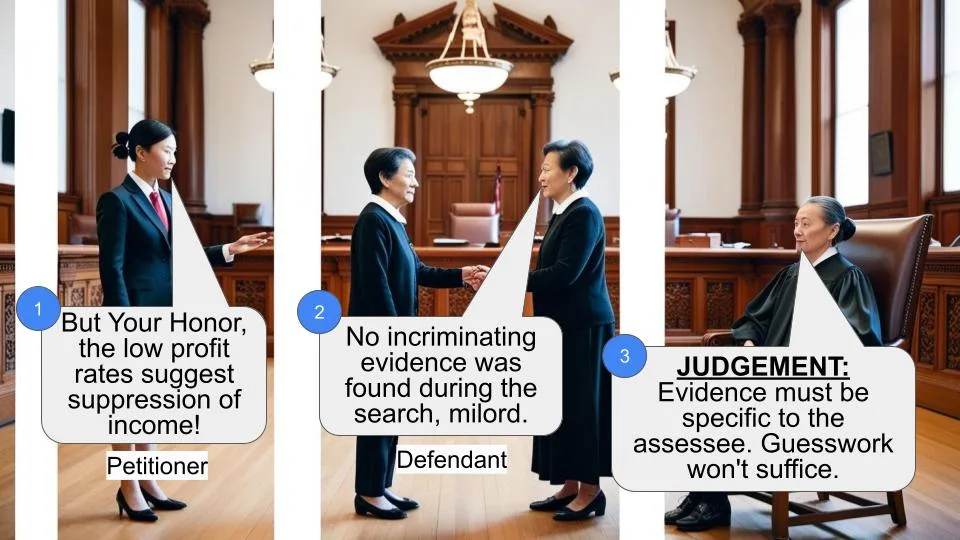
3. Estimations of gross profit rates cannot be made on pure guesswork.
4. The court emphasized the importance of incriminating evidence found during searches to justify additions.
**Issue**:
Whether the Income Tax Appellate Tribunal was correct in deleting the additions made by the Assessing Officer on account of low gross profit rates and alleged Hawala transactions?
**Facts**:
- The assessee, Lachman Dass Bhatia, is an individual engaged in the business of Hing, Jeera, etc.
- A search was conducted on the assessee's premises on 13.12.2005 under Section 132 (of Income Tax Act, 1961).
- Assessment proceedings were initiated under Section 153A (of Income Tax Act, 1961) for multiple assessment years.
- The Assessing Officer made additions to the assessee's income based on allegedly low gross profit rates and suspected Hawala transactions.
- The additions were made based on documents seized from premises not belonging to the assessee.
- The CIT(Appeals) and ITAT deleted these additions, leading to the Revenue's appeal in the High Court.
**Arguments**:
Revenue's Arguments:
- The assessee had declared low or negative gross profit rates in some years.
- Seized documents from related parties suggested suppression of sales and under-invoicing.
- The assessee failed to respond to summons issued under Section 131 (of Income Tax Act, 1961).
Assessee's Arguments:
- No incriminating material was found during the search on the assessee's premises.
- The documents used for making additions were seized from unrelated parties and pertained to different assessment years.
- There was no evidence to establish a connection between the assessee and the seized documents.
**Key Legal Precedents**:
The judgment doesn't explicitly cite any specific legal precedents. However, it refers to an earlier order dated 11.08.2009 passed in the case of ACIT vs. Om Prakash Bhatia in ITA No.1688/Del/09, which dealt with similar issues and was used as a reference for the current case.
**Judgement**:
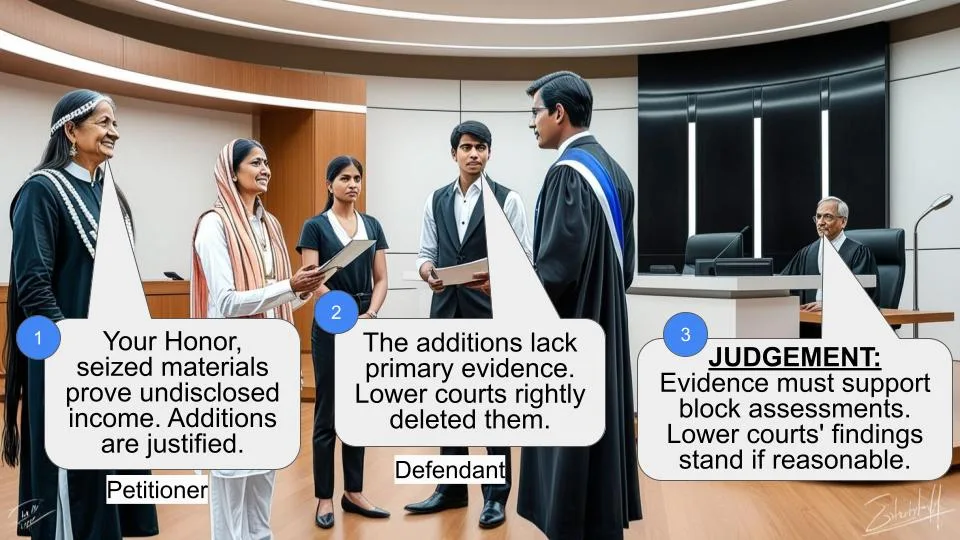
1. The High Court dismissed the Revenue's appeals and upheld the ITAT's decision.
2. The court agreed that additions to gross profits should be based on valid material relating to the concerned assessee only.
3. The court found no reason to interfere with the concurrent findings of the CIT(Appeals) and ITAT.
4. Regarding the Hawala transactions, the court directed the Assessing Officer to wait for the fresh order from the Adjudicating Officer of the Enforcement Directorate before making any additions.
**FAQs**:
1. Q: What was the main issue in this case?
A: The main issue was whether the additions made by the Assessing Officer to the assessee's income based on low gross profit rates and alleged Hawala transactions were justified.
2. Q: Why did the court reject the Revenue's appeals?
A: The court rejected the appeals because there was no incriminating material found during the search on the assessee's premises, and the documents used for making additions were seized from unrelated parties and pertained to different assessment years.
3. Q: What principle did the court establish regarding additions to gross profits?
A: The court emphasized that additions to gross profits should be based on valid material relating specifically to the concerned assessee and not on pure guesswork.
4. Q: How did the court address the issue of Hawala transactions?
A: The court directed the Assessing Officer to wait for a fresh order from the Adjudicating Officer of the Enforcement Directorate before making any additions related to Hawala transactions.
5. Q: What does this judgment mean for taxpayers?
A: This judgment reinforces the principle that tax authorities must have concrete, relevant evidence specific to the assessee before making additions to declared income, protecting taxpayers from arbitrary assessments.

In these appeals by the Revenue under Section 260A (of Income Tax Act, 1961) („Act‟), the following substantial questions of law were framed on 14th May, 2012 and the appeals were heard: -
ITA 1731/2010
“(1) Whether the Income Tax Appellate Tribunal was right in holding that the assessment proceedings could not have been initiated under Section 153A (of Income Tax Act, 1961)?
(2) Whether the Income Tax Appellate Tribunal was right in deleting addition of `17,05,123/- made by the Assessing Officer on account of low GP rate?”
ITA 1733/2010
“(1) Whether the Income Tax Appellate Tribunal was right in holding that the assessment proceedings could not have been initiated under Section 153A (of Income Tax Act, 1961)?
(2) Whether the Income Tax Appellate Tribunal was right in deleting addition of `65,15,268/- made by the Assessing Officer on account of low GP rate?”
ITA 1734/2010
“(1) Whether the Income Tax Appellate Tribunal was right in deleting the addition of `2,39,913/- made on account of low GP rate?
(2) Whether the order of the Income Tax Appellate Tribunal confirming the order passed by the first appellate authority in respect of addition of `1,94,64,000/- is in accord with the earlier order dated 11th August, 2009 passed in case of ACIT vs. Om Prakash Bhatia in ITA No.1688/Del/09?”
2. The common question for all the three assessment years, namely, 2004-05, 2003-04, 2000-01 relates to the addition towards gross profits. The brief facts in this connection may be noted. The respondent-assessee is an individual engaged in the business of Hing, Jeera etc. On 13.12.2005 there was a search on the assessee‟s premises under Section 132 (of Income Tax Act, 1961), hereinafter referred to as the Act. Several connected persons and members belonging to the same group were also subjected to search on the same date. Proceedings for assessment of the assessee were initiated under Section 153A (of Income Tax Act, 1961) and the assessee was called upon to furnish the returns of income. Notices under Section 142(1) (of Income Tax Act, 1961) and Section 143(2) (of Income Tax Act, 1961) along with the questionnaire were also issued to the assessee. It is seen from the assessment orders that the assessee did not effectively comply with the notices/questionnaire. The Assessing Officer, therefore, proceeded to complete the assessments for the years in question on the basis of the material on record.
3. One of the additions made by the Assessing Officer was the addition towards low gross profits earned by the assessee. He noted that the assessee had declared gross profits rates as follows:-
Assessment year G.P. Rate (%)
2000-01 3.24%
2001-02 7.93%
2002-03 No sales
2003-04 (-) 13.86%
2004-05 (-)3.97%
2005-06 6.69%
2006-07 10.98%
According to the Assessing Officer the gross profits rates declared by the Assessee were low and in respect of two assessments years, the assessee had declared negative gross profit. From these details, the Assessing Officer came to the conclusion that the assessee was manipulating the accounts to return profits according to his whims and fences. The Assessing Officer also adverted to the fact that the group, of which the assessee is a part, was engaged in the import of Hing and its processing. In the course of the search in the business and residential premises of another member of the group (name not mentioned) certain loose papers referred to as Annexure A-6 in the assessment order, were seized. These documents were seized from the residential premises No.31-B, Rajpur Road, Delhi by the search party. The papers are related to the business transactions of the group between 1.11.2005 and 18.11.2005. According to the Assessing Officer, these seized papers disclosed that the assessee was indulging in suppression of sales. He referred to certain bills in which two rates of sale were mentioned, one higher than the other. According to the Assessing Officer, the lower rate was meant for issuing sales bills, whereas the higher rate was the actual sale price of Hing. In this manner, the assessee was allegedly suppressing the sales price.
4. The Assessing Officer issued summons under Section 131 (of Income Tax Act, 1961) to the assessee to seek clarifications in the above matter. Though the summons are stated to have been served, the assessee did not respond and offer any explanation. Eventually the Assessing Officer estimated the gross profit rate earned by the assessee at 10% and applied the same for these assessment years for which proceedings were initiated under Section 153A (of Income Tax Act, 1961). The relevant details have been reproduced below:-
Assessment Year
Sales G.P. @ 10% G.P. declared Additions
2000-01 35,49,724 3,54,972 1,15,059 2,39,913
2001-02 16,44,403 1,64,440 1,32,048 32,392
2003-04 2,73,01,567 27,30,157 (-) 37,85,111 65,15,268
2004-05 1,22,08,877 12,20,888 (-)4,84,235 17,05,123
2005-06 23,06,298 2,30,630 1,54,291 76,339
2006-07 8,73,137 87,314 95,957 --
Thus for the assessment year 2004-05 an addition of `17,05,123/- was made, for the assessment year 2003-04 an addition of 65,15,268/- was made and for the assessment year 2000-01 an addition of `2,39,913/- was made.
5. The assessee appealed to the CIT (Appeals) who passed a separate order for each of the above-said years. However, in substance the orders on this point are the same. The decision of the CIT (Appeals) in respect of the assessment year 2004-05 is reproduced below:-
“The next addition is on account of low gross profit rate. The AO made a reference to some material found during search for the revision of gross profit rate. From the order of AO it is evident that the material in respect of sales and purchases relating to the year relevant to AY 2006-07. Besides they are recovered from a different person not from appellant. Unless the nexus between that person and assessee is established beyond doubt, the said material could not be used against the assessee. Independently no discrepancies were brought on record to suggest that the trading results disclosed by the appellant do not represent true and correct profits. It is to be noted that the assessee is subjected search U/s 142 (of Income Tax Act, 1961), still no incriminating material had been found or recovered from him suggesting that there exists suppression of sales or purchase or excess/short of stock, so that it can be deemed the profits disclosed are not correct. Reference to documents relating to some other year cannot be a ground to estimate the GP every year uniformly at same rate. Estimation always should be preceded by some material but not on the basis of pure guess work. Under the circumstances and facts of the case, addition on estimate basis without any record of evidence is unsustainable. AO is directed to delete the addition of `17,05,123/- on account of low gross profit.” (underlining ours)
On this basis, the additions for all three years were deleted. 6. The Revenue carried the matter in appeals before the Tribunal. The Tribunal noted that the addition was made by the Assessing Officer without any material which was relevant for the assessment years, that no incriminating material was found during the search on the assessee so as to suggest that the profits disclosed in the books were incorrect or that there was any under-invoicing of sales. That the material referred to in the assessment order on the basis of which the additions for low gross profits were made were related to a subsequent period which fell in the accounting year 2005-06 which cannot be the basis for making gross profit additions in respect of the earlier assessment years and that in these circumstances the CIT (Appeals) was justified in deleting the additions. The appeals of the Revenue on this point were accordingly dismissed.
7. It will be seen from the above that both the CIT (Appeals) and the Tribunal have recorded a concurrent finding that there was no basis for making any addition towards low gross profit. They have found that the search on the assessee did not yield any incriminating material on the basis of which it can be said that the assessee was indulging in under-invoicing or suppression of sales. They also found that the documents on which the Assessing Officer has placed reliance, were seized from a different person and not from the assessee and that no nexus between that person and the assessee has been established beyond doubt. In such circumstances, it has been held that the seized material cannot be used against the assessee. It has also been recorded by the CIT (Appeals), whose decision has been confirmed by the Tribunal, that the documents upon which the Assessing Officer placed reliance relate to a subsequent period and not to the years under consideration. They relate to the period from 1.11.2005 to 18.11.2005. It has thus been concurrently found by the CIT(Appeals) and the Tribunal that even if an estimate of the gross profits has to be made, it has to be based on valid material which was absent in the present case and that there was no justification for making an addition for low gross profits on pure guess work. These factual findings have not been sought to be disturbed or impeached by reference to any material or evidence to the contrary. The Assessing Officer has not referred to any material to show that the quality of the hing sold by the assessee was the same as that sold by the members of the group from whom the sale bills were seized during the search carried out simultaneously. Therefore the CIT (Appeals) and the Tribunal have rightly held that there was nothing to connect the assessee with those sale bills. In the light of this position, their finding that no addition can be made to the gross profit by substituting the sale price mentioned in the seized sale bills cannot be said to be vitiated as unreasonable. In such circumstances, we are unable to hold that the Tribunal was not right in deleting the additions made to the gross profit declared by the assessee. Accordingly, we answer the question No.2 in ITA Nos. 1731/10 & 1733/10 and Question No.1 in ITA No.1734/2010 in the affirmative, in favour of the assessee and against the Revenue.
8. So far as the first question in ITA No.1731 and 1733/10 is concerned, there is no categorical finding in the order of the Tribunal that the assessment proceedings could not have been validly initiated under Section 153A (of Income Tax Act, 1961). It is seen that the assesse did make out a grievance before the CIT(Appeals) that the assessment proceedings have been completed without the permission of the Joint Commissioner of Income Tax. The CIT(Appeals), however, held that there is no justification for such a grievance because the approval has been obtained for all the years along with the other cases belonging to the group from the concerned range head and that merely because the Assessing Officer did not record or note in the assessment order that such approval has been obtained does not render the assessment orders passed under Section 153A (of Income Tax Act, 1961) invalid. We have gone through the order of the Tribunal dated 11.12.2009 but do not find any reference to the assessee‟s objection to the validity of the proceedings initiated under Section 153A (of Income Tax Act, 1961). Apparently such a ground was not taken before the Tribunal. In case such a ground was taken before the Tribunal and the Tribunal had omitted to consider the same, that would be different matter. In that case, it will be for the assessee to move an appropriate application before the Tribunal for adjudication of the ground, if it had not been taken. From the order of the Tribunal as it presently stands, we do not find any reference to the validity of the proceedings under Section 153A (of Income Tax Act, 1961). Therefore, this question raised in ITA Nos.1731 & 1733/2010 cannot be answered. Since in some connected cases this question was involved and the Tribunal had also decided the same, we had framed a substantial question of law for decision. Since several cases of the group were heard together involving different assessees and different years with overlapping issues, it appears that this was not pointed out at the time of hearing. The question framed is infructuous.
9. In ITA No.1734/2010, question No.2 remains to be decided. This relates to the addition of `1,94,64,000/- made in respect of alleged Hawala transactions. It would appear that on the basis of some papers found and recovered in the course of the search in one of the family members premises, the Assessing Officer came to the conclusion that the assessee has also committed violation of „Foreign Exchange Regulation Act („FERA‟) by making payments through Hawala business. The Adjudicating officer of the Enforcement Directorate had passed an order indicting the assessee as well as other family members and had also imposed penalty. That order was appealed against and the Appellant Tribunal of Foreign Exchange who set aside the order of the Adjudicating Officer with directions to him to reframe the order after supplying the relevant documents to the persons involved within the 8 months from the date 07.04.2008. According to the Tribunal, so far no consequential order has been passed by the Adjudicating Authority under FERA and this has also been confirmed in the assessment order. The Tribunal has also held in the impugned order (para 15) that the Assessing Officer has not processed any material independent of the order of the Adjudicating Officer, FERA and that the addition for Hawala transaction had been made solely on the basis of FERA transaction. In these circumstances, the Tribunal found that the CIT (Appeals) has rightly set aside the addition made in the assessment order with the direction to the Assessing Officer to pass necessary consequential orders as per law after obtaining the order of the Adjudicating Authority, Enforcement Directorate, passed in pursuance of the directions of the Appellant Tribunal for Foreign Exchange. The Tribunal also noted that such a course adopted by the CIT(Appeals) in another case, namely, ACIT vs. Om Prakash Bhatia in ITA No.1688/Del/09 has been upheld by the Tribunal vide order dated 11.8.2009. In the order dated 11.8.2009, the following observations have been made:-
“From the above, we find that Ld. CIT(A) has directed the Assessing Officer to make fresh assessment consequent to the order of Adjudicating Authority in the relevant assessment year to which, those payments relates to. It is also noted by Ld. CIT(A) that to frame such assessment, the Assessment Officer gets further time as contemplated u/s 150 (of Income Tax Act, 1961). Considering all these facts, we find no reason to interfere in the order of Ld. CIT(A) on this issue because the addition was made by the Assessing officer only on the basis of order of Adjudicating Officer which has been set aside by the Appellate Tribunal for foreign exchange and the Assessing Officer can make fresh assessee as per law in the relevant year if any addition on this account is made by the Adjudicating Officer.”
10. We do not see how the Department can be said to be aggrieved by the direction of the Tribunal based on its order dated 11.8.2009 in the case of ACIT vs. Om Prakash Bhatia (Supra). The CIT(Appeals) in the impugned proceedings has no doubt deleted the addition made in respect of Hawala business, but that is only because the Appellate Tribunal for Foreign Exchange had set aside the order passed by the Adjudicating Officer, Enforcement Directorate. However, the Adjudicating Officer, Enforcement Directorate was also directed by the Appellate Tribunal for Foreign Exchange to pass fresh orders after supplying the relevant documents to the persons involved. Therefore, the CIT(Appeals) directed the Assessing Officer to pass necessary consequential orders as per law, after obtaining the order of the Adjudicating Officer by the Enforcement Directorate passed pursuant to the directions of the Appellate Tribunal for Foreign Exchange. These directions of the CIT(Appeals) have been confirmed by the Tribunal in the impugned order and in our opinion rightly so. We clarify that it would be open to the Assessing Officer, if he finds that the Adjudicating Officer of the Enforcement Directorate has reiterated his earlier order even after giving the concerned persons an opportunity of hearing as well as the relevant documents, to follow the same. However, before doing so, the Assessing Officer shall confront the assessee with the fresh order passed by the Adjudicating Officer/Enforcement Directorate and decide the matter in accordance with law. Thus in effect, we hold that the order of the Tribunal confirming the order passed by the CIT(Appeals) in respect of the addition of `1,94,64,000/- is in conformity with its earlier order dated 11.8.2009 passed in the case of ACIT vs. Om Prakash Bhatia (Supra) in ITA No.1688/Del/09. The question is accordingly answered in the affirmative, in favour of the assessee and against the Revenue.
11. In the result, all the three appeals filed by the Revenue are dismissed with no order as to costs.
R.V. EASWAR, J.
SANJIV KHANNA, J.
AUGUST 7, 2012
×
Similar Ripples
Questions
Court Rejects Revenue's Appeal on Gross Profit Additions, Upholds Taxpayer's Position
Write your CommentSimilar Posts
Generic
- Reportdata/5579.pdf
