


Court Rejects Tax Rectification Plea: Omission Not "Apparent Mistake"


Full News

Court Rejects Tax Rectification Plea: Omission Not "Apparent Mistake"
Court Rejects Tax Rectification Plea: Omission Not "Apparent Mistake"
This case involves M/S. Nagaraj and Company Pvt. Ltd. (the Appellant/Assessee) against the Assistant Commissioner of Income Tax (the Respondent). The dispute arose when the Appellant failed to claim deductions for interest payments in their tax returns for assessment years 2003-04 and 2004-05. They later tried to rectify this omission using Section 154 (of Income Tax Act, 1961), but their application was rejected at various levels, including by the High Court.
Get the full picture - access the original judgement of the court order here
Case Name:
M/S. Nagaraj and Company Pvt. Ltd. vs Assistant Commissioner of Income Tax (High Court of Madras)
T.C.A.Nos.370 & 371 of 2019
Date: 10th March 2020
Key Takeaways:
1. Mistakes rectifiable under Section 154 (of Income Tax Act, 1961) must be apparent from the record and not require further investigation.
2. Omissions in original tax returns should be addressed through revised returns under Section 139(5) (of Income Tax Act, 1961), not Section 154 (of Income Tax Act, 1961).
3. The court emphasized the narrow scope of Section 154 (of Income Tax Act, 1961), limiting it to clear and obvious mistakes.
Issue:
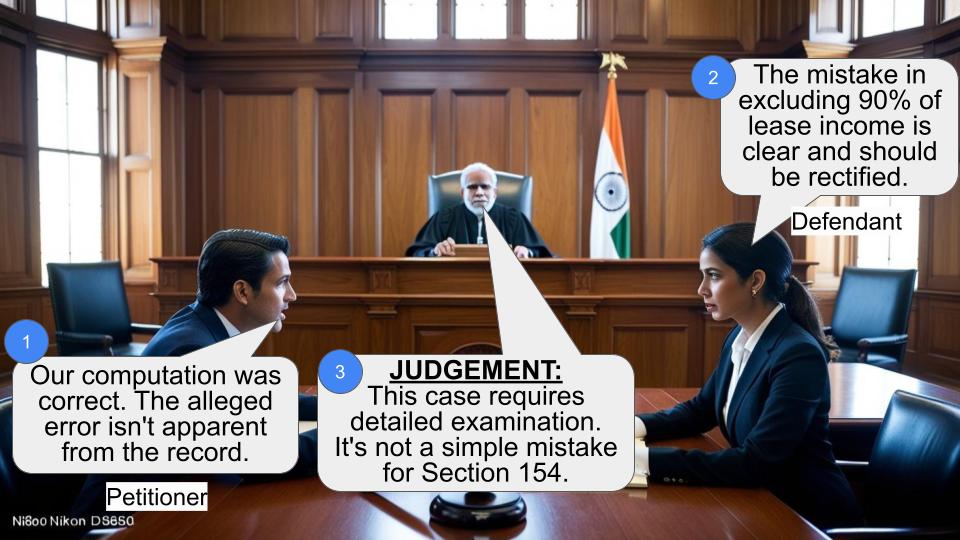
Can an omission to claim deductions in original tax returns be rectified under Section 154 (of Income Tax Act, 1961) as a "mistake apparent from the record"?
Facts:
1. The Appellant filed tax returns for assessment years 2003-04 and 2004-05.
2. They omitted to claim deductions for interest paid to IDBI under Section 43B (of Income Tax Act, 1961).
3. After assessments were completed, the Appellant filed applications under Section 154 (of Income Tax Act, 1961) to rectify the omission.
4. The applications were rejected by the Assessing Officer, Commissioner of Income Tax (Appeals), and Income Tax Appellate Tribunal.
5. The Appellant then filed Tax Case Appeals in the High Court.
Arguments:
Appellant's Arguments:
- The omission was a mistake apparent from the record, visible in the ledger extract.
- The mistake was not deliberate and should be rectifiable under Section 154 (of Income Tax Act, 1961).
Respondent's Arguments:
- Assessments were completed based on the returns filed by the Appellant.
- The proper remedy was to file revised returns under Section 139(5) (of Income Tax Act, 1961), not Section 154 (of Income Tax Act, 1961).
- The omission requires further investigation and isn't apparent from the record.
Key Legal Precedents:
1. Master Construction Private Limited vs. State of Orissa (AIR 1966 SC 1047):
Defined the scope of rectification under similar provisions.
2. Commissioner of Income Tax vs. Lakshmi Vilas Bank (2010 329 ITR 0591): Clarified that mistakes under Section 154 (of Income Tax Act, 1961) must be very clear and distinct.
3. Anchor Pressings (P) Ltd. vs. Commissioner of Income Tax U.P. (1986 3 SCC 439):
Held that omission of relief in assessment isn't a "mistake apparent from record".
Judgement:
The High Court dismissed the appeals, ruling in favor of the Respondent. Key points:
1. The omission to claim deductions isn't a mistake apparent from the record under Section 154 (of Income Tax Act, 1961).
2. The proper remedy was to file revised returns under Section 139(5) (of Income Tax Act, 1961).
3. The claim for interest deductions requires investigation and doesn't qualify for rectification under Section 154 (of Income Tax Act, 1961).
4. The court emphasized the narrow scope of Section 154 (of Income Tax Act, 1961), limiting it to clear and obvious mistakes.
FAQs:
Q1: What is Section 154 (of Income Tax Act, 1961)?
A1: It's a provision allowing for rectification of mistakes apparent from the record in tax-related orders.
Q2: Why couldn't the Appellant use Section 154 (of Income Tax Act, 1961) to rectify their omission?
A2: The court ruled that the omission wasn't a clear mistake apparent from the record and required further investigation.
Q3: What should the Appellant have done instead?
A3: They should have filed revised returns under Section 139(5) (of Income Tax Act, 1961) before the assessment was completed.
Q4: Does this judgment set a precedent for similar cases?
A4: Yes, it reinforces the narrow interpretation of what constitutes a "mistake apparent from the record" under Section 154 (of Income Tax Act, 1961).
Q5: Can taxpayers use Section 154 (of Income Tax Act, 1961) to claim omitted deductions after assessment?
A5: Generally no, especially if the omission requires investigation or isn't immediately apparent from the records.

The assessee has filed these appeals under Section 260-A (of Income Tax Act, 1961), 1961 aggrieved by the common order dated 11.10.2012 passed by the Income Tax Appellate Tribunal “D” Bench, Chennai.
Brief facts leading to the filing of these Tax Case Appeals:
2. The assessee who is the Appellant herein has filed returns of income tax for the Assessment Years 2003-04 and 2004-05. It is the case of the Appellant/Assessee that they omitted to claim deduction for the interest amounts paid by them to Industrial Development Bank of India (in short “IDBI”) under Section 43B (of Income Tax Act, 1961). It is their case that after noticing the mistake of omitting to claim deduction for interest payments, they filed separate petitions under Section 154 (of Income Tax Act, 1961) seeking rectification of the mistake on account of the said omission. The Assessing Officer rejected the rectification petitions on 06.06.2007 by separate orders on the ground that the mistake is not apparent from the record as it involves debatable point of law. Aggrieved by the separate orders dated 06.06.2007 passed by the Assessing Officer, the Appellant/Assessee preferred the statutory appeals before the Commissioner of Income Tax (Appeals)-VI, Chennai in ITA.No.194/10-11 & ITA.No.193/10-11. The Commissioner of Income Tax (Appeals)-VI, Chennai confirmed the orders of the Assessing Officer by dismissing the appeals on 28.11.2011 by separate orders on the ground that merely by relying on figures given in financial statements, one cannot arrive at the amount allowable under Section 43B (of Income Tax Act, 1961) especially when the quantum of principal and interest waived in one time settlement is not apparent from record. Aggrieved by the separate orders dated 28.11.2011 for the respective assessment years, the Appellant/Assessee preferred separate Appeals before the Income Tax Appellate Tribunal, 'D' Bench, Chennai in ITA.No.200/Mds/2012 & ITA.No.199/Mds/2012. The Income Tax Appellate Tribunal by a common order dated 11.10.2012 for both the Assessment Years dismissed the Appeals and confirmed the findings of the Assessing Officer as well as the Commissioner of Income Tax (Appeals)-VI on the ground that when the Assessments have been completed based on the computation of income filed by the Appellant/Assessee, it cannot be stated that such assessments suffered from any mistake apparent from record on an item of expenditure never claimed by the Assessee for allowance. Aggrieved by the common order dated 11.10.2012 passed by the Income Tax Appellate Tribunal, these Tax Case Appeals have been filed under Section 260-A (of Income Tax Act, 1961).
3. The following substantial questions of law have been raised by the Appellant/Assessee in the grounds of both the tax case appeals: “1.Whether on the facts and circumstances of the case, the Tribunal was right in holding that the Appellant's claim for allowing outstanding interest on loans paid to IDBI under section 43B (of Income Tax Act, 1961) was not a rectifiable issue coming within the purview of Sec 154 (of Income Tax Act, 1961)? 2.Whether on the facts and circumstances of the case, the Tribunal was right in holding that the CBDT Circular No.669 dt 25.10.1993 is not applicable to the facts of the case?”
4. Heard Mr.R.Venkatnarayanan, learned counsel for the Appellant and Mr.Karthick Ranganathan, learned counsel for the respondent. Submissions of the learned Counsels:
5. According to the learned counsel for the Appellant/Assessee , the Appellant/Assessee while filing their returns for the Assessment years 2003-04 & 2004-05 omitted to claim deduction under Section 43B (of Income Tax Act, 1961), for the interest amounts paid by them to IDBI which is apparent from the returns. According to him, only in such circumstances, the Appellant/Assessee filed applications under Section 154 (of Income Tax Act, 1961) for rectification of the mistake committed in the original returns. According to him, interest payments are undisputed as it is reflected in the ledger extract which is filed as a document in the typed set of papers. According to him, the omission to claim deductions for interest payments is not deliberate and only by mistake, deductions towards interest payments were not claimed by the Appellant/Assessee in their original returns for the Assessment Years 2003-04 & 2004-05. According to the learned counsel for the Appellant since the mistake committed by the Appellant/Assessee is apparent from the record namely the ledger extract, an application for rectification under Section 154 (of Income Tax Act, 1961) is maintainable. According to him, the authorities below have erroneously rejected the applications under Section 154 (of Income Tax Act, 1961) filed by the Appellant/Assessee.
6. The learned counsel for the Appellant drew the attention of this Court to the following authorities:
(a) Commissioner of Income Tax Vs. Pruthvi Brokers & Shareholders (P) Ltd., reported in (2012) 252 CTR 0151(Bombay High Court)
(b) Commissioner of Income Tax vs. Lakshmi Vilas Bank reported in (2010) 329 ITR 0591
(c) Anchor Pressings (P) Ltd vs. Commissioner of Income Tax reported in (1986) 161 ITR 159 (SC)
7. Relying on the aforesaid decisions, the learned counsel for the Appellant/Assessee would submit that since the mistakes committed by the Appellant/Assessee in their returns filed for the assessment years 2003-04 & 2004-05 is not deliberate and is apparent from the record, the authorities below have erroneously rejected the applications filed by the Appellant/Assessee under Section 154 (of Income Tax Act, 1961).
8. Per contra, learned standing counsel for the respondent would submit that the Assessing Officer having completed the Assessments for the Assessment years 2003-04 & 2004-05, based on the returns filed by the Appellant/Assessee, it cannot be stated that such assessments suffer from any mistake apparent from the record. According to him, when the assessments have been completed, the only remedy that was available to the assessee is to file revision of assessment under Section 139(5) (of Income Tax Act, 1961) before completion of Assessment or within one year from the end of the assessment year whichever is earlier. According to him, the Appellant/Assessee having failed to file revision of Assessment to rectify the mistake within the prescribed period, the Appellant/Assessee cannot resort to section 154 (of Income Tax Act, 1961), which is meant to rectify mistakes apparent from the record and not meant to rectify omissions committed in the original returns. Discussion:
9. Any rectification of mistake under Section 154 (of Income Tax Act, 1961) can be sought for only when it is apparent from the record. As evident from the section, the mistake must be one which is patent, which is obvious and whose discovery is not dependent on further investigation.
10. We shall now examine as to whether the omission to claim deduction for interest payments in the original returns for the Assessment Years 2003-04 & 2004-05 will enable the Appellant/Assessee to file applications under Section 154 (of Income Tax Act, 1961) to rectify the said omission. It is an admitted fact that the Appellant/Assessee did not claim deduction under Section 43B (of Income Tax Act, 1961) for interest payments to IDBI in the original returns filed by them for the Assessment Years 2003-04 & 2004-05. It is also an admitted fact that the Assessments of the Appellant/Assessee for the assessment years 2003-04 & 2004-05 have been completed based on the computation of income submitted by the Appellant/Assessee along with its returns. The Appellant/Assessee has also not filed revision of Assessment for the respective Assessment Years under Section 139(5) (of Income Tax Act, 1961) to rectify the alleged omission to claim deduction for interest payments to IDBI in their original returns filed for the Assessment years 2003-04 & 2004-05.
11. Section 139(5) (of Income Tax Act, 1961) which deals with revision of Assessment and enables an Assessee to seek revision of Assessment in case of any omission or mistake committed under the original return filed for an Assessment Year. The ledger extract filed by the Appellant/Assessee along with the applications under Section 154 (of Income Tax Act, 1961) of the Income Tax 1961 seeking rectification of mistake is a self serving statement of account. Though, the payment of interest is disclosed in the statement submitted by the Appellant/Assessee, the same has not been admitted by the respondent/Revenue. Whether interest payments claimed by the Appellant/Assessee is allowable or not is a matter for investigation and there is no element of mistake apparent from the record.
12. Under Section 139(5) (of Income Tax Act, 1961), an assessee can file a revised return before the completion of Assessment or within one year from the end of the respective assessment year whichever is earlier. In the case on hand, admittedly assessments have been completed based on the original returns filed for the respective assessment years by the Appellant/Assessee and no revised returns have been filed to rectify the omission to claim deduction for interest payments within the prescribed period. Section 139(5) (of Income Tax Act, 1961) enables the assessee to file a revised return in case the assessee discovers any omission or any wrong statement under the original returns. The Appellant/Assessee has failed to file revised returns to rectify the alleged omission. As observed earlier, the allowability of interest payments is a debatable issue and it requires further investigation. Therefore, the omission to claim deduction under Section 43B (of Income Tax Act, 1961) for interest payments in the original returns is not a mistake coming within the purview of section 154 (of Income Tax Act, 1961).
13. The Hon'ble Supreme Court had an occasion to consider a similar provision under another taxing statute namely Orissa Sales Tax Act in the case of Master Construction Private Limited vs. State of Orissa reported in AIR 1966 SC 1047. Rule 83 (of Income Tax Rules, 1962) of the Orissa Sales Tax Rules (1947) is akin to section 154 (of Income Tax Act, 1961). The material part of Rule 83 (of Income Tax Rules, 1962) of Orissa Sales Tax Rules reads as follows: “The Commissioner of Sales Tax....... may at any time correct any arithmetical or clerical mistakes or any error apparent on the face of the record arising or occurring from accidental slip or omission in an order passed by him, or it.” Interpreting the above provision, the Hon'ble Supreme Court held as follows:
“Rule 83 (of Income Tax Rules, 1962) provides a summary remedy within a narrow compass. The jurisdiction of the Commissioner under this rule is limited and is confined only to the correction of mistakes or omissions mentioned therein. An arithmetical mistake is a mistake of calculation; a clerical mistake is a mistake in writing or typing. An error arising out of or occurring from an accidental slip or omission is an error due to a careless mistake or omission unintentionally made. There is another qualification namely, such an error,shall be apparent on the face of the record, that is to say, it is not an error which depends for its discovery, on elaborate arguments on questions of fact or law. The accidental slip or omission is an accidental slip or omission made by the court. The obvious instance is a slip or omission to embody in the order something which the court in fact ordered to be done.. This is sometimes described as a decretal order not being in accordance with the judgment. 'But the slip or omission may be attributed to the Judge himself. He may say something or omit to say something which he did not intend to say or omit. This 'is described as a slip or omission in the judgment itself. The cause for such a slip or omission may be the Judge's inadvertence or the, advocate's mistake. But, however wide the said expressions are construed, they cannot countenance a re- argument on merits on questions of fact or law, or permit a party to raise new arguments which he has not advanced at the first instance.”
14. The case on hand does not fall within the above referred parameters laid down by the Hon'ble Supreme Court for rectification of mistake as the mistake alleged by the Appellant/assessee company is not apparent on the face of the record. Further, the assessments for the respective assessment years having been completed and the Appellant/assesse company having not filed any revised returns to rectify the mistakes committed in the original returns for the respective assessment years, they cannot fall back on section 154 (of Income Tax Act, 1961) as the said section is meant only to rectify mistakes which is apparent on the face of the record. The case on hand does not fall in the said category as the interest payments are debatable and requires further investigation. It would have never been intention of the legislature to give two options either under section 139(5) (of Income Tax Act, 1961) or under section 154 (of Income Tax Act, 1961) for the Assessee to rectify the omission to claim deduction for interest payments. As observed earlier, the objects of section 139(5) (of Income Tax Act, 1961) and section 154 (of Income Tax Act, 1961) are different. In case of omission, the only remedy available is under section 139(5) (of Income Tax Act, 1961) by filing revised returns. Instead in the case on hand, the Appellant/Assessee having failed to file revised returns to rectify the alleged omission has filed applications under section 154 (of Income Tax Act, 1961) which is meant only to correct mistakes which are apparent from the records and not to cases involving omissions which are debatable and requires further investigation. The ratio decidendi in Master Construction Private Limited vs. State of Orissa reported in AIR 1966 SC 1047 referred to supra is also applicable to the case on hand as section 154 (of Income Tax Act, 1961) is pari materia to Rule 83 (of Income Tax Rules, 1962) of the Orissa Sales Tax Rules. Therefore, only mistakes which are patent, obvious and whose discovery is not dependent on any further investigation can be rectified under section 154 (of Income Tax Act, 1961). The case on hand does not fall in the said category for the above mentioned reasons. A Division Bench of this Court had also an occasion to consider the scope of section 154 (of Income Tax Act, 1961) in the case of Commissioner of Income Tax vs. Lakshmi Vilas Bank reported in 2010 329 ITR 0591 and held that the expression used in section 154 (of Income Tax Act, 1961) regarding mistake apparent from the record will have to be construed to be a mistake which is very clear, distinct and apparent. The relevant portion of the aforesaid decision is extracted hereunder:
“10.The expression used in s.154 of the IT Act regarding the mistake apparent from the record will have to be construed to be a mistake which is very clear, distinct and apparent. The said mistake should be manifest and could be identified by a mere look and which does not need a long drawn out process of reasoning. It is no doubt true that a mere mistake by itself cannot be a ground to invoke section 154 (of Income Tax Act, 1961). It is also true that an issue which is debatable also cannot be decided under section 154 (of Income Tax Act, 1961). However, when the mistake is glaring and in a case where facts are not in dispute then the said mistake being one apparent on the face of the record will have to be rectified under section 154 (of Income Tax Act, 1961).”
15. The Hon'ble Supreme Court in the case of Anchor Pressings (P) Ltd. vs. Commissioner of Income Tax U.P. and other reported in 1986 3 SCC 439 has also held that omission of relief while making assessment would not amount to “mistake apparent from record” within the meaning section 154 (of Income Tax Act, 1961). In that decision, the Assessee claimed relief under section 84 (of Income Tax Act, 1961) which was rejected by the assessing officer and the Hon'ble Supreme Court held that an application filed under section 154 (of Income Tax Act, 1961) to rectify the alleged mistake is not maintainable as the omission of the relief while making assessment would not amount to “mistake apparent from record”.
16. In the case on hand, the claim for interest deductions under section 43B (of Income Tax Act, 1961), which was omitted by the Appellant/assessee company while filing the original returns can be adjudicated by the assessing officer only through a process of investigation. Even as seen from the computation of income filed along with the rectification applications filed under section 154 (of Income Tax Act, 1961), the Assessee has produced a self serving statement of account disclosing interest payments which does not exactly tally with the computation of income filed along with the section 154 (of Income Tax Act, 1961) applications. Therefore, unless and until a complete investigation is done by the assessing officer, the quantum of deduction for interest payments cannot be ascertained. Hence, the omission claimed by the Appellant/Assessee will not fall under the category of a “mistake apparent from the record”. The judgment relied upon by the learned counsel for the Appellant/Assessee in the case of Commissioner of Income Tax vs. Pruthvi Brokers and Shareholders Pvt. Ltd. reported in (2012) 252 CTR 0151 referred to supra will not apply to the case on hand as it was not a decision rendered under Section 154 (of Income Tax Act, 1961) as its scope falls on a narrow compass involving “mistakes apparent from the record”.
17.Circular No.14 (XL-35 1955 dated 11.04.1955) has no bearing to the facts of the present case as the payment of interest to IDBI was never disclosed by the Appellant/Assessee in the income tax returns. Unless and until, the tax returns disclosed interest payments, it is impossible for the assessing officer to assist the Appellant/Assessee to rectify the alleged mistake of omission to claim deduction for interest payments under section 43B (of Income Tax Act, 1961).
18. For the foregoing reasons, the concurrent findings of the authorities below does not suffer from any perversity or illegality and the substantial questions of law raised by the Appellant/assessee in these tax case appeals does not deserve any merit and are answered against the Appellant/Assessee and the Tax Case Appeals are dismissed. No costs.
[M.S.N.J] [A.Q.J]
×
Similar Ripples
Questions
Court Rejects Tax Rectification Plea: Omission Not "Apparent Mistake"
Write your CommentSimilar Posts


Generic
- Reportdata/5999.pdf
