Full News
Court Revokes Auction Sale, Grants Original Owner Chance to Clear Tax Dues
Court Revokes Auction Sale, Grants Original Owner Chance to Clear Tax Dues
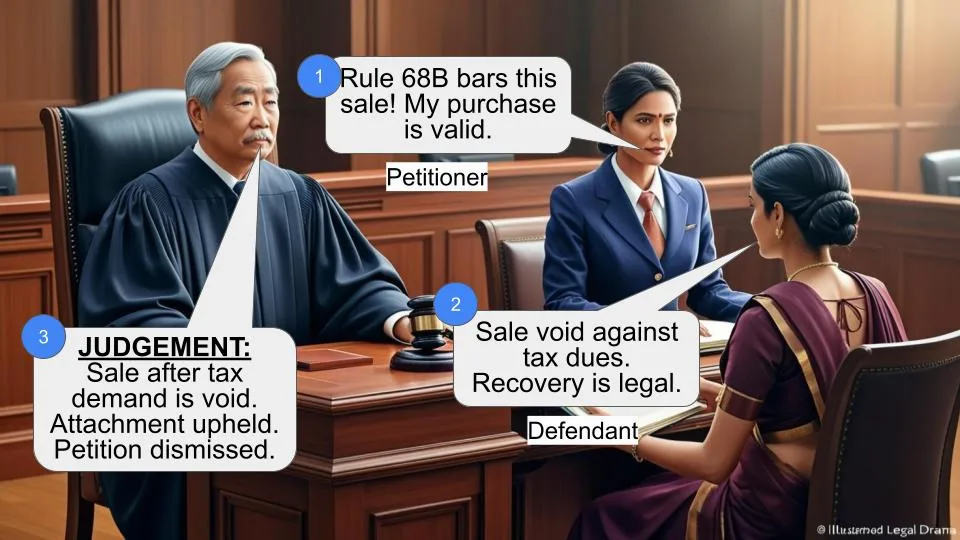
This case involves a dispute over a property auction conducted by the Income Tax Department. The petitioner, who had purchased part of the property from the original owner (4th respondent), challenged the auction sale to the predecessor of respondents 5-8. The court ultimately revoked the auction sale and allowed the petitioner to clear the tax dues to retain the property.
Get the full picture - access the original judgement of the court order here
Case Name:
Mohammed Niyas Vs Commissioner of Income Tax & Others (High Court of Kerala)
W.P(C).No.27423 of 2013(C)
Date: 11th August 2016
Key Takeaways:
- Failure to deposit balance sale consideration can lead to forfeiture of auction rights.
- Rule 58 (of Income Tax Rules, 1962) applies when auction purchasers default.
- Courts may consider equity in long-standing property disputes.
- Original purchasers may be given a chance to clear tax dues in certain circumstances.
Issue:
Should the auction sale be set aside due to the purchaser’s failure to deposit the balance sale consideration, and should the petitioner be allowed to clear the tax dues to retain the property?
Facts:
- The 4th respondent defaulted on income tax payments for 1977-78 and 1978-79.
- The Income Tax Department attached 2.05 acres of the 4th respondent’s property.
- The petitioner and his father purchased 1.5 acres of this property from the 4th respondent in 1985.
- The remaining property was auctioned by the Income Tax Department on 25/02/1987.
- The predecessor of respondents 5-8 successfully bid in the auction, paying 25% of the bid amount.
- The petitioner filed a suit challenging the auction, obtaining an interim injunction.
- The suit was dismissed in 1998, followed by appeals and reviews until 2013.
- The auction purchaser (and later their legal heirs) never deposited the balance sale consideration.
Arguments:
Petitioner:
- The auction purchaser failed to remit the balance consideration despite no stay order for a long period.
- Under Rule 58 of the Second Schedule to the Income Tax Act, the auction purchaser should be deemed a defaulter.
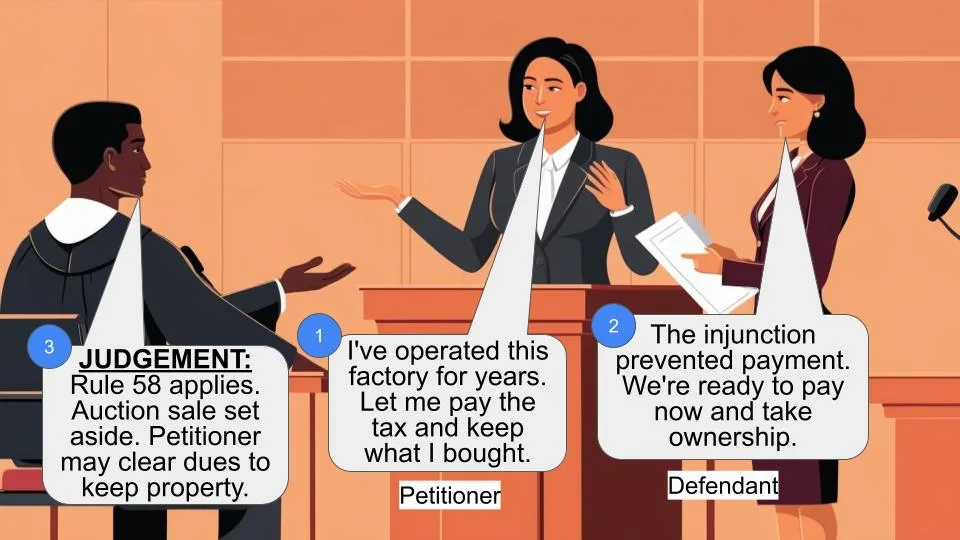
- The petitioner should be allowed to pay the entire dues to the Income Tax Department with interest.
Respondents 5-8:
- The injunction prevented the deposit of the balance consideration for a long time.
- By the time legal proceedings concluded, the original auction purchaser had passed away.
- They are now willing to pay the balance consideration to effect conveyance of the property.
Key Legal Precedents:
The judgment primarily relies on Rule 58 (of Income Tax Rules, 1962), 1961. While no specific case laws are cited, this rule is crucial in determining the outcome of the case.
Judgement:
- The court set aside the auction sale to the predecessor of respondents 5-8.
- The petitioner was given a chance to settle the entire dues under the IT Act by 10/11/2016.
- If the petitioner pays the dues, they will retain unencumbered title to the property covered by Exhibits P1 and P2.
- If the petitioner fails to deposit the amount, the Income Tax Department can proceed with a new auction.
- The court directed the return of the 25% deposit to respondents 5-8, subject to adjustments for re-auction expenses.
FAQs:
Q: Why did the court set aside the auction sale?
A: The auction purchaser failed to deposit the balance sale consideration for a prolonged period, triggering Rule 58 (of Income Tax Rules, 1962).
Q: Why was the petitioner given a chance to clear the tax dues?
A: The court considered equity, as the petitioner had been in possession of the property prior to the auction and had operated a cashew factory there.
Q: What happens if the petitioner doesn’t pay the tax dues?
A: The Income Tax Department can proceed with a new auction of the properties.
Q: Are the original auction purchasers (respondents 5-8) entitled to any compensation?
A: They may apply to the Income Tax authorities for the return of their 25% deposit, which will be considered under Rule 58 (of Income Tax Rules, 1962).
Q: How does this judgment impact future property auctions by tax authorities?
A: It emphasizes the importance of timely payment of the full auction amount and the potential consequences of failing to do so, even in cases of prolonged litigation.

The petitioner is title holder of 1 acre and 50 cents of property, which originally belonged to the 4th respondent, who is now no more and whose legal heirs are impleaded as additional respondents 9 and 10. The property along with some appurtenant land was sold in auction by the 3rd respondent and purchased by one N.H. Sherief, who is now deceased and was the father of respondents 6 to 8 and husband of 5th respondent. The petitioner is challenging the sale in favour of the predecessor-in-interest of respondents 5 to 8.
2. The specific ground raised is that, the auction purchaser failed to remit the balance consideration of sale despite there being no stay order for a long period and, hence, under Rule 58 of the Second Schedule to the Income Tax Act, 1961 [for brevity “IT Act”] the auction purchaser has to be deemed to be a defaulter and the 25% amounts paid on the date of auction has to be forfeited; thus dis-entitling the purchaser from obtaining the conveyance of the said property at this distance of time. It is also prayed that, on such action taken by the Income Tax authorities; deeming the auction purchaser to be a defaulter, the prescription under Rule 58 (of Income Tax Rules, 1962) is to proceed for a fresh auction for sale, which need not be resorted to, since the petitioner now undertakes to pay the entire dues to the Income Tax Department with interest.
3. Respondents 5 to 8 contend that on the date of auction itself the petitioner obtained an injunction against the confirmation, which prevented the deposit of the balance consideration for a long time when the suit was pending before the trial Court. Subsequently, there was also an appeal filed and then a review. By the time the dismissal of the review was effected, the predecessor-in-interest of respondents 5 to 8, the original auction purchaser, died on 01/07/2002. It was in such circumstance that the balance consideration could not be paid and as of now the respondents 5 to 8 are willing to pay the balance consideration to effect conveyance of the property, as bid in auction and affirmed in favour of their predecessor-in-interest.
4. For adjudication of the dispute, necessarily the facts, over a long period of time, have to be looked into. The original defaulter under the IT Act was the 4th respondent. The default was also with respect to the years 1977-78 and 1978-79. Notices of default were said to have been issued on 22/03/1982 and 29/03/1983 respectively. There was also an attachment of 2.05 acres of property standing in the name of the 4th respondent with regard to the dues under the IT Act. The petitioner and his father purchased 60 and 90 cents respectively out of the total extent of 2.05 acres, from the 4th respondent. The sale deed in favour of the petitioner is produced at Exhibit P1 dated 10/10/1985 and the title deeds executed in favour of the petitioner's father were on 10/09/1985 and 30/09/1985. The properties purchased by the father stood conveyed to the petitioner by Exhibit P2 dated 13/06/1991.
5. The petitioner, after the auction purchase, had filed a claim petition, which was rejected and in the claim petition admittedly the contention was that the 4th respondent had sold the property to the petitioner and his father, so as to satisfy the dues under the IT Act. In such circumstance, the petitioner cannot claim to be a bona fide purchaser; nor can he claim that the statutory charge under the IT Act would be effaced by reason of such purchase. Be that as it may, the contention raised is different, insofar as the purchase having not fructified and the purchaser being disabled from seeking for a conveyance at this belated stage, especially on default in payment of balance sale consideration.
6. In this context, the sale proceedings and litigations are to be looked at. Exhibit P6 is the sale notice issued by the 3rd respondent, which indicates the date of sale as 25/02/1987. On 25/02/1987 the predecessor-in-interest of respondents 5 to 8 successfully bid the properties in auction, as is indicated by Exhibit P5 certificate dated 25/02/1987 itself. Admittedly, 25% of the amounts were paid and the balance had to be paid under Rule 58 (of Income Tax Rules, 1962) of Second Schedule to the IT Act within a period of fifteen days from the certificate being issued. On the very date of sale, the petitioner, along with his father, filed O.S.No.32 of 1987 before the Additional Sub Court, Kollam, in which an interim injunction was prayed for, which was granted as per Exhibit P11. Exhibit P11, passed on 25/02/1987, reads as under; in its operative portion:
“Heard. No objection. Confirmation of the sale is stayed till the disposal of I.A.424/87”.
7. It is admitted that the said order continued till the disposal of the suit itself. The suit was dismissed by judgment and decree dated 24/02/1998 [Exhibit P12 judgment]. The additional 6th defendant arrayed in the suit was the predecessor-in-interest of respondents 5 to 8. The purchaser cannot feign ignorance of the dismissal of the suit. The petitioner is then said to have filed an appeal with 44 days delay before this Court, numbered as A.S.No.468 of 1998. Notice was ordered in the delay condonation application and the predecessor-in-interest of respondents 5 to 8 was also issued with notice. There was no order of stay and the delay itself was condoned on 07/02/2000, by which time considerable time had elapsed and the additional 6th defendant in the suit, who is the purchaser of the property, did not care to remit the balance consideration. The appeal was dismissed for default on 25/05/2011. Again a restoration petition was filed before this Court and after hearing the appeal itself, the same stood dismissed on 10/09/2012. A review petition filed, numbered as R.P.678 of 2013, also stood dismissed on 09/10/2013. Admittedly, till date neither the purchaser nor the legal heirs have cared to deposit the balance sale consideration. In such circumstance, Rule 58 (of Income Tax Rules, 1962) of Schedule II of the IT Act comes into operation and the predecessor-in-interest of respondents 5 to 8 would have to be deemed to be a defaulter. The sale in favour of the predecessor in interest of the party respondents 5 to 8, would stand set aside.
8. As rightly pointed out by the learned Counsel for the petitioner, a re-auction would have to be conducted. In such circumstances, after adjusting the expenses for such re-auction, the respondents 5 to 8 should be returned with the balance amount deposited, being 25% of the bid amount, as evidenced by Exhibit P5, if not decided to be forfeited under Rule 58 (of Income Tax Rules, 1962).
9. However, this is a case in which the petitioner has been in possession of the property prior to the date of sale. The petitioner had, in fact, filed a claim petition at the relevant time, which was rejected as per Exhibit P8. The petitioner, admittedly, was in possession of the Cashew factory in the property purchased by him, as is seen from Exhibit P9; a licence issued in the name of the petitioner's father on 22/07/1985. In such circumstance, equity demands that the petitioner be given a chance to settle the entire dues under the IT Act created by the 4th respondent, which also occasioned the charge being created on the property purchased by the petitioner.
10. The respondents 1 to 3 shall, hence, intimate the amounts due as on 10th November, 2016 with any interest accruing to the dues and the petitioner shall be permitted to pay the said amounts within the said period; i.e., on or before 10.11.2016. The intimation of computation of amounts with interest shall be served on the petitioner within three weeks from the date of receipt of a certified copy of this judgment. If the petitioner makes the payment prior to 10/11/2016, deduction in the interest shall also be made so as to compute the interest only till the date of payment. If such payment is made, attachment shall be lifted. It is also directed that if amounts with respect to the dues have already been received, the same shall be deducted; for which the petitioner relies on Exhibit P10. The petitioner then shall be retained and reverted with unencumbered title of the property covered by Exhibits P1 and P2. The balance property covered by Exhibit P 5 shall then be enjoyed by the legal heirs of the 4th respondent or their assignees.
11. In that circumstance, it would have to be considered as to whether the respondents 5 to 8 can be returned with the 25% amount deposited. That is a matter for which an appropriate application ca0n be made before the Income Tax authorities; which would be considered in accordance with law, under Rule 58 (of Income Tax Rules, 1962).
12. If the petitioner fails to deposit the amount as directed hereinabove, then necessarily the Income Tax Department would be entitled to proceed for auction and sale of the properties, in which event any amounts remaining after satisfaction of the dues will be paid to the petitioner and the legal heirs or assignees of the 4th respondent, in proportion to the extent of their respective holding.
The writ petition is allowed with the above directions.
Parties are left to suffer their respective costs.
Sd/-
K.Vinod Chandran
Judge.
×