


Full News

Court rules against Revenue in tax reassessment case, affirming validity of original assessment.
Court rules against Revenue in tax reassessment case, affirming validity of original assessment.
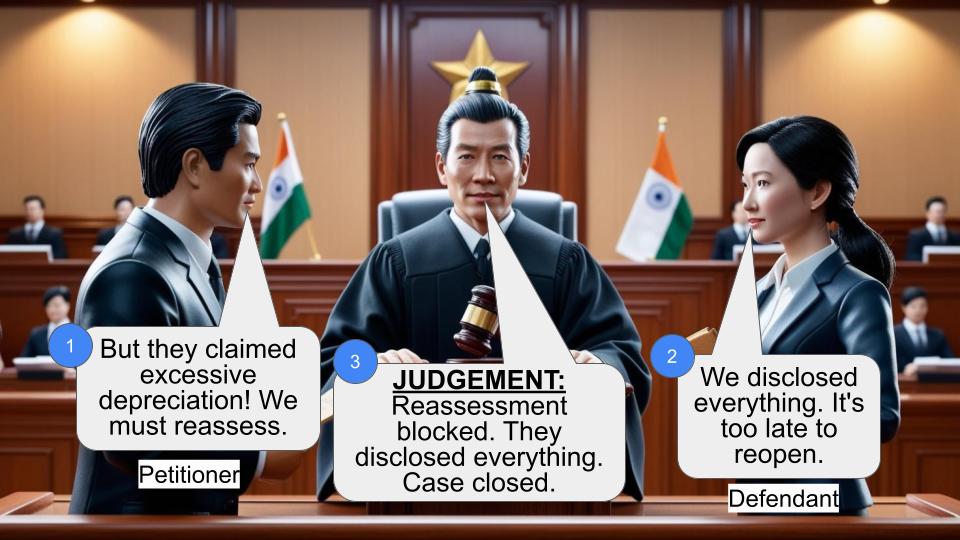
In the case of Commissioner of Income Tax vs. Schwing Stetter India P. Ltd., the court addressed whether the Income Tax Appellate Tribunal was correct in upholding the order of the Commissioner of Income Tax (Appeals) that deemed the reassessment proceedings invalid. The court ultimately sided with the assessee, confirming that the reassessment was based on a mere change of opinion rather than new evidence.
Get the full picture - access the original judgement of the court order here
Case Name:
Commissioner of Income Tax vs. Schwing Stetter India P. Ltd. (High Court of Madras)
Tax Case (Appeal) No.217 of 2015
Date: 2nd June 2015
Key Takeaways:
- The court emphasized that reassessment cannot be based solely on a change of opinion.
- It reinforced the principle that the Assessing Officer must have tangible material to justify reopening an assessment.
- The decision highlights the importance of full disclosure of material facts by the assessee during the original assessment.
Issue
Was the Appellate Tribunal correct in upholding the order of the CIT(A) that the reassessment proceedings were invalid?
Facts
- The case pertains to the assessment year 2001-2002, where Schwing Stetter India P. Ltd. filed a return admitting an income of ₹1,36,15,445.
- The original assessment was completed under Section 143(3) (of Income Tax Act, 1961), determining the total income at ₹1,40,40,250.
- The Assessing Officer later issued a notice under Section 148 (of Income Tax Act, 1961) to reopen the assessment, claiming the assessee failed to disclose details regarding MODVAT credit.
- The assessee argued that the details were already provided during the original assessment, and the reopening was merely a change of opinion.
Arguments
- For the Revenue: The Assessing Officer contended that the assessee did not fully disclose material facts regarding MODVAT credit, justifying the reopening of the assessment.
- For the Assessee: The company argued that all relevant details were disclosed during the original assessment, and the reopening was based on the same material, constituting a mere change of opinion.
Key Legal Precedents
- CIT v. Cholamandalam Investment and Finance Company Limited, 309 ITR 110: This case established that reopening assessments based on previously available information is not permissible.
- CIT v. Kelvinator of India Ltd., 320 ITR 561 (SC): The Supreme Court ruled that the Assessing Officer can only reopen assessments if there is tangible material indicating income has escaped assessment, not merely based on a change of opinion.
Judgement
The court upheld the decision of the Income Tax Appellate Tribunal, affirming that the reassessment proceedings initiated by the Revenue were invalid. The court reasoned that the details regarding MODVAT credit were already available during the original assessment, and the reopening was based on a mere change of opinion without any new evidence. Consequently, the appeal by the Revenue was dismissed.
FAQs
Q1: What does this ruling mean for the Revenue?
A1: The ruling indicates that the Revenue cannot reopen assessments without new evidence and cannot rely on a mere change of opinion.
Q2: How does this affect other taxpayers?
A2: This case sets a precedent that emphasizes the importance of full disclosure during assessments and protects taxpayers from arbitrary reassessments.
Q3: What happens next for Schwing Stetter India P. Ltd.?
A3: The company will not face the reassessment, and the original assessment stands as valid.
Q4: Can the Revenue appeal this decision?
A4: The ruling from the High Court is typically final unless there are grounds for further appeal to the Supreme Court, which would require substantial legal questions.

1. This Tax Case (Appeal) is filed by the Revenue as against the order of the Income Tax Appellate Tribunal raising the following substantial question of law:
“1. Whether on the facts and in the circumstances of the case, the Appellate Tribunal was right in upholding the order of the CIT(A) who held that the reassessment proceedings made was not valid?
2. Is not the finding of the Tribunal bad especially when the assessee had not furnished the details relating to working of MODVAT which resulted in failure on the part of the assessee by not disclosing fully and truly all material facts that was necessary for assessment?”
2. The brief facts of the case are as follows:
The assessment in this case relates to the assessment year
2001-2002. The assessee is engaged in the business of manufacture
of concrete mixtures, concrete pumps, concrete mixing plants
components and software development. The assessee company had
filed its return of income for the assessment year admitting a total
income of Rs.1,36,15,445/-. The return was processed under Section
143(1) of the Income Tax Act and subsequently assessment under
Section 143(3) (of Income Tax Act, 1961) was made by the Assessing
Officer determining the total income at Rs.1,40,40,250/-. Thereafter,
the Assessing Officer had issued notice under Section 148 (of Income Tax Act, 1961) of the
Income Tax Act for initiating proceedings under Section 147 (of Income Tax Act, 1961) of the
Income Tax Act. In response to the said notice, the assessee filed a
letter dated 16.4.2008 requesting to treat the original return filed as
the return filed in response to the notice issued under Section 148 (of Income Tax Act, 1961) of
the Income Tax Act. Thereafter, notice under Section 143(2) (of Income Tax Act, 1961) was
issued to reopen the assessment. The assessee had asked for reasons
for reopening the assessment and it appears the reasons were
communicated to the assessee on the same day. In the return of
income filed, the assessee had arrived the MODVAT Credit utilization
during the current year. According to the Assessing Officer, as per
memo of computation of income, the excise duty debited to Profit and
Loss Account which was actually payable after adjustment of MODVAT
Credit was Rs.3,73,70442/- and the same would be paid at the time of
removal of finished goods and collected from purchasers. Hence, the
Assessing Officer took the view that there was no question of
adjustment of excise duty paid on finished goods upto the date of filing
the return. Accordingly, the Assessing Officer issued show cause
notice calling for explanation from the assessee as to why the excess
claim made by the assessee to the tune of Rs.22,60,275/- has to be
rejected. In response to the same, the assessee had replied that the
working of MODVAT credit had correctly made and submitted a
detailed working sheet justifying the correctness of the claim.
However, the Assessing Officer did not accept the said explanation and
came to hold that excise duty on finished goods had to be included in
the total income, since, the value of closing stock of finished goods
represented value as on 31
st March of each year ready for removal but
not removed from the factory. Thus, the Assessing Officer was of the
view that the excise duty did not get crystallised as on 31
st March and
it would get crystallised only at the time of actual removal and based
on the closing stock, no provision for payment of duty could be created
and therefore, a sum of Rs.22,60,275/- was added to the total income
of the assessee. Accordingly, he made re-assessment disallowing the
excess MODVAT Credit.
3. Aggrieved by the same, the assessee had filed an appeal
before the Commissioner of Income Tax (Appeals), who was of the
view that the workings pertaining to the MODVAT Credit had already
available before the Assessing Officer at the time of passing an order
under Section 143(3) (of Income Tax Act, 1961) and the re-assessment
proceedings have been initiated on a mere change of opinion on the
same material on record. Reliance was placed by the assessee before
the Commissioner of Income Tax (Appeals) the decision of this Court
in the case of CIT V. Cholamandalam Investment and Finance
Company reported in 309 ITR 110; CIT V. Tamilnadu Transport
Development Finance Corporation Limited reported in 306 ITR 136 and
CIT V. Kelvinator of India Ltd. reported in 320 ITR 561(SC). After
hearing both sides, the Commissioner of Income Tax (Appeals)
allowed the appeal in favour of the assessee holding as follows:
“4.2. I have carefully considered the facts of the
case and the submission of the ld. AR. I have also
gone through the decisions relied on by the ld. AR. In
this case return was filed on 29.10.2001. It was
processed on 02.01.2003. Subsequently, assessment
order u/s. 143(3) (of Income Tax Act, 1961) was passed on 31.03.2004. Notice
for reopening the assessment u/s 148 (of Income Tax Act, 1961) has been issued
on 28.03.2008. Thus it is clear that the notice was
issued beyond four years from the end of the relevant
assessment year. The appellant has claimed that the
original assessment was completed after obtaining all
the details required for the purpose of assessment. It
is seen that the AO has reopened the assessment to
disallow the excess claim made by the appellant in
respect of MODVAT Credit. The appellant has stated
that the details of MODVAT credit was given in
Annexure 1(A) of the Tax Audit Report. Further, the
appellant itself has disallowed the amount in
computing the total income for the year. Therefore,
the ld. AR has stated that the addition made by the AO
actual tantamount to duplication of disallowance.
Regarding the reopening the appellant has relied on
the decision in the case of CIT V. Cholamandalam
Investment and Finance Company 309 ITR 110; CIT V.
Tamilnadu Transport Development Finance Corporation
Limited 306 ITR 136 and CIT V. Kelvinator of India Ltd.
320 ITR 561(SC). He has also given the decision of
the ITAT, Mumbai dated 29.03.2010. After perusing
the details I am of the opinion that the AO could not
have reopened the assessment because of the details
required for the assessment were available on record
at the time of passing the original order u/s 143(3) (of Income Tax Act, 1961).
The details of MODVAT working for the purpose of
s.145A was provided by the appellant in Annexure 1(A)
at point No.12(b) of the return of income. Therefore,
as the details pertaining to MODVAT were already
available to the AO during the assessment proceedings
u/s 143(3) (of Income Tax Act, 1961), the reassessment proceedings have been
initiated on mere change of opinion on the same
material on record and, therefore, would amount to
review of earlier assessment which is not permissible.
This view is supported by decision of Hon'ble Supreme
Court in the case of CIT v. Kelvinator of India Ltd
(supra) where it was held that AO can reopen the
assessment only if there is tangible material to come
to the conclusion that there is escapement of income.
Reopening cannot be done on change of opinion only.
The AO does not have power to review and has power
only to reassess. I am of the opinion that the ratio of
this decision is applicable to the facts of the case. I
also find that the Hon'ble ITAT, Mumbai in the case of
Modepro India Private Limited (supra) has allowed the
appeal of the appellant under similar facts. In the
above case the AO completed the assessment u/s
143(3). Subsequently, on the perusal of records the
AO noticed that the assessee had failed to include
Modvat credit in its closing stock in contravention of
the provisions of section 145A (of Income Tax Act, 1961). The AO issued notice
u/s 148 (of Income Tax Act, 1961) after the expiry of four years from the end of
the relevant assessment year and completed
assessment after making addition on account of
Modvat credit. The CIT(A) directed the AO to verify
the facts and make addition if there is difference in the
figure. The ITAT, under the above circumstances, held
that there was no failure on the part of the assessee to
disclose fully and truly all material facts qua the
Modvat credit as the same was part of Tax Audit
Report annexed to the Balance sheet filed along with
the return of income. The notice being beyond the
period of four year was obviously time barred. The
assessment flowing out of such time barred notice
cannot stand and was therefore quashed. In view of
the above precedents and the facts of the case, it is
held that the reopening is not valid and hence the
ground is allowed."
4. On the issue of disallowance of MODVAT credit on opening
stock, the Commissioner of Income Tax (Appeals) held that it has
become academic in nature, as he found that the reopening of
assessment by the Assessing Officer was not valid.
5. Aggrieved by the said order of the Commissioner of Income
Tax (Appeals), the Revenue pursued the matter before the Income Tax
Appellate Tribunal. The Tribunal, after hearing both sides, concurred
with the view of the Commissioner of Income Tax (Appeals), thereby,
dismissed the appeal holding as follows:
"11. We have heard both the sides and considered
the material on record and find that the return of income
for the year under consideration was filed on 29.10.2001,
which was first processed under section 143(1) (of Income Tax Act, 1961) on
02.01.2003 and subsequently assessment was framed
under section 143(3) (of Income Tax Act, 1961) on 31.03.2004, whereas, notice
under section 148 (of Income Tax Act, 1961) was issued on 28.03.2008, which
period is beyond four years from the end of assessment
year and no fresh material or evidence is found to have
come in the possession of the Assessing Officer when
reopening was done to disallow the excess claim made by
the assessee in respect of MODVAT credit and the
assessee has stated that the details of MODVAT credit are
given in Annexure 1(a) of the tax audit report. Further,
the assessee itself is stated to have disallowed the amount
in computing the total income for the year and further
disallowance of the same amount in computing the total
income for the year and further disallowance of the same
amount, amounted to duplication of the disallowance and
otherwise, all the details required for the assessment were
available on record at the time of passing of the original
order under section 143(3) (of Income Tax Act, 1961). when details of MODVAT
working for the purpose of section 145A (of Income Tax Act, 1961) was provided by
the assessee in Annexure 1(A) at point No.12(b) of the
return of income. So, the reassessment proceeding
initiated in the absence of any fresh material or evidence
coming into the possession of the Assessing Officer has
rightly been held to be mere change of opinion on the
same material already on record as held by the Hon'ble
Jurisdictional High Court in the case of CIT v.
Cholamandalam Investment and Finance Company Limited
(supra). Therefore, in view of the facts, circumstances
and material on record, we hold that the issue is squarely
covered in favour of the assessee and the ld. CIT(A) has
exactly did the same thing to treat the reassessment to be
not valid in law. Therefore, while, upholding the order of
the ld. CIT(A), we dismiss the appeal of the Revenue
being devoid of any merits."
6. Aggrieved by the said order of the Tribunal, the Revenue is
before this Court.
7. Mr.T.Ravikumar, learned Standing Counsel appearing for the
Revenue tried to distinguish the decision of this Court in the case of
CIT v. Cholamandalam Investment and Finance Company
Limited reported in 309 ITR 110 by placing reliance on the decision
of the Bombay High Court in the case of Dr.Amin's Pathology
Laboratory V. P.N.Prasad, Joint Commissioner of Income Tax
and others (No.1) reported in [2001] 252 ITR 673. He laid
emphasis on this decision to state that the mere production of balance
sheet and profit and loss account will not amount to disclosure within
the meaning of first proviso to Section 147 (of Income Tax Act, 1961). He
submitted that Explanation 1 and 2(c)(i) and (iii) to Section 147 (of Income Tax Act, 1961) of the
Income Tax Act would get attracted to the facts of the case and hence,
the Assessing Officer is correct in initiating re-assessment proceedings.
8. Heard Mr.T.Ravikumar, learned Standing Counsel appearing
for the Revenue at length and perused the materials placed before this
Court.
9. Before going into the merits of the case, for better
appreciation, we first consider the scope of Section 147 (of Income Tax Act, 1961) and the first
proviso. The said provision reads as follows:
"Income escaping assessment.
147. If the Assessing Officer has reason to believe that
any income chargeable to tax has escaped assessment for
any assessment year, he may, subject to the provisions of
sections 148 to 153, assess or reassess such income and
also any other income chargeable to tax which has escaped
assessment and which comes to his notice subsequently in
the course of the proceedings under this section, or
recompute the loss or the depreciation allowance or any
other allowance, as the case may be, for the assessment
year concerned (hereafter in this section and in sections
148 to 153 referred to as the relevant assessment year) :
Provided that where an assessment under sub-
section (3) of section 143 (of Income Tax Act, 1961) or this section has been
made for the relevant assessment year, no action
shall be taken under this section after the expiry of
four years from the end of the relevant assessment
year, unless any income chargeable to tax has
escaped assessment.
Provided further that the Assessing Officer may assess or
reassess such income, other than the income involving
matters which are the subject-matter of any appeal,
reference or revision, which is chargeable to tax and has
escaped assessment.
Explanation 1.—Production before the Assessing
Officer of account books or other evidence from
which material evidence could with due diligence
have been discovered by the Assessing Officer will
not necessarily amount to disclosure within the
meaning of the foregoing proviso.
Explanation 2.—For the purposes of this section, the
following shall also be deemed to be cases where
income chargeable to tax has escaped assessment,
namely :—
(a) where no return of income has been furnished by the
assessee although his total income or the total income of
any other person in respect of which he is assessable
under this Act during the previous year exceeded the
maximum amount which is not chargeable to income-tax ;
(b) where a return of income has been furnished by the
assessee but no assessment has been made and it is
noticed by the Assessing Officer that the assessee has
understated the income or has claimed excessive loss,
deduction, allowance or relief in the return ;
(c) where an assessment has been made, but—
(i) income chargeable to tax has been under
assessed ; or
(ii) such income has been assessed at too low a rate ; or
(iii) such income has been made the subject of
excessive relief under this Act ; or
(iv) excessive loss or depreciation allowance or any other
allowance under this Act has been computed.
(emphasis supplied)
10. A plain reading of the above provision reveals that if the
Assessing Officer had reason to believe that income chargeable to tax
had escaped assessment, in exercise of his power under Section 147 (of Income Tax Act, 1961) of
the Income Tax Act, he may pursue the matter in accordance with the
said provision by issuing notice to the assessee within a period of four
years. Admittedly, in the present case, the proceedings initiated is
beyond the period of four years from the end of the relevant
assessment year. It is not the case of the Department that the
assessee has failed to file a return under Section 139 (of Income Tax Act, 1961) or failed to
respond to the notice issued under Section 142 (of Income Tax Act, 1961) or Section 148 (of Income Tax Act, 1961) of the
Income Tax Act . The only other issue is whether there was any
failure on the part of the assessee to disclose fully and truly all
material facts necessary for the assessment for that assessment year.
11. Before the Commissioner of Income Tax (Appeals), the
assessee had argued and filed written submissions, which were
extracted in the order of the Commissioner of Income Tax (Appeals).
For better clarity, we extract the same hereunder:
"a. The assessment was reopened after a lapse of four
years from the end of the assessment year vide notice u/s
148 of the Act, dated 28
th March, 2008. The appellant
humbly submits that the initial assessment by the learned
AO was completed after obtaining all details required for
the purpose of assessment. Hence, the assessment cannot
be reopened.
b. In this regard, the appellant relates to the decision of
jurisdictional High Court in the case of CIT v.
Cholamandalam Investment and Finance Company Limited
209 ITR 110 and case of CIT v. Tamil Nadu Transport
Development Finance Corporation Limited 306 ITR 136.
c. The assessment having been completed under scrutiny
u/s 143(3) (of Income Tax Act, 1961), any further reopening would amount to only a
change of opinon.
d. Details with respect to MODVAT working was specifically
given in Annexure 1(A) to the Tax Audit report, which is
intended exclusively for the purpose of scrutiny and
assessment proceedings.
e. The Supreme Court of India in the case of CIT v.
Kelvinator of India Ltd. Civil -2010-TIOL-06-SC-IT-LB held
that it was not open to the assessing officer to review his
own decision as the learned Assessing Officer has not
demonstrated any fresh material that has been received
after completion of assessment.”
12. Having furnished the details of the working of the MODVAT
Credit in Annexure 1(A) to the Tax Audit Report, which is a mandate as
per the provisions of the Act and the Assessing Officer has considered
the said issue in the order passed under Section 143(3) (of Income Tax Act, 1961), the Commissioner of Income Tax (Appeals) has given a clear
finding that the details of MODVAT credit working were considered by
the Assessing Officer during the assessment proceedings under Section
143(3) and the re-assessment is initiated on a mere change of opinion
on the same material on record. Such being the case, the issue is
whether there was a failure on the part of the assessee to disclose fully
and truly all material facts necessary for assessment. The answer is a
clear 'no'. The Department, at the threshold, has to cross the first
proviso to Section 147 (of Income Tax Act, 1961) before proceeding
further to reopen the assessment on the ground of income escaping
assessment.
13. For the purpose of assumption of jurisdiction under Section
147 of the Income Tax Act, the Officer must have reason based on
materials that there has been an income escaping assessment, which
warranted assumption of jurisdiction under Section 147 (of Income Tax Act, 1961). A perusal of the assessment order shows that the Assessing
Officer had not mentioned that there are materials for escapement of
income. The Assessing Officer also did not record any reason that
there was failure on the part of the assessee to disclose fully and truly
all material facts necessary for assessment.
14. We find from the order of the Commissioner of Income Tax
(Appeals) and the Tribunal and also on facts as has been culled out
from the assessment order in question that there is no element of
failure to disclose fully and truly all material facts necessary for
assessment.
15. The reliance placed by the learned Standing Counsel
appearing for the Revenue on Explanation (1) to Section 147 (of Income Tax Act, 1961) of the
Income Tax Act cannot be pressed into service by the Department in
the instant case, because the details of such claim has been revealed
in the Tax Audit Report and apparently, the same has been considered
by the Assessing Officer at the time of passing an order under Section
143(3) of the Income Tax Act. Therefore, Explanation (1) does not get
attracted to this case. Explanation (2)(c)(i) and (iii) to Section 147 (of Income Tax Act, 1961) of
the Income Tax Act, which is sought to be invoked in the present case,
can arise only in a case where the Department is able to establish that
there is income escaping assessment and the proviso to Section 147 (of Income Tax Act, 1961)
gets attracted. In this case, we find that the finding of the
Commissioner of Income Tax (Appeals) and the Tribunal is that the
Proviso to Section 147 (of Income Tax Act, 1961) did not get attracted and
it is a case of mere change of opinion of the Assessing Officer.
16. Our view is fortified by the decision of the Full Bench of the
Delhi High Court in the case of Commissioner of Income Tax V.
Kelvinator of India Ltd. reported in [2002] 256 ITR 1 (Del),
wherein, the Delhi High Court held as follows:
“We also cannot accept the submission of Mr. Jolly to
the effect that only because in the assessment order,
detailed reasons have not been recorded an analysis of the
materials on the record by itself may justify the Assessing
Officer to initiate a proceeding under section 147 (of Income Tax Act, 1961).
The said submission is fallacious. An order of assessment
can be passed either in terms of sub-section (1) of section
143 or sub-section (3) of section 143 (of Income Tax Act, 1961). When a regular order
of assessment is passed in terms of the said sub-section (3)
of section 143 (of Income Tax Act, 1961) a presumption can be raised that such an
order has been passed on application of mind. It is well
known that a presumption can also be raised to the effect
that in terms of clause (e) of section 114 (of Income Tax Act, 1961) of the Indian
Evidence Act judicial and official acts have been regularly
performed. If it be held that an order which has been
passed purportedly without application of mind would itself
confer jurisdiction upon the Assessing Officer to reopen the
proceeding with out anything further, the same would
amount to giving a premium to an authority exercising
quasi-judicial function to take benefit of its own wrong.”
17. The above said decision of the Full Bench of the Delhi High
Court was upheld by the Supreme Court in the decision reported in
[2010] 320 ITR 561 (SC) COMMISSIONER OF INCOME-TAX v.
(1) KELVINATOR OF INDIA LTD., wherein the Supreme Court held
that the concept of "change of opinion" on the part of the Assessing
Officer to reopen the assessment did not stand obliterated after the
substitution of Section 147 (of Income Tax Act, 1961). The Supreme
Court also held that the Assessing Officer has power to reopen the
assessment, provided there is "tangible material" to come to a
conclusion that there was an escapement of income from assessment.
For better appreciation, the relevant portion of the said decision reads
as follows:
“6. On going through the changes, quoted above,
made to section 147 (of Income Tax Act, 1961), we find that, prior to
the Direct Tax Laws (Amendment) Act, 1987, reopening
could be done under the above two conditions and
fulfilment of the said conditions alone conferred
jurisdiction on the Assessing Officer to make a back
assessment, but in section 147 (of Income Tax Act, 1961) (with effect
from 1st April, 1989), they are given a go-by and only
one condition has remained, viz., that where the
Assessing Officer has reason to believe that income has
escaped assessment, confers jurisdiction to reopen the
assessment. Therefore, post-1st April, 1989, power to
reopen is much wider. However, one needs to give a
schematic interpretation to the words " reason to
believe" failing which, we are afraid, section 147 (of Income Tax Act, 1961) would
give arbitrary powers to the Assessing Officer to reopen
assessments on the basis of " mere change of opinion",
which cannot be per se reason to reopen. We must also
keep in mind the conceptual difference between power
to review and power to reassess. The Assessing Officer
has no power to review ; he has the power to reassess.
But reassessment has to be based on fulfilment of
certain preconditions and if the concept of " change of
opinion" is removed, as contended on behalf of the
Department, then, in the garb of reopening the
assessment, review would take place. One must treat
the concept of " change of opinion" as an in-built test to
check abuse of power by the Assessing Officer. Hence,
after 1st April, 1989, the Assessing Officer has
power to reopen, provided there is " tangible
material" to come to the conclusion that there is
escapement of income from assessment. Reasons
must have a live link with the formation of the
belief. Our view gets support from the changes made
to section 147 (of Income Tax Act, 1961), as quoted herein above.
Under the Direct Tax Laws (Amendment) Act, 1987,
Parliament not only deleted the words " reason to
believe" but also inserted the word " opinion" in section
147 of the Act. However, on receipt of representations
from the companies against omission of the words "
reason to believe", Parliament reintroduced the said
expression and deleted the word " opinion" on the
ground that it would vest arbitrary powers in the
Assessing Officer. We quote hereinbelow the relevant
portion of Circular No. 549 dated October 31, 1989
([1990] 182 ITR (St.) 1,29), which reads as follows :
"7.2 Amendment made by the Amending Act,
1989, to reintroduce the expression ' reason to
believe' in section 147 (of Income Tax Act, 1961).—A number of
representations were received against the
omission of the words ' reason to believe' from
section 147 (of Income Tax Act, 1961) and their substitution by the '
opinion' of the Assessing Officer. It was pointed
out that the meaning of the expression, ' reason
to believe' had been explained in a number of
court rulings in the past and was well settled and
its omission from section 147 (of Income Tax Act, 1961) would give arbitrary
powers to the Assessing Officer to reopen past
assessments on mere change of opinion. To allay
these fears, the Amending Act, 1989, has again
amended section 147 (of Income Tax Act, 1961) to reintroduce the
expression ' has reason to believe' in place of the
words ' for reasons to be recorded by him in
writing, is of the opinion' . Other provisions of the
new section 147 (of Income Tax Act, 1961), however, remain the same."
(emphasis supplied)
18. Similar view has been taken by this Court in the decision
reported in [2009] 309 ITR 110 (Mad) COMMISSIONER OF
INCOME-TAX v. CHOLAMANDALAM INVESTMENT AND FINANCE
CO. LTD. , wherein it was held as follows:
“In those circumstances, it could not be regarded
that the assessee had failed to disclose fully and truly all
material facts relevant for the assessment. As the facts
revealed that the Assessing Officer who made the original
assessment order has called for all the details regarding
the case where 100 per cent. depreciation were claimed
and the assessee had furnished the invoices for purchase
of assets on which 100 per cent. depreciation were
claimed, there was no failure on the part of the assessee
and if at all there was any failure, according to the
Commissioner of Income-tax (Appeals), it was on the
part of the Assessing Officer, who made the original
assessment without going behind the nature of the
transactions accepting the details furnished by the
assessee. The Tribunal also extracted that portion of the
order and found on the fact that there was no fault on
the part of the assessee so as to enable the Department
to reopen the assessment as the proviso to section 147 (of Income Tax Act, 1961)
of the Income-tax Act would squarely apply to the case
of the assessee. We find no infirmity in the order passed
by the Tribunal. Hence, the appeal is dismissed.”
19. In an identical circumstance, a learned single Judge of this
Court had considered the issue in the decision reported in [2000] 241
ITR 672 (Mad) FENNER (INDIA) LTD. v. DEPUTY
COMMISSIONER OF INCOME-TAX, wherein, it was observed as
follows:
“ The pre-condition for the exercise of the power
under section 147 (of Income Tax Act, 1961) in cases where power is exercised
within a period of four years from the end of the relevant
assessment year is the belief reasonably entertained by
the Assessing Officer that any income chargeable to tax
has escaped assessment for that assessment year.
However,when the power is invoked after the expiry of
the period of four years from the end of the assessment
year, a further pre-condition for such exercise is imposed
by the proviso namely, that there has been a failure on
the part of the assessee to make a return under section
139 or in response to a notice issued under section 142 (of Income Tax Act, 1961)
or section 148 (of Income Tax Act, 1961) or failure on the part of the assessee to
disclose fully and truly all material facts necessary for his
assessment for that assessment year. Unless, the
condition in the proviso is satisfied, the Assessing Officer
does not acquire jurisdiction to initiate any proceeding
under section 147 (of Income Tax Act, 1961) after the expiry of four
years from the end of the assessment year. Thus, in
cases where the initiation of the proceedings is beyond
the period of four years from the end of the assessment
year, the Assessing Officer must necessarily record not
only his reasonable belief that income has escaped
assessment but also the default or failure committed by
the assessee. Failure to do so would vitiate the notice
and the entire proceedings. The relevant words in the
proviso are,
“. . . . unless any income chargeable to tax has escaped
assessment for such assessment year by reason of the
failure on the part of the assessee ... . .”
Mere escape of income is insufficient to justify the
initiation of action after the expiry of four years from the
end of the assessment year. Such escapement must be
by reason of the failure on the part of the assessee either
to file a return referred to in the proviso or to truly and
fully disclose the material facts necessary for the
assessment.
Whenever a notice is issued by the Assessing Officer
beyond a period of four years from the end of the
relevant assessment year, such notice being issued
without recording the reasons for his belief that income
escaped assessment, it cannot be presumed in law that
there is also a failure on the part of the assessee to file
the returns referred to in the proviso or a failure to fully
and truly disclose the material facts. The reasons
referred to in the main paragraph of section 147 (of Income Tax Act, 1961) would,
in cases where the proviso is attracted, include reasons
referred to in the proviso and it is necessary for the
Assessing Officer to record that any one or all the
circumstances referred to in the proviso existed before
the issue of notice under section 147 (of Income Tax Act, 1961).
After an assessment has been made, in the normal
circumstances, there would be no reason for anyone to
doubt that the assessment has been made on the basis
of all relevant facts. If the Assessing Officer chooses to
entertain the belief that the assessment has been made
in the background of the assessee’s failure to disclose
truly and fully all material facts, it is necessary for him to
record that fact, and in the absence of a record to that
effect, it cannot be held that a notice issued without
recording such a fact is capable of being regarded as a
valid notice. As to whether the material facts disclosed by
the assessee are full and true is always a question of fact
and unless the facts disclosed had been examined in
relation to the extent of failure if any on the part of the
assessee, it is not possible to form the opinion that there
had been a failure on the assessee’s part to truly and
fully disclose the material facts. A notice issued without a
record of the Assessing Officer’s reasonable belief that
there was such failure on the part of the assessee would
be indicative of a failure on the part of the Assessing
Officer to apply his mind to material facts, and on that
ground also the notice issued would be vitiated.
The reasons actually recorded and as set out by the
officer in the counter affidavit are such that even after
close scrutiny they do not establish even prima facie a
failure on the part of the assessee to fully and truly
disclose the material facts for the assessment.
.........
The duty of an assessee is limited to fully and truly
disclosing all the material facts. The assessee is not
required thereafter to prepare a draft assessment order.
If the details placed by the assessee before the
Assessing Officer were in conformity with the
requirements of all applicable laws and known
accounting principles, and material details had been
exhibited before the Assessing Officer, it is for the
Assessing Officer to reach such conclusions as he
considered was warranted from such data and any
failure on his part to do so cannot be regarded as the
assessee’s failure to furnish the material facts truly and
fully. Any lack of comprehension on the part of the
Assessing Officer in understanding the details placed
before him cannot confer a justification for reopening the
assessment, long after the period of four years had
expired. On the facts of this case, it is clear that the
escapement of income, if any, on this account is not on
account of any failure on the assessee’s part to disclose
the material facts fully and truly. The notice issued by
the Assessing Officer in exercise of his power under
section 147 (of Income Tax Act, 1961), therefore, cannot be sustained.”
20. In the case of ICICI Securities Ltd. V. Assistant
Commissioner of Income Tax 3(2), Mumbai, the Bombay High
Court vide order dated 22.08.2006 in W.P.No.1919 of 2006, while
dealing with the issue on the reopening of assessment, held as follows:
"7. In the facts of the present case, there is nothing new
which has come to the notice of the revenue. The accounts
had been furnished by the Petitioner when called upon.
Thereafter the assessment was completed under section
143(3) of the Income Tax Act. Now, on a mere relook, the
officer has come to the conclusion that the income has
escaped assessment and he is of course justified in his
analysis. In our view, this is not something which is
permissible under the proviso to section 147 (of Income Tax Act, 1961) which speaks about a failure on the part of the
assessee to make a proper return. In the present case, no
such case is made out on the record.
8. In the circumstances, we allow this petition in terms of
prayer (a) and quash and set aside the notice dated 27th
March 2006 directing reopening of the assessment for the
year 1999-2000."
21. The above-said view of the Bombay High Court was affirmed
by the Supreme Court in Civil Appeal No.5960 of 2012.
22. In the light of the above, we hold that when the Assessing
Officer had failed to record anywhere his satisfaction or belief that the
income chargeable to tax had escaped assessment on account of the
failure of the assessee to disclose truly and fully all material facts
necessary for assessment, the notice issued under Section 147 (of Income Tax Act, 1961) of the
Income Tax Act beyond the period of four years was wholly without
jurisdiction and cannot be sustained.
23. Hence, we have no hesitation in holding that reopening is
bad. Accordingly, we uphold the findings of the Tribunal that it is a
case of mere change of opinion on the same material already available
on record, which has been submitted by the assessee in Annexure 1A
of the Tax Audit Report at Point No.12(b) of the return of income.
24. The reliance placed by the learned Standing Counsel
appearing for the Revenue on the decision of the Bombay High Court
in the case of Dr.Amin's Pathology Laboratory V. P.N.Prasad,
Joint Commissioner of Income Tax and others (No.1) reported
in [2001] 252 ITR 673 cannot come to the aid of the Department, in
view of the decision of the Supreme Court in the case of CIT V.
Kelvinator of India Ltd. Reported in 320 ITR 561(SC), which was
rendered subsequently; in any event, on facts, the said decision of the
Bombay High Court stands distinguished.
25. In view of our finding that reopening of the assessment
itself is bad, it is not necessary to go into the second question.
Accordingly, the Tax Case (Appeal) stands dismissed. No costs.
Index: Yes / No (R.S.,J.) (K.B.K.V.,J.)
Internet: Yes / No 02.06.2015
To
1. The Income Tax Appellate Tribunal, Madras 'A' Bench.
2. The Commissioner of Income Tax (Appeals), Large Taxpayer Unit,
Chennai.
3. The Assistant Commissioner of Income Tax, Large Taxpayer Unit,
Chennai.
R.SUDHAKAR,J.
AND
K.B.K.VASUKI,J.
Tax Case (Appeal) No.217 of 2015
02.06.2015
×
Similar Ripples
Questions
Court rules against Revenue in tax reassessment case, affirming validity of original assessment.
Write your CommentSimilar Posts


Generic
- Reportdata/3714.pdf
