


Court Rules Factoring Charges Not Subject to TDS as Interest



Full News
Court Rules Factoring Charges Not Subject to TDS as Interest
Court Rules Factoring Charges Not Subject to TDS as Interest
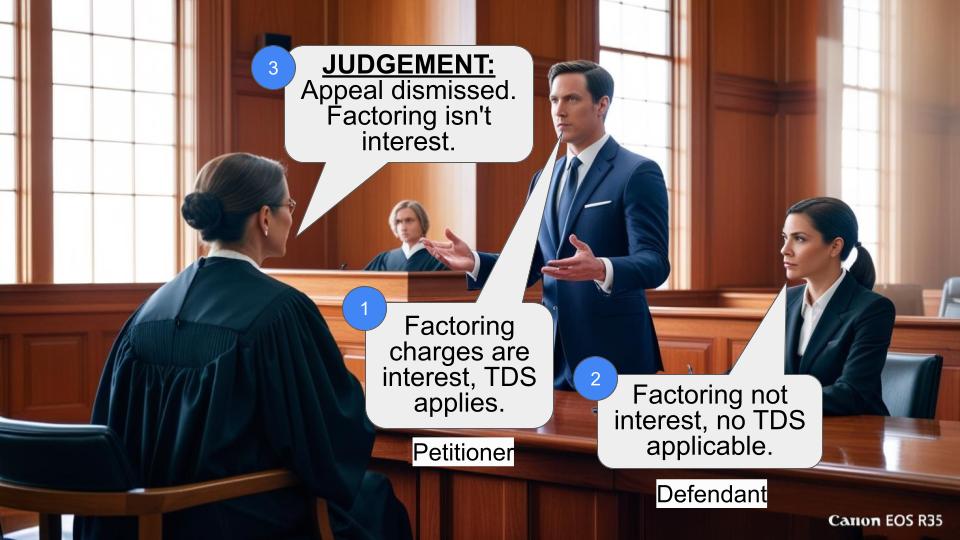
This case involves a dispute between the Income Tax Department (Revenue) and M Sons Gems N. Jewellery (P) Ltd. (Assessee) regarding the treatment of factoring charges for tax deduction at source (TDS) purposes. The High Court upheld the Income Tax Appellate Tribunal's decision that factoring charges cannot be treated as interest under Section 194A (of Income Tax Act, 1961), and therefore, are not subject to TDS.
Get the full picture - access the original judgement of the court order here
Case Name:
Principal Commissioner of Income Tax Vs Sons Gems N. Jewellery (P) Ltd. (High Court of Delhi)
ITA 9/2016
Date: 25th April 2016
Key Takeaways:
1. Factoring charges are distinct from interest payments and are not subject to TDS under Section 194A (of Income Tax Act, 1961).
2. The obligation to deduct tax at source is on the 'payer' of interest, not the recipient.
3. Courts will consider the nature of the transaction and the terms of the agreement when determining whether a payment constitutes interest or another type of charge.
Issue:
Was the Income Tax Appellate Tribunal (ITAT) justified in holding that the sum of Rs.93,68,870 debited to the Profit & Loss account towards factoring/discounting charges should not have been disallowed by the Assessing Officer under Section 40(a)(ia) (of Income Tax Act, 1961)?
Facts:
1. M Sons Gems N. Jewellery (P) Ltd. is engaged in manufacturing and trading gold, diamond jewelry, and bullion.
2. For the Assessment Year 2009-10, the company declared an income of Rs. 2,79,89,810.
3. The company availed a factoring facility from Global Trade Finance Ltd. (GTFL).
4. In its Profit & Loss account, the company debited Rs. 93,68,870 under "factoring/discounting charges".
5. The company did not deduct TDS on these charges, claiming they were not interest.
Arguments:
Assessing Officer (AO):
- Examined the agreement between GTFL and the Assessee.
- Disbelieved the Assessee's claim that the amount was factoring charges.
- Claimed that as per the agreement, GTFL would advance a loan to the Assessee at 13% interest.
- Treated the entire Rs. 93,68,870 as interest payable under Section 194A (of Income Tax Act, 1961).
- Disallowed the sum since TDS was not deducted under Section 40(a)(ia) (of Income Tax Act, 1961).
Assessee:
- Argued that the amount was for factoring facility, not interest.
- Claimed that factoring charges on sales cannot be termed as interest.
- Pointed out that discounting charges are not covered under the definition of interest as per Section 2(28A) (of Income Tax Act, 1961), 1961.
Key Legal Precedents:
1. CIT v. M/s MKJ Enterprises Ltd. (Calcutta High Court, ITA No. 74 of 2014): Held that factoring charges on sales cannot be termed as interest.
2. CIT v. Cargill Global Trading (P) Ltd. 335 ITR 94 (Del.): Similar ruling to the above case.
3. The Supreme Court dismissed the Revenue's Special Leave Petition against the judgment in Cargill Global Trading on 10th May 2012 in CC No. 19572/2011.
Judgement:
1. The High Court dismissed the appeal by the Revenue.
2. The Court noted that under Section 194A (of Income Tax Act, 1961), the obligation to deduct tax at source is on the 'payer' of interest, not the recipient.
3. The Court found that the term sheet issued by GTFL showed that interest at 13% pa would be charged only in the event of repayment of borrowings, which was different from the factoring charges of 0.10% payable to GTFL.
4. The Court concluded that there was no factual basis for the AO to disbelieve the Assessee's explanation and treat the entire amount as interest.
5. The Court upheld the ITAT's view that factoring/discounting charges cannot be treated as interest for the purpose of Section 194A (of Income Tax Act, 1961).
FAQs:
1. Q: What is the difference between factoring charges and interest?
A: Factoring charges are fees paid for a factoring service, where a company sells its accounts receivable to a third party at a discount. Interest, on the other hand, is the cost of borrowing money.
2. Q: Why is this case significant?
A: It clarifies the tax treatment of factoring charges, distinguishing them from interest payments and exempting them from TDS under Section 194A (of Income Tax Act, 1961).
3. Q: Does this ruling apply to all types of factoring arrangements?
A: While the ruling provides guidance, each case may be evaluated based on its specific facts and the nature of the arrangement.
4. Q: What should businesses consider when entering into factoring agreements?
A: Businesses should clearly document the nature of the charges and ensure that factoring charges are distinct from any interest components in the agreement.
5. Q: Could this ruling be challenged in the future?
A: While possible, the dismissal of the Special Leave Petition by the Supreme Court in a similar case (Cargill Global Trading) suggests that this interpretation is likely to stand.

1. This appeal by the Revenue is against the order dated 17th June 2015 passed by the Income Tax Appellate Tribunal („ITAT‟) in ITA No. 5419/Del/2012 for the Assessment Year („AY‟) 2009-10.
2. The question sought to be urged by the Revenue is whether the ITAT was justified in holding that the sum of Rs. 93,68,870 debited to the Profit & Loss („P&L‟) account towards factoring/discounting charges ought not have been disallowed by the Assessing Officer („AO‟) under Section 40(a)(ia) (of Income Tax Act, 1961), 1961 ('Act').
3. The Assessee is a private limited company engaged in the business of manufacturing and trading in gold, diamond jewellery and bullion. In its return of income for AY 2009-10 it declared an income of Rs. 2,79,89,810. The return was picked up for scrutiny. It was noticed from the notes to the accounts that the Assessee company had availed factoring facility from Global Trade Finance Ltd. („GTFL‟). It was further noticed that in the P&L account, an amount of Rs.93,68,870 was debited under the head “factoring/discounting charges”. It was clarified that the Assessee had not deducted TDS on the factoring charges as it was not an interest amount.
4. In the assessment proceedings, the AO examined the agreement entered into between the GTFL and the Assessee. The AO disbelieved the Assessee‟s contention that the aforementioned amount constituted factoring charges. According to the AO as per the agreement, GTFL would advance a loan to the Assessee on which the Assessee was liable to pay interest @13%. This was separate from the factoring charges. The AO proceeded to treat the entire amount of Rs. 93,68,870 as interest payable by the Assessee to GTFL under Section 194 (of Income Tax Act, 1961) A of the Act. The AO, therefore, disallowed the said sum since TDS was not deducted therefrom in terms of Section 40(a)(ia) (of Income Tax Act, 1961).
5. After the Commissioner of Income Tax (Appeals) [CIT(A)] upheld the above order by disposing of the Assessee‟s appeal by order dated 27th July 2012, the Assessee went in appeal before the ITAT. In the impugned order, the ITAT relied on the order dated 12th August 2014 of the Calcutta High Court in ITA No. 74 of 2014 (CIT v. M/s MKJ Enterprises Ltd.) to the effect that the factoring charges on sales cannot be termed as interest. The ITAT also noted the submission of the Assessee that this Court in CIT v. Cargill Global Trading (P) Ltd. 335 ITR 94 (Del.) also held likewise.
6. Mr. Kapil Goel, learned counsel for the Assessee, points out that the Revenue's Special Leave Petition against the judgment of this Court in Cargill Global Trading (supra) was dismissed by the Supreme Court on 10th May 2012 in CC No. 19572/2011.
7. The Court first notes that under Section 194A (of Income Tax Act, 1961), the obligation to deduct tax at source is on the 'payer' of interest. In the instant case, the Assessee has permitted factoring and discounting charges to be deducted upfront by GTFL. In response to a query raised by the AO during assessment proceedings, the Assessee by its letter dated 12th September 2011 clarified as under:
"The assessee company had paid discount to M/s. Global Trade Finance Ltd. (GTF) for availment of Factoring facility and not interest. This fact is very clear as per the sanction letter given by the GTF which was filed before your goodself vide our letter dated 02.09.2011. The assessee company had discounted its sales invoices from GTF on a discount and it had not taken any amount in the nature of loan or debt. The factoring facility is known as synonymous for bill discounting facility. As per section 2(28A) (of Income Tax Act, 1961), 1961, discounting charges are not covered under the definition of interest."
8. Further the Court finds that the term sheet issued by the GTFL showed that the interest at 13% pa will be charged in the event of repayment of any borrowings. This is different from the factoring charges @0.10% payable to GTFL. As a matter of fact, the Assessee has debited the above sum to its P&L account towards “factoring/discounting charges”. In light of the above factors, there was no factual basis for the AO to have disbelieved the Assessee's explanation and simply treat the entire amount as interest. The question of disallowing the entire amount under Section 40(a)(ia) (of Income Tax Act, 1961) on the ground that the TDS was not deducted in terms of Section 194A (of Income Tax Act, 1961) did not arise.
9. In the facts and circumstances of the case, the Court is unable to find any legal infirmity in the view expressed by the ITAT that the factoring/discounting charges in the present case cannot be treated as interest for the purpose of 194A. No substantial question of law arises.
10. The appeal is dismissed.
S.MURALIDHAR, J
VIBHU BAKHRU, J
APRIL 25, 2016
×
Questions
Court Rules Factoring Charges Not Subject to TDS as Interest
Write your CommentSimilar Posts


Generic
- Reportdata/2888.pdf
