


Court rules on tax liability for individuals claiming exemption under Section 1…


Full News
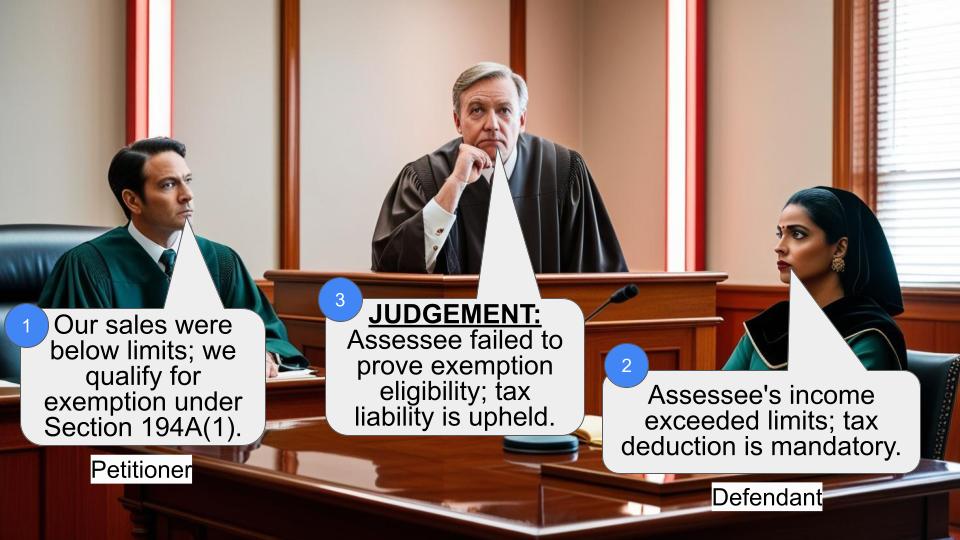
Court rules on tax liability for individuals claiming exemption under Section 194A(1) (of Income Tax Act, 1961).
Court rules on tax liability for individuals claiming exemption under Section 194A(1) (of Income Tax Act, 196…
In the case of Thomas George Muthoot vs. Commissioner of Income Tax, the court addressed whether individuals and Hindu Undivided Families (HUFs) could claim exemption from tax deduction under Section 194A(1) (of Income Tax Act, 1961). The court found that the burden of proof lies with the assessee to demonstrate that they meet the conditions for exemption, which they failed to do. Consequently, the court upheld the tax liability.
Get the full picture - access the original judgement of the court order here
Case Name:
Thomas George Muthoot vs. Commissioner of Income Tax (High Court of Kerala)
ITA. No. 267 of 2014
Date: 3rd July 2015
Key Takeaways:
- The burden of proof for claiming tax exemptions under Section 194A(1) (of Income Tax Act, 1961) lies with the taxpayer.
- Individuals and HUFs are liable to deduct tax if their total sales or receipts exceed specified limits.
- The court emphasized the importance of compliance with tax laws and the consequences of non-compliance.
Issue
Did the assessee, an individual, satisfy the conditions for claiming exemption from tax deduction under Section 194A(1) (of Income Tax Act, 1961)?
Facts
- The assessee, Thomas George Muthoot, claimed exemption under Section 194A(1) (of Income Tax Act, 1961).
- The court noted that the exemption applies only if the total sales, gross receipts, or turnover from business do not exceed the limits specified under
Section 44AB (of Income Tax Act, 1961).
- The Income Tax Appellate Tribunal found that the assessee's business income exceeded these limits, thus making them liable to deduct tax.
Arguments
- Assessee's Argument: The assessee argued that they qualified for the exemption under Section 194A(1) (of Income Tax Act, 1961) as their total sales and receipts were below the specified limits.
- Revenue's Argument: The Revenue contended that the assessee's business income exceeded the limits set by Section 44AB (of Income Tax Act, 1961), and therefore, they were required to deduct tax.
Key Legal Precedents
- The court referenced Section 194A(1) (of Income Tax Act, 1961), which outlines the conditions under which individuals and HUFs are exempt from tax deduction.
- The court also cited Section 40(a)(ia) (of Income Tax Act, 1961), which states that if tax is deductible at source and not deducted, the amount is not allowable as a deduction.
Judgement
The court ruled against the assessee, confirming that they were liable to deduct tax under Section 194A(1) (of Income Tax Act, 1961) due to exceeding the specified limits of income. The court emphasized that the burden of proof was on the assessee to demonstrate eligibility for the exemption, which they failed to do. The appeals filed by the assessee were dismissed.
FAQs
Q1: What does Section 194A(1) (of Income Tax Act, 1961) entail?
A1: Section 194A(1) (of Income Tax Act, 1961) specifies the conditions under which individuals and HUFs can claim exemption from tax deduction on interest payments.
Q2: What happens if the tax is not deducted as required?
A2: If tax is not deducted when required, the amount is not allowable as a deduction under Section 40(a)(ia) (of Income Tax Act, 1961).
Q3: Can individuals and HUFs always claim exemption under Section 194A(1) (of Income Tax Act, 1961)?
A3: No, the exemption is only available if their total sales, gross receipts, or turnover do not exceed the limits specified under Section 44AB (of Income Tax Act, 1961).
Q4: What was the outcome for the assessee in this case?
A4: The court upheld the tax liability of the assessee, ruling that they did not meet the conditions for exemption under Section 194A(1) (of Income Tax Act, 1961).

1.These three appeals are filed by the assessee, who is aggrieved by the orders passed by the Income Tax Appellate Tribunal, Cochin Bench, upholding the assessment orders passed for the assessment years 2006-07, 2008-09 and 2010-11.
2.Assessee is a company engaged in portfolio management services having obtained necessary registration from the SEBI. The return of income for the assessment year 2008-09 was filed and assessment under section 143(3) (of Income Tax Act, 1961) was completed, treating the transactions in purchase and sale of shares as 'business income' instead of capital gains as shown by the assessee company. In so far as the assessment year 2006-07 is concerned, return of income was processed under section 143(1) (of Income Tax Act, 1961) and assessment was completed. After completing the assessment for the assessment year 2008-09, the assessment for 2006-07 was reopened by the Assessing
Officer invoking his power under section 147 (of Income Tax Act, 1961). Accordingly, assessment was completed under section 143(3) (of Income Tax Act, 1961), where also, the income of the
assessee from the purchase and sale of shares, which was originally treated as short term capital gains and taxed at the lower rate, was assessed as business income. The assessment for the year 2010-11 was also completed under section 143(3) (of Income Tax Act, 1961) as in the case of the assessment year 2008-09. These orders were confirmed by the Commissioner of Income Tax (appeals) and the
Tribunal, dismissing the appeals filed by the assessee. This is the background in which these appeals are filed.
3.The questions of law framed in ITA.267/14, which is common in these appeals, are the following:
“(1) Whether on the facts and circumstances of the case, the Appellate Tribunal is right in confirming the reopening of assessment under Section 147 (of Income Tax Act, 1961)?
(2) Whether on the facts and circumstances of the case, the Appellate Tribunal is right in confirming that the profit on sale of shares is to
be assessed under the head “income business” and not under the head “capital gains”?
(3) Whether there was any material or documents on record to justify the finding of the Appellate Tribunal that the Appellant is engaged in trading
activity and therefore profit on sale of shares should be assessed under the head “income from business”?
(4) Whether on the facts and circumstances of the case and in the light of the Department having accepted the assessment of similar income under the head “capital gains” for earlier Assessment Years and intervening Assessment
Years, the assessment under the head “income from business” for this Assessment Year is justified?
(5) Whether the Appellate Tribunal is right in law in disregarding the decisions of various High Courts including the jurisdictional High Court
which were relied on at the time of hearing, without a speaking order as to why they are not followed.”
4.We heard the senior counsel for the appellant and the learned senior standing counsel appearing for the Revenue.
5.According to the learned senior counsel, the re-opening of the assessment for the year 2006-07, invoking the power under section 147 (of Income Tax Act, 1961), is
illegal. He also contended that the grounds contemplated for re-opening an assessment under section 147 (of Income Tax Act, 1961) are not existing in this case. According to him, the assessee has been in the business since the assessment year 2002-03 and that till 2006-07, the income derived by the assessee from the sale and
purchase of shares was accepted by the Department as capital gains and that by treating such income for the aforesaid three assessment years as business
income, the Department has shown that it did not have consistency in the matter of assessment and treatment of income. It was also his case that even after re-opening the assessments for the year 2006-07 and completing the assessments for the years 2008-09 and 2010-11, the Department has left out assessments for the years 2007-08 and 2009-2010. According to the
counsel, such picking and choosing some of the years and leaving out the remaining years when the assessee had returned loss is impermissible.
6.These contentions were contradicted by the learned senior counsel appearing for the Revenue.
7.We have considered the submissions made. The first
issue that is required to be considered is the scope
of the power of the Assessing Officer under section
147 of the Act. Section 147 (of Income Tax Act, 1961) provides that
if the Assessing Officer has reason to believe that
any income chargeable to tax has escaped assessment
for any assessment year, he may, subject to the
provisions of sections 148 to 153, assess or re-
assess such income and also any other income
chargeable to tax which has escaped assessment and
which comes to his notice subsequently in the course
of the proceedings under this section, or recompute
the loss or the depreciation allowance or any other
allowance, as the case may be, for the assessment
year concerned. Under the first proviso, a time
limit of 4 years from the end of the relevant
assessment year has been fixed for taking action
under section 147 (of Income Tax Act, 1961), unless any income chargeable to
tax has escaped assessment by reason of the failure
on the part of the assessee to make a return under
section 139 (of Income Tax Act, 1961) or in response to a notice under section
142(1) or section 148 (of Income Tax Act, 1961) or to disclose fully and truly
all material facts necessary for his assessment for
that year. This provision, therefore, shows that the
power thereunder can be invoked by an Assessing
Officer if he has reason to believe that any income
chargeable to tax has escaped assessment for any
assessment year.
8.The expression 'reason to believe' incorporated in
Section 147 (of Income Tax Act, 1961) by Act 3 of 1989 with effect from
1.4.1989 came up for the consideration of courts on
various occasions. In Assistant Commissioner of
Income Tax v. Rajesh Jhaveri Stock Brokers P. Ltd
[(2007)291 ITR 500], the Apex Court examined this
expression and held thus:
“Section 147 (of Income Tax Act, 1961) authorises and permits the
Assessing Officer to assess or reassess income
chargeable to tax if he has reason to believe that
income for any assessment year has escaped
assessment. The word reason in the phrase
reason to believe would mean cause or
justification. If the Assessing Officer has cause
or justification to know or suppose that income
had escaped assessment, it can be said to have
reason to believe that an income had escaped
assessment. The expression cannot be read to
mean that the Assessing Officer should have
finally ascertained the fact by legal evidence or
conclusion. The function of the Assessing Officer
is to administer the statute with solicitude for
the public exchequer with an inbuilt idea of
fairness to taxpayers. As observed by the
Supreme Court in Central Provinces Manganese
Ore Co. Ltd. v. ITO [1991 (191) ITR 662], for
initiation of action under Section 147(a) (of Income Tax Act, 1961) (as the
provision stood at the relevant time) fulfilment of
the two requisite conditions in that regard is
essential. At that stage, the final outcome of the
proceeding is not relevant. In other words, at the
initiation stage, what is required is reason to
believe, but not the established fact of
escapement of income. At the stage of issue of
notice, the only question is whether there was
relevant material on which a reasonable person
could have formed a requisite belief. Whether
the materials would conclusively prove the
escapement is not the concern at that stage. This
is so because the formation of belief by the
Assessing Officer is within the realm of
subjective satisfaction (see ITO v. Selected
Dalurband Coal Co. Pvt. Ltd. [1996 (217) ITR 597
(SC)]; Raymond Woollen Mills Ltd. v. ITO [1999
(236) ITR 34 (SC)].
The scope and effect of Section 147 (of Income Tax Act, 1961) as
substituted with effect from April 1, 1989, as
also Sections 148 to 152 are substantially
different from the provisions as they stood prior
to such substitution. Under the old provisions of
Section 147 (of Income Tax Act, 1961), separate clauses (a) and (b) laid
down the circumstances under which income
escaping assessment for the past assessment
years could be assessed or reassessed. To confer
jurisdiction under Section 147(a) (of Income Tax Act, 1961) two conditions
were required to be satisfied firstly the
Assessing Officer must have reason to believe
that income profits or gains chargeable to income
tax have escaped assessment, and secondly he
must also have reason to believe that such
escapement has occurred by reason of either (i)
omission or failure on the part of the assessee to
disclose fully or truly all material facts necessary
for his assessment of that year. Both these
conditions were conditions precedent to be
satisfied before the Assessing Officer could
have jurisdiction to issue notice under Section
148 read with Section 147(a) (of Income Tax Act, 1961). But under the
substituted Section 147 (of Income Tax Act, 1961) existence of only the
first condition suffices. In other words if the
Assessing Officer for whatever reason has
reason to believe that income has escaped
assessment it confers jurisdiction to reopen the
assessment. It is however to be noted that both
the conditions must be fulfilled if the case falls
within the ambit of the proviso to Section 147 (of Income Tax Act, 1961).
The case at hand is covered by the main provision
and not the proviso.”
9. Commissioner of Income Tax v. Kelvinator of India
Ltd. [(2010) 228 CTR 488] is another case where the
Apex Court had again considered the scope of this
provision and it was held that one needs to give a
schematic interpretation to the words 'reason to
believe', failing which, section 147 (of Income Tax Act, 1961) would give
arbitrary powers to the Assessing Officer to re-open
assessments on the basis of 'mere change of opinion'
which may not be, per se, reason to re-open.
Accordingly, the Apex Court held thus:
“. . . . . However, one needs to give a schematic
interpretation to the words “reason to believe”
failing which, we are afraid, s.147 would give
arbitrary powers to the AO to reopen
assessments on the basis of “mere change of
opinion”, which cannot be per se reason to reopen.
We must also keep in mind the conceptual
difference between power to review and power to
reassess. The AO has no power to review; he has
the power to reassess. But reassessment has to
be based on fulfillment of certain pre-condition
and if the concept of “change of opinion” is
removed, as contended on behalf of the
Department, then, in the grab of reopening the
assessment, review would take place. One must
treat the concept of “change of opinion” as an
inbuilt test to check abuse of power by the AO.
Hence, after 1
st April, 1989, AO has power to
reopen, provided there is “tangible material” to
come to the conclusion that there is escapement
of income from assessment. Reasons must have a
live link with the formation of the belief. Our
view gets support from the changes made to
s.147 of the Act, as quoted hereinabove. Under
the Direct Tax Laws (Amendment) Act, 1987,
Parliament not only deleted the words “reason to
believe” but also inserted the word “opinion” in
s.147 of the Act. However, on receipt of
representations from the companies against
omission of the words “reason to believe”,
Parliament re-introduced the said expression and
deleted the word “opinion” on the ground that it
would vest arbitrary powers in the AO. . . . . . “
10.The Full Bench of Delhi High Court had occasion to
consider the above expression in its judgment in
Commissioner of Income Tax v. Usha International
Ltd. [(2012) 348 ITR 485] and after survey of all
relevant precedents on the subject, the position was
summarised thus:
“It is, therefore, clear from the aforesaid
position that:
(1) Reassessment proceedings can be validly
initiated in case return of income is processed
under Section 143(1) (of Income Tax Act, 1961) and no scrutiny assessment
is undertaken. In such cases there is no change
of opinion.
(2) Reassessment proceedings will be invalid
in case the assessment order itself records that
the issue was raised and is decided in favour of
the assessee. Reassessment proceedings in the
said cases will be hit by the principle of “change
of opinion”.
(3) Reassessment proceedings will be invalid
in case an issue or query is raised and answered
by the assessee in original assessment
proceedings but thereafter the Assessing
Officer does not make any addition in the
assessment order. In such situations it should be
accepted that the issue was examined but the
Assessing Officer did not find any ground or
reason to make addition or reject the stand of
the assessee. He forms an opinion. The
reassessment will be invalid because the
Assessing Officer had formed an opinion in the
original assessment, though he had not recorded
his reasons.
In the second and third situation, the
Revenue is not without remedy. In case the
assessment order is erroneous and prejudicial to
the interest of the Revenue, they are entitled to
and can invoke power under Section 263 (of Income Tax Act, 1961) of the
Act. This aspect and position has been
highlighted in CIT v. DLF Power Ltd. I.T.A.No.973
of 2011 decided on November 29, 2011 - since
reported in [2012] 345 ITR 446 (Delhi) and BLB
Ltd. v. Asst. CIT Writ Petition (Civil)No.6884 of
2010 decided on December 1, 2011 - since
reported in [2012] 343 ITR 129 (Delhi). In the
last decision it has been observed (page 135):
“The Revenue had the option, but did not
take recourse to section 263 (of Income Tax Act, 1961), in
spite of audit objection. Supervisory and
revisionary power under Section 263 (of Income Tax Act, 1961)
is available, if an order passed by the Assessing
Officer is erroneous and prejudicial to the
interest of the Revenue. An erroneous order
contrary to law that has caused prejudiced can
be correct, when jurisdiction under Section
263 is invoked.”
Thus, where an Assessing Officer incorrectly or
erroneously applies law or comes to a wrong
conclusion and income chargeable to tax has
escaped assessment, resort to section 263 (of Income Tax Act, 1961) of the
Act is available and should be resorted to. But
initiation of reassessment proceedings will be
invalid on the ground of change of opinion.”
11.From the principles laid down in the above
judgments, it can be seen that the power under
section 147 (of Income Tax Act, 1961) can be invoked by the
Assessing Officer, if, on the materials available
before him, he has reason to believe that any income
chargeable to tax has escaped assessment in any
assessment year, provided such proceedings are not
barred by the time limit prescribed in the first
proviso to the said section. The requirement that
the Assessing Officer must have 'reason to believe'
cannot be taken to mean that the Assessing Officer
must be satisfied that there exists grounds for
reopening the assessment or the Assessing Officer
should have formed an opinion about the nature of the
final order that is likely to be passed after re-
opening the assessment. The question is whether the
Assessing Officer was justified in re-opening the
assessment for the year 2006-07. For the assessment
year 2006-07, assessment was initially completed
under section 143(1) (of Income Tax Act, 1961). The scope of
enquiry that is permissible in an assessment
proceedings under section 143(1) (of Income Tax Act, 1961) is very limited as
is evident from the section itself, which reads thus:
“143. Assessment - (1) Where a return has been
made under section 139 (of Income Tax Act, 1961), or in response to a
notice under sub-section (1) of section 142 (of Income Tax Act, 1961), such
return shall be processed in the following manner,
namely:-
(a) the total income or loss shall be computed
after making the following adjustments,
namely:-
(i) any arithmetical error in the return; or
(ii) an incorrect claim, if such incorrect claim
is apparent from any information in the
return;
(b) the tax and interest, if any, shall be
computed on the basis of the total income
computed under clause (a);
(c) the sum payable by, or the amount of refund
due to, the assessee shall be determined
after adjustment of the tax and interest, if
any, computed under clause (b) by any tax
deducted at source, any tax collected at
source, any advance tax paid, any relief
allowable under an agreement under section
90 or section 90A (of Income Tax Act, 1961), or any relief allowable
under section 91 (of Income Tax Act, 1961), any rebate allowable under
Part A of Chapter VIII, any tax paid on self-
assessment and any amount paid otherwise
by way of tax or interest;
(d) an intimation shall be prepared or generated
and sent to the assessee specifying the sum
determined to be payable by, or the amount
of refund due to, the assessee under clause
(c); and
(e) the amount of refund due to the assessee in
pursuance of the determination under clause
(c) shall be granted to the assessee:
Provided that an intimation shall also be sent
to the assessee in a case where the loss declared
in the return by the assessee is adjusted but no
tax or interest is payable by, or no refund is due
to him;
provided further that no intimation under
this sub-section shall be sent after the expiry of
one year from the end of the financial year in
which the return is made.”
12.The scope of this provision was considered by the
Apex Court in its judgment in Assistant Commissioner
of Income Tax v. Rajesh Jhaveri Stock Brokers P. Ltd
(supra), where it was held thus:
“It is to be noted that substantial changes
have been made to Section 143(1) (of Income Tax Act, 1961) with effect
from June 1, 1999. Up to March 31, 1989, after a
return of income was filed the Assessing Officer
could make an assessment under Section 143(1) (of Income Tax Act, 1961)
without requiring the presence of the assessee or
the production by him of any evidence in support
of the return. Where the assessee objected to
such an assessment or where the officer was of
the opinion that the assessment was incorrect or
incomplete or the officer did not complete the
assessment under Section 143(1) (of Income Tax Act, 1961), but wanted to
make an inquiry, a notice under Section 143(2) (of Income Tax Act, 1961)
was required to be issued to the assessee
requiring him to produce evidence in support of
his return. After considering the material and
evidence produced and after making necessary
inquiries, the officer had power to make
assessment under Section 143(3) (of Income Tax Act, 1961). With effect
from April 1, 1989, the provisions underwent
substantial and material changes. A new scheme
was introduced and in the new substituted
Section 143(1) (of Income Tax Act, 1961) prior to the subsequent
substitution with effect from June 1, 1999, in
Clause (a), a provision was made that where a
return was filed under section 139 (of Income Tax Act, 1961) or in response
to a notice under section 142(1) (of Income Tax Act, 1961), and any tax or
refund was found due on the basis of such return
after adjustment of tax deducted at source, any
advance tax or any amount paid otherwise by way
of tax or interest, an intimation was to be sent
without prejudice to the provisions of Section
143(2) to the assessee specifying the sum so
payable and such intimation was deemed to be a
notice of demand issued under Section 156 (of Income Tax Act, 1961). The
first proviso to Section 143(1)(a) (of Income Tax Act, 1961) allowed the
Department to make certain adjustments in the
income or loss declared in the return. They were
as follows :
(a) any arithmetical errors in the return,
accounts and documents accompanying it were to
be rectified;
(b) any loss carried forward, deduction,
allowance or relief which on the basis of the
information available in such return, accounts or
documents, was prima facie admissible, but which
was not claimed in the return was to be allowed;
(c) any loss carried forward, relief claimed
in the return which on the basis of the
information as available in such returns accounts
or documents were prima facie inadmissible was
to be disallowed.
What were permissible under the first
proviso to Section 143(1)(a) (of Income Tax Act, 1961) to be adjusted were,
(i) only apparent arithmetical errors in the
return, accounts or documents accompanying the
return, (ii) loss carried forward, deduction
allowance or relief, which was prima facie
admissible on the basis of information available in
the return but not claimed in the return and
similarly (iii) those claims which were on the basis
of the information available in the return, prima
facie inadmissible, were to be rectified/
allowed/disallowed. What was permissible was
correction of errors apparent on the basis of the
documents accompanying the return. The
Assessing Officer had no authority to make
adjustments or adjudicate upon any debatable
issues. In other words, the Assessing Officer
had no power to go behind the return, accounts or
documents, either in allowing or in disallowing
deductions, allowance or relief.”
13.For the assessment year 2006-07, assessment under
section 143(1) (of Income Tax Act, 1961) was completed by order dated
23.12.2008. It was thereafter the Assessing Officer
completed the assessment under section 143(3) (of Income Tax Act, 1961) for the
year 2008-09 by his order dated 30.12.2010. In that
order, the income earned by the assessee in the
purchase and sale of shares as capital gains, was
treated as business income and was taxed. It was
thereafter that proceedings under section 147 (of Income Tax Act, 1961) were
initiated with respect to the assessment year 2006-07
and assessment was completed under section 143(3) (of Income Tax Act, 1961) by
order dated 15.12.2011. The question that is
required to be considered is whether the reopening of
assessment is based on the mere change of opinion of
the Assessing Officer as contended by the counsel for
the appellant.
14.In our view, the aforesaid contention cannot be
accepted. Law mandates that the Assessing Officer
should have reason to believe that income chargeable
to tax has escaped assessment for any assessment year
to invoke the power to re-open assessments under
section 147 (of Income Tax Act, 1961). Admittedly, assessments for the year
2006-07 were completed treating the income in
question as capital gains. Once the assessment for
the year 2008-09 was completed and the income for
that year was assessed as business income, the
Assessing Officer had sufficient materials to believe
that income chargeable to tax as business income for
the assessment year 2006-07 had escaped assessment.
It was on that basis, proceedings under section 147 (of Income Tax Act, 1961)
was initiated. The initiation of such proceedings
under section 147 (of Income Tax Act, 1961), according to us, is fully within
the four corners of section 147 (of Income Tax Act, 1961).
15.It is true that returns treating the income as
capital gains were accepted in the previous
assessment years also. It is on that factual basis
that contention was raised by the assessee that
Department should maintain consistency in the matter
of assessment. In support of this contention,
counsel for the appellant relied on the judgment of
the Bombay High Court in Commissioner of Income Tax
v. Gopal Purohit [(2011) 336 ITR 287]. This again is
an untenable argument for the reason that in the
matter of assessment of income tax, the decision
arrived at in the previous year cannot be regarded as
binding in the assessment for the subsequent years.
It has been so held by the Apex Court in Dwarakadas
Kesardeo Morarka v. Commissioner of Income Tax
[(1962) XLIV ITR 529], the relevant paragraph of
which is extracted herein:
“. . . . . It cannot be said that because in the
previous years the shares were held to be stock-
in-trade, they must be similarly treated for the
assessment year 1949-50. In the matter of
assessment of income-tax, each year's
assessment is complete and the decision arrived
at in a previous year on materials before the
taxing authorities cannot be regarded as binding
in the assessment for the subsequent years. . . . “
Therefore, though consistency is desirable, the
desirability of consistency cannot operate against
the Revenue in completing assessments for subsequent
years in accordance with law. This is all the more
so since the assessments for the previous years were
completed under section 143(1) (of Income Tax Act, 1961). In so far
as the judgment of the Bombay High Court in Gopal
Purohit (supra) is concerned, though the court has
highlighted the need for consistency, it has also
taken note of the fact that in that case, the Revenue
did not furnish any justification for adopting a
divergent approach for the assessment year in
question.
16. It is true, as contended by the learned counsel,
that assessments for the years 2007-08 and 2009-2010
were left out and according to the counsel, the
Revenue has, therefore, adopted a pick and choose
method, choosing the assessment years when the
assessee had returned profit. Though this contention
would appear to be attractive, a closer examination
thereof would show that there is no substance in it.
Admittedly, for the assessment years 2007-08 and
2009-2010, the assessee had returned loss. The
assessment for such years were also completed under
section 143(1) (of Income Tax Act, 1961). Re-opening of those assessments is
permissible only under section 147 (of Income Tax Act, 1961) and power under
that section could be invoked only if any income
chargeable to tax has escaped assessment. Here, in
the instant case, the assessee has returned loss and
therefore, no income chargeable to tax has escaped
assessment, permitting invocation of the power under
this provision.
17.Similar is the case with the revisional power of the
Commissioner under section 263 (of Income Tax Act, 1961), which also can be
invoked only if any order passed is prejudicial to
the interest of the Revenue. Such being the case,
the assessee cannot be heard to complain that the
Revenue has adopted a pick and choose method in the
matter of assessment for the years in question.
18.The main question that arises for consideration is
regarding the legality of assessment treating the
income for the years in question as 'business income'
instead of 'capital gains'.
19.Before we proceed to consider the relevant facts,
it would be appropriate to examine the legal
principles which govern the issue. Although both
sides have cited before us various precedents on the
subject, in our view, having regard to the principles
laid down by the Apex Court in its judgment in
Commissioner of Income Tax, Nagpur v. Sutlej Cotton
Mills Supply Agency Ltd. [(1975) 100 ITR 706], it is
unnecessary to refer to all those judgments. In this
judgment, after referring to various other
authorities, the Apex Court summarised the principles
thus:
“In the absence of any evidence of trading
activity in cases of purchase and resale of
shares, it has been held that profit arising from
the resale is an accretion to the capital. If a
transaction is in the assessee's ordinary line of
business there can be no difficulty in holding
that it is in the nature of trade. But the
difficulty arises where the transaction is outside
the assessee's line of business and then, it must
depend upon the facts and circumstances of each
case whether the transaction is in the nature of
trade.
It is not necessary to constitute trade that
there should be a series of transactions, both of
purchase and of sale. A single transaction of
purchase and sale outside the assessee's line of
business may constitute an adventure in the
nature trade. Neither repetition nor continuity
of similar transactions is necessary to constitute
a transaction an adventure in the nature of
trade. If there is repetition and continuity, the
assessee would be carrying on a business and the
question whether the activity is an adventure in
the nature of trade can hardly arise. A
transaction may be regarded as isolated although
a similar transaction may have taken place a
fairly long time before [see Commissioners of
Inland Revenue v. Reinhold (1953) 34 TC 389].
The principles underlying the distinction
between a capital sale and an adventure in the
nature of trade were examined by this court in
G.Venkataswami Naidu & Co. v. Commissioner of
Income-tax [(1959) 35 ITR 594 (SC)], where this
court said that the character of a transaction
cannot be determined solely on the application of
any abstract rule, principle or test but must
depend upon all the facts and circumstances of
the case. Ultimately, it is a matter of first
impression with the court whether a particular
transaction is in the nature of trade or not. It
has been said that a single plunge may be enough
provided it is shown to the satisfaction of the
court that the plunge is made in the waters of
the trade; but mere purchase/sale of shares-if
that is all that is involved in the plunge-may fall
short of anything in the nature of trade.
Whether it is in the nature of trade will depend
on the facts and circumstances.
Where the purchase of any article or of any
capital investment, for instance, shares, is made
without the intention to resell at a profit, a
resale under changed circumstances would only
be a realisation of capital and would not stamp
the transaction with a business character (see
Commissioner of Income-tax v. P.K.N.Co.Ltd
(1966) 60 ITR 65 (SC).
Where a purchase is made with the intention
of resale, it depends upon the conduct of the
assessee and the circumstances of the case
whether the venture is on capital account or in
the nature of trade. A transaction is not
necessarily in the nature of trade because the
purchase was made with the intention of resale
(see Jenkinson v. Freedland [(1961) 39 TC 636
(CA)], Radha Debi Jalan v. Commissioner of
Income-tax [(1951) 20 ITR 176 (Cal)], India Nut
Co. Ltd. v. Commissioner of Income-tax [(1960)
39 ITR 234 (Ker)], Mrs.Sooniram Poddar v.
Commissioner of Income-tax [(1939) 7 ITR 470,
478-9 (Rang)(FB)], Ajax Products Ltd. v.
Commissioner of Income-tax [(1961) 43 ITR 297,
310 (Mad)], Gustad Irani v. Commissioner of
Income-tax [(1957) 31 ITR 92 (Bom)] and
Mrs.Alexander v. Commissioner of Income-tax
[(1952) 22 ITR 379, 402 (Mad)].
A capital investment and resale do not lose
their capital nature merely because the resale
was foreseen and contemplated when the
investment was made and the possibility of
enhanced values motivated the investment (see
Leeming v. Jones [(1930) 15 TC 333 (HL)] and
also the decisions of this court in Saroj Kumar
Mazundar v. Commissioner of Income-tax [(1959)
37 ITR 242, 250-1(SC)] and Janki Ram Bahadur
Ram v. Commissioner of Income-tax [(1965) 57
ITR 21 (SC)].
In Commissioner of Inland Revenue v. Fraser
[(1942) 24 TC 498, 502] Lord Normand said:
“The individual who enters into a purchase of an
article or commodity may have in view the resale
of it at a profit, and yet it may be that that is
not the only purpose for which he purchased the
article or the commodity, nor the only purpose to
which he might turn it if favourable opportunity
for sale does not occurr.... An amateur may
purchase a picture with a view to its resale at a
profit and yet he may recognise at the time or
afterwards that the possession of the picture
will give him aesthetic enjoyment if he is unable
ultimately, or at his chosen time, to realise it at a
profit.....”
An accretion to capital does not become
income merely because the original capital was
invested in the hope and expectation that it
would rise in value; if it does so rise, its
realisation does not make it income. Lord
Dunedin said in Leeming v. Jones at page 360:
“The fact that a man does not mean to hold an
investment may be an item of evidence tending to
show whether he is carrying on a trade or
concern in the nature of trade in respect of his
investments but per se it leads to no conclusion
whatever.”
This court laid down in G.Venkataswami Naidu
& Co. v. Commissioner of Income-tax [(1959) 35
ITR 594, 610, 622(SC)] that the dominant or
even sole intention to resell is a relevant factor
and raises a strong presumption, but by itself is
not conclusive proof, of an adventure in the
nature of trade.
The intention to resell would, in conjunction
with the conduct of the assessee and other
circumstances, point to the business character of
the transaction.”
20.We may, in this context, also refer to the judgment
of the Apex Court in M/s.Rajputana Textiles
(Agencies) Ltd. v. Commissioner of Income tax,
Bombay City [42 ITR 743], where the contention that
buying and selling in shares was not one of the
objects of the company was rejected and the court
held that this was only one of the circumstances in
the totality of the circumstances which must be
considered, though this by itself is not
determinative of the question. Again, in its
judgment in Sutlej Cotton Mills Ltd. v. Commissioner
of Income Tax, West Bengal [(1979) 116 ITR 1], the
Apex Court held that the way in which entries are
made by the assessee in its books of accounts is not
determinative of the question whether the assessee
has earned any profit or suffered any loss.
Therefore, even if it is accepted that the objects
clause in the Memorandum of Association of the
assessee did not provide for trading in shares and
that in the accounts it was shown as investments,
that by itself would not be determinative of the
issue involved in these appeals.
21.While the precedents that we have referred to above
lead to the irresistible conclusion that it is the
totality of the circumstances which is determinative
of the question as to whether the profit earned by
the assessee is an accretion to the capital or is a
trading profit, it is also relevant that the Central
Board of Direct Taxes issued circular No.4/2007 dated
15.6.2007 indicating the tests to draw a distinction
between the shares held as stock-in-trade and shares
held as investment. This circular being relevant is
extracted below for reference:
C.B.D.T. Circulars
Circular No.4/2007, dated June 15, 2007
Sub: Distinction between shares held as stock-
in-trade and shares held as investment-Tests
for such a distinction.
The Income-tax Act, 1961 makes a
distinction between a capital asset and a trading
asset.
2. Capital asset is defined in section 2(14) (of Income Tax Act, 1961)
of the Act. Long-term capital assets and gains
are dealt with under section 2(29A) (of Income Tax Act, 1961) and section 2 (of Income Tax Act, 1961)
(29B). Short-term capital assets and gains are
dealt with under section 2(42A) (of Income Tax Act, 1961) and section 2 (of Income Tax Act, 1961)
(42B).
3. Trading asset is dealt with under section 28 (of Income Tax Act, 1961)
of the Act.
4. The Central Board of Direct Taxes (CBDT)
through Instruction No.1827 dated August 31,
1989, had brought to the notice of the Assessing
Officers that there is a distinction between
shares held as investment (capital asset) and
shares held as stock-in-trade (trading asset). In
the light of a number of judicial decisions
pronounced after the issue of the above
instructions, it is proposed to update the above
instructions for the information of the assessees
as well as for guidance of the Assessing Officers.
5. In the case of CIT v. Associated Industrial
Development Company (P) Ltd. [1971] 82 ITR 586,
the Supreme Court observed that (headnote):
Whether a particular holding of shares is by
way of investment or forms part of the stock-in-
trade is a matter which is within the knowledge
of the assessee who holds the shares and he
should, in normal circumstances, be in a position
to produce evidence from his records as to
whether he has maintained any distinction
between those shares which are his stock-in-
trade and those which are held by way of
investment.
6. In the case of CIT v. H.Holck Larsen [1986]
160 ITR 67, the Supreme Court observed (page
87):
The High Court, in our opinion, made a
mistake in observing whether transactions of sale
and purchase of shares were trading transactions
or whether these were in the nature of
investment was a question of law. This is a mixed
question of law and fact.
7. The principles laid down by the Supreme
Court in the above two cases afford adequate
guidance to the Assessing Officers.
8. The Authority for Advance Rulings (AAR)
[2007] 288 ITR 641, referring to the decisions
of the Supreme Court in several cases, has culled
out the following principles (page 651):
(i) Where a company purchases and sells shares,
it must be shown that they were held as stock-in-
trade and that existence of the power to
purchase and sell shares in the memorandum of
association is not decisive of the nature of
transaction;
(ii) the substantial nature of transactions, the
manner of maintaining books of account, the
magnitude of purchases and sales and the ratio
between purchases and sales and the holding
would furnish a good guide to determine the
nature of transactions;
(iii) ordinarily the purchase and sale of shares
with the motive of earning a profit, would result
in the transaction being in the nature of
trade/adventure in the nature of trade; but
where the object of the investment in shares of
a company is to derive income by way of dividend
etc. then the profits accruing by change in such
investment (by sale of shares) will yield capital
gain and not revenue receipt.
9. Dealing with the above three principles, the
AAR has observed in the case of Fidelity group as
under (page 661):
We shall revert to the aforementioned
principles. The first principle requires us to
ascertain whether the purchase of shares by a
FII in exercise of the power in the memorandum
of association/trust deed was as stock-in-trade
as the mere existence of the power to purchase
and sell shares will not by itself be decisive of
the nature of transaction. We have to verify as
to how the shares were valued/held in the books
of account i.e., whether they were valued as
stock-in-trade at the end of the financial year
for the purpose of arriving at business income or
held as investment in capital assets. The second
principle furnishes a guide for determining the
nature of transaction by verifying whether there
are substantial transactions, their magnitude,
etc. maintenance of books of account and finding
the ratio between purchases and sales. It will
not be out of place to mention that regulation 18
of the SEBI Regulations enjoins upon every FII
to keep and maintain books of account containing
true and fair accounts relating to remittance of
initial corpus of buying and selling and realizing
capital gains on investments and accounts of
remittance to India for investment in India and
realising capital gains on investment from such
remittances. The third principle suggests that
ordinarily purchases and sales of shares with the
motive or realising profit would lead to inference
of trade/adventure in the nature of trade; where
the object of the investment in shares of
companies is to derive income by way of dividends
etc., the transactions of purchases and sales of
shares would yield capital gains and not business
profits.
10. The Central Board of Direct Taxes also
wishes to emphasis that it is possible for a tax
payer to have two portfolios, i.e., an investment
portfolio comprising of securities which are to be
treated as capital assets and a trading portfolio
comprising of stock-in-trade which are to be
treated as trading assets. Where an assessee
has two portfolios, the assessee may have income
under both heads i.e., capital gains as well as
business income.
11. The Assessing Officers are advised that
the above principles should guide them in
determining whether, in a given case, the shares
are held by the assessee as investment (and
therefore giving rise to capital gains) or as stock-
in-trade (and therefore giving rise to business
profits). The Assessing Officers are further
advised that no single principle would be decisive
and the total effect of all the principles should
be considered to determine whether, in a given
case, the shares are held by the assessee as
investment or stock-in-trade.
12. These instructions shall supplement the
earlier Instruction No.1827 dated August 31,
1989.
22.Bearing the above in mind, we may now proceed to
consider the facts that are available before us to
decide whether the authorities were right in treating
the sale of shares as business income as against
capital gains. The transactions during the
assessment year 2008-09, as reflected in the order of
the Tribunal, show that the assessee has traded in
the shares of 45 companies. Among the 45 companies,
the maximum weighted holding period is in respect of
219,641 shares held by the assessee in M/s.JK Investo
Trade and the minimum weighted holding period is in
respect of 30000 shares of KITEX Garments traded by
it. If the average holding period of the 45 scrips
held by the assessee is taken, in the case of 36
shares, it ranges from 91 days to 3 days. The
Tribunal has also referred to the frequency of
purchases and sales which show that during the
assessment years 2006-07, 2008-09 and 2010-11 the
assessee company had purchased and sold shares in 62
companies, 53 companies and 78 companies
respectively. It is also seen that the scrip wise
purchase to sales also indicate that in the
assessment year 2006-07, while the company purchased
shares in 55 companies, it had sold shares in 57
companies. In the assessment year 2008-09, the
company purchased 51 scrips and sold 45 scrips.
Similarly, during the assessment year 2010-11, while
it purchased scrips in 67 companies, it had sold
scrips in 72 companies.
23.The authorities have also taken note of the fact
that the assessee has all the infrastructure for
buying and selling shares and that it has incurred
establishment expenses and various establishment
expenses have been charged to Profit and Loss Account
which indicated an organised and systematic activity
carried on by the assessee. It was also found that
the income earned by the company in the form of
dividend was only in respect of very few scrips which
gave a very low rate of return as compared to the
value of shares held by it. Yet another finding that
has been entered into is that the involvement of the
assessee in the trading of shares was not an
occasional one but was carried on by it in a
systematic and organised manner. The authorities
have also found that the short period of holding of
shares reveal that the assessee had no intention to
hold the shares for longer term as an investment.
These findings of the authorities below are
absolutely unassailable and therefore, the fact that
trading in shares is not the main object of the
assessee or that the shares were shown as stock-in-
trade in the books of accounts of the assessee cannot
be of any consequence.
24.It is true as contended by the learned counsel for
the assessee that it is possible for an assessee to
have more than one portfolio, viz., that a part of
the shares could have been held by it as investment
and the remaining part, as stock-in-trade. Such a
distinction has been recognised by the Central
Government in circular No.4/07 (supra). This
submission was made mainly with reference to the
219,641 shares of M/s.JK Investo Trade held by the
assessee, which has the maximum weighted holding
period. In so far as these shares are concerned,
along with I.A.1518/15, the Revenue has produced
before us the details of acquisition of these shares
which show that the company acquired these shares
over a period of time from 8.12.2005 to 1.12.2006 and
sold these shares during the period from 4.4.2007 to
26.11.2007. This particular transaction has been
discussed in the assessment order for the year 2008-
09, where the Assessing Officer has found thus:
“16. In order to see whether the shares of JK
Investo Trade Ltd. was held by the assessee as
an investment or as a prudent step to earn more
income, the price value chart of the above said
share for the period 1.12.2005 to 30.11.2007 was
called for. The papers presented by the assessee
is annexed as Annexure B, C & D. The assessee
started purchasing the share on 8.12.2005 and
went on buying it continuously till 1.12.2006. It
started selling it off in 4.4.2007 and sold off the
entire shares by 26.11.2007. Now a look at the
price value chart show that except for a rise for
the period May, 2006 to August, 2006, the price
of the share was almost statue till June-July,
2007. It started shooting upon in August 2007
and assessee started selling it in Sept., 2007 and
the entire shares were sold off in Nov. 2007.
Thus, it can be seen that holding of this share is
not with an investors mind, but with a real
business man's mind to sell it off at the right
time. This instance itself shows that the
assessee was not a mere investor but a prudent
business man making the right calculation to see
when to buy and when to sell, which share. This
is definitely an adventure in the nature of trade.
It may also be seen that though the assessee had
held this share for a long period, it was engaged
in buying and selling all the time throughout the
year.”
25. The factual correctness of the findings of the
Assessing Officer was not disputed at any stage of
the proceedings. It was on the basis of the
assessment for the year 2008-09 that the assessment
for the year 2006-07 was re-opened and the same
standard has been applied in respect of the
assessment for 2010-11 also. These findings, the
factual correctness of which has been concurrently
confirmed by the first appellate authority and the
Tribunal, when appreciated in the light of the
principles laid down by the Apex Court in
Commissioner of Income Tax, Nagpur v. Sutlej Cotton
Mills Supply Agency Ltd. [(1975) 100 ITR 706],
only leads to the conclusion that the assessee was
engaged in trading in shares and was not holding the
shares as stock-in-trade to contend that the
accretions are only capital gains. In such
circumstances, the questions of law raised will have
to be answered in favour of the Revenue.
Appeals are dismissed.
Sd/-
ANTONY DOMINIC, Judge.
Sd/-
SHAJI P. CHALY, Judge.
×
Similar Ripples
Questions
Court rules on tax liability for individuals claiming exemption under Section 194A(1) (of Income Tax Act, 1961).
Write your CommentSimilar Posts

Generic
- Reportdata/3658.pdf
