


Court rules that Maruti Suzuki's AMP expenses do not constitute an internationa…







Full News
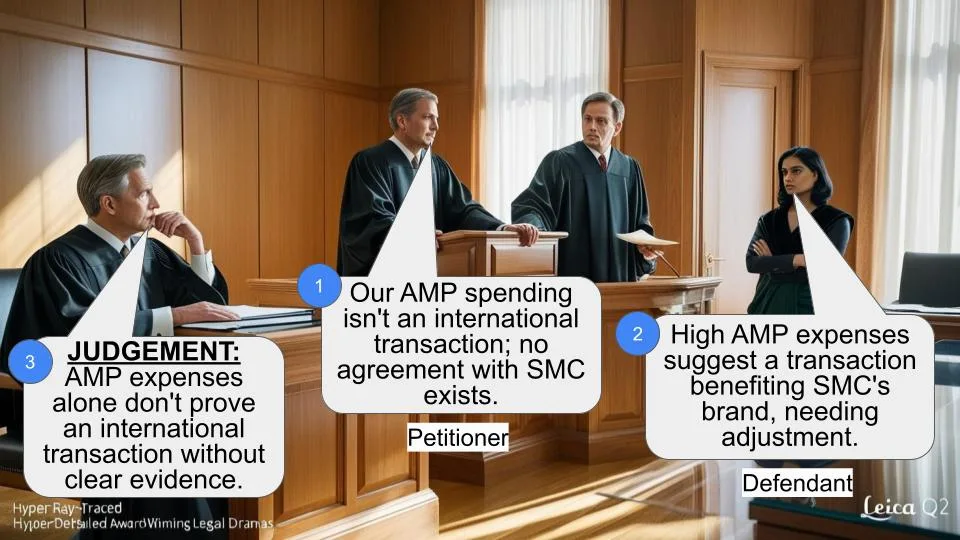
Court rules that Maruti Suzuki's AMP expenses do not constitute an international transaction.
Court rules that Maruti Suzuki's AMP expenses do not constitute an international transaction.
In the case of Maruti Suzuki India Ltd. & Anr. vs. Commissioner of Income Tax & Anr., the court addressed whether the advertising, marketing, and sales promotion (AMP) expenses incurred by Maruti Suzuki (MSIL) could be classified as an international transaction under Indian tax law. The court ultimately decided that the Revenue failed to demonstrate the existence of such a transaction based solely on the quantum of AMP expenditure.
Get the full picture - access the original judgement of the court order here
Case Name:
Maruti Suzuki India Ltd. & Anr. vs. Commissioner of Income Tax & Anr. (High Court of Delhi)
ITA 110/2014
Date: 11th December 2015
Key Takeaways:
- The court clarified that AMP expenses cannot be automatically classified as international transactions based on their amount.
- The decision emphasized the need for clear evidence of an agreement or arrangement between MSIL and its associated enterprise (AE), Suzuki Motor Corporation (SMC), regarding AMP expenditures.
- The ruling highlighted the limitations of using the Bright Line Test (BLT) for determining the existence of international transactions.
Issue
Did the AMP expenses incurred by Maruti Suzuki qualify as an international transaction under Section 92B (of Income Tax Act, 1961)?
Facts
- Maruti Suzuki India Ltd. (MSIL) is a subsidiary of Suzuki Motor Corporation (SMC), which holds a significant share in MSIL.
- MSIL incurred substantial AMP expenses, which the Revenue claimed were for promoting SMC's brand.
- The Transfer Pricing Officer (TPO) determined that these expenses
constituted an international transaction and proposed adjustments to MSIL's income based on the excess AMP expenditure compared to industry standards.
Arguments
- Revenue's Argument: The Revenue argued that the high level of AMP expenditure by MSIL indicated an international transaction with SMC, as it was believed that these expenses were incurred for the benefit of SMC's brand.
- MSIL's Argument: MSIL contended that the Revenue failed to prove the existence of any agreement or arrangement obligating MSIL to incur such expenses for SMC. They argued that the BLT used by the TPO was not a valid basis for determining the existence of an international transaction.
Key Legal Precedents
- Sony Ericsson Mobile Communications India Pvt. Ltd. v. Commissioner of Income Tax (2015) 374 ITR 118: This case was referenced to highlight that AMP expenses cannot be automatically classified as international transactions based solely on their amount. The court in Sony Ericsson emphasized that the existence of an international transaction must be established through clear evidence, not merely inferred from expenditure levels.
- Section 92B (of Income Tax Act, 1961): Defines what constitutes an international transaction, requiring a mutual agreement or arrangement between associated enterprises.
Judgement
The court ruled in favor of MSIL, stating that the Revenue did not demonstrate the existence of an international transaction based solely on the quantum of AMP expenditure. The court emphasized that the decision in Sony Ericsson clarified that AMP expenses cannot be treated as international transactions without clear evidence of an agreement or arrangement. Consequently, the court set aside the adjustments proposed by the TPO regarding the AMP expenses.
FAQs
Q1: What does this ruling mean for Maruti Suzuki?
A1: The ruling allows Maruti Suzuki to avoid additional tax liabilities related to the AMP expenses, as the court found no basis for classifying these expenses as international transactions.
Q2: Can the Revenue appeal this decision?
A2: The Revenue may have options to appeal, but the court's ruling is based on established legal principles that emphasize the need for clear evidence of international transactions.
Q3: What is the significance of the Bright Line Test in this context?
A3: The court's decision indicates that the Bright Line Test cannot be used to infer the existence of an international transaction based solely on the level of expenditure, emphasizing the need for concrete evidence of an agreement.
Q4: How does this case impact future tax assessments for companies with similar AMP expenditures?
A4: This case sets a precedent that companies must be able to demonstrate clear agreements regarding AMP expenditures to classify them as international transactions, potentially affecting how tax authorities approach similar cases in the future.

1. These are two appeals by the Assessee, Maruti Suzuki India Ltd. (‘MSIL’), under Section 260A (of Income Tax Act, 1961) (‘Act’). ITA No.110 of 2014 is directed against an order dated 2nd August 2013 passed by the Income Tax Appellate Tribunal (‘ITAT’) in ITA No.5237/Del/2010 for the Assessment Year (‘AY’) 2005-06. ITA No.710 of 2015 is an appeal against the order dated 24th August 2015 passed by the ITAT in ITA No. 5120/Del/2010 for the AY 2006-07.
2. These appeals concern the issue of determination of arm’s length price(‘ALP’) of the advertisement, marketing and sales promotion (‘AMP’)
expenses incurred by the Assessee, MSIL.
3. By the impugned order dated 2nd August 2013, the ITAT followed its
decision in LG Electronics India Pvt. Ltd. v. ACIT 2013 22 ITR (Trib) I
and held that the Assessing Officer (‘AO’) was entitled to make a transfer pricing adjustment under Chapter X of the Act in respect of the AMP expenditure incurred by MSIL on the ground that such expenditure created brand value and marketing intangibles in respect of the brands/trademarks belonging to MSIL's Associated Enterprise (‘AE’), Suzuki Motor Corporation, Japan (hereinafter ‘SMC’).
Background facts
4. MSIL is engaged in the manufacture of passenger cars in India. It is a subsidiary of SMC. As on 31st March 2006, SMC held 54.21% shares in
MSIL. 10.27% of the shares were held by the Government of India and the
balance was held by the Indian public and others.
5. MSIL started its business in 1982 as a Government of India owned
company. SMC was selected as the business partner independently by
MSIL. It is stated that the co-branded trademark ‘Maruti-Suzuki’ was used since the inception of MSIL. A licence agreement was entered between MSIL and SMC in October 1982 for its models M-800, Omni and Gypsy. By the said agreement, MSIL was permitted to use the co-branded
trademark ‘Maruti-Suzuki’ on the said vehicles.
6. MSIL filed its return of income for the AY 2005-06 on 31st October
2005, declaring an income of Rs. 13,46,51,71,140/-. Its case was selected for scrutiny and notices under Sections 143(2) (of Income Tax Act, 1961) and 142(1) of the Act were issued. During the course of assessment proceedings, the AO invoked the provisions of Section 92CA(1) (of Income Tax Act, 1961) and referred the case to the transfer pricing officer (‘TPO’) for determination of ALP in relation to the international transactions undertaken by MSIL with its AE, SMC. This included purchase of components, consumables and spare parts, sale of vehicles, purchase of capital items, technical/other services, sale of spares and components, warranty and product recall charges, purchase of CBUs, cost sharing and payment of royalty for technology/trademark.
7. On the basis of the above reference, the TPO passed an order dated 21st December 2010 under Section 92CA(3) (of Income Tax Act, 1961), determining the ALP of the
aforementioned international transactions between MSIL and SMC. The
TPO proposed an addition of Rs.252.26 crores to the returned income of
MSIL. The TPO made an adjustment of Rs.98.14 crores as regards the
royalty paid by MSIL attributing the same towards payment for use of
foreign trademark of SMC on the ground that the brand had no value. The
said adjustment was later deleted by the ITAT. The remaining adjustment
of Rs.154.12 crores was towards the AMP expenses by imputing a
notional/purported arm’s length compensation towards the AMP expenses
incurred by MSIL for SMC.
8. The case of MSIL is that while undertaking the above exercise, the TPO,on his own, benchmarked the AMP expenses incurred by MSIL in India,
although that international transaction was not specifically referred to the TPO. The aggregate AMP expenses incurred by MSIL was Rs. 204.4 crores which constituted 1.87% of its sales. Of this, Rs.162 crores was
advertisement expenses and Rs. 42.10 crores was towards sales promotion.
The TPO undertook the benchmarking analysis by applying the ‘bright line
test’ (‘BLT’) and compared the proportion of such expenses incurred by
MSIL with that incurred by comparable companies. The TPO compared the
AMP expenses incurred by MSIL i.e. 1.87% of its turnover with the mean
of 0.620% incurred by the comparable companies i.e. Hindustan Motors,
Tata Motors and Mahindra & Mahindra. Since the ratio of selling and
distribution expenses as a percentage of sales of MSIL was higher than that incurred by the comparable companies, the TPO concluded that the excess must be regarded as having been incurred for promoting the brand ‘Suzuki’ owned by SMC. Accordingly, the adjustment on account of AMP expenses was computed at Rs.154.12 crores.
9. On the basis of aforementioned order of the TPO, the AO issued a draft assessment order dated 31st December 2010 for AY 2005-06 under Sections 143 (of Income Tax Act, 1961) (3) and 144-C (1) of the Act. The total income was proposed at Rs.16,38,06,61,370.
10. Aggrieved by the aforementioned draft assessment order, the Assessee
filed objections before the Dispute Resolution Panel (‘DRP’) under Section 144-C(2) (of Income Tax Act, 1961). By its order dated 23rd September 2011, the DRP upheld the addition made by the TPO on account of AMP expenses.
11. The AO completed the assessment in terms of the directions of the DRP and passed the final assessment order on 28th October 2011, assessing the total income of MSIL at Rs. 16,34,18,35,040 after making an addition of Rs.154.12 crores on account of the AMP expenses.
12. The appeal filed against the above order by the MSIL, being ITA No.
5237/Del/2011 for AY 2005-06 was disposed of by the ITAT by the
impugned order dated 2nd August 2013.
The decision of the Special Bench in LG Electronics
13. On account of the importance of the issue of the ALP of AMP expenses
undertaken by a wide range of industries by way of international
transactions, a Special Bench of the ITAT was constituted in the case of LG Electronics (supra) to consider the issue. The two questions considered by the Special Bench of the ITAT in LG Electronics were:
“1. Whether, on the facts and in circumstances of the case, the
Assessing Officer was justified in making transfer pricing
adjustment in relation to advertisement, marketing and sales
promotion expenses incurred by the Assessee?
2. Whether the Assessing Officer was justified in holding that
the assessee should have earned a mark up from the associated
enterprise in respect of advertising, marketing and promotion
expenses alleged to have been incurred for and on behalf of
the associated enterprise?”
14. It may be mentioned at this stage that several companies, including
MSIL, intervened in the proceedings. By a judgment dated 23rd January
2013, the majority of the ITAT came to the following conclusions:
(i) The scope of Section 92CA(2B) (of Income Tax Act, 1961) covers all types of international
transactions in respect of which the Assessee had not furnished a report.
The TPO had jurisdiction to give a report on a different international
transaction as long as reference of an international transaction is made to him for determination of the ALP.
(ii) The word 'transaction' under Section 92F(v) (of Income Tax Act, 1961) included an agreement
between two AEs which could be formal or in writing, or informal or oral The incurring of ‘proportionately more’ AMP expenses coupled with the
advertisement of brand or logo of the foreign AE gave “strength to the
inference of some informal or implied agreement in this regard”. The fact that the Assessee, apart from promoting its name and products through advertisement, also promoted the foreign brand simultaneously, coupled with its expenses being ‘proportionately much higher’ than those incurred by comparable cases, lent credence to the inference of the transaction between MSIL and SMC for creating marketing intangibles for the benefit of the latter.
(iii) The second exception carved out by the Court in CIT v. LK Appliances Ltd. 345 ITR 241 (Del) i.e. “where the form and substance of the transaction are the same but the arrangements made in relation to the transaction, viewed in their totality differ from those which would have been adopted by the individual enterprise behaving in a commercially rational manner” governed the situation where the AMP expenses incurred by the Assessee was higher or different from what was incurred by independent enterprises behaving in a commercially rational manner. The question to be answered was: “Whether an independent enterprise behaving in a commercially rational manner would incur the expenses to the extent the assessee has incurred”. If the answer to this question was affirmative,then the transaction cannot be re-characterised. If however, the answer is in negative then the transaction needs to be probed further for determining
whether it required re-characterization. In other words, the majority of the ITAT in LG Electronics was advocating the use of the bright line test for the purposes of determining the existence as well as ALP of an international transaction involving AMP expenses.
(iv) The concept of economic ownership of the brand, although relevant in a commercial sense, was not recognized for the purposes of the Act. This is because it was only the foreign AE which would recover the entire sale consideration for the sale of the brand and would be subject to the tax as per the relevant taxing provisions. The distributors or wholesalers to whom the Assessee sells the goods by using the brand logo of the foreign AE are economic owners “only in a commercial sense for the limited purpose of exploiting it for the business purpose”.
(v) Unless a transaction was an international transaction, within the
meaning of Section 92B (of Income Tax Act, 1961), it could not be subjected to the transfer pricin
provisions. The meaning assigned to ‘international transaction’ in terms of Clause (iv) of Section 92B (of Income Tax Act, 1961) was inclusive and not limited to the types of transactions in sub-clauses A to C and E of Clause (i). The bright line test was a way of finding out the cost and value of the international transaction,which was the first variable under Section 92 (of Income Tax Act, 1961). If the Assessee failed to supply the cost/value of the international transaction and did not come forth to suggest any cogent way of determining such cost/value, then the onus was on the TPO to determine it on some rational basis. This could be by first identifying the comparable domestic cases.
(vi) The exercise of separating the amount spent by the Assessee in relation to the international transaction of building brand for its foreign AE in terms of Section 92 (of Income Tax Act, 1961) cannot be considered as a case of disallowance of AMP expenses under Section 37(1) (of Income Tax Act, 1961). Both the Sections 37(1) and 92 operated in different domains.
(vii) Section 92 (of Income Tax Act, 1961) was of a much wider amplitude than Section 40A(2) (of Income Tax Act, 1961). While Section 40A(2) (of Income Tax Act, 1961) restricted the deduction to the extent it is reasonable, Section 92 (of Income Tax Act, 1961) requires benchmarking of all the international
transactions whether they related to the expenses incurred by the Indian
entity vis-à-vis its foreign AE or the income earned from such foreign AE or any other transaction having any effect on the income, losses or assets of the Indian entity. The initial burden was on the Assessee to show that the international transaction with the AE was at ALP. This was also the purport of Circular No. 214 of 2001 issued by the CBDT.
(viii) A distinction needed to be made between expenses incurred for sales promotion on the one hand and the expenses in connection with sales on the other. While expenses for sales promotion directly led to brand building,expenses in connection with sales was only sales specific. If the expenditure was not in the nature of AMP, it ought to be excluded at the outset.
(ix) The correct approach under the transactional net margin method
(‘TNMM’) was to consider the operating profit for each international
transaction in relation to the total cost or sales or capital employed etc. of such international transaction and not the net profit, total costs, sales, capital employed by the Assessee as a whole at the entity level.
(x) The contention of the Revenue that the method for determining the
AMP can be a combination of methods prescribed under Section 92C(1) (of Income Tax Act, 1961)
was devoid of force. On a plain reading of Section 92C(1) (of Income Tax Act, 1961) with Rule 10 (of Income Tax Rules, 1962)
B(1), it was neither possible to invent a new method nor to substitute a new methodology in place of the one prescribed in Rule 10B(1) (of Income Tax Rules, 1962).
15. In the case of LG Electronics, the majority of the Special Bench of the ITAT held that the DRP as well as the AO were right in applying the spirit of the ‘cost plus method’ by first identifying the cost/value of service provided to the Assessee and thereafter adding mark-up. It was held that a reading of Section 92F(ii) (of Income Tax Act, 1961) with Rules 10A(a) and 10B(1) (c) of the Income Tax Rules 1962 ('Rules') showed that ALP was the price of a transaction between non-AEs in uncontrolled conditions. There could not be a hypothetical profit mark up under Rule 10B(1)(c) (of Income Tax Rules, 1962). In LG Electronics, therefore, the majority of the ITAT set aside the cost/value of the international transaction as determined by the TPO and restored the case to the file of the TPO/AO for determining of the value afresh.
Proceedings in the writ petition of MSIL in this Court
16. The decision of the majority of the Special Bench of the ITAT in LG
Electronics also separately dealt with the case of the MSIL which was an
intervener. Even while the decision of the Special Bench was awaited,
MSIL filed W.P.(C) 6876 of 2008 in this Court challenging the notice
issued by the TPO for determining the ALP of the AMP expenses
purportedly incurred by MSIL. By an interim order dated 19th September
2008, this Court directed that the proceedings before the TPO may go on
but the final order passed would not be given effect to. Thereafter the TPO passed a final order on 30th October 2008. The writ petition was then amended to challenge the said order.
Final order of the TPO
17. In the final order, the TPO came to the conclusion that the trade mark ‘Suzuki’ owned by the SMC had piggybacked on the trade mark ‘Maruti’,without any compensation being paid by SMC to MSIL. He also came to the conclusion that the trade mark ‘Maruti’ had acquired the status of a 'super brand' whereas the trade mark ‘Suzuki’ was a relatively weak brand. He concluded that the promotion of the co-branding of ‘Maruti-Suzuki’ had resulted in (a) promotion of the trade mark of the AE; (b) the use of the trade mark ‘Maruti’ of the MSIL; (c) reinforcement of the Suzuki trademark which was a weak brand as compared to Maruti in India and; (d) impairment of the value of the Maruti trademark due to cobranding process.
18. The TPO noted that MSIL had incurred an expenditure of Rs. 204.40
crores on AMP expenses for the promotion of the "Maruti Suzuki" brand
name which was benefiting SMC. It was accordingly held that "AMP
expenditure of Rs. 204.40 Crores is an international transaction." The
assessee has incurred the cost in connection with a benefit and services
provided to the AE under a mutual agreement which was not in writing but
such arrangements were "proved from the conduct of the assessee". After
undertaking a comparability analysis of the AMP expenses incurred by
other comparable entities for the AY in question, the TPO concluded: "The assessee had incurred above expenditure, in excess of bright line limit of Rs 136.76 Crores for brand promotion and market development for the AE,which would lead to creation of marketing intangibles legal ownership of which was with the associated enterprise of the assessee". After applying a 'mark up' the TPO recommended that the AO should enhance the income of the assessee by an amount of Rs. 154.12 Crores on account of compensation to be received from its AE for promoting the brand name of its AE."
Order of the High Court in the writ petition
19. In the final order passed in the writ petition, i.e. MSIL v. ACIT/TPO (2010) 328 ITR 210 (Del.), the Division Bench of this Court came to the following conclusions:
(i) The contractual obligations on MSIL under the agreement dated 12th
December 1992 to use the joint trademark ‘Maruti Suzuki’ as well as the
parts manufactured and/or sold by MSIL in India showed that SMC wanted
to popularize its name in India at the cost of brand Maruti.
(ii) It could not be accepted that there was no possible benefit to ‘Suzuki’ on account of the compulsory use of the joint trademark ‘Maruti Suzuki’ on all the parts and products manufactured and sold by Maruti in India. Since the TPO may not be able to devise an objective and fair method to assess the monetary value of the benefit obtained by Suzuki in the form of marketing intangibles including the benefit on account of compulsory use of the joint trademark ‘Maruti Suzuki’, the TPO would have to determine the ALP by finding out “what payment, if any, a comparable independent domestic entity would have made in respect of an agreement of this nature”.
(iii) Mere use of a foreign brand name by an AE in an intangible
promotional activity does not by itself entail payment by the owner of the foreign brand name. The question was obviously whether a comparable
independent entity would have incurred such expenditure or not. Unless it is shown that the expenditure incurred was disproportionate, there could be no justification for apportioning the AMP expenses between a domestic entity and the foreign entity.
(iv) The order passed by the TPO in making adjustment was based on no
evidence and the procedure followed by him was faulty. The order passed
by him was arbitrary and irrational. The TPO was accordingly directed to
re-determine the appropriate AMP in respect of the international transaction entered into by MSIL with SMC in terms of Section 92C (of Income Tax Act, 1961).
(v) While giving the above direction, the Division Bench summarized its
conclusions which included the following:
(a) The onus was on MSIL to satisfy the TPO/AO that the AMP
computed by it was consistent with Section 92 (of Income Tax Act, 1961). If the
TPO/AO proposed to make adjustment by revising the AMP, notices
would have to be given to MSIL, followed by their reply and
producing evidence.
(b) The AMP expenditure incurred by the domestic entity using the
trademark of the foreign name does not normally require payment or
compensation by the owner of the foreign trademark or such use “so
long as the expenses incurred by the domestic entity do not exceed
the expenses which a similarly situated and comparable independent
domestic entity would have incurred”.
Order of the Supreme Court
20. Aggrieved by the above decision of the Division Bench, the MSIL filed a Special Leave Petition in the Supreme Court. The order of the Supreme Court, reported as MSIL v. ACIT (2011) 335 ITR 121 (SC), reads as under:
“By consent, the matter is taken up for hearing.
In this case, the High Court has remitted the matter to the
Transfer Pricing Officer (“the TPO” for short) with liberty to
issue fresh show-cause notice. The High Court has further
directed the Transfer Pricing Officer to decide the matter in
accordance with law. Further, on going through the impugned
judgment of the High Court dated July 1, 2010, we find that the
High Court has not merely set aside the original show cause
notice but it has made certain observations on the merits of the
case and has given directions to the Transfer Pricing Officer,
which virtually conclude the matter. In the circumstances, on
that limited issue, we hereby direct the Transfer Pricing
Officer, who, in the meantime, has already issued a show cause
notice on September 16, 2010, to proceed with the matter in
accordance with law uninfluenced by the observations/directions given by the High Court in the impugned judgment dated July 1, 2010.
The Transfer Pricing Officer will decide this matter on or
before December 31, 2010. The civil appeal is, accordingly, disposed of with no order as to costs.”
ITAT's answers to the two issues
21. The ITAT in the judgment in LG Electronics insofar as it pertained to the case of MSIL, concluded that the directions given by the High Court to the TPO for determining the AMP “has lost the tag of binding force”. However, the ITAT was of the view that the decision of the High Court on the AMP expenses incurred by the MSIL towards brand building of SMC was neither commented upon nor considered by the Supreme Court.
Therefore, the contention that the entire judgment of the High Court was
not set aside was rejected by the majority of the ITAT. It was held that the direction by the Supreme Court that the TPO has to make determination of the ALP “inherently recognizes that there is a transaction of brand building between the assesse and the foreign AE, which is an international transaction as per section 92B (of Income Tax Act, 1961) and the TPO has the jurisdiction to determine the ALP of such transaction.”
22. The conclusion of the majority of the ITAT in LG Electronics on the
two questions were as under:
(i) A transfer pricing adjustment in relation to AMP expenses incurred by the Assessee for creating and improving the marketing intangibles for its foreign AE was permissible.
(ii) Earning the mark up from the AE in respect of AMP expenses incurred
by the foreign AE was also allowed.
23. The matter was restored to the file of the TPO for fresh determination. The decision of this Court in Sony Ericsson Mobile Communications
24. The correctness of the decision of the Special Bench in LG Electronics came up for consideration in a batch of appeals before this Court which came to be decided by a decision in Sony Ericsson Mobile
Communications India P. Ltd. v. Commissioner of Income Tax (2015)
374 ITR 118.
25. Several appeals and cross-appeals filed by the Assessees and the
Revenue before this Court against the decision of the Special Bench of the ITAT in LG Electronics and other decisions of the ITAT that followed the decision of the Special Bench in LG Electronics. Although arguments were heard in all the appeals, the Court decided the appeals of only six Assessees i.e. Sony Ericsson Mobile Communications India Pvt. Ltd, Discovery Communications India, Daikin Air-conditioning India Pvt. Ltd., Haier Appliances (India) Pvt. Ltd., Reebok India Company and Canon India Pvt. Ltd.
26. The Court explained that all the above six Assessees were engaged in
distribution and marketing of imported branded products. In other words,
none of the Assessee whose appeals were decided was a manufacturer. The
second common factor noted by the Court was: “There is no dispute or lis
that the assesse are AEs who had entered into controlled transactions with the foreign associated enterprises”. Thirdly, the Court noted: “It is also uncontested that the controlled international transactions can be made subject-matter of the transfer pricing adjustment in terms of Chapter X of the Income Tax Act, 1961”.
27. The Court further explained the features particular to three of the said Assessees i.e Sony Mobile Communications India Pvt. Ltd., Reebok India Company and Canon India Pvt. Ltd. In the case of Sony Mobile
Communications India Pvt. Ltd., TNMM had been followed. In respect of
Reebok India, the TNMM had been followed for the sourcing of goods and
exports from India, the CUP method had been followed in respect of the
royalty paid by the Indian entity to the foreign AE and for import of
apparels and footwear for re-sale, the re-sale price (‘RP’) method had been followed. In the case of Cannon India, the RP method was adopted for import of finished goods for resale.
28. The following questions were addressed by the Division Bench in Sony
Ericsson (supra):
(i) Whether the additions suggested by the Transfer Pricing
Officer on account of Advertising/Marketing and Promotion
Expenses (AMP Expenses' for short) was beyond jurisdiction
and bad in law as no specific reference was made by the
Assessing Officer, having regard to retrospective amendment to
Section 92CA (of Income Tax Act, 1961) by Finance Act,
2012.
(ii)Whether AMP Expenses incurred by the assessee in India
can be treated and categorized as an international transaction
under Section 92B (of Income Tax Act, 1961)?
(iii) Whether under Chapter X of the Income Tax Act, 1961, a
transfer pricing adjustment can be made by the Transfer Pricing
Officer/ Assessing Officer in respect of expenditure treated as
AMP Expenses and if so in which circumstances?
(iv) If answer to question Nos.2 and 3 is in favour of the
Revenue, whether the Income Tax Appellate Tribunal was right
in holding that transfer pricing adjustment in respect of AMP
Expenses should be computed by applying Cost Plus Method.
(v) Whether the Income Tax Appellate Tribunal was right in
directing that fresh bench marking/comparability analysis
should be undertaken by the Transfer Pricing Officer by
applying the parameters specified in paragraph 17.4 of the order
dated 23.01.2013 passed by the Special Bench in the case of
LG Electronics India (P) Ltd.?”
29. The summary of the conclusions of the Division Bench in Sony
Ericsson (supra) was as under:
(i) The Court concurred with the majority of the Special Bench of the ITAT in the LG Electronics case qua the applicability of 92CA(2B) and how it cured the defect inherent in 92CA(2A). The issue concerning retrospective insertion of 92CA(2B) was decided in favour of the Revenue.
(ii) AMP expenses were held to be international transaction as this was not denied as such by the assessees.
(iii) Chapter X and Section 37(1) (of Income Tax Act, 1961) operated independently. The
former dealt with the ALP of an international transaction whereas the latter deals with the allowability/disallowability of business expenditure. Also, once the conditions for applicability of Chapter X were satisfied nothing shall impede the law contained therein to come into play.
(iv) Chapter X dealt with ALP adjustment whereas Section 40A(2)(b) (of Income Tax Act, 1961) dealt
with the reasonability of quantum of expenditure.
(v) TNMM applied with equal force on single transaction as well as
multiple transactions as per the scheme of Chapter X and the TP Rules.
Thus, the word ‘transaction’ would include a series of closely linked
transactions.
(vi) The TPO/AO could overrule the method adopted by the Assessee for
determining the ALP and select the most appropriate method. The reasons
for selecting or adopting a particular method would depend upon functional analysis comparison, which required availability of data of comparables performing of similar or suitable functional tasks in a comparable business. When suitable comparables relating to a particular method were not available and functional analysis or adjustment was not possible, it would be advisable to adopt and apply another method.
(vii) Once the AO /TPO accepted and adopted the TNMM, but chooses to
treat a particular expenditure like AMP as a separate international
transaction without bifurcation/segregation, it would lead to unusual and incongruous results as AMP expenses was the cost or expense and was not diverse. It was factored in the net profit of the inter-linked transaction. The TNMM proceeded on the assumption that functions, assets and risk being broadly similar and once suitable adjustments have been made, all things get taken into account and stand reconciled when computing the net profit margin. Once the comparables pass the functional analysis test and adjustments have been made, then the profit margin as declared when matches with the comparables would result in affirmation of the transfer price as the arm‘s length price. Then to make a comparison of a horizontal item without segregation would be impermissible.
(viii) The Bright Line Test was judicial legislation. By validating the Bright Line Test the Special Bench in LG Electronics Case went beyond Chapter X of the Act. Even international tax jurisprudence and commentaries do not recognise BLT for bifurcation of routine and non-routine expenses.
(ix) Segregation of aggregated transactions requires detailed scrutiny
without which there shall be no segregation of a bundled transaction. Set off of transactions segregated as a single transaction is just and equitable and not prohibited by Section 92(3) (of Income Tax Act, 1961). Set-off is also recognized by international tax experts and commentaries.
(x) Segregation of bundled transactions shall be done only if exceptions laid down in the EKL Appliances Case are justified. Re-categorisation and segregation of transactions are different exercises; former would require separate comparables and functional analysis.
(xi) Economic ownership of a brand would only arise in cases of long-term contracts and where there is no negative stipulation denying economic ownership. Economic ownership of a brand or a trade mark when pleaded can be accepted if it is proved by the Assessee. The burden is on the Assessee. It cannot be assumed.
(xii) After the order of the Supreme Court in the Maruti Suzuki case, the judgment of the Delhi High Court does not continue to bind the parties. This position was misunderstood by the majority of the Special Bench in the LG Electronics Case.
(xii) The RP Method loses its accuracy and reliability where the reseller adds substantially to the value of the product or the goods are further processed or incorporated into a more sophisticated product or when the product/service is transformed. RP Method may require fewer adjustments on account of product differences in comparison to the CUP Method because minor product differences are less likely to have material effect on the profit margins as they do on the price.
(xiii) Determination of cost or expense can cause difficulties in applying cost plus (CP) Method. Careful consideration should be given to what would constitute cost i.e. what should be included or excluded from cost. A studied scrutiny of CP Method would indicate that when the said Method is applied by treating AMP expenses as an independent transaction, it would not make any difference whether the same are routine or non-routine, once functional comparability with or without adjustment is accepted.
(xiv) The task of arm’s length pricing in the case of tested party may
become difficult when a number of transactions are interconnected and
compensated but a transaction is bifurcated and segregated. CP Method,
when applied to the segregated transaction, must pass the criteria of most appropriate method. If and when such determination of gross profit with reference to AMP transaction is required, it must be undertaken in a fair,objective and reasonable manner.
(xv) The marketing or selling expenses like trade discounts, volume
discounts, etc. offered to sub-distributors or retailers are not in the nature and character of brand promotion. They are not directly or immediately related to brand building exercise, but have a live link and direct connect with marketing and increased volume of sales or turnover. The brand building connect is too remote and faint. To include and treat the direct marketing expenses like trade or volume discount or incentive as brand building exercise would be contrary to common sense and would be highly exaggerated. Direct marketing and sale related expenses or
discounts/concessions would not form part of the AMP expenses.
(xvi) The prime lending rate cannot be the basis for computing mark-up
under Rule 10B(1)(c) (of Income Tax Rules, 1962), as the case set up by the Revenue
pertains to mark-up on AMP expenses as an international transaction. Mark up as per sub-clause (ii) to Rule 10B(1)(c) (of Income Tax Rules, 1962) would be comparable gross profit on the cost or expenses incurred as AMP. The mark-up has to be benchmarked with comparable uncontrolled transactions or transactions for providing similar service/product.
(xvii) The exceptions laid down in EKL Appliances Case were neither
invoked in the present case nor were the conditions satisfied.
(xviii) An order of remand to the ITAT for de novo consideration would be appropriate because the legal standards or ratio accepted and applied by the ITAT was erroneous. On the basis of the legal ratio expounded in this decision, facts have to be ascertained and applied. If required and
necessary, the assessed and the Revenue should be asked to furnish details or tables. The ITAT, in the first instance, would try and dispose of the appeals, rather than passing an order of remand to the AO /TPO. An endeavour should be to ascertain and satisfy whether the gross/net profit margin would duly account for AMP expenses. When figures and calculations as per the TNM or RP Method adopted and applied show that the net/gross margins are adequate and acceptable, the appeal of the assessed should be accepted. Where there is a doubt or the other view is plausible, an order of remand for re-examination by the AO/TPO would be justified. A practical approach is required and the ITAT has sufficient discretion and flexibility to reach a fair and just conclusion on the ALP.
The present appeals by MSIL: ITA 110 of 2014
30. It may be noted that ITA No. 110 of 2014 by MSIL for AY 2005-06
was heard with the above batch in Sony Ericsson (supra). However, as far
as ITA 110 of 2014 (pertaining to AY 2005-06), no questions of law were
separately framed. On 30th September, 2014, the Court passed the
following order in all the appeals being heard together at that time,
including ITA 110 of 2014:
"Arguments on behalf of some of the assessees have been heard. It
transpires that in some of the appeals, in addition to advertisement,
marketing and sales promotion expenses, other issues and questions
have been raised either by the assessees or by the revenue.
Substantial questions of law have been framed in some appeals, but,
substantial questions of law in other appeals are yet to be framed. It
will be desirable if the counsel for the assessees as well as the
Standing Counsel for the Department-revenue sit down and prepare a
chart of cases which can be disposed of on the basis of arguments
relating to Transfer Pricing adjustment on account of advertisement,
marketing and sales, promotion expenses. We can also include
appeals, which are already covered or do not require lengthy or
detailed arguments on other unconnected aspect."
31. Thereafter on 29th October 2014, the following questions were framed
in some of the appeals, including ITA 110 of 2014, in which till then
questions had not been framed:
“1. Whether the additions suggested by the Transfer Pricing
Officer on account of Advertising Marketing and Promotion
Expenses ('AMP Expenses' for short) was beyond jurisdiction
and bad in law as no specific reference was made by the
Assessing Officer with regard to retrospective amendment to
Section 92CA (of Income Tax Act, 1961) by the Finance
Act, 2012.
2. Whether AMP Expenses incurred by the Assessee in India
can be treated and categorized as an international transaction
under Section 92B (of Income Tax Act, 1961)?
3. Whether under Chapter X of the Income Tax Act, 1961, a
transfer pricing adjustment can be made by the Transfer
Pricing Officer Assessing Officer in respect of expenditure
treated as AMP Expenses and if so in which circumstances?
4. If answer to questions Nos.2 and 3 is in favour of the
Revenue, whether the Income Tax Appellate Tribunal was
right in holding that transfer pricing adjustment in respect of
AMP Expenses should be computed by applying the Cost Plus
Method.
5. Whether the Income Tax Appellate Tribunal was right in
directing that fresh bench marketing/comparability analysis
should be undertaken by the Transfer Pricing Officer by
applying the parameters specified in paragraph17.4 of the
order dated 23.01.2013 passed by the Special Bench in the
case of LG Electronics India (P) Ltd. v. ACIT?
32. However, on the next date i.e. 30th October 2014, the Court was of the view that the said appeal should be de-linked and passed the following order:
"These matters will not be treated as part-heard as substantial
corporate tax issues also arise for consideration and detailed
arguments on these aspects are required and necessary."
33. At this stage, it is necessary to advert the brief facts giving rise to the filing of ITA No. 710 of 2015 by MSIL for AY 2006-07. The TPO passed an order on 26th October 2009 under Section 92CA(3) (of Income Tax Act, 1961) proposing addition of Rs.124.24 crores to the return income on account of the excessive AMP expenses. The AO passed the draft assessment order on 31st December 2009, accepting the above report. This was upheld by DRP on 30th September 2010. The AO then passed a final assessment order on 20th
October 2010 making the addition as proposed. On 23rd November 2011 the
TPO passed the order under Section 154 (of Income Tax Act, 1961) read with Section 92CA(v) (of Income Tax Act, 1961),
enhancing addition by Rs.34,39,96,700 and recomputing the AMP
adjustment to Rs.158.64 crores. The AO passed rectification order dated
12th April 2012 under Section 154 (of Income Tax Act, 1961), enhancing the total addition by the
above sum while computing the total income.
34. The ITAT by its order dated 24th August 2015 partly allowed MSIL's
appeals against both the orders dated 20th October 2010 and 12th April
2012 and sent the matter back to the file of TPO/AO for determination of
the AMP in the light of the Sony Ericsson (supra). By an order dated 10th September 2015, this Court framed identical questions of law as framed in ITA 110 of 2014 and directed both appeals to be heard together. Preliminary issues
35. One preliminary issue that requires to be addressed is whether on
account of the decision in Sony Ericsson it would be open to MSIL to
question the existence of an international transaction involving it and the AE i.e. SMC as far as AMP expenses are concerned?
36. It is contented of Mr. G.C. Srivastava, learned Special counsel for the Revenue, that after the decision in Sony Ericsson the existence of an international transaction between MSIL and SMC as far as AMP expenses
is concerned is not in dispute. It is submitted that in paras 51 and 52 of the decision in Sony Ericsson, the Court answered the question “whether AMP expenses incurred by the Assessee in India can be treated and categorised as an international transaction under Section 92B (of Income Tax Act, 1961)" in the affirmative. It is further submitted that the Sony Ericsson case does not distinguish the cases of the manufacturers from those of the distributors except observing that TNMM may not be an appropriate method in the case of entities which are performing complex functions like manufacturing or making substantial value addition to the material imported from the AE.
37. It is further submitted by Mr. Srivastava that the distinction sought to be drawn in cases of manufacturers and distributors is untenable for the following reasons:
(i) The Appellants are not independent manufacturers who take all the risk. They are not completely independent in their pricing policies including price of raw material purchased from the AE, royalty payable to the AE and payments made to the AE for copyrights and patents. Even their product pricing is not completely independent. Therefore, benefits emanating from the AMP function cannot be enjoyed by the Appellant by their own.
(ii) The Appellants are engaged in not only manufacturing but in
distribution of goods manufactured by the AE and other group companies.
(iii) The benefits to the AE from AMP function continue to be the same as in the case of distributor like increase in sale of raw material, increase in royalty, and increase in copyright and patent payments apart from creation/enhancement of brand value.
38. It is further submitted that the Bright Line Test (‘BLT’) was used by the Revenue only as an arithmetical tool to arrive at the cost base of the AMP expenditure. The determination of the cost base is a necessary step for arriving at ALP of the transaction under different methods including the TNMM. It is submitted that although the decision in Sony Ericsson rejects the use of BLT for determining the existence of an international transaction for determining ALP, and although the Revenue had filed an appeal in the Supreme Court against the said finding, as far as the present appeals are concerned, the Revenue seeks to establish the existence of an international transaction de hors the BLT.
39. In reply it is pointed out by Mr. S. Ganesh, learned Senior counsel for MSIL, that the contention of the Revenue that the question regarding
existence of an international transaction on account of the incurring of
AMP expenditures by the Assessee has been decided by the Sony Ericsson
case is based on a patent misreading of that judgment. Reference is made to para 3 of the judgment which notes the admitted facts in those three cases.
It is submitted that once the BLT has been rejected by the decision in Sony Ericsson, the question of there being an international transaction does not arise. It is submitted that the TPO’s order and the Assessee’s case makes it clear that the BLT has been used first to infer the existence of an international transaction and thereafter quantify the amount of the TP adjustment. After the judgment in Sony Ericsson, BLT cannot be used for either of the purposes.
40. Independent of the above, it is submitted by Mr. Ganesh that the
Revenue has to show the existence of an agreement or an arrangement or an understanding between MSIL and SMC prior to incurring of the AMP
expenditure, in terms of which MSIL would incur AMP expenditure in
excess of the bona fide requirements of its business in India and thereby may add to the value of the brand of the foreign AE, i.e. SMC. In other words, a mere incurring of the AMP expenditure may not be considered as an international transaction.
41. Having considered the above submissions the Court proceeds to analyse the decision in Sony Ericsson to determine if it conclusively answers the issue concerning the existence of an international transaction as a result of incurring of AMP expenditures by an Assessee.
42. As already noticed, the judgment in Sony Ericsson does not seek to
cover all the cases which may have been argued before the Division Bench. In particular, as far as the present appeal ITA No. 110 of 2014 is concerned,although it was heard along with the batch of appeals, including those disposed of by the Sony Ericsson judgment, at one stage of the proceedings on 30th October 2014 the appeal was delinked to be heard separately.
43. Secondly, the cases which were disposed of by the Sony Ericsson
judgment, i.e. of the three Assessees Canon, Reebok and Sony Ericsson
were all of distributors of products manufactured by foreign AEs. The said Assessees were themselves not manufacturers. In any event, none of them appeared to have questioned the existence of an international transaction involving the concerned foreign AE. It was also not disputed that the said international transaction of incurring of AMP expenses could be made subject matter of transfer pricing adjustment in terms of Section 92 (of Income Tax Act, 1961).
44. However, in the present appeals, the very existence of an international transaction is in issue. The specific case of MSIL is that the Revenue has failed to show the existence of any agreement, understanding or arrangement between MSIL and SMC regarding the AMP spend of MSIL.
It is pointed out that the BLT has been applied to the AMP spend by MSIL
to (a) deduce the existence of an international transaction involving SMC and (b) to make a quantitative 'adjustment' to the ALP to the extent that the expenditure exceeds the expenditure by comparable entities. It is submitted that with the decision in Sony Ericsson having disapproved of BLT as a legitimate means of determining the ALP of an international transaction involving AMP expenses, the very basis of the Revenue's case is negated.
45. Since none of the above issues that arise in the present appeals were contested by the Assessees who appeals were decided in the Sony Ericsson case, it cannot be said that the decision in Sony Ericsson, to the extent it affirms the existence of an international transaction on account of the incurring of the AMP expenses, decided that issue in the appeals of MSIL as well. In this context, para 52 of the decision in Sony Ericsson has to be read as a whole. It reads as under:
“52. The contention that AMP expenses are not
international transactions has to be rejected. There seems
to be an incongruity in the submission of the assessee on
the said aspect for the simple reason that in most cases the
assessed have submitted that the international transactions
between them and the AE, resident abroad included the
cost/value of the AMP expenses, which the assessee had
incurred in India. In other words, when the assessed raise
the aforesaid argument, they accept that the declared price
of the international transaction included the said element
or function of AMP expenses, for which they stand duly
compensated in their margins or the arm's length price as
computed.”
46. The said passage has to be read in the context of the discussion
preceding it which concerns the Assessees whose appeals were being
disposed of by the said judgment. It is in the context of those Assessees that para 52 notes that “in most cases the assessed have submitted that the international transactions between them and the AE, resident abroad included the cost/value of the AMP expenses...”.
47. As regards the submission regarding the BLT having been rejected in
the decision in Sony Ericsson is concerned, the Court notes that the
decision in Sony Ericsson expressly negatived the use of the BLT both as
forming the base and determining if there is an international transaction and secondly for the purpose of determining the ALP. Once BLT is negatived,there is no basis on which it can be said in the present case that there is an international transaction as a result of the AMP expenses incurred by MSIL.
Although the Revenue seems to contend that the BLT was used only to
arrive at the quantum of the TP adjustment, the order of the TPO in the
present case proceeds on the basis that an international transaction can be inferred only because the AMP expenses incurred were significantly higher that what was being spent by comparable entities and it was also used for quantifying the amount of the TP adjustment. Consequently, the Court does not agree with the submission of the learned Special counsel for the Revenue that de hors the BLT, which has been rejected in the Sony Ericsson judgment, the existence of an international transaction on account of the incurring of the AMP expenses can be established.
48. The submission also proceeds on the basis that since MSIL pays royalty to the foreign AE and makes payment in respect of the use of copyright and patent, the benefit emanating from the AMP function cannot be said to be enjoyed by MSIL alone. It also proceeds on the basis that the benefits to the AE from AMP function would be same as in the case of a distributor namely increase in sale of raw material, increase in royalty, and increase in copyright and patent payments etc. The Court finds that these submissions are not based on any empirical data and proceeds more on the basis of surmises. Royalty payments have been separately assessed for transfer pricing purposes. Likewise, payments for copyrights and patents have also been separately treated.
49. As far as the benefit to the AE, i.e. SMC, is concerned, the Revenue has been unable to counter the submission on behalf of the MSIL that by the time SMC acquired a controlling interest in MSIL in 2002, the Maruti
brand had already built a huge reputation. A significant amount of AMP
expenses had already been incurred by MSIL on its products. These
products carried the co-branded mark ‘Maruti-Suzuki’ which had a high
degree of name recognition. The Revenue has been unable to dispute that
MSIL has the highest market share of automobiles manufactured in India
(about 45%) and year on year growth of turnover of about 21%. In other
words, the AMP expenses incurred by it have substantially benefitted
MSIL.
50. The second aspect which the Revenue has been unable to dispute is that SMC’s AMP expenditure worldwide has been 7.5% of its sales whereas
MSIL is spending only 1.87% of its total sales towards AMP. Therefore,
this belies the possibility of any 'arrangement' or 'understanding' between MSIL and SMC whereby MSIL is obliged to incur the AMP expenditure for and on behalf of SMC.
51. The result of the above discussion is that in the considered view of the Court the Revenue has failed to demonstrate the existence of an
international transaction only on account of the quantum of AMP
expenditure by MSIL. Secondly, the Court is of the view that the decision in Sony Ericsson holding that there is an international transaction as a result of the AMP expenses cannot be held to have answered the issue as far as the present Assessee MSIL is concerned since finding in Sony Ericsson to the above effect is in the context of those Assessees whose cases have been disposed of by that judgment and who did not dispute the existence of an international transaction regarding AMP expenses.
Effect of the earlier decision in the writ petition by MSIL
52. Another preliminary major issue that has been raised by the Revenue
concerns the effect of the earlier decision of this Court in the writ petition filed by MSIL and the decision of the Supreme Court in the SLP filed against the said decision.
53. It is submitted on behalf of the Revenue that in light of the said
judgment of this Court, the findings which have not been disturbed by the Supreme Court, it can no longer be contended by MSIL that there is no international transaction resulting from the incurring of AMP expenses.
This submission is countered by the Assessee by pointing out that the
earlier decision in MSIL's writ petition virtually set aside the order of the TPO and AO and required the TPO to proceed de novo. The Supreme Court in its turn did not express any view on the existence of an international transaction and, therefore, it was incorrect to contend that the judgment of the Supreme Court impliedly affirmed the finding of the High Court regarding the existence of an international transaction.
54. The Court finds that the Division Bench in Sony Ericsson had occasion to deal with this very issue. In Sony Ericsson in para 156 after discussing the issue it was observed as under:
“156. A Division Bench of Delhi High Court in the writ
petition challenging the Transfer Pricing Order had dealt
with transfer pricing issues and had enrolled and culled out
legal ratios and principles. Directions were issued. At the
same time, an order of remand to the TPO to compute the
arm's length price on the basis of said principles was
passed. It would not be correct to hold that the Supreme
Court had accepted and had given seal of approval and not
interfered with the principles/ratio enunciated in the
judgment by the Delhi High Court. The Supreme Court as
is lucid did not want to examine the principles or ratio as
enunciated and express their opinion on merits, though the
directions issued by the High Court, it was observed,
―conclude the matter. The Supreme Court perceived and
accepted that the issue' of arm's length price should be re-
examined by the TPO without being curtailed or restrained
by the legal principles/ratio delineated. As the Supreme
Court itself was not examining the principles/ratio on
merits, it did not pass any order in favour or against the
assessee or the Revenue. Accordingly, the aforesaid
observations. The effect thereof was that the judgment of
the Delhi High Court would not operate as res judicata
between the parties and merits, if required, would be
examined and gone into in the appellate proceedings. The
majority judgment has incorrectly inferred that the legal
principles and directions issued by the Delhi High Court
would continue to be binding decidendi and had attained
finality, viz. the tax authorities and the Tribunal. It is not
so indicated. If the legal principles/ratio was not binding
on the writ petitioner, i.e. the assessed in the said case, it
would be malapropos and inappropriate to treat the
directions as binding ratio, in respect of third parties.
Therefore, we have not treated the decision of the Delhi
High Court in the case of Maruti Suzuki Ltd. (supra) as a
binding precedent. Importantly, the Revenue has relied
upon the final conclusions as recorded and the assessed
have relied upon the earlier portions of the judgment. We
have considered the reasoning given in the aforesaid
decision and have reached our own conclusion.”
55. Consequently, this Court in Sony Ericsson proceeded on the basis that the decision of this Court in the writ petition by MSIL was not a binding precedent. Be that as it may, there are other reasons why the earlier decision in the writ petition filed by MSIL cannot be held to survive. A careful reading of the judgment of the Supreme Court reveals that the Supreme Court asked the TPO to proceed with the matter in accordance with law“uninfluenced by the observations/directions given by the judgment in the impugned order dated July 1, 2010.” That virtually nullifies the judgment of the High Court on all aspects. A further reason is that even this Court in disposing of the writ petition of MSIL proceeded on the basis of there being an international transaction only on account of the excessive AMP expenses incurred by MSIL. In other words, this Court disposing of MSIL's writ petition also applied the BLT to determine the existence of an international transaction whereas throughout it has been MSIL's case that the fact that its
AMP spend is significantly higher cannot ipso facto lead to the conclusion regarding the existence of an international transaction in that regard between MSIL and SMC. With the decision in Sony Ericsson having jettisoned the BLT, the very basis of the judgment of this Court in the writ petition must be held to be no longer binding. In any event, as far as MSIL is concerned, it did question the decision of the Division Bench and succeeded in its appeal in the Supreme Court insofar as the TPO was asked to determine the issue afresh uninfluenced by the order of the High Court.
56. The upshot of the above conclusion is that, in the considered view of the Court, the earlier judgment of the Division Bench of this Court in the writ petition by MSIL cannot be said to preclude MSIL from contesting the finding regarding the existence of an international transaction concerning AMP expenses.
Is there an international transaction concerning AMP expenses?
57. The Court next turns to the principal contention of the Revenue that in a particular situation of independent distributors/licensed manufacturers matters relating to promotion of a brand of a foreign AE would necessarily be a matter of negotiation between the parties and not necessarily be reduced to writing as part of an agreement between them.
58. It is necessary at this juncture to discuss the reasons for enactment of Chapter X in the Act with the whole new scheme of provisions concerning transfer pricing in the form of Sections 92B to 92F.
59. Nevertheless, there is no specific mention of AMP expenses as one of
the items of expenditure which can be deemed to be an international
transaction. For this purpose, Section 92B(1) (of Income Tax Act, 1961) read with Section 92(1) (of Income Tax Act, 1961)
becomes significant. Under Section 92B(1) (of Income Tax Act, 1961) an 'international transaction'
means-
(a) a transaction between two or more AEs, either or both of whom are non-resident
(b) the transaction is in the nature of purchase, sale or lease of tangible or intangible property or provision of service or lending or borrowing money or any other transaction having a bearing on the profits, incomes or losses of such enterprises, and
(c) shall include a mutual agreement or arrangement between two or more
AEs for allocation or apportionment or contribution to the any cost or
expenses incurred or to be incurred in connection with the benefit, service or facility provided or to be provided to one or more of such enterprises.
60. As far as clause (a) is concerned, SMC is a non-resident. It has, since 2002, a substantial share holding in MSIL and can, therefore, be construed to be a non-resident AE of MSIL. While it does have a number of'transactions' with MSIL on the issue of licensing of IPRs, supply of raw materials, etc. the question remains whether it has any 'transaction' concerning the AMP expenditure. That brings us to clauses (b) and (c).
They cannot be read disjunctively. Even if resort is had to the residuary part of clause (b) to contend that the AMP spend of MSIL is "any other transaction having a bearing" on its "profits, incomes or losses", for a 'transaction' there has to be two parties. Therefore for the purposes of the ‘means’ part of clause (b) and the 'includes’ part of clause (c), the Revenue has to show that there exists an 'agreement' or 'arrangement' or 'understanding' between MSIL and SMC whereby MSIL is obliged to spend excessively on AMP in order to promote the brand of SMC. As far as the legislative intent is concerned, it is seen that certain transactions listed in the Explanation under clauses (i) (a) to (e) to Section 92B (of Income Tax Act, 1961) are described as 'international transaction'. This might be only an illustrative list, but significantly it does not list AMP spending as one such transaction.
61. The submission of the Revenue in this regard is: "The mere fact that the service or benefit has been provided by one party to the other would by itself constitute a transaction irrespective of whether the consideration forn the same has been paid or remains payable or there is a mutual agreement to not charge any compensation for the service or benefit." Even if the word 'transaction' is given its widest connotation, and need not involve any transfer of money or a written agreement as suggested by the Revenue, and even if resort is had to Section 92F(v) (of Income Tax Act, 1961) which defines 'transaction' to include
'arrangement', 'understanding' or 'action in concert', 'whether formal or in writing', it is still incumbent on the Revenue to show the existence of an'understanding' or an 'arrangement' or 'action in concert' between MSIL and SMC as regards AMP spend for brand promotion. In other words, for both the ‘means’ part and the ‘includes’ part of Section 92B(1) (of Income Tax Act, 1961) what has to be definitely shown is the existence of transaction whereby MSIL has been obliged to incur AMP of a certain level for SMC for the purposes of promoting the brand of SMC.
Step wise analysis of statutory provisions
62. If a step by step analysis is undertaken of Sections 92B to 92F, the sine qua non for commencing the transfer pricing exercise is to show the
existence of an international transaction. The next step is to determine the price of such transaction. The third step would be to determine the ALP by applying one of the five price discovery methods specified in Section 92C (of Income Tax Act, 1961).
The fourth step would be to compare the price of the transaction that is
shown to exist with the ALP and make the transfer pricing adjustment by
substituting the ALP for the contract price.
63. A reading of the heading of Chapter X ["Computation of income from
international transactions having regard to arm's length price"] and Section92(1) (of Income Tax Act, 1961) which states that any income arising from an international
transaction shall be computed having regard to the ALP, Section 92C(1) (of Income Tax Act, 1961)
which sets out the different methods of determining the ALP, makes it clear that the transfer pricing adjustment is made by substituting the ALP for the price of the transaction. To begin with there has to be an international transaction with a certain disclosed price. The transfer pricing adjustment envisages the substitution of the price of such international transaction with the ALP.
64. The transfer pricing adjustment is not expected to be made by deducing from the difference between the 'excessive' AMP expenditure incurred by the Assessee and the AMP expenditure of a comparable entity that an international transaction exists and then proceed to make the adjustment of the difference in order to determine the value of such AMP expenditure incurred for the AE. And, yet, that is what appears to have been done by the Revenue in the present case. It first arrived at the 'bright line' by comparing the AMP expenses incurred by MSIL with the average percentage of the AMP expenses incurred by the comparable entities. Since on applying the BLT, the AMP spend of MSIL was found 'excessive' the Revenue deduced the existence of an international transaction. It then added back the excess expenditure as the transfer pricing 'adjustment'. This runs counter to legal position explained in CIT v. EKL Appliances Ltd. (2012) 345 ITR 241(Del), which required a TPO "to examine the ‘international transaction’ as he actually finds the same.” In other words the very existence of an international transaction cannot be a matter for inference or surmise.
65. As already noticed, the decision in Sony Ericsson has done away with
the BLT as means for determining the ALP of an international transaction
involving AMP expenses. Revenue's contentions
66. It is contended by the Revenue that the mere fact that the Indian entity is engaged in the activity of creation, promotion or maintenance of certain brands of its foreign AE or for the creation/promotion of new/existing markets for the AE, is by itself enough to demonstrate that there is an arrangement with the parent company for this activity. It is urged that merely because MSIL and SMC do not have an explicit
arrangement/agreement on this aspect cannot lead to the inference that there is no such arrangement or the entire AMP activity of the Indian entity is unilateral and only for its own benefit. According to the Revenue, "the only credible test in the context of TP provisions to determine whether the Indian subsidiary is incurring AMP expenses unilaterally on its own or at the instance of the AE is to find out whether an independent party would have also done the same." It is asserted: "An independent party with a short term
agreement with the MNC will not incur costs which give long term benefits of brand & market development to the other entity. An independent party will, in such circumstances, carry out the function of development of markets only when it is adequately remunerated for the same."
67. Reference is made by Mr. Srivastava to some sample agreements
between Reebok (UK) and Reebok (South Africa) and IC Issacs & Co and
BHPC Marketing to urge that the level of AMP spend is a matter of
negotiation between the parties together with the rate of royalty. It is further suggested that it might be necessary to examine whether in other
jurisdictions the foreign AE i.e., SMC is engaged in AMP/brand promotion
through independent entities or their subsidiaries without any compensation to them either directly or through an adjustment of royalty payments.Absence of a machinery provision
68. The above submissions proceed purely on surmises and conjectures and
if accepted as such will lead to sending the tax authorities themselves on a wild-goose chase of what can at best be described as a 'mirage'. First of all,there has to be a clear statutory mandate for such an exercise. The Court is unable to find one. To the question whether there is any 'machinery' provision for determining the existence of an international transaction involving AMP expenses, Mr. Srivastava only referred to Section 92F(ii) (of Income Tax Act, 1961)which defines ALP to mean a price "which is applied or proposed to be applied in a transaction between persons other than AEs in uncontrolled conditions". Since the reference is to ‘price’ and to ‘uncontrolled conditions’ it implicitly brings into play the BLT. In other words, it emphasises that where the price is something other than what would be paid or charged by one entity from another in uncontrolled situations then that would be the ALP. The Court does not see this as a machinery provision particularly in light of the fact that the BLT has been expressly negatived by the Court in Sony Ericsson. Therefore, the existence of an international transaction will have to be established de hors the BLT.
69. There is nothing in the Act which indicates how, in the absence of the BLT, one can discern the existence of an international transaction as far as AMP expenditure is concerned. The Court finds considerable merit in the contention of the Assessee that the only TP adjustment authorised and permitted by Chapter X is the substitution of the ALP for the transaction price or the contract price. It bears repetition that each of the methods specified in S.92C (1) is a price discovery method. S.92C (1) thus is explicit that the only manner of effecting a TP adjustment is to substitute the transaction price with the ALP so determined. The second proviso to Section 92C(2) (of Income Tax Act, 1961) provides a 'gateway' by stipulating that if the variation between the ALP and the transaction price does not exceed the specified percentage, no TP adjustment can at all be made. Both Section 92CA (of Income Tax Act, 1961), which provides for making a reference to the TPO for computation of the ALP and the manner of the determination of the ALP by the TPO, and Section 92CB (of Income Tax Act, 1961) which provides for the "safe harbour” rules for determination of the ALP, can be applied only if the TP adjustment involves substitution of the transaction price with the ALP. Rules 10B, 10C and the new Rule 10AB (of Income Tax Rules, 1962) only deal with the determination of the ALP. Thus for the purposes of Chapter X of the Act, what is envisaged is not a quantitative adjustment but only a substitution of the transaction price with the ALP.
70. What is clear is that it is the 'price' of an international transaction which is required to be adjusted. The very existence of an international transaction cannot be presumed by assigning some price to it and then deducing that since it is not an ALP, an 'adjustment' has to be made. The burden is on the Revenue to first show the existence of an international transaction. Next, to ascertain the disclosed 'price' of such transaction and thereafter ask whether it is an ALP. If the answer to that is in the negative the TP adjustment should follow. The objective of Chapter X is to make adjustments to the price of an international transaction which the AEs involved may seek to shift from one jurisdiction to another. An 'assumed' price cannot form the reason for making an ALP adjustment.
71. Since a quantitative adjustment is not permissible for the purposes of a TP adjustment under Chapter X, equally it cannot be permitted in respect of AMP expenses either. As already noticed hereinbefore, what the Revenue has sought to do in the present case is to resort to a quantitative adjustment by first determining whether the AMP spend of the Assessee on application of the BLT, is excessive, thereby evidencing the existence of an international transaction involving the AE. The quantitative determination forms the very basis for the entire TP exercise in the present case.
72. As rightly pointed out by the Assessee, while such quantitative
adjustment involved in respect of AMP expenses may be contemplated in
the taxing statutes of certain foreign countries like U.S.A., Australia and New Zealand, no provision in Chapter X of the Act contemplates such an adjustment. An AMP TP adjustment to which none of the substantive or
procedural provisions of Chapter X of the Act apply, cannot be held to be permitted by Chapter X. In other words, with neither the substantive nor the machinery provisions of Chapter X of the Act being applicable to an AMP TP adjustment, the inevitable conclusion is that Chapter X as a whole, does not permit such an adjustment.
73. It bears repetition that the subject matter of the attempted price
adjustment is not the transaction involving the Indian entity and the
agencies to whom it is making payments for the AMP expenses. The
Revenue is not joining issue, the Court was told, that the Indian entity
would be entitled to claim such expenses as revenue expense in terms of
Section 37 (of Income Tax Act, 1961). It is not for the Revenue to dictate to an entity how much it should spend on AMP. That would be a business decision of such entity keeping in view its exigencies and its perception of what is best needed to promote its products. The argument of the Revenue, however, is that while such AMP expense may be wholly and exclusively for the benefit of the Indian entity, it also enures to building the brand of the foreign AE for which the foreign AE is obliged to compensate the Indian entity. The burden of the Revenue's song is this: an Indian entity, whose AMP expense is extraordinary (or 'non-routine') ought to be compensated by the foreign AE to whose benefit also such expense enures. The 'non-routine' AMP spend is taken to have 'subsumed' the portion constituting the 'compensation' owed to the Indian entity by the foreign AE. In such a scenario what will be required to be benchmarked is not the AMP expense itself but to what extent the Indian entity must be compensated. That is not within the realm of the provisions of Chapter X.
74. The problem with the Revenue's approach is that it wants every instance of an AMP spend by an Indian entity which happens to use the brand of a foreign AE to be presumed to involve an international transaction. And this,notwithstanding that this is not one of the deemed international transactions listed under the Explanation to Section 92B (of Income Tax Act, 1961). The problem does not stop here. Even if a transaction involving an AMP spend for a foreign AE is able to be located in some agreement, written (for e.g., the sample agreements produced before the Court by the Revenue) or otherwise, how should a TPO proceed to benchmark the portion of such AMP spend that the Indian entity should be compensated for?
75. As an analogy, and for no other purpose, in the context of a domestic transaction involving two or more related parties, reference may be made to Section 40 (of Income Tax Act, 1961) A (2) (a) under which certain types of expenditure incurred by way of payment to related parties is not deductible where the AO "is of the opinion that such expenditure is excessive or unreasonable having regard to the fair market value of the goods." In such event, "so much of the expenditure as is so considered by him to be excessive or unreasonable shall not be allowed as a deduction." The AO in such an instance deploys the 'best judgment' assessment as a device to disallow what he considers to
be an excessive expenditure. There is no corresponding 'machinery'
provision in Chapter X which enables an AO to determine what should be
the fair 'compensation' an Indian entity would be entitled to if it is found that there is an international transaction in that regard. In practical terms,absent a clear statutory guidance, this may encounter further difficulties. The strength of a brand, which could be product specific, may be impacted by numerous other imponderables not limited to the nature of the industry, the geographical peculiarities, economic trends both international and domestic, the consumption patterns, market behaviour and so on. A simplistic approach using one of the modes similar to the ones contemplated by Section 92C (of Income Tax Act, 1961) may not only be legally impermissible but will lend itself to arbitrariness. What is then needed is a clear statutory scheme encapsulating the legislative policy and mandate which provides the necessary checks against arbitrariness while at the same time addressing the apprehension of tax avoidance.
76. As explained by the Supreme Court in CIT v. B.C. Srinivasa Setty
(1979) 128 ITR 294 (SC) and PNB Finance Ltd. vs. CIT (2008) 307 ITR
75 (SC) in the absence of any machinery provision, bringing an imagined
international transaction to tax is fraught with the danger of invalidation. In the present case, in the absence of there being an international transaction involving AMP spend with an ascertainable price, neither the substantive nor the machinery provision of Chapter X are applicable to the transfer pricing adjustment exercise.
Economic ownership of the brand
77. The next issue is concerning the economic ownership and legal
ownership of the brand. According to the Revenue, viewing legal
ownership as something distinct from economic ownership “may not be the
right way of looking at things.”
78. It is necessary at this juncture to examine the history of the relationship between MSIL and SMC. When the licence agreements were originally entered in 1982, MSIL was known as Maruti Udyog Limited (‘MUL’) and SMC did not hold a single share in MUL. In 2003 SMC acquired the controlling interest in MSIL. There are various models of Suzuki motor cars anufactured by MSIL and each model is covered by a separate licence agreement. Under these agreements SMC grants license to MSIL to
manufacture that particular car model; provides technical know-how and
information and right to use Suzuki’s patents and technical information. It also gives MSIL the right to use Suzuki’s trade mark and logo on the
product. Pursuant to the above agreement, MSIL has been using the co-
brand i.e. Maruti-Suzuki trade mark and logo for more than 30 years. As
already noted, this co-brand cannot be used by SMC and is not owned by it.
79. The clauses in the agreement between MSIL and SMC indicate that
permission was granted by SMC to MSIL to use the co-brand ‘Maruti-
Suzuki’ name and logo. The mere fact that the cars manufactured by MSIL
bear the symbol ‘S’ is not decisive as the advertisements are of the
particular model of the car with the logo ‘Maruti-Suzuki’. The Revenue has been unable to contradict the submission of MSIL that the co-brand mark‘Maruti-Suzuki’ in fact does not belong to SMC and cannot be used by
SMC either in India or anywhere else. The decision in Sony Ericsson
requires that the mark or brand should belong to the foreign AE. The
Revenue also does not deny that as far as the brand ‘Suzuki’ is concerned its legal ownership vests with the foreign AE i.e. SMC. The Revenue proceeds on the basis that the benefit of the economic ownership also accrues to the foreign AE by way of increased royalty, increased raw material sales, increased brand value etc.
80. The Revenue is proceeding on a presumption regarding the comparative
benefits to MSIL and SMC as a result of the AMP expenditure incurred by
MSIL. The Revenue is unable to deny that MSIL's expenditure on AMP is
only 1.87% of its total sales whereas SMC's expenditure worldwide on
AMP is 7.5% of its sales. In the circumstances, in the absence of some data,it cannot be simply asserted that the benefit of MSIL's AMP spend to SMC is not merely incidental. The Court is unable to accept the assertion of the Revenue that the mere fact of incurring AMP expenditure should lead to an inference of the existence of an international transaction.
81. It must be recalled here that the royalty paid to SMC for use of its logo on the product manufactured with its technical knowhow is separately subject to transfer pricing. Likewise, payments for use of patents or copyrights are separately assessed. What the present appeals are concerned with is only the AMP expenditure incurred and nothing more. As pointed out by the Revenue the issue is not about the expenditure incurred by MSIL in engaging Indian third parties for AMP but the extent to which the AMP spend can be attributed to enure to the benefit of SMC's brand. This can be a complex exercise and in the absence of clear guidance under the statute and the rules, can result in arbitrariness as a result of proceeding on surmises or conjectures. The TPO will need to access data as regards the strength of the foreign AE's brand and what it commands in the international market and to what extent the presence of the brand in the advertisement actually adds to the benefit of the brand internationally.
82. Para 6 D of the OECD Guidelines deals with 'Marketing activities
undertaken by enterprises not owning trademarks or trade names'. It
contains a discussion on promotion of trade marks by distributors of
branded goods. It acknowledges the difficulties in determining the extent to which the expenses have contributed to the success of a product. It is stated:
“For instance, it can be difficult to determine what
advertising and marketing expenditures have contributed
to the production or revenue, and to what degree. It is also
possible that a new trademark or one newly introduced into
a particular market may have no value or little impression
on the market (or perhaps loses its impact). A dominant
market share may to some extent be attributable to
marketing efforts of a distributor. The value and any
changes will depend to an extent on how effectively the
trademark is promoted in the particular market. More
fundamentally, in many cases higher returns derived from
the sale of trademarked products may be due as much to
the unique characteristics of the product or its high quality
as to the success of advertising and other promotional
expenditures. The actual conduct of the parties over a
period of years should be given significant weight in
evaluating the return attributable to marketing activities.”
83. The OECD Guidelines set out broad parameters for determining the
existence of international transaction and for ascertaining the ALP of such transaction. They may not ipso facto become applicable in situations where no studies have been conducted on a scientific basis on the behaviour of market and assessment of brand value.
Incidental benefit to SMC
84. The Court next deals with the submission of the Revenue that the
benefit to SMC as a result of the MSIL selling its products with the co-
brand ‘Maruti-Suzuki’ is not merely incidental. The decision in Sony
Ericsson acknowledges that an expenditure cannot be disallowed wholly or
partly because its incidentally benefits the third party. This was in context on Section 57(1) (of Income Tax Act, 1961). Reference was made to the decision in Sassoon J David & Co Pvt. Ltd. v. CIT (1979) 118 ITR 26 (SC). The Supreme Court in the said decision emphasised that the expression 'wholly and exclusively' used in Section 10(2)(xv) (of Income Tax Act, 1961) did not mean 'necessarily'. It said: "The fact that somebody other than the Assessee is also benefitted by the expenditure should not come in the way of an expenditure being allowed by way of a deduction under Section 10(2)(xv) (of Income Tax Act, 1961) if it satisfies otherwise the tests laid down by the law."
85. The OECD Transfer Pricing Guidelines, para 7.13 emphasises that there should not be any automatic inference about an AE receiving an entity group service only because it gets an incidental benefit for being part of a larger concern and not to any specific activity performed. Even paras 133 and 134 of the Sony Ericsson judgment makes it clear that AMP adjustment cannot be made in respect of a full-risk manufacturer.
MSIL's higher operating margins
86. In Sony Ericsson it was held that if an Indian entity has satisfied the TNMM i.e. the operating margins of the Indian enterprise are much higher than the operating margins of the comparable companies, no further separate adjustment for AMP expenditure was warranted. This is also in consonance with Rule 10B (of Income Tax Rules, 1962) which mandates only arriving at the net profit by comparing the profit and loss account of the tested party with the comparable. As far as MSIL is concerned, its operating profit margin is 11.19% which is higher than that of the comparable companies whose profit margin is 4.04%. Therefore, applying the TNMM method it must be stated that there is no question of TP adjustment on account of AMP expenditure.
Allowable expenditure under Section 37(1) (of Income Tax Act, 1961)
87. The decision in Sony Ericsson also holds that “the issue of arm’s length price per se does not arise when deduction under Section 37(1) (of Income Tax Act, 1961) is claimed."
Further the decision of an Assessee whether or not to incur an expenditure cannot be substituted and disallowed by the AO. In the context of the AMP expenses incurred by manufacturer exclusively for its own business, it is arguable that once such expense is allowed under Section 37(1) (of Income Tax Act, 1961), it cannot be disallowed for the purpose of Chapter X by attributing some part of the said expenditure to promoting the brand of the foreign AE. The key words as far as Section 37(1) (of Income Tax Act, 1961) is concerned are ‘wholly and exclusively’.
88. However, the Court does not consider it necessary to further dwell on this aspect since it is not required for the answers to the central questions arising in this case.
Answers to the questions framed
89. To answer the questions framed by the orders dated 29th October 2014
and 10th September 2015 in ITA Nos. 110 of 2014 and 710 of 2015
respectively:
(i) Question No.1 stands answered by the judgment in Sony Ericsson viz.,
that the TPO could have examined the question whether AMP expenses by
themselves constitute an international transaction in the absence of any
specific reference being made in that behalf by the AO.
(ii) Question No.2 is answered in the negative i.e. in favour of the Assessee and against the Revenue. In other words, it is held that AMP expenses incurred by MSIL cannot be treated and categorised as an international transaction under Section 92B (of Income Tax Act, 1961).
(iii) Since answer to Question No.2 is in favour of the Assessee, the
question of the TPO making any transfer pricing adjustment in respect of
such transaction Chapter X does not arise and, therefore, question (3) is answered in the negative and in favour of the Assessee and against the Revenue.
(iv) In view of the answer to Question No.2, Question No.4 does not arise for consideration.
(v) Question No.5 is answered in the negative i.e. in favour of the Assessee and against the Revenue. It is held that the ITAT was not right in directing a fresh benchmarking comparative analysis to be undertaken by the TPO in view of the decision of the Special Bench of the ITAT in LG Electronics India Pvt. Ltd.
90. The impugned order dated 2nd August 2013 passed by the ITAT in ITA
No.5237/Del/2010 for AY 2005-06 and the order dated 24th August 2015
passed by the ITAT in ITA No. 5120/Del/2010 for AY 2006-07, and the
corresponding orders of the DRP, AO and TPO are hereby set aside. The
appeals are allowed in the above terms, but with no orders as to costs.
S.MURALIDHAR, J
VIBHU BAKHRU, J
December 11, 2015
×
Similar Ripples
Questions
Court rules that Maruti Suzuki's AMP expenses do not constitute an international transaction.
Write your CommentSimilar Posts

Generic
- Reportdata/3242.pdf
