


Court strikes down amendment limiting stay orders in tax appeals, reinforcing t…




Full News
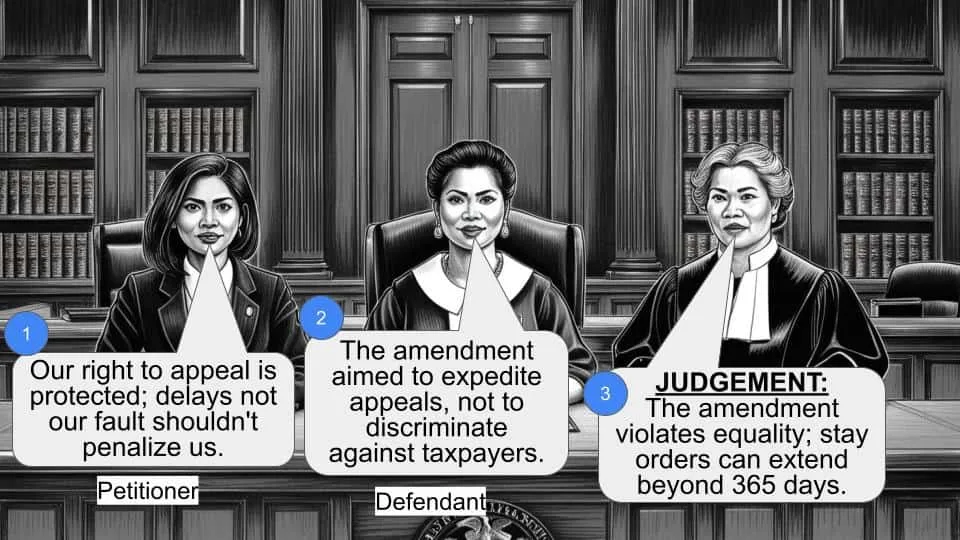
Court strikes down amendment limiting stay orders in tax appeals, reinforcing taxpayers’ rights.
Court strikes down amendment limiting stay orders in tax appeals, reinforcing taxpayers’ rights.
In the case of Pepsi Foods Pvt. Ltd. Vs Assistant Commissioner of Income Tax & Anr, the court addressed the constitutional validity of a provision in the Income Tax Act that restricted the extension of stay orders beyond 365 days, even if the delay was not the taxpayer’s fault. The court ruled that this amendment violated the principle of equality under Article 14 of the Constitution, allowing the Tribunal to extend stay orders in deserving cases.
Get the full picture - access the original judgement of the court order here
Case Name:
Pepsi Foods Pvt. Ltd. Vs Assistant Commissioner of Income Tax & Anr (High Court of Delhi)
W.P.(C) 1334/2015 & CM 2337/2015
Date: 19th May 2015
Key Takeaways:
- The court reaffirmed that the right to appeal must be meaningful and not illusory.
- The amendment introduced by the Finance Act, 2008, which limited stay orders, was struck down for violating Article 14 of the Constitution.
- Taxpayers are entitled to have their appeals heard without arbitrary restrictions on stay orders.
Issue
Can the Income Tax Appellate Tribunal extend stay orders beyond 365 days if the delay in hearing the appeal is not attributable to the taxpayer?
Facts:
- The case involved multiple writ petitions challenging the constitutional validity of the third proviso to Section 254(2A) (of Income Tax Act, 1961), 1961.
- The amendment in question was introduced by the Finance Act, 2008, which stated that stay orders would automatically vacate after 365 days, regardless of the reasons for the delay.
- The petitioners argued that this provision rendered their right to appeal ineffective, especially when delays were not their fault.
Arguments
- Petitioners’ Arguments: They contended that the amendment violated Article 14 of the Constitution by treating taxpayers unequally. They argued that the Tribunal should have the power to extend stay orders beyond 365 days if the delay was not due to the taxpayer’s actions.
- Respondent’s Arguments: The revenue argued that the amendment clarified legislative intent and was not discriminatory. They maintained that the Tribunal’s powers were not affected and that the provision aimed to expedite the appeal process.
Key Legal Precedents
- The court referenced Narang Overseas Private Limited v. Income Tax Appellate Tribunal: 295 ITR 22 (Bombay), which had previously interpreted similar provisions in a way that allowed for extensions of stay orders if the delay was not attributable to the taxpayer.
- The court also cited Maruti Suzuki (India) Limited, where the implications of the third proviso were discussed, emphasizing the need for a fair interpretation of the law to avoid arbitrary results.
Judgement
The court ruled in favor of the petitioners, striking down the amendment introduced by the Finance Act, 2008, as unconstitutional. The court held that the provision violated Article 14 by treating taxpayers unequally and rendering their right to appeal illusory. The Tribunal was reaffirmed to have the power to extend stay orders beyond 365 days in cases where the delay was not the taxpayer’s fault.
FAQs
Q1: What does this ruling mean for taxpayers?
A1: Taxpayers can now have their stay orders extended beyond 365 days if the delay in their appeal is not due to their actions, ensuring their right to appeal is protected.
Q2: How does this affect the Income Tax Appellate Tribunal’s powers?
A2: The Tribunal retains the authority to grant extensions on stay orders, allowing for a more equitable process in tax appeals.
Q3: What was the main legal principle established in this case?
A3: The ruling reinforced that legislative provisions must not violate the principle of equality and must ensure that the right to appeal is meaningful and not arbitrary.
Q4: Can the government appeal this decision?
A4: The government may seek to challenge the ruling, but the court’s decision is based on constitutional principles, which are typically upheld unless there is a compelling reason to overturn them.

1. These writ petitions are taken up together because they raise a common issue and, that is, the challenge to the constitutional validity of the third proviso to Section 254(2A) (of Income Tax Act, 1961), 1961 (hereinafter referred to as ‘the said Act’). An alternative prayer has also been made to read down the provisions of the said proviso to Section 254(2A) of the said Act to mean that the power of the Income Tax Appellate Tribunal to grantinterim relief is co-terminus with the main power of disposal of the appeal, as stipulated in Section 254(1) of the said Act. In each of these petitions, initially stay was granted by the Income Tax Appellate Tribunal. But, the period of 365 days from the grant of initial stay has elapsed and in view of the provisions of Section 254(2A) (of Income Tax Act, 1961), as it stands now, the Tribunal cannot grant any further extension of the stay even though the appeals filed by the petitioners before the Tribunal are pending. The delay in the disposal of the appeals is also not on account of any conduct attributable to the petitioners.
2. The Constitutional validity of the third proviso to Section 254(2A) (of Income Tax Act, 1961)
and, particularly, to the amendment introduced therein by virtue of the
Finance Act, 2008, with effect from 01.08.2008, which added the words –
‘even if the delay in disposing of the appeal is not attributable to the
assessee’– is in question before us. The case of the petitioners is that prior to the said amendment, in a decision of the Bombay High Court in the case of Narang Overseas Private Limited v. Income Tax Appellate Tribunal: 295 ITR 22 (Bombay), the third proviso to Section 254(2A) (of Income Tax Act, 1961) had been read down
in such a manner that even if the period of 365 days from the initial grant of stay had expired, the Tribunal could extend the stay granted, provided the delay was not attributable to the assessee. The amendment brought about by the Finance Act, 2008 sought to nullify this reading of the third proviso to Section 254(2A) of the said Act by introducing the words – ‘even if the
delay in disposing of the appeal is not attributable to the assessee’. It was urged on the part of the petitioners that the right of appeal is not inherent, but once it has been granted, it has to be construed as one which effectively redresses the grievances. It was further contended that the right to obtain a stay of demand/ penalty was integral and cardinal to an effective right of appeal. It was also contended that the introduction of the above mentioned words by virtue of the amendment of 2008 has made the right of appeal illusory and the amendment is, therefore, clearly arbitrary and contrary to the provisions of the Article 14 of the Constitution of India. It was also contended that the said amendment introduces a classification which has no nexus with the object sought to be achieved. In the first place, it clubs assessees belonging to two different categories as one class. It was contended that the assessees, who are not responsible for any delay in the hearing of the appeal, have been clubbed together with those assessees to whom the delay was attributable. Therefore, the persons belonging to different groups/ classes have been clubbed together in one category and this has caused hostile discrimination against those assessees who are law abiding and did not cause any delay in the hearing of their respective appeals. This, in itself, was violative of Article 14 of the Constitution of India and, therefore, the amendment introduced by virtue of the Finance Act, 2008 was liable to be struck down, as being invalid.
3. The learned counsel for the petitioners referred to several decisions in
support of their contentions. They were:-
(i) ITO v. M. K. Mohammed Kunhi: 71 ITR 815 (SC);
(ii) Wire Netting Store, Delhi & Another v. Regional Provident Fund
Commissioner & Others: (1984) 1 ILR 76 (Delhi) (DB);
(iii) Mardia Chemicals Limited & Others v. Union of India and
Another: (2004) 4 SCC 311;
(iv) Narang Overseas Private Limited v. Income Tax Appellate
Tribunal: (2007) 295 ITR 22 (Bombay) (DB) ;
(v) PML Industries Limited v. CCE & Another: 2013 (30) STR 113
(Punjab and Haryana High Court) (DB);
(vi) CIT v. Maruti Suzuki (India) Limited: (2014) 362 ITR 215
(Delhi) (DB); and
(vii) Dr Subramanian Swamy v. Director, CBI: (2014) 8 SCC 682(SC)
4. On the other hand, the learned counsel for the revenue submitted that
there was nothing wrong with the amendment brought about in 2008
inasmuch as all it did was to clarify the legislative intent and make it explicit.
What was already provided under the said Act in the third proviso to Section
254(2A) has merely been clarified. It was contended that there has been no
class treatment given by the legislature and that the said provision is not
discriminatory. The intention behind the amendment was to clarify that the
period of stay cannot be extended beyond 365 days under any circumstances.
A reference was also made to this Court’s decision in Maruti Suzuki (India)
Limited (supra). Reliance was also placed on a decision of the Bombay
High Court in the case of Jethmal Faujimal Soni v. Income Tax Appellate
Tribunal: (2011) 333 ITR 96 and V. M. Salgaocar and Brothers v. Board
of Trustees of Port of Mormugao and Another: (2005) 4 SCC 613.
5. At this point, it would be relevant to set out the provisions of Section
254 (2A), including its provisos, which reads as under:-
“254. Orders of Appellate Tribunal.
(2A) In every appeal, the Appellate Tribunal, where it is
possible, may hear and decide such appeal within a period of
four years from the end of the financial year in which such
appeal is filed under sub-section (1) or sub-section (2) or sub-
section (2A) of section 253 (of Income Tax Act, 1961):
Provided that the Appellate Tribunal may, after considering the
merits of the application made by the assessee, pass an order of
stay in any proceedings relating to an appeal filed under sub-
section (1) of section 253 (of Income Tax Act, 1961), for a period not exceeding one
hundred and eighty days from the date of such order and the
Appellate Tribunal shall dispose of the appeal within the said
period of stay specified in that order:
Provided further that where such appeal is not so disposed of
within the said period of stay as specified in the order of stay,
the Appellate Tribunal may, on an application made in this
behalf by the assessee and on being satisfied that the delay in
disposing of the appeal is not attributable to the assessee,
extend the period of stay, or pass an order of stay for a further
period or periods as it thinks fit; so, however, that the aggregate
of the period originally allowed and the period or periods so
extended or allowed shall not, in any case, exceed three
hundred and sixty-five days and the Appellate Tribunal shall
dispose of the appeal within the period or periods of stay so
extended or allowed:
Provided also that if such appeal is not so disposed of within
the period allowed under the first proviso or the period or
periods extended or allowed under the second proviso, which
shall not, in any case, exceed three hundred and sixty-five days,
the order of stay shall stand vacated after the expiry of such
period or periods, even if the delay in disposing of the appeal is
not attributable to the assessee.
(underlining added)
6. Section 254(2A) (of Income Tax Act, 1961) stipulates that the Appellate Tribunal, where it is
possible, may hear and decide the appeal within a period of four years from
the end of the financial year in which such appeal is filed under Section
253(1), (2) or (2A). Initially, there was no proviso to Section 254(2A) (of Income Tax Act, 1961). The
provisos were added, for the first time, by virtue of the Finance Act, 2001.
At that point of time, the provisos inserted by the Finance Act, 2001 read as under:-
“Provided that where an order of stay is made in any
proceedings relating to an appeal filed under sub-section (1) of
section 253 (of Income Tax Act, 1961), the Appellate Tribunal shall dispose of the appeal
within a period of one hundred and eighty days from the date of
such order:
Provided further that if such appeal is not so disposed of
within the period specified in the first proviso, the stay order
shall stand vacated after the expiry of the said period.”
7. It is clear from the above that with effect from 01.06.2001, it was
stipulated that where an order of stay had been granted, the Appellate
Tribunal was required to dispose of the appeal within a period of 180 days
from the date of said order. It was further provided that if appeal was not
disposed of within the specified period of 180 days, the stay order would
stand vacated after the expiry of the said period. As pointed out by the
learned counsel for the revenue, the Courts, while interpreting the said
provisos, as they stood with effect from 01.06.2001, did not limit the powers of the Tribunal to pass fresh orders of stay on expiration of the period of 180 days. Consequently, by virtue of the Finance Act of 2007, with effect from 01.06.2007, the three provisos, as they stand today, except the last portion of the third proviso, which reads as – ‘even if the delay in disposing of the appeal is not attributable to the assessee’–, were substituted for the provisos which had earlier been inserted by the Finance Act of 2001. Thereafter, by virtue of the Finance Act, 2008, the third proviso was substituted by the existing proviso with effect from 01.10.2008, the difference being that the expression – ‘even if the delay in disposing of the appeal is not attributable to the assessee’– was now added by virtue of the amendment of 2008.
8. Prior to the amendment of 2008, the provisos clearly stipulated that, in
the first instance, a stay order could be passed for a period, not exceeding
180 days from the date of said order, and that the Tribunal was required to
dispose of the appeal within that period. The second proviso stipulated that
in case the appeal was not so disposed of within the period initially stipulated by the Tribunal, the Tribunal could, on an application made on this behalf by the assessee and on being satisfied that the delay in disposing of the appeal was not attributable to the assessee, extend the period of stay for a period or periods, provided that the aggregate of the period originally allowed and the period or periods so extended, would not, in any case, exceed 365 days. The Tribunal was also required to dispose of the appeal within the period or periods of stay so extended or allowed. The third proviso stipulated that if the appeal had not been disposed of within the period of 365 days, the order of stay would stand vacated after the expiry of such period. This provision came up for consideration before the Bombay High Court in Narang Overseas (supra). The exact question which was considered by the Bombay High Court was whether the third proviso to Section 254(2A) of the said Act had the effect of denuding the Tribunal of its incidental power to grant interim relief. A Division Bench of the Bombay High Court, after considering various provisions and decisions, observed as under:-
“20. It would not be possible on the one hand to hold that
there is a vested right of appeal and on the other hand to hold
that there is no power to continue the grant of interim relief
for no fault of the assessee by divesting the incidental power
of the Tribunal to continue the interim relief. Such a reading
would result in such an exercise being rendered unreasonable
and vilative of Article 14 of the Constitution. Courts must,
therefore, construe and / or give a construction consistent with
the constitutional mandate and principle to avoid a provision
being rendered unconstitutional.”
“23. We are of the respectful view that the law as enunciated
in Kumar Cotton Mills (P) Ltd. (supra) should also apply to
the construction of the third proviso as introduced in Section
254(2A) by the Finance Act, 2007. The power to grant stay or
interim relief being inherent or incidental is not defeated by
the provisos to the sub-section. The third proviso has to be
read as a limitation on the power of the Tribunal to continue
interim relief in a case where the hearing of the appeal has
been delayed for acts attributable to the assessee. It cannot
mean that a construction be given that the power to grant
interim relief is denuded even if the acts attributable are not of
the assessee but of the revenue or of the Tribunal itself. The
power of the Tribunal, therefore, to continue interim relief is
not overridden by the language of the third proviso to Section
254(2A). This would be in consonance with the view taken in
Kumar Cotton Mills (P) Ltd. (supra). There would be power
in the Tribunal to extend the period of stay on good cause
being shown and on the Tribunal being satisfied that the
matter could not be heard and disposed of for reasons not
attributable to the assessee.”
9. From the above extract, it is evident that the Bombay High Court was of the view that if it were to be held that the Tribunal, while it had the power to pass an order in an appeal, did not have the power to continue the grant of interim relief for no fault of the assessee, the result would be rendered unreasonable or violative of Article 14 of the Constitution. In other words, the Bombay High Court took the view that the Tribunal had the power to extend the stay beyond the period of 365 days, provided the delay in disposal of the appeal was not attributable to the assessee. The Bombay High Court also took the view that if the third proviso to Section 254(2A) (of Income Tax Act, 1961) were not interpreted in such manner and it was to be held that the Tribunal had no power to extend the period of stay beyond a period of 365 days even though the delay was not attributable to the assessee then, the provision would run afoul of Article 14 of the Constitution and would have to be struck down as such. While observing this, the Bombay High Court was mindful that the Courts are required to construe and/ or to give a construction to a provision which was consistent with the constitutional mandate so as to avoid a provision being rendered unconstitutional. It is in this light that the Bombay High Court read down and interpreted the third proviso (prior to the amendment of 2008) to not take away the power of the Tribunal to extend
the period of stay beyond 365 days, provided, of course, that the delay in
disposing of the appeal was not attributable to the assessee.
10. The Notes on Clauses pertaining to the Finance Bill, 2008, to the
extent relevant, read as under:-
“Clause 46 seeks to amend section 254 (of Income Tax Act, 1961),
relating to orders of the Appellate Tribunal.
Sub-section (2A) of the said section provides that the
Income-tax Appellate Tribunal, where it is possible, may hear
and decide an appeal within a period of four years from the end
of the financial year in which such appeal is filed under sub-
section (1) or sub-section (2) of section 253 (of Income Tax Act, 1961).
The first proviso to this sub-section provides that the
said Appellate Tribunal may, on merit, pass an order of stay in
any proceedings relating to an appeal. However, such period
of stay cannot exceed 180 days from the date of such order and
the said Appellate Tribunal shall dispose of the appeal within
the specified period of stay.
The second proviso to this sub-section provides that
where the appeal has not been disposed of within the said
specified period and the delay in disposing of the appeal is not
attributable to the assessee, the Appellate Tribunal can further
extend the period of stay originally allowed. However, the
aggregate of period originally allowed and the period so
extended should not exceed 365 days. The Appellate Tribunal
is required to dispose of the appeal within the extended period.
The third proviso to this sub-section provides that if such
appeal is not decided within the period allowed originally or
the period or periods so extended or allowed, the order of stay
shall stand vacated after the expiry of such period or periods.
The intention behind these provisions have been very
clear that the Appellate Tribunal cannot grant stay either under
the original order or under any subsequent order, beyond the
period of 365 days in aggregate.
To make this intention clear, it is proposed to amend
section 254 (of Income Tax Act, 1961) and further provide that the
aggregate of the period originally allowed and the period or
periods so extended or allowed shall not, in any case, exceed
three hundred and sixty five days, even if the delay in
disposing of the appeal is not attributable to the assessee.
This amendment will take effect from 1st October,
2008.”
From the above, it is evident that the object behind the introduction of the
words – ‘even if the delay in disposing of the appeal is not attributable to the assessee’– was to make it clear that the aggregate of the period originally allowed and the period or periods so extended or allowed was not to, in any case, exceed 365 days, even if the delay in disposing of the appeal was not attributable to the assessee.
11. It is evident that the amendment introduced by virtue of the Finance
Act, 2008 had nullified the effect of the decision of the Bombay High court
in Narang Overseas (supra). The said provision, after its amendment by
virtue of the Finance Act, 2008, came up for consideration before this Court
in Maruti Suzuki (India) Limited (supra). The following observations made
by a Division Bench of this Court in that case are relevant:-
“26. In view of the aforesaid discussion, we have reached the
following conclusion:-
(i) In view of the third proviso to Section 254(2A) (of Income Tax Act, 1961)
substituted by Finance Act, 2008 with effect from 1st October,
2008, tribunal cannot extend stay beyond the period of 365 days
from the date of first order of stay.
(ii) In case default and delay is due to lapse on the part of the
Revenue, the tribunal is at liberty to conclude hearing and
decide the appeal, if there is likelihood that the third proviso to
Section 254(2A) (of Income Tax Act, 1961) would come into operation.
(iii) Third proviso to Section 254(2A) (of Income Tax Act, 1961) does not bar or
prohibit the Revenue or departmental representative from
making a statement that they would not take coercive steps to
recover the impugned demand and on such statement being
made, it will be open to the tribunal to adjourn the matter at the
request of the Revenue.
(iv) An assessee can file a writ petition in the High Court
pleading and asking for stay and the High Court has power and
jurisdiction to grant stay and issue directions to the tribunal as
may be required. Section 254(2A) (of Income Tax Act, 1961) does not prohibit/bar the
High Court from issuing appropriate directions, including
granting stay of recovery.
27. We have not examined the constitutional validity of the
provisos to Section 254(2A) (of Income Tax Act, 1961) and the issue is left
open.”
(underlining added)
12. From the above extract, it is evident that the Division Bench was not
called upon and did not examine the constitutional validity of the provisos to Section 254(2A) of the said Act and left the issue open. It is only on a plain reading of the provisos, as they existed, that the Division Bench came to the conclusion that the Tribunal had no power to extend stay beyond a period of 365 days from the date of the first order of stay but that an assessee could file a writ petition in the High Court asking for stay even beyond the said period of 365 days and the High Court had the power and jurisdiction to grant stay and issue directions to the Tribunal and that Section 254(2A) (of Income Tax Act, 1961) did not prohibit / bar the High Court from issuing appropriate directions, including grant of stay of recovery. A similar view was taken by the Bombay High Court in Jethmal Faujimal Soni (supra). But that decision was also rendered on a plain meaning of the provisos, as they stood. There was no challenge to the constitutional validity of the third proviso to Section 254(2A) of the said Act after the amendment introduced by the Finance Act, 2008. No decision of any High Court has been brought to our notice by the learned counsel for the parties, wherein the constitutional validity of the third proviso to Section 254(2A) of the said Act has been examined.
13. At this point, we may also refer to certain other observations of the
Division Bench in Maruti Suzuki (India) Limited (supra). The Court had
examined various data with regard to the filing of appeals, pendency of
appeals and stay orders granted by the Tribunal etc.. Paragraphs 21, 22 and
23 are of material importance and they are reproduced herein below:-
“21. Information/data in this regard was received vide letter dated
30th January, 2014 written by Assistant Registrar, Tribunal. The
relevant portion of the said letter reads as under:-
“a) Number of appeals filed before the Tribunal by the
assessee and the revenue is as under:-
Year Assessee Revenue Total
2011 3359 3013 6372
2012 3593 3462 7055
2013 3975 3102 7077
Total 10927 9577 20504
b) No data is available with regard to average time taken
for disposal of the appeal before the Tribunal.
c) (i) The year-wise details of the stay orders passed by
the Tribunal are as under:-
Year Number of stay orders
2011 173
2012 278
2013 321
(ii) The complete details in respect of each and every appeal
where stay order was passed is annexed as Annexure-1, 2 & 3.
d) The year-wise details of the cases/appeals which
remained pending beyond 365 days of the stay order are as
under:-
Year Number of appeals disposed-off after 365
days or pending for more than 365 days
2011 90 Appeals
2012 131 Appeals
2013 36 Appeals
e) The year-wise details of the number of appeals
disposed of within 365 days from the date of grant of stay
are as under:-
Year Number of appeals disposed-off within 365
days or pending within 365 days
2011 83 Appeals
2012 147 Appeals
2013 285 Appeals”
22. The aforesaid data does not mention the quantum of
demand, which was subject matter of stay, but the position is
certainly not bleak and unpalatable. Most of the appeals in which
stay had/has been granted, were/are being disposed of within 365
days. Number of appeals, which were not disposed of within 365
days of grant of stay, have come down sharply in the year 2013.
Grant of stay by the tribunal is not a matter of right, but is decided
by a speaking order, recording prima facie view on merits. In case
there is an error or the tribunal has erred in granting stay, Revenue
is not without remedy and can approach the High Court in
accordance with law.
23. We do not have figures or data on whether the demands
raised, which was subject matter of stay, was sustained/upheld or
were deleted by the tribunal. Merits and justification of additions
is examined by the appellate forums and demands raised have
relevance when they are sustained by the tribunal/High Court and
the Supreme Court.”
14. From the above data, it is evident that the number of stay orders
granted by the Tribunal in the years 2011, 2012 and 2013 do not even
amount to 10% of the appeals filed by assessees before the Tribunal.
Furthermore, even a fewer number of appeals, in which stay orders have
been passed, remain pending beyond the period of 365 days. It is in this
light that the Division Bench observed that most of the appeals in which stay had/has been granted were/are being disposed of within 365 days. The
Division Bench also observed that the grant of stay by the Tribunal was not a matter of right but was decided by a speaking order, recording the prima
facie view on merits. Furthermore, in case there was an error, the revenue
was not without remedy and could approach the High Court in accordance
with law. From the above figures, it is evident that there is a very small
percentage of appeals before the Tribunal which remain pending beyond the
period of 365 days in which stay orders were granted.
15. We may also refer to paragraph 17 of the decision in Maruti Suzuki
(India) Limited (supra) which was relied upon by the revenue. The said
paragraph reads as under:-
“17. In these circumstances, we have examined whether we
can read down the third proviso, by applying principles of
equity, justice and fair play and also the principle that the court
should interpret a provision in a manner that it does not lead to
arbitrary results or make it violative of Article 14 or would
render it unconstitutional. However, it is clear to us that the
legislative mandate has to be respected and the courts do not
legislate but interpret the statute as a legislative edict. The third
proviso after amendment, undoubtedly bars and prohibits the
tribunal from extending interim stay order beyond 365 days. It
stipulates deemed vacation and imposes no fault consequences
in strict terms. The language is clear and therefore has to be
respected. However, the provision does not bar or prohibit an
assessee from approaching the High Court by way of writ
petition for continuation, extension or grant of stay. Fairly, the
standing counsel for Revenue accepts and admits that in spite of
Section 254(2A) (of Income Tax Act, 1961), the High Court has power to grant and extend
stay where the appeal is pending before the tribunal. The
constitutional power and right is available and has not and
cannot be curtailed. The powers of the High Court under
Articles 226 and 227 form a part and parcel of the basic
structure of the Constitution and cannot be over written and
nullified as held by the Constitutional Bench in L. Chandra
Kumar versus Union of India, (1997) 3 SCC 261. Thus, the
High Court in appropriate matters can grant or extend stay even
when the tribunal has not been able to dispose of an appeal
within 365 days from the date of grant of initial stay. This
perhaps appears to be and apparently is the intention of the
Parliament. High Court while granting or rejecting the writ
petition will examine the factual matrix, record reasons as to
who is to be blamed and is responsible for the default and can
also issue appropriate directions or orders for expeditious and
early disposal of the appeal. The provision will propel and
ensure that the tribunal will try and dispose of and decide
appeals within 365 days of the grant of stay order. The Bombay
High Court in Jethmal Faujimal Soni vs. Income Tax
Appellate Tribunal [2011] 333 ITR 96, had occasion to deal
with a similar situation and entertained the writ petition. In the
said case constitutional validity of the third proviso inserted in
Section 254(2A) (of Income Tax Act, 1961) by Finance Act, 2008, w.e.f. 1st
October, 2008 was challenged It was observed that the proviso
enacted a stringent provision as a result of which even if the
delay in disposing of the appeal was/is not attributable to the
assessee, the stay stands vacated after 365 days. Thus, the
tribunal was/is under binding duty and obligation to dispose of
the appeal within the said time, particularly when the fault was
not on the part of the assessee. In the said case, directions were
issued for expeditious disposal of the appeal and it was also
directed that the Revenue shall not take coercive steps for
enforcing demand subject matter of the appeal.”
(underlining added)
16. At this juncture itself, we may reiterate that the decision of the
Division Bench in Maruti Suzuki (India) Limited (supra) was based on an
interpretation of the third proviso to Section 254(2A) (of Income Tax Act, 1961) as it stands. The
constitutional validity of the same had not been examined. It only spelt out
the legislative intent and that was more than clear that no stay could be
granted by the Tribunal beyond the period of 365 days under any
circumstances. The question that we have to examine is whether this
intention of the legislature is not hit by Article 14 of the Constitution of
India. We may also point out that the fact that judicial review was available to an assessee under Article 226 of the Constitution, would not, in any way, add to or subtract from the issue of constitutional validity of the third proviso to Section 254(2A) (of Income Tax Act, 1961).
17. It would now be relevant to examine the decision of the Supreme
Court in Mohammed Kunhi (supra). The question before the Supreme
Court was whether the Income Tax Appellate Tribunal had power under the
relevant provisions of the said Act to stay the recovery of the realization of the penalty imposed by the departmental authorities on an assessee during
the pendency of an appeal before it. In that case, the Tribunal had declined
to order any stay holding that it had no power to grant such a prayer. We
must be mindful of the fact that at that point of time Section 254(2A) (of Income Tax Act, 1961) was not there in the said Act. The said provision was introduced with effect from 01.06.1999 by the Finance Act, 1999. In the absence of any specific
provision, permitting the Tribunal to grant stay, the question arose as to
whether the Tribunal had the power to stay the proceedings as also the
collection of penalties pending the appeal. The High Court of Kerala held
that the Tribunal had such power and that the power was incidental and
ancillary to its appellate jurisdiction. The Supreme Court observed that the
powers, which had been conferred by Section 254 (of Income Tax Act, 1961) on the Appellate Tribunal,
were of the widest possible amplitude and, therefore, must carry with them,
by necessary implication, all powers and duties incidental and necessary to
make the exercise of those fully effective. Finally, the Supreme Court
concluded by holding:-
“13. Section 255(5) (of Income Tax Act, 1961) does empower the Appellate
Tribunal to regulate its own procedure, but it is very doubtful if
the power of stay can be spelt out from that provision. In our
opinion the Appellate Tribunal must be held to have the power
to grant stay as incidental or ancillary to its appellate
jurisdiction. This is particularly so when Section 220(6) (of Income Tax Act, 1961) deals
expressly with a situation when an appeal is pending before the
Appellate Assistant Commissioner, but the Act is silent in that
behalf when an appeal is pending before the Appellate Tribunal.
It could well be said that when Section 254 (of Income Tax Act, 1961) confers appellate
jurisdiction, it impliedly grants the power of doing all such acts,
or employing such means, as are essentially necessary to its
execution and that the statutory power carries with it the duty in
proper cases to make such orders for staying proceedings as
will prevent the appeal if successful from being rendered
nugatory.
14. A certain apprehension may legitimately arise in the
minds of the authorities administering the Act that if the
Appellate Tribunals proceed to stay recovery of taxes or
penalties payable by or imposed on the Assessees as a matter of
course the revenue will be put to great loss because of the
inordinate delay in the disposal of appeals by the Appellate
Tribunals. It is needless to point out that the power of stay by
the Tribunal is not likely to be exercised in a routine way or as
a matter of course in view of the special nature of taxation and
revenue laws. It will only be when a strong prima facie case is
made out that the tribunal will consider whether to stay the
recovery proceedings and on what conditions, and the stay will
be granted in most deserving and appropriate cases where the
tribunal is satisfied that the entire purpose of the appeal will be
frustrated or rendered nugatory by allowing the recovery
proceedings to continue during the pendency of the appeal.”
(underlining added)
18. From this decision, it is evident that the power to grant a stay is
incidental or ancillary to the appellate jurisdiction of the Tribunal. It is also clear that the power of stay exercised by the Tribunal is not likely to be exercised in a routine way or as a matter of course in view of the special nature of taxation and revenue laws and it is only when a strong prima facie case is made out that the Tribunal would consider whether to stay the recovery proceedings and on what conditions. The stay is also granted in deserving and appropriate cases where the Tribunal is satisfied that the entire purpose of the appeal would be frustrated or rendered nugatory by allowing the recovery proceedings to continue during the pendency of the appeal.
These words of the Supreme Court were indeed prophetic, as can be
discerned from the data which has been referred to by a Division Bench of
this Court in Maruti Suzuki (India) Limited (supra), which shows that in
less than 10% of the appeals filed by assessees, the Tribunal has granted stay orders and in a very few of such cases, the appeals are pending beyond the period of 365 days stipulated under the provisions, as they now stand.
19. A reference has been made to Mardia Chemicals Limited (supra).
The passages referred to were paragraphs 55, 61 and 80, which read as
under:
“55. We may then turn to the arguments raised on behalf of
the petitioners that the remedy before the Debts Recovery
Tribunal under Section 17 (of Income Tax Act, 1961) is illusory, burdened with
onerous and oppressive condition of deposit of 75% of the
amount of the demand notice before an appeal can be
entertained by the Tribunal. We feel that it would be difficult to
brush aside the challenge made to the condition of such a
deposit. Sub-section (2) of Section 17 (of Income Tax Act, 1961) itself says that no appeal
shall be entertainable unless the borrower has deposited the
aforesaid sum of amount claimed. Much stress has been given
in reply to the proviso to sub-section (2) of Section 17 (of Income Tax Act, 1961),
according to which the Tribunal has power to waive or reduce
the amount. While waiving the condition of depositing the
amount or reducing it, the Tribunal is required to record reasons
for the same. It is submitted for the respondents that in an
appropriate case, DRT which is presided over by a Member of a
Higher Judicial Service, would exercise its discretion and may
waive or reduce the amount required to be deposited in
deserving cases. It is, therefore, not an absolute condition which
must in all cases and all circumstances be fulfilled irrespective
of the special features of a particular case.”
“61. In the case of Seth Nandlal (supra), while considering the
question of validity of pre-deposit before availing the right of
appeal the Court held:
“right of appeal is a creature of the statute and while
granting the right the legislature can impose
conditions for the exercise of such right so long as
the conditions are not so onerous as to amount to
unreasonable restrictions rendering the right almost
illusory.”
(emphasis supplied).
While making said observation this Court referred to the
decision in the case of Anant Mills Co. Ltd. (supra). In both the
above noted decisions this Court had negated the plea raised
against pre-deposit but in the case of Seth Nandlal (supra) it
was found that the condition was not so onerous since the
amount sought to be deposited was meager and that too was
confined to the landholding tax payable in respect of the
disputed area i.e. the area or part thereof which is declared
surplus by the Prescribed Authority (emphasis supplied) after
leaving the permissible area to the appellant. In the above
circumstances it was found that even in the absence of a
provision conferring discretion on the appellate authority to
waive or reduce the amount of pre- deposit, it was considered to
be valid, for the two reasons indicated above. The facts of the
case in hand are just otherwise.”
“80. Under the Act in consideration, we find that before
taking action a notice of 60 days is required to be given and
after the measures under Section 13(4) (of Income Tax Act, 1961) have been
taken, a mechanism has been provided under Section 17 (of Income Tax Act, 1961) of the
Act to approach the Debts Recovery Tribunal. The above noted
provisions are for the purpose of giving some reasonable
protection to the borrower. Viewing the matter in the above
perspective, we find what emerges from different provisions of
the Act, is as follows :-
1. Under sub-section (2) of Section 13 (of Income Tax Act, 1961) it is
incumbent upon the secured creditor to serve 60 days
notice before proceeding to take any of the measures
as provided under sub-section (4) of Section 13 (of Income Tax Act, 1961) of the
Act. After service of notice, if the borrower raises
any objection or places facts for consideration of the
secured creditor, such reply to the notice must be
considered with due application of mind and the
reasons for not accepting the objections, howsoever
brief they may be, must be communicated to the
borrower. In connection with this conclusion we have
already held a discussion in the earlier part of the
judgment. The reasons so communicated shall only
be for the purposes of the information/knowledge of
the borrower without giving rise to any right to
approach the Debts Recovery Tribunal under Section
17 of the Act, at that stage.
2. As already discussed earlier, on measures
having been taken under sub-section (4) of Section
13 and before the date of sale/auction of the property
it would be open for the borrower to file an appeal
(petition) under Section 17 (of Income Tax Act, 1961) before the
Debts Recovery Tribunal.
3. That the Tribunal in exercise of its ancillary
powers shall have jurisdiction to pass any
stay/interim order subject to the condition as it may
deem fit and proper to impose.
4. In view of the discussion already held in this
behalf, we find that the requirement of deposit of
75% of amount claimed before entertaining an appeal
(petition) under Section 17 (of Income Tax Act, 1961) is an
oppressive, onerous and arbitrary condition against
all the canons of reasonableness. Such a condition is
invalid and it is liable to be struck down.
5. As discussed earlier in this judgment, we find
that it will be open to maintain a civil suit in civil
court, within the narrow scope and on the limited
grounds on which they are permissible, in the matters
relating to an English mortgage enforceable without
intervention of the court.”
20. The learned counsel for the petitioners had also referred to a decision
of the Division Bench of the Punjab and Haryana High Court in PML
Industries Limited (supra). Although that decision pertained to Section 35C (of Income Tax Act, 1961)
(2A) of the Central Excise Act, 1944, the provision under consideration was
somewhat similar. It pertained to the waiver of pre-deposit at the stage of an appeal pending before the Central Excise Service Tax Appellate Tribunal.
The provision indicated that the waiver would stand vacated after 180 days.
In that context, the question arose, as to whether the second proviso to
Section 2A of Section 35C (of Income Tax Act, 1961) was directory and that the Tribunal, in
appropriate circumstances, could extend the period of stay beyond 180 days.
While considering the said question, the Punjab and Haryana High Court
held as under:-
“51. Though the right of appeal is a creation of Statute and it
can be exercised only subject to the conditions specified
therein, but the conditions specified have to be in relation to the
assessee as something which is required to be complied with by
the assessee. But where the assessee has no control over the
functioning of the Tribunal, then the provision of vacation of
stay cannot be sustained.
52. The assessee having preferred appeal and that Tribunal
being satisfied that condition for dispensing with the pre-
deposit of duty demanded and penalty levied is made out, is
compelled to pay the duty demanded and penalty levied, if the
appeal is not decided within 180 days. The assessee has no
control in respect of matters pending before the Tribunal; in the
matter of availability of infrastructure; the members of the
Tribunal and the workload. Therefore, for the reason that the
Tribunal is not able to decide appeal within 180 days, the
vacation of stay is a harsh and onerous and unreasonable
condition. The condition of vacation of stay for the inability of
the Tribunal to decide the appeal is burdening the assessee for
no fault of his. Such a condition is onerous and renders the right
of appeal as illusory. An order passed by a judicial forum is
sought to be annulled for no fault of assessee. Therefore, in
terms of judgments in Anant Mills Ltd. and Seth Nandlal cases
(supra), such condition of automatic vacation of stay on the
expiry of 180 days, has to be read down to mean that after 180
days the Revenue has a right to bring to the notice of the
Tribunal the conduct of the assessee in delay or avoiding the
decision of appeal, so as to warrant an order of vacation of stay.
If the provision is not read down in the manner mentioned
above, such condition suffers from illegality rendering the right
of appeal as redundant.
54. Consequently, the second proviso in sub-section (2A) of
Section 35C (of Income Tax Act, 1961) is ordered to be read down to mean that after 180
days, the Revenue has a right to seek vacation of stay on proof
of the fact that the assessee is the one, who is defaulted or taken
steps to delay the ultimate decision.”
The said Court read down the provision in question in much the same
manner as did the Bombay High Court in the case of Narang Overseas
(supra). The object being that, if the provision were to be read strictly, it would render the right of appeal to be illusory and for no fault of the
assessee.
21. The decision in Wire Netting Store, Delhi (supra) was relied upon by
the learned counsel for the petitioners for the proposition that the availability of a constitutional remedy would not remove the lacuna of a provision which was inherently unconstitutional. There can be no dispute with this proposition. The provision which is challenged, as being violative of Article 14 of the Constitution, would have to be tested on its own without recourse to the availability of the remedy of judicial review under Article 226 of the Constitution.
22. In Dr Subramanian Swamy (supra), a Constitution Bench of the
Supreme Court, while considering the parameters which needed to be kept in
mind in determining whether a particular provision of a statute was violative of Article 14 or not, made the following observations:-
“46. In Air India v. Nergesh Meerza and Ors. : (1981) 4 SCC
335, the three-Judge Bench of this Court while dealing with
constitutional validity of Regulation 46(i)(c) of Air India
Employees' Service Regulations (referred to as 'A.I.
Regulations') held that certain conditions mentioned in the
Regulations may not be violative of Article 14 on the ground of
discrimination but if it is proved that the conditions laid down
are entirely unreasonable and absolutely arbitrary, then the
provisions will have to be struck down. With regard to due
process clause in the American Constitution and Article 14 of
our Constitution, this Court referred to State of West Bengal v.
Anwar Ali Sarkar : (1952) SCR 284, and observed that the due
process clause in the American Constitution could not apply to
our Constitution. The Court also referred to A.S. Krishna v.
State of Madras: 1957 S.C.R. 399 (of Income Tax Rules, 1962) wherein Venkatarama Ayyar,
J. observed:
"13. ....The law would thus appear to be based on
the due process clause, and it is extremely doubtful
whether it can have application under our Constitution."
47. In D.S. Nakara and Ors. v. Union of India: (1983) 1 SCC
305, the Constitution Bench of this Court had an occasion to
consider the scope, content and meaning of Article 14. The
Court referred to earlier decisions of this Court and in para 15,
the Court observed:
“15. Thus the fundamental principle is that
Article 14 forbids class legislation but permits
reasonable classification for the purpose of legislation
which classification must satisfy the twin tests of
classification being founded on an intelligible
differentia which distinguishes persons or things that
are grouped together from those that are left out of the
group and that differentia must have a rational nexus
to the object sought to be achieved by the statute in
question.””
“Court's approach
49. Where there is challenge to the constitutional validity of a
law enacted by the legislature, the Court must keep in view that
there is always a presumption of constitutionality of an
enactment, and a clear transgression of constitutional principles
must be shown. The fundamental nature and importance of the
legislative process needs to be recognized by the Court and due
regard and deference must be accorded to the legislative
process. Where the legislation is sought to be challenged as
being unconstitutional and violative of Article 14 of the
Constitution, the Court must remind itself to the principles
relating to the applicability of Article 14 in relation to
invalidation of legislation. The two dimensions of Article 14 in
its application to legislation and rendering legislation invalid are
now well recognized and these are (i) discrimination, based on
an impermissible or invalid classification and (ii) excessive
delegation of powers; conferment of uncanalised and unguided
powers on the executive, whether in the form of delegated
legislation or by way of conferment of authority to pass
administrative orders-if such conferment is without any
guidance, control or checks, it is violative of Article 14 of the
Constitution. The Court also needs to be mindful that a
legislation does not become unconstitutional merely because
there is another view or because another method may be
considered to be as good or even more effective, like any issue
of social, or even economic policy. It is well settled that the
courts do not substitute their views on what the policy is.”
It is clear that where a legislation is sought to be challenged, as being
unconstitutional or violative of Article 14 of the Constitution, the Court must keep in mind the principles relating to the applicability of Article 14 in relation to invalidation of a legislation. The two dimensions of Article 14 in its application to legislation and for rendering legislation invalid are well settled and these are – (i) discrimination, based on an impermissible or an invalid classification and (ii) excessive delegation of powers; conferment of uncanalised and unguided powers on the executive, whether in the form of delegated legislation or by way of conferment of authority to pass administrative orders. The Constitution Bench also cautioned that the Courts need to be mindful that a legislation does not become unconstitutional merely because there is another view or because another method may be considered to be as good or even more effective, like any issue of social, or even economic policy.
23. Keeping in mind the principles set out by the Supreme Court in
Dr Subramanian Swamy (supra), we need to examine whether the present
challenge to the validity of the third proviso to Section 254(2A) (of Income Tax Act, 1961) can be
sustained. This is not a case of excessive delegation of powers and,
therefore, we need not bother about the second dimension of Article 14 in its application to legislation. We are here concerned with the question of
discrimination, based on an impermissible or invalid classification. It is
abundantly clear that the power granted to the Tribunal to hear and entertain an appeal and to pass orders would include the ancillary power of the Tribunal to grant a stay. Of course, the exercise of that power can be
subjected to certain conditions. In the present case, we find that there are
several conditions which have been stipulated. First of all, as per the first proviso to Section 254(2A) (of Income Tax Act, 1961), a stay order could be passed for a period not exceeding 180 days and the Tribunal should dispose of the appeal within that period. The second proviso stipulates that in case the appeal is not disposed of within the period of 180 days, if the delay in disposing of the appeal is not attributable to the assessee, the Tribunal has the power to extend the stay for a period not exceeding 365 days in aggregate. Once again, the Tribunal is directed to dispose of the appeal within the said period of stay. The third proviso, as it stands today, stipulates that if the appeal is not disposed of within the period of 365 days, then the order of stay shall stand vacated, even if the delay in disposing of the appeal is not attributable to the assessee.
While it could be argued that the condition that the stay order could be
extended beyond a period of 180 days only if the delay in disposing of the
appeal was not attributable to the assessee was a reasonable condition on the power of the Tribunal to the grant an order of stay, it can, by no stretch of imagination, be argued that where the assessee is not responsible for the delay in the disposal of the appeal, yet the Tribunal has no power to extend the stay beyond the period of 365 days. The intention of the legislature, which has been made explicit by insertion of the words – ‘even if the delay in disposing of the appeal is not attributable to the assessee’– renders the right of appeal granted to the assessee by the statute to be illusory for no fault on the part of the assessee. The stay, which was available to him prior to the 365 days having passed, is snatched away simply because the Tribunal has, for whatever reason, not attributable to the assessee, been unable to dispose of the appeal. Take the case of delay being caused in the disposal of the appeal on the part of the revenue. Even in that case, the stay would stand vacated on the expiry of 365 days. This is despite the fact that the stay was granted by the Tribunal, in the first instance, upon considering the prima facie merits of the case through a reasoned order.
24. Furthermore, the petitioners are correct in their submission that
unequals have been treated equally. Assessees who, after having obtained
stay orders and by their conduct delay the appeal proceedings, have been
treated in the same manner in which assessees, who have not, in any way,
delayed the proceedings in the appeal. The two classes of assessees are
distinct and cannot be clubbed together. This clubbing together has led to
hostile discrimination against the assessees to whom the delay is not
attributable. It is for this reason that we find that the insertion of the
expression – ‘even if the delay in disposing of the appeal is not attributable to the assessee’– by virtue of the Finance Act, 2008, violates the non-discrimination clause of Article 14 of the Constitution of India.
The object that appeals should be heard expeditiously and that assesses should not misuse the stay orders granted in their favour by adopting delaying tactics is not at all achieved by the provision as it stands. On the contrary, the clubbing together of ‘well behaved’ assesses and those who cause delay in the appeal proceedings is itself violative of Article 14 of the Constitution and has no nexus or connection with the object sought to be achieved. The said expression introduced by the Finance Act, 2008 is, therefore, struck down as being violative of Article 14 of the Constitution of India. This would revertus to the position of law as interpreted by the Bombay High Court in Narang Overseas (supra), with which we are in full agreement. Consequently, we hold that, where the delay in disposing of the appeal is not attributable to the assessee, the Tribunal has the power to grant extension of stay beyond 365 days in deserving cases. The writ petitions are allowed as above.
25. Consequently, the petitioners may approach the Tribunal for extension
of stay in each of the cases before us and till the Tribunal passes such orders, the interim orders granted by us in these matters shall continue. The petitioners shall move the Tribunal within four weeks from the date of this judgment. The parties are left to bear their own costs.
BADAR DURREZ AHMED, J
SANJEEV SACHDEVA, J
MAY 19, 2015
×
Similar Ripples
Questions
Court strikes down amendment limiting stay orders in tax appeals, reinforcing taxpayers’ rights.
Write your CommentSimilar Posts

Generic
- Reportdata/3733.pdf
