


"Court Strikes Down Reassessment: Change of Opinion Not Valid Ground for Reopen…



Full News
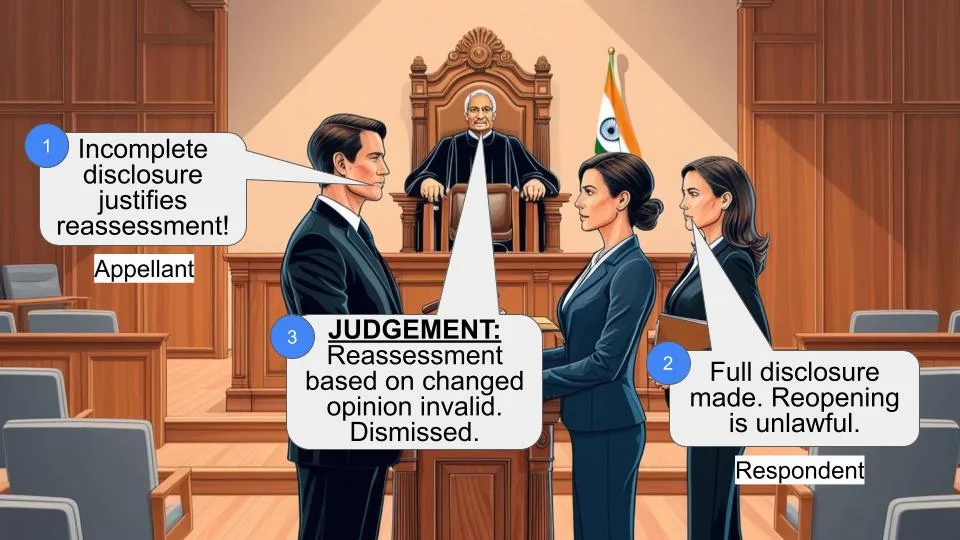
"Court Strikes Down Reassessment: Change of Opinion Not Valid Ground for Reopening"
"Court Strikes Down Reassessment: Change of Opinion Not Valid Ground for Reopening"
This case involves an appeal by the Income Tax Department against an order of the Income Tax Appellate Tribunal (ITAT) that dismissed the department's reassessment proceedings against Hindustan Zinc Ltd. The ITAT ruled that reopening an assessment based merely on a change of opinion is not legally valid. The High Court upheld the ITAT's decision, dismissing the department's appeal.
Get the full picture - access the original judgement of the court order here
Case Name:
Commissioner of Income Tax Vs Hindustan Zinc Ltd. (High Court of Allahabad)
D.B. Income Tax Appeal No.166/14
Date: 20th May 2016
Key Takeaways:
1. Reassessment proceedings cannot be initiated based solely on a change of opinion.
2. The Assessing Officer must have "reason to believe" that income has escaped assessment, supported by new material evidence.
3. The taxpayer's duty is limited to full and true disclosure of primary facts; drawing inferences is the Assessing Officer's responsibility.
4. Courts can examine if there's a rational connection between the reasons and the belief for reopening, but cannot judge the sufficiency of reasons.
Issue:
Can the Income Tax Department reopen a completed assessment under Section 147 (of Income Tax Act, 1961), based solely on a change of opinion without any new material evidence?
Facts:
1. Hindustan Zinc Ltd. filed its income tax return for the assessment year 2005-06 on 29.10.05.
2. The Assessing Officer completed the assessment under Section 143(3) (of Income Tax Act, 1961) on 26.12.07.
3. Later, the Assessing Officer initiated reassessment proceedings by issuing a notice under Section 148 (of Income Tax Act, 1961).
4. The reassessment was based on the claim of additional depreciation on Captive Power Plant (CPP) & Wind Mills.
5. The Commissioner of Income Tax (Appeals) upheld the validity of reassessment proceedings but allowed the additional depreciation claim.
6. The Income Tax Department appealed to the ITAT, which allowed the assessee's cross-objection and struck down the reassessment proceedings.
Arguments:
Revenue's Argument:
- The assessee failed to disclose complete facts by not bifurcating the amount of additional depreciation in the depreciation charts.
- The reopening was not based on a change of opinion but on the discovery of an incorrect claim of additional depreciation.
Assessee's Argument:
- All material facts were fully and truly disclosed during the original assessment.
- The reassessment was based merely on a change of opinion, which is not permissible under law.
Key Legal Precedents:
1. Calcutta Discount Co. Ltd. vs. Income-tax Officer, Companies District I, Calcutta (1961) 41 I.T.R.191(SC) (of Income Tax Rules, 1962): Explained the scope of reassessment provisions and the duty of the assessee to disclose material facts.
2. S.Narayanappa and Others Vs. Commissioner of Income Tax, Bangalore (1996) 62 ITR 219: Held that the existence of belief can be challenged, but not the sufficiency of reasons for the belief.
3. Income Tax Officer, I Ward Distt VI, Calcutta Vs. Lakhmani Mewal Das (1976) 103 ITR 437: Emphasized that the assessee's duty ends with true and full disclosure of primary facts.
4. CIT vs. Kelvinator of India Ltd. (2010) 320 ITR 561 (SC): Established that "reason to believe" must be based on tangible material and not mere change of opinion.
Judgement:
The High Court dismissed the Revenue's appeal, upholding the ITAT's decision. Key points of the judgment:
1. The assessee had made a true and full disclosure of all relevant facts during the original assessment.
2. The Assessing Officer's belief regarding escapement of assessment was based on reappreciation of existing material, amounting to a mere change of opinion.
3. Reopening an assessment without any fresh material, based solely on a change of opinion, is without jurisdiction and erroneous.
FAQs:
1. Q: What is the significance of "reason to believe" in reassessment proceedings?
A: "Reason to believe" is a safeguard against arbitrary reopening of assessments. It must be based on new, tangible material and not merely a change of opinion.
2. Q: What is the taxpayer's duty regarding disclosure of information?
A: The taxpayer must disclose all primary facts fully and truly. Drawing inferences from these facts is the responsibility of the Assessing Officer.
3. Q: Can a court examine the reasons for reopening an assessment?
A: Yes, but only to the extent of checking if there's a rational connection between the reasons and the belief. The court cannot judge the sufficiency of the reasons.
4. Q: What is the impact of this judgment on future reassessment cases?
A: This judgment reinforces that tax authorities cannot reopen assessments based solely on a change of opinion. They must have new material evidence to support their "reason to believe" that income has escaped assessment.

1. This appeal is directed against order dated 4.3.14 of the Income Tax Appellate Tribunal (ITAT), Jodhpur Bench, Jodhpur, whereby the Cross Objection filed by the assessee in the appeal preferred by the Revenue against the order dated 31.7.13 of Commissioner of Income Tax (Appeal) [CIT (A)], Udaipur, has been allowed and while striking down the re-assessment proceedings initiated by the Assessing Officer (AO) for the assessment year 2005-06, on the change of opinion, the appeal preferred by the Revenue has been dismissed as having become infructuous.
2. The relevant facts are that the assessee filed its return of income for assessment year 2005-06, on 29.10.05, disclosing total income at Rs.587,04,55,500/-, which was assessed under Section 143(3) (of Income Tax Act, 1961) by the AO on 26.12.07 at total income of Rs.609,09,40,080/-. The order passed by the AO was appealed against by the assessee before the CIT (A), which reduced the assessed income to Rs.587,04,55,500/-. After scrutiny of assessment, it was observed that the assessee has made incorrect claim of additional depreciation on Captive Power Plant (CPP) & Wind Mills. The re-assessment proceedings were initiated by the AO by issuing notice under Section 148 (of Income Tax Act, 1961) (for short “the Act”). The AO framed the assessment order under Section 143(3) (of Income Tax Act, 1961) read with Section 148 (of Income Tax Act, 1961) and disallowed the additional depreciation on CPP claimed by the assessee to the tune of Rs.30,09,36,309/- and accordingly assessed the taxable income at Rs.617,13,91,709/-. Aggrieved thereby, the assessee preferred an appeal before the CIT (A), Udaipur. It was contended on behalf of the assessee that the assessments completed after scrutiny assessment under Section 143(3) (of Income Tax Act, 1961), cannot be reopened under Section 147 (of Income Tax Act, 1961) merely on the basis of change of opinion. The CIT(A) arrived at the finding that the re-assessment proceeding initiated by the AO for the reasons recorded is valid. However, after due consideration of the matter on merits, the CIT(A) allowed by the additional depreciation for the Captive Power Plant of Rs.30,09,36,309/-. In these circumstances, the Revenue preferred the appeal against the order of the CIT (A) before the ITAT. The assessee filed Cross Objection questioning the order passed by the CIT(A), confirming the proceedings under Section 147 (of Income Tax Act, 1961)/148 of the Act. It was contended on behalf of the assessee that the assessee has disclosed true and complete material facts before the AO and no new facts had come on record, justifying the action in initiating re-assessment proceedings. It was contended that the re-assessment proceeding initiated by the AO on the basis of change of opinion, is not sustainable in the eyes of law. As noticed hereinabove, the ITAT has allowed the Cross Objection filed on behalf of the assessee, consequently, the appeal preferred by the Revenue questioning the order of the CIT(A) in allowing the additional depreciation, has been dismissed as having become infructuous. Hence, this appeal.
3. Learned counsel appearing for the Revenue contended that the ITAT has ignored the finding recorded by the AO that in the depreciation charts, the assessee never bifurcated amount of additional depreciation allowable on assets during the relevant assessment year and thus, apparently, there was failure on the part of the assessee in disclosing the complete facts. Learned counsel submitted that it is true that the assessment for assessment year 2005-06 was completed under Section 143(3) (of Income Tax Act, 1961) but the fact remains that the additional depreciation on CPP was allowed without examination and thus, it cannot be said that the reopening of the assessment is based on change of opinion. Learned counsel would submit that the ITAT has erred in dismissing the appeal of the Revenue without examination of the sustainability of the disallowance made by the AO, is ex facie erroneous.
4. We have considered the submissions of the learned counsel for the Revenue and perused the material on record.
5. Indisputably, as per the provision of Section 147 (of Income Tax Act, 1961), the Assessing Officer is empowered to initiate the re- assessment proceedings if any income of the assessee chargeable to tax has escaped assessment for any assessment year. But then, before initiating the re-assessment proceedings, the AO has to record the reasons in terms of sub-section (2) of Section 148 (of Income Tax Act, 1961), for formation of the belief that any income of the assessee chargeable to tax for the relevant assessment year has escaped assessment. As laid down by the Hon'ble Supreme Court, the belief entertained by the Assessing Officer must not be arbitrary or irrational, it must be reasonable and based on material on record. The assumption of jurisdiction by the Assessing Officer under the provisions of the Act pre-supposes due application of mind by the Assessing Officer on the material on record and formation of the belief by the Assessing Officer that the income has escaped assessment cannot be based on whims and fancy, there must exists rational and intelligible nexus between the reasons and the belief.
6. In the matter of “Calcutta Discount Co. Ltd. vs. Income-tax Officer, Companies District I, Calcutta”, (1961)41 I.T.R.191(SC) (of Income Tax Rules, 1962), the Hon'ble Supreme Court while dealing with the ambit and scope of the provisions of Section 34 of the Indian Income Tax, 1922, which were similar to the provisions of Section 147 (of Income Tax Act, 1961) explained the purports of Section 34 (of Income Tax Act, 1961) ,as under:-
“To confer jurisdiction under this section to issue notice in respect of assessments beyond the period of four years, but within a period of eight years, from the end of the relevant year two conditions have therefore to be satisfied. The first is that the Income-tax Officer must have reason to believe that income, profits or gains chargeable to income-tax have been under- assessed. The second is that he must have also reason to believe that such “under-assessment”, has occurred by reason of either (i) omission or failure on the part of an assessee to make a return of his income under section 22 (of Income Tax Act, 1961), or (ii) omission or failure on the part of an assessee to disclose fully and truly all material facts necessary for his assessment for that year. Both these conditions are conditions precedent to be satisfied before the Income-tax Officer could have jurisdiction to issue a notice for the assessment or reassessment beyond the period of four years, but within the period of eight years, from the end of the year in question.”
The Hon'ble Supreme court further observed that it is duty of every assessee to disclose fully and truly all material facts necessary for his assessment. But, his duty does not extend beyond this. The Hon'ble Supreme Court opined that once all primary facts are before the Assessing Authority, he requires no further assistance by way of disclosure . It is for him to decide what inferences of facts can be reasonably drawn and what legal inferences have ultimately to be drawn.
7. In the matter of 'S.Narayanappa and Others Vs. Commissioner of Income Tax, Bangalore' (1996) 62 ITR 219, the Hon'ble Supreme Court while relying upon the decision in the matter of Calcutta Discount Co. Ltd. vs. Income-tax Officer, Companies District I, Calcutta, (1961)41 I.T.R.191(SC) (of Income Tax Rules, 1962),has observed as under :
“But the legal position is that if there are in fact some reasonable grounds for the Income-tax Officer to believe that there had been any non-disclosure as regards any fact, which could have a material baring on the question of under-assessment, that would be sufficient to give jurisdiction to the Income Tax Officer to issue the notice under section 34 (of Income Tax Act, 1961). Whether these grounds are adequate or not is not a matter for the court to investigate. In other words, the sufficiency of the grounds which induced the Income-tax Officer to act is not a justiciable issue. It is of course open for the assessee to contend that the Income-tax Officer did not hold the belief that there had been such non-disclosure. In other words, the existence of the belief can be challenged by the assessee but not the sufficiency of the reasons for the belief. Again the expression “reason to believe” in section 34 (of Income Tax Act, 1961) does not mean a purely subjective satisfaction on the part of the Income-tax Officer. The belief must be held in good faith: it cannot be merely a pretence. To put it differently, it is open to the court to examine whether the reasons for the belief have a rational connection or a relevant bearing to the formation of the belief and are not extraneous or irrelevant to the purpose of the section. To this limited extent, the action of the Income-tax Officer in starting proceedings under section 34 (of Income Tax Act, 1961) is open to challenge in a court of law.” (Emphasis supplied)
8. In the matter of 'Income Tax Officer, I Ward Distt VI, Calcutta Vs. Lakhmani Mewal Das', (1976) 103 ITR 437, the Hon'ble Supreme Court has observed as under : “Production before the Income-tax Officer of the account books or other evidence from which material evidence could with due diligence amount to disclosure contemplated by law. The duty of the assessee in any case does not extend beyond making a true and full disclosure of primary facts. Once he has done that his duty ends. It is for the Income-tax Officer to draw the correct inference from the primary facts. It is no responsibility of the assessee to advice the Income-tax Officer with regard to the inference which he should draw from the primary facts. If an Income-tax Officer draws an inference which appears subsequently to be erroneous, mere change of opinion with regard to that inference would not justify initiation of action for reopening assessment. The grounds or reasons which lead to the formation of the belief contemplated by section 147(a) (of Income Tax Act, 1961) must have a material bearing on the question of escapement of income of the assessee from assessment because of his failure or omission to disclose fully and truly all material facts. Once there exist reasonable grounds for the Income-tax Officer to form the above belief, that would be sufficient to clothe him with jurisdiction to issue notice. Whether the grounds are adequate or not is not a matter for the court to investigate. The sufficiency of the grounds which induce the Income-tax Officer to act is, therefore, not a justiciable issue. It is, of course, open to the assessee to contend that the Income-tax Officer did not hold the belief that there had been such non-disclosure. The existence of the belief can be challenged by the assessee but not the sufficiency of the reasons for the belief. The expression “reason to believe” does not mean a purely subjective satisfaction on the part of the Income-tax Officer. The reason must be held in good faith. It cannot be merely a pretense. It is open to the court to examine whether the reasons for the formation of the belief have a rational connection with or a relevant bearing on the formation of the belief and are not extraneous or irrelevant for the purpose of the section. To this limited extent, the action of the Income-tax Officer in starting proceedings in respect of income escaping assessment is open to challenge in a court of law.” The Hon'ble Supreme Court further observed :- “As stated earlier, the reasons for the formation of the belief must have a rational connection with or relevant bearing on the formation of the belief. Rational connection postulates that there must be a direct nexus or live link between the material coming to the notice of the Income -tax Officer and the formation of his belief that there has been escapement of the income of the assessee from assessment in the particular year because of his failure to disclose fully and truly all material facts.” (emphasis supplied)
9. In the matter of 'M/s. S.Ganga Saran & Sons (Pvt.) Ltd., Calcutta vs. Income Tax Officer & Ors.', (1981) 3 SCC, 143, the Hon'ble Supreme Court held as under:-
“6. It is well settled as a result of several decisions of this Court that two distinct conditions must be satisfied before the Income Tax Officer can assume jurisdiction to issue notice under Section 147(a) (of Income Tax Act, 1961). First, he must have reason to believe that the income of the assessee has escaped assessment and secondly, he must have reason to believe that such escapement is by reason of the omission or failure on the part of the assessee to disclose fully and truly all material facts necessary for his assessment. If either of these conditions is not fulfilled, the notice issued by the Income Tax Officer would be without jurisdiction. The important words under Section 147(a) (of Income Tax Act, 1961) are “has reason to believe” and these words are stronger than the words “ is satisfied”. The belief entertained by the Income Tax Officer must not be arbitrary or irrational. It must be reasonable or in other words it must be based on reasons which are relevant and material. The court, of course, cannot investigate into the adequacy or sufficiency of the reasons which have weighed with the Income Tax Officer in coming to the belief, but the court can certainly examine whether the reasons are relevant and have a bearing on the matters in regard to which he is required to entertain the belief before he can issue notice under Section 147(a) (of Income Tax Act, 1961). If there is no rational and intelligible nexus between the reasons and the belief, so that, on such reasons, no one properly instructed on facts and law could reasonably entertain the belief, the conclusion would be inescapable that the Income Tax Officer could not have reason to believe that any such escapement was by reason of the assessee had escaped assessment and such escapement was by reason of the omission or failure on the part of the assessee to disclose fully and truly all material facts and the notice issued by him would be liable to be struck down as invalid.” (emphasis supplied)
10. In the matter of ' Sri Krishna Pvt. Ltd., Etc. Vs. Income Tax officer and Others' (1996) 221 ITR 538, the Hon'ble Supreme Court has observed as under :
“The Income-tax Officer can issue notice under section 148 (of Income Tax Act, 1961), proposing to reopen an assessment only where he has reason to believe that on account of either the omission or failure on the part of the assessee to file the return or on account of the omission or failure on the part of the assessee to disclose fully and truly all material facts necessary for his assessment for that year, income has escaped assessment. The existence of the reason(s) to believe is intended to be a check, a limitation, upon his power to reopen the assessment. Section 148(2) (of Income Tax Act, 1961) imposes a further check upon the said power, viz., the requirement of recording of reasons for such reopening by the Income-tax Officer. Section 151 (of Income Tax Act, 1961) imposes yet another check upon the said power, viz., the Commissioner or the Board, as the case may be, has to be satisfied, on the basis of the reasons recorded by the Income-tax Officer, that it is a fit case for issuance of such a notice. The power conferred upon the Income-tax Officer by sections 147 and 148 is thus not an unbridled one. It is hedged in with several safeguards conceived in the interest of eliminating room for abuse of this power by the Assessing Officers. The idea was to save the assessees from harassment resulting from mechanical reopening of assessments but this protection avails only to those assessees who disclose all material facts truly and fully. Every disclosure is not and cannot be treated to be true and full disclosure. A disclosure may be a false one or a true one. It may be a full disclosure or it may not be. A partial disclosure may very often be a misleading one. What is required is a full and true disclosure of all material facts necessary for making assessment for that year. All the requirements stipulated by section 147 (of Income Tax Act, 1961) must be given due and equal weight.
It was further observed that :
“Since the belief is that of the Income-tax Officer, the sufficiency of reasons for forming the belief is not for the court to judge but it is open to an assessee to establish that, in fact there existed no belief or that the belief was not at all a bona fide one or was based on vague, irrelevant and non-specific information. To that limited extent, the court may look into the conclusion arrived at by the Income-tax Officer and examine whether there was any material available on the record from which the requisite belief could be formed by the Income-tax Officer and further whether that material had any rational connection or a live link for the formation of the requisite belief.” (emphasis supplied)
11. In the matter of “CIT vs. Kelvinator of India Ltd.”, (2010) 320 ITR 561 (SC), the Hon'ble Supreme Court held: “However, one needs to give a schematic interpretation to the words 'reason to believe', failing which section 147 (of Income Tax Act, 1961) would give arbitrary powers to the Assessing Officer to reopen assessments on the basis of 'mere change of opinion', which cannot be per se reason to reopen. One must also keep in mind the conceptual difference between power to review and power to reassess. The Assessing Officer has no power to review; he has the power to reassess, but the reassessment has to be based on fulfilment of certain pre-conditions and if the concept of 'change of opinion' is removed as contended on behalf of the department, then in the garb of reopening the assessment, review would take place. One must treat the concept of 'change of opinion' as an in-built test to check abuse of power by the Assessing Officer. Hence, after 1-4-1989, the Assessing Officer has power to reopen, provided there is 'tangible material' to come to conclusion that there is escapement of income from assessment. Under the Direct Tax Laws (Amendment) Act, 1987, the Parliament not only deleted the words 'reason to believe', the Parliament reintroduced the said expression and deleted the word 'opinion' on the ground that it would vest arbitrary powers in the Assessing Officer.” (emphasis supplied)
12. In the backdrop of the settled position of law noticed hereinabove adverting to the facts of the present case, it is to be noticed that the assessee had made true and full disclosure of all relevant facts relating to the claim of additional depreciation and also in respect of claim for grant of deduction under Section 80 (of Income Tax Act, 1961) IA. A separate audit report in the prescribed form 10CCB in support of the claim for deduction under Section 80IA (of Income Tax Act, 1961)/80IB was also duly submitted. The assessee had also submitted reply pursuant to all queries made by AO during the assessment proceedings under Section 143(3) (of Income Tax Act, 1961). In this view of the matter, the contention sought to be raised by the Revenue about non-disclosure on the basis of the failure on the part of the assessee in mentioned bifurcated amount of additional depreciation allowable in the depreciation chart is absolutely baseless. It is to be noticed that all that has been said by the AO is that after scrutiny assessment, it was observed that assessee has made incorrect claim of additional depreciation on CPP whereas, the claim for additional depreciation on CPP was allowed by the AO while framing the assessment under Section 143(3) (of Income Tax Act, 1961) after conscious consideration of the material on record. It is not even the case of the Revenue that the formation of the belief regarding the escapement of the assessment by the AO is based on any new material coming on record. Apparently, the formation of the belief by the AO regarding escapement of the assessment is based on re-appreciation of the material already available on record at the time of scrutiny assessment which amounts to mere change of opinion. Obviously, in the garb of purported exercise of the power to reassess, the AO cannot be permitted to review his own order or the order passed by his predecessor. Thus, the finding arrived at by the ITAT that the reassessment proceedings initiated by the AO by mere change of opinion is patently illegal, cannot be faulted with.
13. The ITAT having arrived at the categorical finding that re- opening of the completed assessment without any fresh material, merely on the basis of change of opinion of the AO, is without jurisdiction and erroneous, the appeal preferred by the Revenue has rightly been dismissed as having become infructuous.
14. In the result, the appeal fails, it is hereby dismissed.
(KAILASH CHANDRA SHARMA),J. (SANGEET LODHA),J.
×
Questions
"Court Strikes Down Reassessment: Change of Opinion Not Valid Ground for Reopening"
Write your CommentSimilar Posts
Generic
- Reportdata/2824.pdf
