


Court Upholds Addition to Assessee's Income Due to Unproven Cash Credits


Full News

Court Upholds Addition to Assessee's Income Due to Unproven Cash Credits
Court Upholds Addition to Assessee's Income Due to Unproven Cash Credits
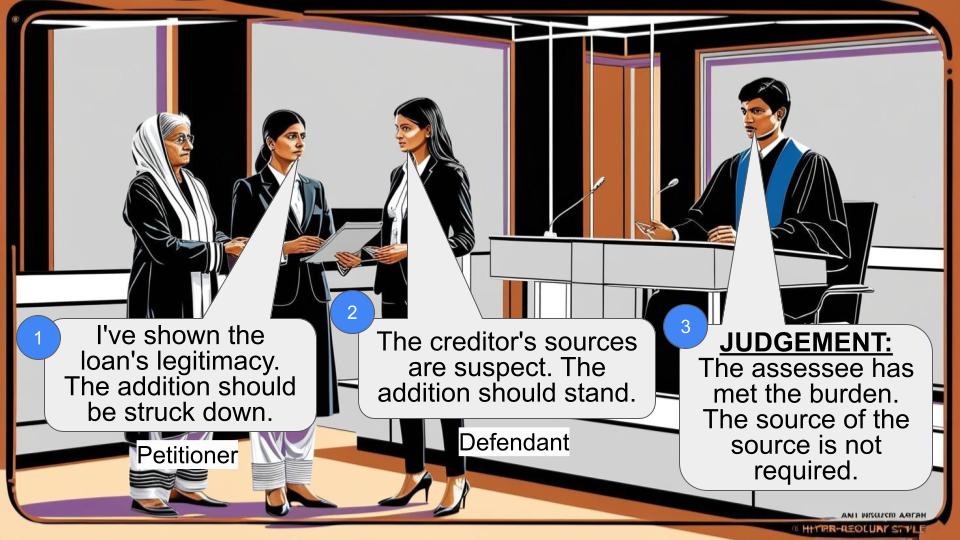
This case involves an assessee (taxpayer) who appealed against the Income Tax Appellate Tribunal's decision confirming an addition to their taxable income. The assessee's appeal was dismissed by the High Court, which found no substantial question of law arising from the Tribunal's order. The court upheld the addition made by the Assessing Officer due to the assessee's failure to prove the legitimacy of certain cash credits.
Get the full picture - access the original judgement of the court order here
Case Name:
Ishwar Prakash Vs Commissioner of Income Tax (High Court of Punjab & Haryana)
ITA No. 326 of 2007
Date: 13th December 2007
Key Takeaways:
1. Changing stance during assessment proceedings can weaken an assessee's case.
2. Failure to substantiate claims with proper evidence can lead to adverse tax consequences.
3. The court will not interfere with factual findings of lower authorities unless substantial questions of law arise.
Issue:
Did the Income Tax Appellate Tribunal err in confirming the addition made by the Assessing Officer to the assessee's income, and does this decision raise any substantial questions of law?
Facts:
1. The assessee filed a return declaring an income of Rs.81,960/- for the assessment year 2002-03.
2. During assessment, the Assessing Officer verified credits standing in the name of two firms: M/s New Rajdhani Roadlines, Guwahati (Rs.1,80,508/-) and M/s Mahesh Coal Traders (Rs.87,580/-).
3. The Assessing Officer appointed a Commission under Section 141(1)(d) (of Income Tax Act, 1961) to confirm these balances.
4. Based on the report from the ITO Guwahati, it was found that the concerned firms did not admit to any transactions with the assessee in the assessment year or earlier years.
5. When confronted, the assessee changed their stance, claiming the credits were actually from four truckers.
6. The assessee's appeal was dismissed by the CIT(A) and subsequently by the Income Tax Appellate Tribunal.
Arguments:
Assessee's arguments:
1. Not providing the ITO Guwahati's report violated principles of natural justice.
2. Adequate opportunity for hearing or leading evidence was not provided.
3. The Tribunal erred in holding that cross-examination or confrontation with the report was not material.
4. The assessee had discharged the onus of proof placed under the Act.
5. The Tribunal was wrong in confirming the addition when adequate opportunity was not afforded.
Revenue's position:
The assessee failed to substantiate their claims and took a vacillating stand during the proceedings.
Key Legal Precedents:
The judgment doesn't explicitly mention any specific legal precedents. However, it relies on the principle that findings of fact by lower authorities (Assessing Officer, CIT(A), and Tribunal) should not be interfered with unless substantial questions of law arise.
Judgement:
1. The High Court dismissed the assessee's appeal, finding it "wholly without merit."
2. The court held that there were pure findings of fact recorded by the Assessing Officer, CIT(A), and the Tribunal.
3. The assessee's changing stance and failure to substantiate claims were key factors in the decision.
4. The court found no requirement for supplying a copy of the ITO Guwahati's report given the assessee's vacillating stand.
5. No substantial question of law was found to arise from the Tribunal's order.
FAQs:
Q1: Why did the court dismiss the assessee's appeal?
A1: The court found no substantial questions of law arising from the Tribunal's order. The assessee's changing stance and failure to substantiate claims were key factors in the dismissal.
Q2: What was the significance of the assessee changing their stance during the proceedings?
A2: The change in stance weakened the assessee's credibility and made their claims about the cash credits less believable to the authorities and the court.
Q3: Why wasn't the non-provision of the ITO Guwahati's report considered a violation of natural justice?
A3: The court deemed this issue insignificant because the assessee had taken a vacillating stand and failed to substantiate their later claims about the source of the cash credits.
Q4: What lesson can taxpayers learn from this case?
A4: Taxpayers should maintain consistent statements and provide substantial evidence to support their claims during tax proceedings. Changing stances without proper documentation can lead to adverse outcomes.
Q5: Does this judgment set any new legal precedent?
A5: While the judgment doesn't establish new legal principles, it reinforces the importance of factual findings by lower authorities and the high bar for interference by higher courts in tax matters.

The assessee has filed the instant appeal under Section 260A (of Income Tax Act, 1961) against the order of the Income Tax Appellate Tribunal, Chandigarh Bench SMC, Chandigarh (for brevity 'the Tribunal') passed in ITA No.40/Chandi/20-06 dated 18.10.2006 for the assessment year 2002-03. It has been claimed that the following substantial questions of law would arise for the determination of this Court:
“1.Whether not providing the report of the ITO Guwahati to the appellant specially when the entire case of the revenue authorities is based on the said report and even when asked for by the assessee in the course of assessment proceedings as well as before the appellate authorities amounts to violation of principles of natural justice;
2.Whether adequate opportunity of hearing or leading evidence was afforded to the appellant;
3.Whether the learned Tribunal was right in law in holding that opportunity of cross-examining the said concern or not confronting the report of ITO, Guwahati is not material as those are not the factors which have ultimately being defended by the assessee;
4. Whether the assessee has discharged his onus of proof placed under the Act; and
5.Whether the learned Tribunal was right in confirming the addition made by the Assessing Officer when the adequate opportunity of hearing and leading evidences was not afforded to the assessee”?
Facts in brief are that the assessee filed a return of income declaring an income of Rs. 81,960/- during the relevant assessment year. In the course of assessment proceedings, the Assessment Officer carried verification of credit standing in the name of M/s New Rajdhani Roadlines, Guwahati, Rs.1,80,508/- and M/s Mahesh Coal Traders Rs 87,580/-.The Assessing Officer appointed Commission under Section 141(1)(d) (of Income Tax Act, 1961) to get these balances confirmed. On the basis of the report of ITO Guwahati, the Assessing Officer observed that the said concern did not admit any transactions with the assessee in the assessment year under consideration or even in the earlier years. The order of the Assessing Officer was challenged before the Commissioner of Income Tax (A) under Section 250(6) (of Income Tax Act, 1961) and the same was dismissed and the order passed by the Assessing Officer was upheld. On further appeal, the Tribunal accepted the findings recorded by the Assessing Officer as well as CIT(A) and the appeal filed by the assessee was dismissed on 18.10.2006.
We have heard the learned counsel at a considerable length and find that there is pure findings of fact recorded by the Assessing Officer, CIT(A) and the Tribunal. When the assessee was confronted with the report furnished by the ITO Guwahati in respect of the credit claimed to be outstanding in the name of two firms then the assessee changed his stand and claimed that infact it was standing in the names of four truckers. The assessee was not able to substantiate by producing those truckers nor any other document except the affidavit of those truckers were filed. The question of furnishing a copy of the report prepared by the ITO Guwahati would pale into insignificance whence the assessee himself has taken a vacillating stand. As per the stand taken on later occasion the assessee has not been able to substantiate and prove its case. In such circumstances, we do not find that there was any requirement for supply of a copy of the report by the Income Tax Officer, Guwahati. In these circumstances no question of law much less a substantial question of law would emerge from the order of the Tribunal warranting determination by this Court. The appeal is wholly without merit and the same is accordingly dismissed.
(M.M.Kumar)
Judge
(Rakesh Kumar Jain)
20.12.2007 Judge
×
Similar Ripples
Questions
Court Upholds Addition to Assessee's Income Due to Unproven Cash Credits
Write your CommentSimilar Posts


Generic
- Reportdata/5084.pdf
