


Court Upholds Addition Under Section 68 (of Income Tax Act, 1961): Creditor Cre…


Full News

Court Upholds Addition Under Section 68 (of Income Tax Act, 1961): Creditor Creditworthiness Crucial in Tax Cases
Court Upholds Addition Under Section 68 (of Income Tax Act, 1961): Creditor Creditworthiness Crucial in Tax C…
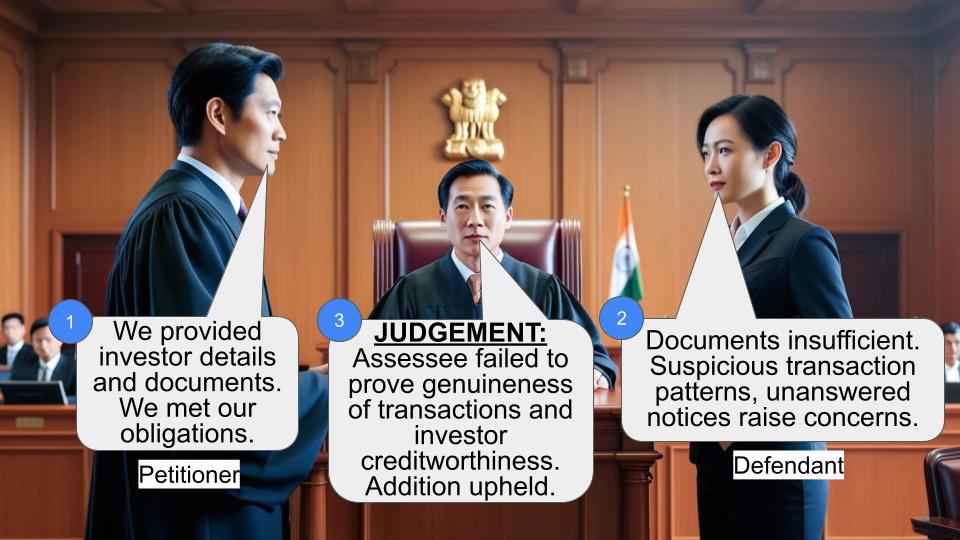
This case is all about the Income Tax Department (the revenue) appealing against an order by the Income Tax Appellate Tribunal (ITAT). The ITAT had deleted an addition of Rs. 41,15,000 made by the Assessing Officer under Section 68 (of Income Tax Act, 1961). The High Court sided with the revenue, emphasizing the importance of proving creditor creditworthiness in such cases.
Get the full picture - access the original judgement of the court order here
Case Name:
Commissioner of Income Tax vs. Mihir Kanti Hazra (High Court of Calcutta)
G.A.No.905 of 2015, G.A.No.904 of 2015 and ITAT 46 of 2015
Date: 28th April 2015
Key Takeaways:
1. Creditworthiness of alleged creditors is crucial in tax cases.
2. The assessee must prove the identity of creditors, their creditworthiness, and transaction genuineness.
3. Mere bank transactions or PAN details aren't enough to prove loan genuineness.
4. The Tribunal shouldn't overturn lower authorities' decisions without proper examination.
Issue:
Was the Income Tax Appellate Tribunal correct in deleting the addition of Rs.41,15,000 made by the Assessing Officer under Section 68 (of Income Tax Act, 1961)?
Facts:
1. The assessee (Mihir Kanti Hazra) claimed to have received unsecured loans totaling Rs.41,15,000 from 39 people.
2. The Assessing Officer issued summons to all 39 alleged lenders under Section 131 (of Income Tax Act, 1961).
3. Out of 39, 9 notices came back as "Not Known," 30 were served, but only 8 people showed up.
4. Some who showed up denied lending money, others were unsure.
5. The Assessing Officer wasn't convinced about the creditworthiness of the alleged creditors or the genuineness of the transactions.
6. The CIT (Appeals) agreed with the Assessing Officer's view.
7. However, the ITAT set aside the CIT (Appeals) order, deleting the addition.
Arguments:
The Revenue's side:
- The assessee failed to prove the creditworthiness of the alleged creditors and the genuineness of the transactions.
- Mere submission of PAN numbers and loan confirmations isn't enough to prove the loans' authenticity.
The Assessee's side:
- They provided PAN numbers and loan confirmations from all creditors.
- The creditors were income tax assessees and had filed returns for the relevant assessment year.
- Bank transactions prove the genuineness of the loans.
Key Legal Precedents:
1. CIT vs. Precision Finance Pvt. Ltd. (1994) 208 ITR 465: This case established that it's the assessee's responsibility to prove creditor identity, creditworthiness, and transaction genuineness.
2. The Dollar Company vs. Collector of Madras AIR 1975 SC 1670: This case emphasized that an appellate authority should interfere only when an order is wrong, not just because it's not right.
3. C.I.T. vs. Orissa Corporation Pvt. Ltd. 1986 (Supp.) SCC 110: This case dealt with a similar situation but had different facts where the assessee was not given full opportunity to prove their case.
4. Sreelekha Banerjee v. CIT: This case held that if there's an entry in the assessee's account books, they must establish the source of that money if asked.
Judgement:
The High Court ruled in favor of the revenue. They found that:
1. The ITAT didn't properly examine the views of the Assessing Officer and CIT (Appeals).
2. The ITAT set aside the order without giving reasons why the lower authorities were wrong.
3. Creditworthiness of alleged creditors and source of funds are crucial inquiries in such cases.
4. Mere bank transactions or PAN details aren't enough to prove loan genuineness.
5. The assessee must prove creditor identity, creditworthiness, and transaction genuineness.
The Court answered the first question in negative, favoring the revenue, and found the second question unnecessary to answer.
FAQs:
Q1: What does Section 68 (of Income Tax Act, 1961) deal with?
A1: Section 68 (of Income Tax Act, 1961) deals with unexplained cash credits in the books of an assessee.
Q2: Is providing PAN numbers and bank transaction details enough to prove loan genuineness?
A2: No, the court emphasized that these alone are not sufficient. The assessee must also prove creditor identity, creditworthiness, and transaction genuineness.
Q3: What's the significance of this judgment for taxpayers?
A3: It highlights the importance of maintaining proper documentation and being able to prove the authenticity of loans or credits in your accounts.
Q4: Can the ITAT overturn lower authorities' decisions without examination?
A4: No, the court emphasized that the ITAT should properly examine and provide reasons before overturning lower authorities' decisions.
Q5: What should an assessee do to satisfy the requirements under Section 68 (of Income Tax Act, 1961)?
A5: They should be prepared to prove the identity of creditors, their creditworthiness, and the genuineness of transactions, beyond just providing basic details like PAN numbers or bank transactions.

The application for condonation of delay of 38 days in filing the appeal, after hearing the parties, is allowed. The application being G.A. No.904 of 2015 is thus disposed of.
The subject matter of challenge in the appeal is a judgement and order
dated 10th September, 2014 passed by the learned Income Tax Appellate Tribunal pertaining to the assessment year 2006-07 by which the learned Tribunal reversed an order passed by the CIT (Appeals) concurring with the views of the assessing officer in so far as the addition under section 68 (of Income Tax Act, 1961) was made. The revenue has come up in appeal. The following questions have been suggested.
“ (I) Whether the Income Tax Appellate Tribunal was correct
in law in deleting the addition of Rs.41,15,000/-, which was made
by the Assessing Officer under Section 68 (of Income Tax Act, 1961),
1961, and which was upheld by the Commissioner of Income Tax
(Appeals) by ignoring the facts recorded by the Assessing Officer
as also the Commissioner of Income Tax (Appeals) and whether in
such view of the mater the decision of the Tribunal could be said
to be perverse?
(II) Whether on the facts and in the circumstances of the
present case the Tribunal was justified in law in applying the
ratio in the case of Dataware Private Limited (being I.T.A.T.
No.263 of 2011 passed by the Hon’ble Calcutta High Court) as such
decision is clearly distinguishable from the facts of the present
case? ”
The facts and circumstances of the case, briefly stated, are that the
assessee, in this case, has allegedly received unsecured loans for an aggregate sum of Rs.41,15,000/- from 39 persons. Summons were issued to all 39 alleged lenders under section 131 (of Income Tax Act, 1961). Notices sent to 9 of them came back with the endorsement “Not Known”. Notices were served upon the balance 30 persons. 22 of them did not turn up. 8 of them did. Some of them deposed that they never lent any money. Some of them were undecided. The assessing officer, for reasons recorded, was of the opinion that the creditworthiness of the alleged creditors and the genuineness of the transactions were not proved by the persons who responded to the summons under section 131 (of Income Tax Act, 1961). Those who did not turn up, naturally, were not examined. The assessee failed to furnish any further explanation.
It is, in that view of the matter, the addition under section 68 (of Income Tax Act, 1961) was made for the aforesaid sum of Rs.41,15,000/-. The CIT (Appeals) concurred with the views of the assessing officer. The learned Tribunal, however, has set aside the order of the CIT (Appeals) for the following reasons:-
“ We have considered the rival submissions. A perusal of the
paper book as filed by the assessee shows that the assessee has
provided Permanent Account Numbers and the confirmation of the
loans by all the loan creditors. Further a perusal of the paper
book clearly shows that all the creditors are assessed to income
tax and they have filed their returns on income for the assessment
year 2006-07 in March, 2007. The assessment in the case of the
assessee has been initiated only after March, 2007, so obviously
it cannot be assumed that the returns had been filed by the
creditors after the initiation of the assessment proceedings in
the case of the assessee. Further a perusal of the paper book
clearly shows that the
return acknowledgement, computation of income along with the
Capital A/c. and the affidavits of the creditors were before the
Assessing Officer. This fact being undisputed clearly the decision
dated 21.09.2011 of the Hon’ble jurisdictional High Court in the
case of Dataware Private Limited is squarely applicable on the
facts of the assessee’s case. Consequently respectfully following
the decision of the Hon’ble jurisdictional High Court in the case
of Dataware Private Limited referred to supra as also the decision
dated 15.07.2014 of the coordinate Bench of this Tribunal in the
case of Jyoti Saraf referred to supra, the addition as made by the
Assessing Officer and as confirmed by the Ld.CIT (Appeals) stands
deleted.”
The learned Tribunal, it is obvious, did not examine the correctness of the
views expressed by the assessing officer and the CIT (Appeals). No reasons have
been disclosed as to why the views expressed by the CIT (Appeals) and the
assessing officer are wrong.
The learned Tribunal proceeded to set aside the order without any
examination whatsoever of the views expressed as would appear from the
paragraph quoted above.
It is now well settled that creditworthiness of the alleged creditors and the
source of the source are relevant enquiries. Reference, in this regard, may be
made to the judgement in the case of CIT –Vs- Precision Finance Pvt. Ltd.
reported in (1994) 208 ITR 465 wherein the following views were expressed:-
“ It is for the assessee to prove the identity of the
creditors, their creditworthiness and the genuineness of the
transactions. In our view, on the facts of this case, the
Tribunal did not take into account all these ingredients which
have to be satisfied by the assessee. Mere furnishing of the
particulars is not enough. The enquiry of the Income-tax Officer
revealed that either the assessee was not traceable or there was
no such file and, accordingly, the first ingredient as to the
identity of the creditors had not been established. If the
identity of the creditors had not been established, consequently
the question of establishment of the genuineness of the
transactions or the creditworthiness of the creditors did not and
could not arise. The Tribunal did not apply its mind to the facts
of this particular case and proceeded on the footing that since
the transactions were through the bank account, accordingly, it is
to be presumed that the transactions were genuine. It was not for
the Income-tax Officer to find out by making investigation from
the bank accounts unless the assessee proves the identity of the
creditors and their creditworthiness. Mere payment by account
payee cheque is not sacrosanct nor can it make a non-genuine
transaction genuine. ”
An appellate authority, it is well settled, does not interfere because the
order is not right. The appellate authority has jurisdiction to interfere only when
the order is wrong.
Reference may be made to the judgement of the Apex Court in the case of
The Dollar Company –Vs-Collector of Madras reported in AIR 1975 SC 1670.
Mr. Majumdar, learned counsel appearing for the assessee-
respondent drew our attention to a judgment of the Apex Court in the case
of C.I.T. Vs. Orissa Corporation Pvt. Ltd. reported in 1986 (Supp.) SCC 110.
What had happened in that case was that a loan for a sum of
Rs.1,50,000/- allegedly obtained by the assessee had been added back
under Section 68 (of Income Tax Act, 1961). The assessee had produced
documentary evidence to show that the loan was backed by hundi
transaction. Discharged hundies were also produced by him. But the
lenders could not be produced for the purpose of giving evidence. The
assessee wanted more time to adduce evidence in support of the loans he
had obtained which the assessing officer refused to give. It is in that case
that the Tribunal and the High Court had held in favour of the assessee
and the Supreme Court refused to interfere. The views expressed by the
Supreme Court in paragraph 13 are as follows;-
“ 13. In this case the assessee had given the names and
addresses of the alleged creditors. It was in the knowledge
of the Revenue that the said creditors were income tax
assessees. Their index number was in the file of the Revenue.
The Revenue, apart from issuing notices under Section 131 (of Income Tax Act, 1961) at
the instance of the assessee, did not pursue the matter
further. The Revenue did not examine the source of income of
the said alleged creditors to find out whether they were
creditworthy or were such who could advance the alleged
loans. There was no effort made to pursue the so-called
alleged creditors. In those circumstances, the assesee could
not do any further. In the premises, if the Tribunal came to
the conclusion that the assessee has discharged the burden
that lay on him then it could not be said that such a
conclusion was unreasonable or perverse or based on no
evidence. If the conclusion is based on some evidence on
which a conclusion could be arrived at, no question of law as
such arises. ”
The law laid down by their Lordships in the peculiar facts of that
case does not apply to the case before us because in this case the assessee
was given fullest opportunity to prove his case. The view that the source of
income of the creditors and their creditworthiness was required to be gone
into militates against the view taken by the Tribunal.
In the case of Sreelekha Banerjee referred to in paragraph 11 of the
judgement, the views expressed were as follows:-
“11. In Sreelekha Banerjee v. CIT, this Court held
that if there was an entry in the account books of the
assessee which showed the receipt of a sum on conversion of
high denomination notes tendered for conversion by the
assessee himself, it is necessary for the assessee to
establish, if asked, what the source of that money was and to
prove that it was not income. The department was not at that
stage required to prove anything. It could ask the assesse to
produce any books of account or other documents or evidence
pertinent to the explanation if one was furnished, and
examine the evidence and the explanation. If the explanation
showed that the receipt was not of an income nature, the
department could not act unreasonably and reject that
explanation to hold that it was income. If, however, the
evidence was unconvincing then such rejection could be made.
The department cannot by merely rejecting unreasonably a good
explanation, convert good proof into no proof. ”
For the aforesaid reasons, we are of the opinion that the view taken
by the learned Tribunal is not sustainable. The first question is answered
in the negative and in favour of the revenue. The second question need not
be answered except for observing that the facts and circumstances are
distinguishable. The appeal is thus admitted and disposed of.
(GIRISH CHANDRA GUPTA, J.)
(ARINDAM SINHA, J.)
×
Similar Ripples
Questions
Court Upholds Addition Under Section 68 (of Income Tax Act, 1961): Creditor Creditworthiness Crucial in Tax Cases
Write your CommentSimilar Posts


Generic
- Reportdata/3797.pdf
