


Court Upholds Addition Under Section 68 (of Income Tax Act, 1961) for Unexplain…


Full News
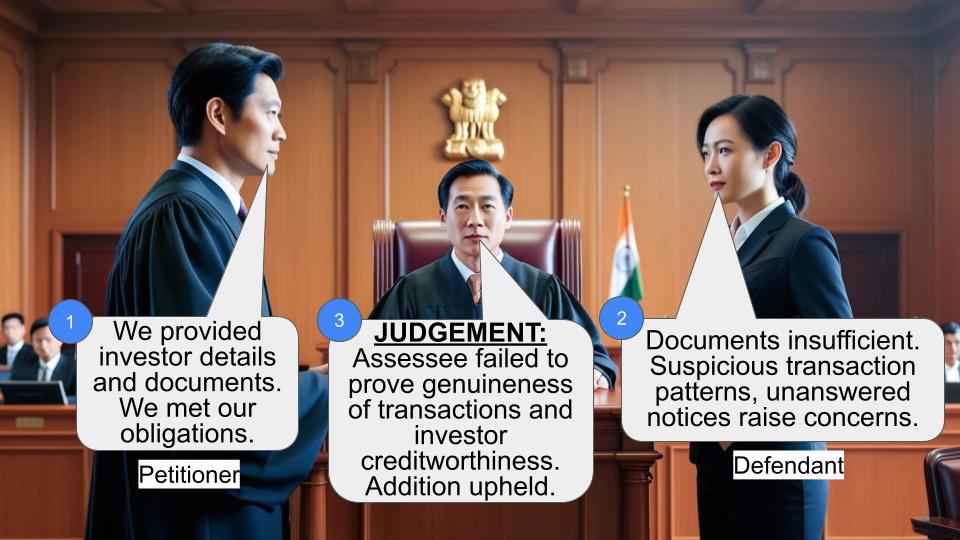
Court Upholds Addition Under Section 68 (of Income Tax Act, 1961) for Unexplained Share Application Money
Court Upholds Addition Under Section 68 (of Income Tax Act, 1961) for Unexplained Share Application Money
This case involves Vashulinga Finance Pvt. Ltd. (the assessee) appealing against an order by the Income Tax Appellate Tribunal (ITAT) Delhi. The ITAT had allowed the Revenue's appeal, reinstating an addition of Rs.1.17 Crore made by the Assessing Officer under Section 68 (of Income Tax Act, 1961) for unexplained cash credits. The High Court dismissed the assessee's appeal, agreeing with the ITAT's decision.
Get the full picture - access the original judgement of the court order here
Case Name:
Vashulinga Finance Pvt. Ltd. Vs Deputy Commissioner of Income Tax (High Court of Delhi)
ITA No. 811/2019
Date: 15th November 2019
Key Takeaways:
1. The burden of proof lies on the assessee to establish the identity, creditworthiness of investors, and genuineness of transactions under Section 68 (of Income Tax Act, 1961).
2. Mere disclosure of investor identity is insufficient; creditworthiness and transaction genuineness must also be proven.
3. Courts should apply the "test of human probabilities" when evaluating evidence in such cases.
Issue:
Did the assessee successfully discharge its onus under Section 68 (of Income Tax Act, 1961) to prove the genuineness of the share application money received and the creditworthiness of the investors?
Facts:
1. The case pertains to the Assessment Year 2004-05.
2. The assessee filed a return declaring 'Nil' income but paid tax under Section 115JB (of Income Tax Act, 1961) on book profit of Rs.24,86,664.
3. During scrutiny, it was found that the assessee received fresh share application money of Rs.1,54,40,710 from 16 entities.
4. The Assessing Officer made an addition of Rs.1.17 Crore under Section 68 (of Income Tax Act, 1961) for unexplained cash credits.
5. The CIT (Appeals) deleted this addition, but the ITAT reversed the CIT (Appeals) order, reinstating the addition.
Arguments:
Assessee's arguments:
1. Identity of investors was disclosed.
2. Necessary documents were submitted to prove the transactions.
Revenue's arguments:
1. Suspicious patterns in bank transactions of investors.
2. Discrepancies in investor addresses and audit details.
3. Failure to produce investors for verification.
4. Non-compliance with notices issued under Sections 131 (of Income Tax Act, 1961) and 133(6).
Key Legal Precedents:
1. Durgaprasad More (82 ITR 540) and Sumanti Dayal vs. CIT (214 ITR 801): The Supreme Court held that "Courts and Tribunals have to judge the evidence before them by applying the test of human probabilities."
2. Pr. CIT (Central)-I Vs. NRA Iron & Steel Private Limited (103 taxmann.com 48 (SC)): This case was cited by the Tribunal, though specific details weren't provided in the judgment.
Judgement:
1. The High Court dismissed the assessee's appeal.
2. It found that both the Assessing Officer and ITAT had conducted an in-depth consideration of all facts and circumstances.
3. The court agreed that the assessee failed to discharge the onus under Section 68 (of Income Tax Act, 1961) to establish the genuineness of the transaction and creditworthiness of investors.
4. The court noted that merely disclosing the identity of investors was insufficient, especially when they remained unresponsive to notices.
5. The court found no question of law arising for consideration, as the ITAT's order was primarily based on appreciation of evidence.
FAQs:
1. Q: What is Section 68 (of Income Tax Act, 1961)?
A: Section 68 (of Income Tax Act, 1961) deals with unexplained cash credits. It places the burden on the assessee to explain the nature and source of any sum found credited in their books.
2. Q: Why wasn't disclosing the identity of investors enough?
A: Under Section 68 (of Income Tax Act, 1961), the assessee must prove three aspects: identity of investors, their creditworthiness, and the genuineness of the transaction. Merely proving identity is insufficient.
3. Q: What is the "test of human probabilities"?
A: It's a principle where courts evaluate evidence based on what is most likely or probable in human experience, rather than accepting explanations that seem implausible.
4. Q: Can the High Court re-appreciate evidence in such cases?
A: Generally, the High Court doesn't re-appreciate evidence in tax appeals. It only intervenes if there's a substantial question of law involved.
5. Q: What lesson can other companies learn from this case?
A: Companies should maintain thorough documentation and be prepared to substantiate the creditworthiness of investors and genuineness of transactions, especially for large share applications or investments.

1. The appellant has preferred the present appeal to assail the order dated 18.04.2019 passed by the Income Tax Appellate Tribunal, Delhi Bench “D”: Delhi in ITA No.190/Del/2009 in respect of the Assessment Year 2004-05. The Tribunal has allowed the appeal preferred by the Revenue against the order dated 03.11.2008 of CIT (Appeals).
2. The CIT (Appeals) had deleted the addition of Rs.1.17 Crore made by the Assessing Officer on account of unexplained cash credits under Section 68 (of Income Tax Act, 1961). The assessee had filed its return of income on 30.11.2004 declaring „Nil‟ income. However, tax was paid under Section 115JB (of Income Tax Act, 1961) on the book profit of Rs.24,86,664/-. The assessee‟s case was selected for scrutiny. During the year, the assessee company received fresh share application money to the tune of Rs.1,54,40,710/- from 16 entities which were as follows:
KSK Share & Stock Brokers (P) Ltd., Kolkata 6,00,000 B.T. Technet Ltd., Delhi 20,00,000 Vital Fincon (P) Ltd., Kolkata 10,00,000 Lodhasons Consultancy Services (P) Ltd., Kolkata 10,00,000 Bothra Suitings Pvt. Ltd., Kolkata 3,00,000 Changia Steels Pvt. Ltd., Delhi 5,00,000 Sekhawati Finance Pvt. Ltd., Delhi 5,00,000 Dadhichi Trading & Holding Pvt. Ltd., Kolkata 15,00,000 KBR Township Pvt. Ltd., Kolkata 6,00,000 Everlast Fincon Pvt. Ltd., Kolkata 1,00,000 Sparton Commerce Ltd., Ludhiana 5,00,000 Reposit Trading Pvt. Ltd., Kolkata 5,00,000 Labh Tronics Overseas Pvt. Ltd., Delhi 5,00,000 Savera Commercial Enterprises Ltd., Ludhiana 5,00,000 Gracious Portfolio Pvt. Ltd., Delhi 10,00,000 Era Advertising & Marketing Co. Pvt. Ltd., Delhi 5,00,000 1,17,00,000 address of outside Delhi. and summons under see`tt
3. The assessee was asked to furnish details of the share application money received, and was also asked to furnish copy of the ITR and audited accounts for Assessment Year in question of all the persons who had advanced the share application money to the assessee company. Bank statements from where the said investment in share application money was made were also called for. After examining the materials produced, the Assessing Officer made the aforesaid addition, since the Assessing Officer was not satisfied with the explanation offered by the appellant assessee. In the order passed by the ITAT, the ITAT has paraphrased the findings returned by the Assessing Officer in the following words:
“2.1 On perusal of the bank statements of the above Companies, A.O. noticed that just before debit entry favouring the assessee company, there was credit entry of the similar amount and in some cases even cash was deposited just before debit entry. Moreover, in some cases, the confirmation was given by the Companies in respect of purchase of shares i.e., they have confirmed that they have purchased the shares with the money so advanced. As against said confirmation, the assessee company has shown only the receipt of share application money pending allotment in the names of those Companies. Moreover, in none of the confirmation letters (All confirmations were on the Letter Head of the respective Companies), the telephone number of the respective Company was mentioned. Besides this, the A.O. observed that Sparton Commerce Ltd., Ludhiana and Savera Commercial Enterprises Ltd., Ludhiana were having their Offices in Ludhiana and have been filing the returns in Ludhiana, but, the Auditors who have conducted the statutory audit of both these companies were situated in Kolkata and the Bank Account, through which, investment was made were maintained with Vijaya Bank, New Delhi. All these facts created suspicion and in order to satisfy the genuineness of the transaction, assessee was asked to produce the Principal Officers of the Companies situated in Delhi for verifying the genuineness of the transaction, but, the assessee company failed to do the needful. Thereafter, the A.O. with a view to verify the genuineness of the transaction, has issued notice under Section 133(6) (of Income Tax Act, 1961) to the Companies having address of outside Delhi and summons under Section 131 (of Income Tax Act, 1961) were issued to the Companies having their addresses in Delhi. In the notice under Section 133(6) (of Income Tax Act, 1961), the Principal Officer of their respective Companies were asked to furnish the details of all the transactions with the assessee company for earlier year and assessment year under appeal, copy of the account of the parties in theirbooks, copy of the bank statements, copy of the income tax returns along with computation of income and balance-sheet. Summons issued under section 131 (of Income Tax Act, 1961) to Principal Officer of these Companies were required to appear in person with similar details above. Out of the above summons and notices sent, summons sent to Gracious Portfolio Pvt. Ltd., Delhi and Changia Steels Pvt. Ltd., Delhi and notices under section 133(6) (of Income Tax Act, 1961) sent to Savera Commercial Enterprises Ltd., Ludhiana and Spartan Commerce Ltd., Ludhiana were received back un-served from the postal authorities with the remarks 'no such firm exists at the mentioned address". The assessee was, therefore, confronted with the same facts. The assessee was requested to get the compliance of these notices/ summons. On the date fixed, the A.P. received replies from courier from three Investors In respect of notice under section 133(6) (of Income Tax Act, 1961) viz. Reposit Trading Private Ltd., Kolkata, Bothra Suitings Pvt. Ltd„ Kolkata and Everlast Fincon Pvt. Ltd., Kolkata. Only a letter was received from these companies. These companies have not sent the Copies of the audited accounts copy of the ITR and copy of the Bank account which could prove the genuineness of the transaction. The A.O. also noted from the envelopes that these envelopes have been sent through courier from Darya Ganj, New Delhi, which were also incorrect. The A.O. also received reply from Savera Commercial Enterprises Ltd., Ludhiana: and Sparton Commerce Ltd., Ludhiana where notices under section 133(6) (of Income Tax Act, 1961) could not be served and returned with the remarks “no such Company exists”. The A.O. therefore, noted that assessee failed to explain the identity, creditworthiness of the Investors and genuineness of the transaction in the matter. The A.O. accordingly made addition of Rs. 1.17 crores under section 68 (of Income Tax Act, 1961).”
4. The appeal preferred by the appellant before the CIT (Appeals) succeeded. As noticed above, the ITAT has reversed the order passed by the CIT (Appeals).
5. The ITAT has examined the position as emerging on record and the findings returned by it are as follows:
“6. We have considered the rival submissions. It is not in dispute that assessee received share application money from 16 parties as reproduced above. It is not in dispute that before giving the amounts in question to the assessee company, there are credit entries of the similar amounts in the accounts of the Investors and in some cases even cash had been deposited before making investment in assessee company. In some cases the alleged amount of share application money was paid but no share have been allotted. The assessee did not explain as to why the premium was paid and why the amount has been taken from the Investors was kept pending for allotment of shares. No telephone number have been mentioned, on the Letter Head of the Investors. In the case of Ludhiana Investors, their accounts have been audited by the C.A. of Kolkata. The Ludhiana Investors have maintained Bank account at New Delhi. The assessee did not produce any of the Directors/Principal Officer of Investor Companies before A.O. for verification of the genuineness of the transaction in the matter. The A.O. issued summons under section 131 (of Income Tax Act, 1961) and notices under section 133(6) (of Income Tax Act, 1961) to the Investors to produce the documents and appeared personally before A.O, but, the same have not been complied with by the Investors, or the assessee. Some of the notices also returned un-served with the remarks "no such person exist at the given address". All these facts were confronted to the assessee to make compliance and to produce Directors/Principal Officer of the Investor Companies, but, no compliance have been made. Few of the Investors have filed their reply to the notice under section 133(6) (of Income Tax Act, 1961), but, their replies have not been sent from Kolkata as same have been sent through courier from Darya Ganj, New Delhi without documents. Ludhiana Investors sent their reply to the notice under Section 133(6) (of Income Tax Act, 1961) from Ludhiana address where they do not exist as per the report of the postal authorities. These factors clearly create a doubt and suspicion in the explanation of assessee. It is well settled Law that burden is upon assessee to prove identity of the Investors, their creditworthiness and genuineness of the transaction in the matter. However, the assessee failed to do so. The assessee merely filed confirmation and certain documents which did not inspire confidence of the A.O. Whatever documentary evidences were produced, were full of doubts and did not prove creditworthiness of the Investors and genuineness of the transaction.
6.1. It may also be noted here that assessee filed return of income declaring NIL income. However, the tax was paid under section 115JB (of Income Tax Act, 1961) on the book profit of Rs.24,86,664/-. The assessee did not explain when assessee filed NIL returned income, why such Investors would make investment in assessee company that too at Premium without verifying the financials of the assessee, which were mostly from Kolkata and Ludhiana.
6.2. On going through the returned income filed by the Investor Companies, it was found that they have filed their returns of income at meager/low net income which ranges income in hundres to thousands only after claiming deductions. Thus, the assessee as well as the Investors have not justified for entering into such transaction. It also creates doubt in the explanation of assessee. It may also be noted here that four Investors from Kolkata have been operating from the same address: Three more Investors from Kolkata are also having the same address. Two Ludhiana parties have also given the same address, but, the postal authorities reported that no such company exist at the given address. These facts clearly show that though the assessee may be able to prove the identity of the creditors because they are assessed to tax, but, assessee failed to prove the creditworthiness of all the Investors as well as genuineness of the transaction in the matter. The Hon'ble Supreme Court in the case of Durgaprasad More 82 ITR 540 and in the case of Sumanti Dayal vs. CIT 214 ITR 801 held that "Courts and Tribunals have to judge the evidence before them by applying the test of human probabilities". If the said test is applied in this matter, it clearly established that assessee has failed to prove the genuineness of the credits received in the matter, Thus, there was no justification for the Ld. CIT(A) to have deleted the addition on very vague and cryptic reasons.”
6. The Tribunal has also noticed several decisions of this Court as well as the decision of the Supreme Court in Pr. CIT (Central)-I Vs. NRA Iron & Steel Private Limited, 103 taxmann.com 48 (SC).
7. The submission of learned counsel for the appellant is that the Tribunal has not disclosed any reasons as to why the order passed by the CIT (Appeals) was erroneous. We do not find any merit in this submission since the order of the Tribunal clearly sets out its reasons as to why it had disagreed with the findings of the CIT (Appeals).
8. Learned counsel for the appellant has also submitted that the appellant had submitted several documents before the Tribunal which do not find any reference in the impugned order. Even this submission has no merit. It is not that the Tribunal is expected to deal with each & every document that the assessee may produce before it. The Tribunal is required to examine the basis on which the Assessing Officer has made the additions, since those additions have been set aside by the CIT (Appeals) in appeal.
9. We have consciously extracted the findings returned by the Assessing Officer as well as by the ITAT, only to demonstrate that there is in-depth consideration of all the facts & circumstances as emerging from the record, and it is absolutely clear and evident that the appellant assessee failed to discharge the onus placed upon it under Section 68 (of Income Tax Act, 1961) to establish the genuineness of the transaction and the creditworthiness of the investors/ creditors. The assessee had only disclosed the identity of the investors, who too remained faceless despite notices to them.
10. In the present case, the first two aspects – as taken note of hereinabove, were not clearly established. In our view, no question of law arises for our consideration in the present appeal since the impugned order is primarily premised on appreciation of evidence.
11. Dismissed.
VIPIN SANGHI, J
SANJEEV NARULA, J
NOVEMBER 15, 2019
×
Questions
Court Upholds Addition Under Section 68 (of Income Tax Act, 1961) for Unexplained Share Application Money
Write your CommentSimilar Posts


Generic
- Reportdata/5330.pdf
