


"Court Upholds Additional Tax on Late Audit Report Filing, Despite Revised Retu…


Full News
"Court Upholds Additional Tax on Late Audit Report Filing, Despite Revised Return"
"Court Upholds Additional Tax on Late Audit Report Filing, Despite Revised Return"
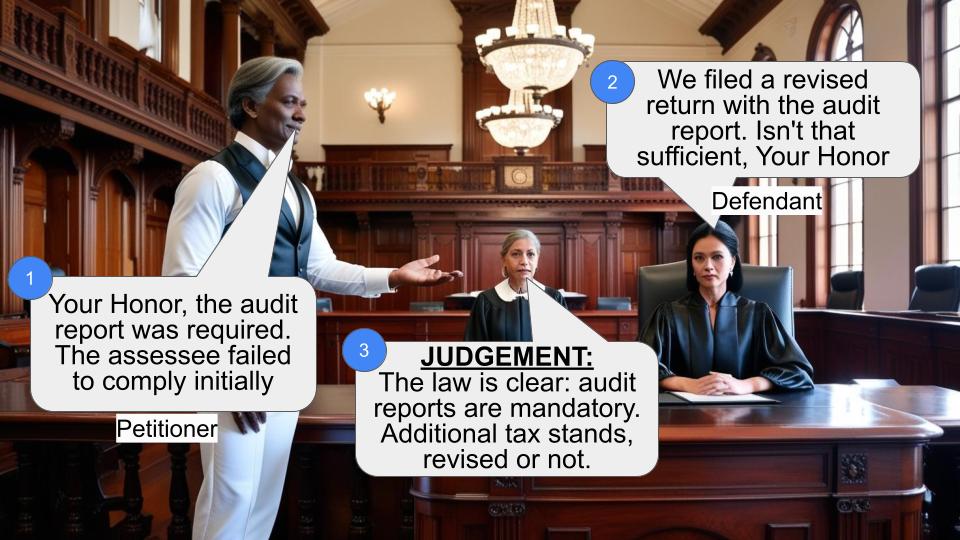
This case involves the Commissioner of Income Tax (the Revenue) appealing against a judgment by the Tribunal that had affirmed an order by the Commissioner (Appeals). The dispute centered around the disallowance of a deduction claim under Section 80HHC (of Income Tax Act, 1961) due to the assessee not filing the required audit report with their original tax return. The High Court ultimately ruled in favor of the Revenue, reinstating the additional tax imposed by the Assessing Officer.
Get the full picture - access the original judgement of the court order here
Case Name:
Commissioner of Income Tax Vs Kothari Impex (High Court of Rajasthan)
Income Tax Appeal No.20 of 2005
Date: 15 February 2008
Key Takeaways:
1. Filing audit reports along with tax returns for claiming certain deductions is mandatory, not just directory.
2. The Assessing Officer can make adjustments under Section 143(1)(a) (of Income Tax Act, 1961) for non-compliance with audit report requirements.
3. Filing a revised return with the audit report doesn't absolve the assessee from additional tax liability imposed earlier.
4. The proviso to Section 143(1B) (of Income Tax Act, 1961) ensures that additional tax liability survives even after processing a revised return.
Issue:
Was the Tribunal justified in holding that the adjustment made by the Assessing Officer for disallowing the deduction under Section 80HHC (of Income Tax Act, 1961) (due to non-filing of the audit report) was outside the purview of Section 143(1)(a) (of Income Tax Act, 1961)?
Facts:
1. The assessee filed a tax return on 31.10.1995, claiming deductions under Section 80HHC (of Income Tax Act, 1961) without enclosing the required audit report.
2. The Assessing Officer made inquiries, including recording a statement from the assessee's partner on 23.08.1996.
3. An assessment order was made under Section 143(1)(a) (of Income Tax Act, 1961) on 26.08.1996, disallowing the deduction and adding it to the total income.
4. The assessee later filed a revised return under Section 139(5) (of Income Tax Act, 1961) along with the audit report dated 16.09.1996.
5. The revised return was processed under Section 143(1B) (of Income Tax Act, 1961), and the deduction was allowed.
6. The assessee applied for rectification under Section 154 (of Income Tax Act, 1961), which was rejected by the Assessing Officer.
Arguments:
Assessee's arguments:
1. Filing the audit report is a procedural requirement and should be considered directory, not mandatory.
2. The Assessing Officer wasn't empowered to make adjustments under Section 143(1)(a) (of Income Tax Act, 1961) for non-filing of the audit report.
3. There was reasonable cause for not filing the audit report with the original return.
Revenue's arguments:
1. The requirement to file the audit report with the return is mandatory as per Section 80HHC (of Income Tax Act, 1961).
2. The assessee made a false verification in the original return.
3. The proviso to Section 143(1B) (of Income Tax Act, 1961) maintains the liability for additional tax even after processing a revised return.
Key Legal Precedents:
1. Zenith Processing Mills vs. CIT (1996) 219 ITR 721 (Guj) - Distinguished, as it dealt with Section 80J (of Income Tax Act, 1961) and the opportunity to rectify procedural defects.
2. Addl. CIT vs. Murlidhar Mathura Prasad (1979) 118 ITR 392 (All) - Distinguished, as it dealt with declarations under Section 184(7) (of Income Tax Act, 1961).
3. CIT vs. Sitaram Bhagwandas (1976) 102 ITR 560 (Pat) - Distinguished for similar reasons as the Allahabad High Court case.
4. Modern Fibotex India Ltd. vs. Dy. CIT (1995) 212 ITR 496 (Cal) - Distinguished, as the current case doesn't involve a debatable point.
Judgement:
The High Court ruled in favor of the Revenue, holding that:
1. The adjustment made by the Assessing Officer under Section 143(1)(a) (of Income Tax Act, 1961) was within its purview.
2. The requirement to file the audit report with the return is mandatory, not directory.
3. The liability for additional tax survives even after filing and processing a revised return, as per the proviso to Section 143(1B) (of Income Tax Act, 1961).
4. The orders of the Tribunal and CIT(A) were set aside, and the Assessing Officer's order was restored.
FAQs:
Q1: Does filing a revised return with the audit report eliminate the additional tax liability?
A1: No, the proviso to Section 143(1B) (of Income Tax Act, 1961) maintains the additional tax liability even after processing a revised return.
Q2: Is the requirement to file an audit report with the return mandatory or directory?
A2: The court held it to be mandatory, especially after the amendment to Section 44AB (of Income Tax Act, 1961).
Q3: Can the Assessing Officer make adjustments under Section 143(1)(a) (of Income Tax Act, 1961) for non-filing of audit reports?
A3: Yes, the court upheld the Assessing Officer's power to make such adjustments.
Q4: What's the significance of this judgment for taxpayers?
A4: It emphasizes the importance of complying with all documentation requirements when filing tax returns, especially for claiming deductions.
Q5: How does this judgment affect the interpretation of Section 80HHC (of Income Tax Act, 1961)?
A5: It reinforces the strict interpretation of the documentation requirements for claiming deductions under Section 80HHC (of Income Tax Act, 1961).

This appeal has been filed by the Revenue against the judgment of the learned Tribunal dt. 29.7.2004, affirming the order of the learned Commissioner (Appeals) dt. 15.3.1999, whereby the learned Commissioner had set aside the order of the assessing officer. The assessing officer had dismissed the assessee's application filed under Section 154 (of Income Tax Act, 1961), for rectification of the mistake. The appeal was admitted by framing following substantial question of law :-
“Whether on the facts and in the circumstances of the case, the learned Tribunal is justified in upholding the order passed by the learned CIT (A) by holding that the impugned adjustment made by the A.O. was outside the purview of Section 143(1) (of Income Tax Act, 1961)
(a) of the I.T. Act.?”
Bereft of unnecessary details the facts are, that the assessee had filed the return, and thereupon after taking recourse to procedure provided under Section 131 (of Income Tax Act, 1961) etc., and giving necessary opportunity of hearing to the assessee, the assessment order was made on 26.8.1996. In the return the assessee had claimed deductions under Section 80HHC (of Income Tax Act, 1961), but then, the assessee did not enclose the required documents. This return was filed on 31.10.1995. On account of absence of the requisite report, the deduction was not allowed, and addition was made in the income to that extent, with all necessary consequences. Thereafter the assessee filed an application under Section 154 (of Income Tax Act, 1961), claiming interalia, that since the auditor of the assessee was of the opinion, that since the sale proceeds were not received within six months, and permission for extension has not been received from the Commissioner of Income Tax, the report cannot be given, and regarding delay in receipt of payments on account of the exports, relied upon the Board's circular dt. 24.8.94 and 25.10.93.
According to which, in case such requisite report is subsequently filed, a rectification under Section 154 (of Income Tax Act, 1961) should be carried out. As appears from the order of the learned assessing officer, that to verify the fact about enclosures, the inspector was directed to make enquiry, who in turn recorded the statement of the partner of the assessee, and it was established that it was falsely noted in the return that a report under Section 80 (of Income Tax Act, 1961) HHC is enclosed. Thus, it was found that a false verification was made. Then, it was found that Section 154 (of Income Tax Act, 1961) has a very limited scope, as it is applicable only for the purpose of rectifying the mistake apparent on record as to facts or law, while there is no mistake, either of fact or law, apparent on the record, because no report as is required for relevant deduction under Section 80HHC (of Income Tax Act, 1961), was enclosed with the return of the income, and therefore, the same was not allowed, and the amount was added to the total income of the assessee, by making adjustment of the income, under Section 143(1)(a) (of Income Tax Act, 1961). Certain circulars of the Board were also pressed into service, but then they were found to be not applicable, as in the case in hand, from the enquiries made it transpires that there was no report even available with the assessee at the time of filing return, and the report was filed only along with the application under Section 154 (of Income Tax Act, 1961). The report is dt. 16.9.1996, while the return was filed on 31.10.1995. Thus, the application was dismissed.
The learned Commissioner relied upon certain judgments of some other High Courts, taking the view, that filing of audit report for relief under Section 80J (of Income Tax Act, 1961), along with the return were directory, and it was found, that the time limit was a matter of mere procedure, and should be taken to be directory. Then, Board's circular dt. 24.8.1994 was also considered, and it was found, that the revised return was filed by the assessee along with the audit report in form No.10CCAC, which has been accepted by processing the said revised return, and the claim of the appellant for deduction under Section 80HHC (of Income Tax Act, 1961) has been fully allowed. It was found that filing of the audit report is only a procedural requirement, and that the assessing officer was not empowered to make any adjustment under Section 143(1)(a) (of Income Tax Act, 1961) on the ground of audit report having not been filed with the return. The claim was found to be perfectly in order, and the audit report was submitted along with the application under Section 154 (of Income Tax Act, 1961), which was before the assessing officer, while deciding the application. It was also held, that there was reasonable cause with the appellant, for not filing the audit report along with the return of income, and that, since the claim of the appellant, for deduction under Section 80HHC (of Income Tax Act, 1961) was not found otherwise inadmissible, the assessing officer was not found to be justified in rejecting the application under Section 154 (of Income Tax Act, 1961), and charging additional tax. Thus, the appeal was allowed, and additional tax, as levied, was ordered to be deleted. This order has been upheld by the learned Tribunal, by holding, that the impugned adjustment made by the assessing officer, was outside the purview of Section 143(1)(a) (of Income Tax Act, 1961); this being a mistake of law apparent on record, the assessing officer ought to have accepted the application under Section 154 (of Income Tax Act, 1961).
We have heard learned counsel for either side, and have gone through the impugned orders, so also various judgments considered by the learned authorities below.
First of all we take up the cases considered by the learned Commissioner. So far as the first judgment relied upon, said to be in C.I.T. Vs. Shivanand Electronics, said to be reported in 209 ITR-63 is concerned, despite best efforts, even with the assistance of the learned counsel for either side, we could not locate the judgment.
Then, coming to the other judgment relied upon, being in Zenith Processing Mills Vs. C.I.T., reported in 219 ITR-721. In this case the learned Gujarat High Court was considering the effect of non-furnishing/non fulfilling certain conditions, regarding auditing of the accounts, and furnishing proof for such audit account, for claiming special deductions under Section 80J (of Income Tax Act, 1961), and it was found, that auditing of the accounts was a mandatory requirement, but furnishing proof of such auditing, was held to be directory, as furnishing of proof of such auditing, was found to be falling in the realm of procedure, for furnishing evidence in support of the claim, and it was held, that it can be furnished at any time, while allowance or disallowance under Section 80J (of Income Tax Act, 1961) is being considered by the concerned authority. In that case the provisions of Section 143(3) (of Income Tax Act, 1961) were also considered, which provided that where the assessing officer is not inclined to accept the return submitted by the assessee, and if he wants to modify the assessment, notice is required to be given to the assessee, and that, giving of this opportunity will include opportunity to erase procedural defect, if any, which is directory in nature. In the present case, as appears from the order of the assessing officer, that after submission of the return, not only notice was given, even the statements of assessee were recorded on 23.6.06, and then assessment was made on 28.6.96, disallowing the deduction, and admittedly the auditor's report is dated 16.9.1996. Therefore, this judgment does not help the cause of the assessee at all.
Then, the next judgment relied upon by the learned Commissioner, being in Addl. Commissioner of Income Tax Vs. Murlidhar Mathura Prasad, reported in 118 ITR-392, is a judgment of Allahabad High Court, wherein the Allahabad High Court was considering the requirement of Section 184(7) (of Income Tax Act, 1961), which requires certain declaration to be furnished along with the return, and it was considered to be a procedural requirement. The declaration required by Section 184(7) (of Income Tax Act, 1961) was, about an essential fact, that there has been no change in the constitution of the firm, or the share of its partners, and it was held, that this procedural requirement is directory, and that, if there is some defect in the declaration form, the assessee is to be given an opportunity to rectify it, under Section 185(2) (of Income Tax Act, 1961), as it then existed. This again, in our view, has no bearing on the controversy.
Then still next case relied upon by the learned Commissioner is, in C.I.T. Vs. Sitaram Bhagwandas, reported in 102 I.T.R.-560 (of Income Tax Rules, 1962). This is the judgment by Patna High Court, again dealing with the same aspect of requirement of declaration under Section 184(7) (of Income Tax Act, 1961), and taking the same view, and in our view, for the same reasons, this judgment also does not help the cause of the assessee.
Then, yet another judgment is the one relied upon by the learned Tribunal, being of the Calcutta High Court, in Modern Fibotex India Ltd. Vs. Deputy Commissioner of Income Tax, reported in 212 ITR-496. This is Single Bench judgment of the Calcutta High Court, taking the view, that the power under Section 143(1)(a) (of Income Tax Act, 1961) cannot be exercised on a debatable point. In our view, this legal principle admits of no doubt. However, here the disallowance of the deduction is found to be not being relatable to a debatable point, in view of the authoritative judgment of this court in Loonkar Tools’ case. Thus this judgment is also of no help to the assessee.
Coming to the precise controversy here, the deduction has been disallowed against the adjustment made under Section 143(1)(a) (of Income Tax Act, 1961) vide order dated 26.8.1996, which is the deduction claimed by the assessee under Section 80HHC (of Income Tax Act, 1961), which provides for deduction in respect of profits retained for export business, and according to sub-section (4A) thereof, the deduction under sub-section (1A) is not admissible, unless the supporting manufacturer furnishes in the prescribed form along with his return of income, the report of the accountant as prescribed therein, and the certificate also from the Export House, and the documents are required to be further certified by the persons mentioned therein. Likewise even under sub-section (4) deductions under sub-section (1) are not admissible, unless certain documents in the prescribed form, are filed with the return. Likewise under Section 44AB (of Income Tax Act, 1961) also, earlier the requirement was to get the accounts audited before the specified date, and to obtain before that audit report of such audit, but then the words “obtain before” have been substituted by the words “furnished by”. Thus, the provision now reads to mean, that the accounts are required to be got audited before the specified date, and the report of such audit, in the prescribed form, duly signed, and verified, is also to be furnished by that date. This amendment was made by the Finance Act of 1995 w.e.f. 1.7.95. Obviously, therefore, if the requirement of obtaining report before this specified date, has consciously been substituted by the requirement of furnishing the report by specified date, even on the face of this provision, now it cannot be said, that the requirement is only directory.
Then, even considering the case from yet another stand point, being, that considering it from the stand point of provisions of Section 143 (of Income Tax Act, 1961), as it existed at the relevant time, as is apparent from the order of the Assessing Officer, that the return was filed on 31.10.1995, which did not enclose the audit report, required by Section 80HHC (of Income Tax Act, 1961), and therefore, the Inspector of Income Tax was directed to make enquiries, who made enquiries, which included recording of statement of the partner of the assessee, which statement was recorded on 23.8.96, and even therefrom, it was established that a false verification was made, and then the assessment was made under Section 143(1)(a) (of Income Tax Act, 1961) on 26.8.1996. It is much thereafter, that the assessee filed the revised return under Section 139(5) (of Income Tax Act, 1961), along with the audit report, and in form 10CCAC, and that return was processed under Section 143(1B) (of Income Tax Act, 1961), and in that assessment the deduction was allowed. It may be observed here, that a bare look at the language of Section 143(1B) (of Income Tax Act, 1961), as it stood at that time, would show, that according to proviso thereof, an assessee, who has furnished revised return under sub- section (5) of Section 139 (of Income Tax Act, 1961), after the service upon him of the intimation under sub-section (1) of Section 143 (of Income Tax Act, 1961), does continue to remain liable to pay additional income tax, in relation to the adjustments made under the first proviso to clause (a) of sub-section (1), and specified in the said intimation, whether or not he has made the said adjustments in the revised return. In our view, this proviso does make it clear, that even filing of the revised return under Section 139(5) (of Income Tax Act, 1961), and it’s being processed, and on such processing the assessee being found entitled to the adjustment, on account of that return being accompanied with the requisite audit report, does not have the effect of absolving the assessee of the liability of additional tax, as imposed, or arrived at, under Section 143(1)(a) (of Income Tax Act, 1961), intimation whereof had been given to the assessee.
In view of this legal and factual position, being, that intimation under Section 143(1)(a) (of Income Tax Act, 1961) was given pursuant to the assessment made on 26.8.1996, which was made after giving opportunity of hearing to the assessee, and it is much thereafter only, that audit report was prepared, and revised return was filed under Section 139(5) (of Income Tax Act, 1961), which was processed under Section 143(1B) (of Income Tax Act, 1961), the question, rather does not arise for consideration, as to whether, the requirement of filing the audit report, along with the return, was mandatory, or directory, and that, if filed before assessment, it was required to be considered, as in the present case, the report is prepared much after the assessment was made under Section 143(1)(a) (of Income Tax Act, 1961), after notice to the assessee.
Obviously, therefore, it cannot be said that the impugned adjustment made by the assessing officer was outside the purview of Section 143(1)(a) (of Income Tax Act, 1961). Admittedly fresh assessment has been made under Section 143(1B) (of Income Tax Act, 1961), consequent upon revised return having been filed under Section 139(5) (of Income Tax Act, 1961), and according to proviso to Section 143(1B) (of Income Tax Act, 1961), even in such an eventuality, the liability of additional tax does survive, the question as framed is required to be answered against the assessee, and in favour of the Revenue.
Consequently, the question is answered accordingly, and the appeal is allowed. The impugned orders of the learned Tribunal, and that of the learned Commissioner are set aside, and that of the assessing officer is restored.
( DEO NARAYAN THANVI ),J. ( N P GUPTA ),J.
×
Questions
"Court Upholds Additional Tax on Late Audit Report Filing, Despite Revised Return"
Write your CommentSimilar Posts


Generic
- Reportdata/4812.pdf
