


Court allows appeal against intimation under s. 143(1)(a), remands case for rec…




Full News
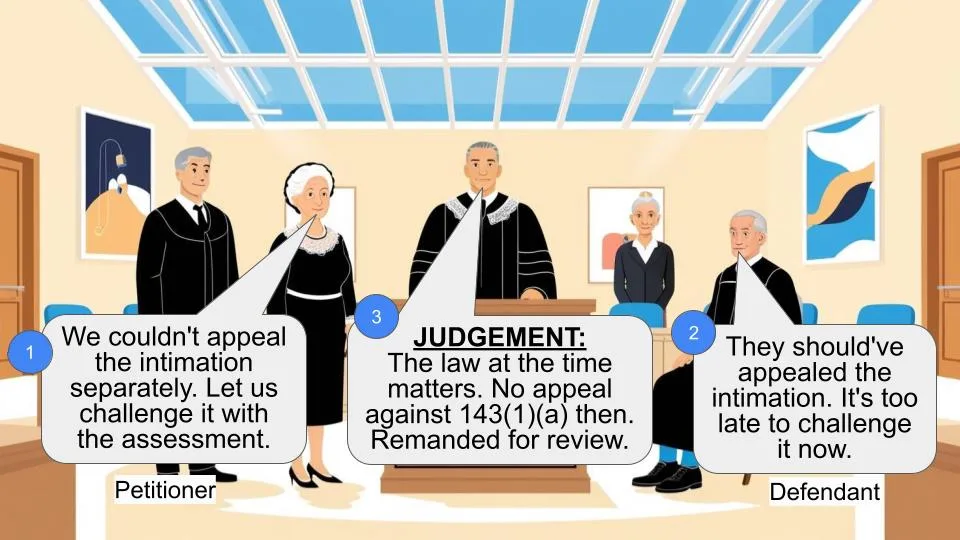
Court allows appeal against intimation under s. 143(1)(a), remands case for reconsideration
Court allows appeal against intimation under s. 143(1)(a), remands case for reconsideration
This case involves an appeal by an assessee (taxpayer) against an order of the Income Tax Appellate Tribunal. The main issue was whether the assessee could challenge an intimation under section 143(1)(a) (of Income Tax Act, 1961) in an appeal against a regular assessment order under section 143(3) (of Income Tax Act, 1961). The court allowed the appeal, set aside the Tribunal's order, and remanded the case for reconsideration on merits.
Get the full picture - access the original judgement of the court order here
Case Name:
Paschimi Rajasthan Dudgh Utpadak Sahakari Sangh Ltd. vs Deputy Commissioner of Income Tax (High Court of Rajasthan)
Income Tax Appeal No.37 of 2003
Date: 4th December 2007
Key Takeaways:
1. An intimation under s. 143(1)(a) dated 11th Nov. 1992 was not appealable under s. 246 at that time.
2. The assessee could challenge such an intimation in an appeal against a regular assessment order under s. 143(3).
3. The Tribunal's decision was based on a misconception of law regarding the availability of appeal rights.
4. The case highlights the importance of understanding the applicable law at the relevant time.
Issue:
Can an assessee challenge an intimation under section 143(1)(a) (of Income Tax Act, 1961) in an appeal against a regular assessment order under section 143(3) (of Income Tax Act, 1961), when no separate appeal was available against the intimation at the time it was issued?
Facts:
1. On 11.11.1992, the Deputy Commissioner of Income Tax sent an intimation to the appellant under s. 143(1)(a) of the Income Tax Act, 1961.
2. A notice for regular assessment was sent on 09.12.1992, fixing a hearing for 08.01.1993.
3. On 21.01.1993, a notice under s. 154 was served, proposing adjustments for gratuity provisions.
4. The assessee allegedly filed a revised return on 25.01.1993.
5. An intimation under s. 143(1)(a) was sent on 28.01.1993, provisionally determining the loss.
6. The regular assessment order under s. 143(3) was made on 25.02.1993.
7. The assessee appealed against this order, and the CIT(Appeals) partly accepted it, remanding the case back to the Assessing Officer.
8. The Revenue appealed to the Tribunal, which accepted the appeal on 13.03.2002.
9. The assessee then filed this appeal against the Tribunal's order.
Arguments:
The main argument centered around whether the assessee could challenge the intimation under s. 143(1)(a) in an appeal against the regular assessment order under s. 143(3). The Revenue argued that a separate appeal should have been filed against the intimation, while the assessee contended that no such appeal was available at the relevant time.
Key Legal Precedents:
The judgment doesn't mention specific case laws, but it focuses on the interpretation of sections 143(1)(a), 143(3), 154(1)(b), and 246 of the Income Tax Act, 1961, as they existed at the relevant time.
Judgement:
1. The court allowed the appeal and set aside the Tribunal's order.
2. It found that s. 246 did not permit filing an appeal against orders under s. 143(1)(a) at the relevant time.
3. The amendment allowing such appeals was made effective from 01.06.1994, after the intimation in question was issued.
4. The court held that the assessee could challenge the intimation under s. 143(1)(a) in an appeal against the regular assessment order under s. 143(3).
5. The case was remanded back to the Tribunal to decide on the merits of the CIT(Appeals)'s findings.
FAQs:
Q1: Why was the assessee allowed to challenge the intimation under s. 143(1)(a) in this case?
A1: Because at the time the intimation was issued, there was no provision for a separate appeal against such intimations under s. 246 of the Income Tax Act.
Q2: What was the main error in the Tribunal's decision?
A2: The Tribunal incorrectly assumed that a separate appeal was available against the intimation under s. 143(1)(a), which was not the case at the relevant time.
Q3: When was the provision for appealing against intimations under s. 143(1) introduced?
A3: The amendment allowing appeals against intimations under s. 143(1) was introduced with effect from 1st June, 1994.
Q4: What is the significance of this judgment?
A4: It clarifies that when no separate appeal is available against an intimation, the assessee can challenge it in an appeal against the regular assessment order.
Q5: What will happen next in this case?
A5: The case has been remanded back to the Tribunal to reconsider the merits of the CIT(Appeals)'s findings.

This appeal has been filed by the assessee, seeking to challenge the order of the learned tribunal dated 13.03.2002, so far it relates to Income Tax Appeal No. 1762/JP/1994, for the Assessment Year 1992-93.
The facts of the case are, that vide Annexure 1, dated 11.11.1992, the Deputy Commissioner of Income Tax (Assessment), Special Range, Jodhpur, sent intimation to the appellant, whereby he intimated amount, determined by him, to be payable by the assessee. This was done in exercise of powers under Section 143(1)(a) (of Income Tax Act, 1961). Thereafter, the appellant was sent notice dated 09.12.1992, for the regular assessment, fixing the hearing on 08.01.1993. However, during the course of assessment proceedings, the notice was served on the appellant under Section 154 (of Income Tax Act, 1961) on 21.01.1993, proposing to make the prima facie adjustment on account of provisions of gratuity under Section 40A(7) (of Income Tax Act, 1961), and it is alleged, that the appellant filed Revised Return, declaring the loss of Rs.55,04,885/- for the Assessment Year 1992-93, on 25.01.1993, instead of the declared loss of Rs.56,57,685/-. Then intimation under Section 143(1)(a) (of Income Tax Act, 1961) was sent to the assessee vide order dated 28.01.1993, and provisionally assessed/determined the loss at Rs.53,76,603/-, and accordingly, the demand was created. Thereafter, the regular assessment, for the Assessment Year 1992-93 was made vide Assessment Order dated 25.02.1993, computing and assessing the loss of Rs.16,73,887/-, and observing rather finding, that the addition of Rs.2,81,082/- made through prima facie adjustment, do not require any modification or amendment, and the observations made in the order dated 28.01.1993, apply here also, and were treated as integral part of the Assessment Order. This assessment order has been produced as Annexure 5. Against this, an appeal was filed by the assessee, under Section 246 (of Income Tax Act, 1961), and the learned Commissioner of Income Tax (Appeals) accepted the same partly, and remanded back to the Assessing Officer, with the direction to re-examine, and to pass fresh order, after affording the assessee opportunity to lead evidence, in support of the claims, while observing, that regular assessment proceedings under Section 143(3) (of Income Tax Act, 1961) are different from the proceedings under Section 143(1)(a) (of Income Tax Act, 1961).
Aggrieved of this, the Revenue filed an appeal before Tribunal, and Tribunal accepted the appeal vide order dated 13.03.2002. The assessee seeks to challenge the order of the learned Tribunal allowing the appeal of the Revenue, being appeal No. 1762/1994.
The tribunal has found, that Section 246 (of Income Tax Act, 1961) provides for a separate appeal against the order under Section 143(1)(a) (of Income Tax Act, 1961), and therefore, the Commissioner had no jurisdiction to decide the issue. It was found, that the Assessing Officer has passed the order under Section 154(1)(b) (of Income Tax Act, 1961), and therefore, the findings recorded by the Commissioner, were reversed on the ground of his having no jurisdiction to decide the issue, in appeal against the order made under Section 143(3) (of Income Tax Act, 1961).
This appeal was admitted vide order dated 08.09.2003, by formulating the following three substantial questions of law:-
“(A) Whether the Income-Tax Appellate Tribunal, Jodhpur Bench, Jodhpur was illegally justified in accepting the appeal, filed by the Assessing Officer, relating to the Asst. Year 1992-93 vide Appellate order dated 13.02.2002, in view of the instant facts and circumstances of the Case, hereinbefore duly mentioned in the paras No.1 to 14 of this Appeal.
(B) Whether the Income Tax Appellate Tribunal, Jodhpur Bench, Jodhpur was illegally justified in accepting the appeal, filed by the Assessing Officer, relating to the Asst. Year 1992-93 inter-alia holding that section 246 (of Income Tax Act, 1961), provides for Separate Appeal, against the order u/S 143(1)(a) (of Income Tax Act, 1961) and the Commissioner of Tax (Appeals) Jodhpur, has & had no jurisdiction to decide the issue, in the Appeal, which has been filed against the Assessment passed u/S 143(3) (of Income Tax Act, 1961) of the Income Tax Ac,t 1961,in view of the settled proposition of law that the intimation, which is being sent to the Assessee, as per the provisions laid down u/S 143(1)(a) (of Income Tax Act, 1961), after making the prima facie Adjustment or subsequently Modified or Amended, vide Rectified intimation, u/S 143(1)(a) (of Income Tax Act, 1961) read with section 154(1)(b) (of Income Tax Act, 1961), is nothing, but the Provisional Assessment of Prima Facie Adjustment or Adjustments for levying Additional Tax Payable u/S 143(1A) (of Income Tax Act, 1961), 1961, and the same is merged with the final Assessment, made u/S 143(3) (of Income Tax Act, 1961).
(C) Whether the provisions laid down in u/S 246 (of Income Tax Act, 1961), for filing separate appeal against the order u/S 143(1)(a) (of Income Tax Act, 1961), and for non-filing of Appeal by the Assessee, debars the right of the Assessee, for challenging the issue in this respect during the Asst Proceedings u/S 143(3) (of Income Tax Act, 1961), & for filing the appeal u/S 246 (of Income Tax Act, 1961) and equally the Appellate Authority has & had no jurisdiction to decide the issue in the appeal against the Asst. order u/S 143(3) (of Income Tax Act, 1961).
A bare reading of the questions would show, that the basic controversy is, as to whether the order under Section 143(1)(a) (of Income Tax Act, 1961), was, or being appelable, and no appeal having been filed, and order having been modified under Section 154(1)(b) (of Income Tax Act, 1961), whether it is open to the assessee, to assail the conclusions recorded in the order under section 143(1)(a) (of Income Tax Act, 1961) read with section 154(1)(b) (of Income Tax Act, 1961), in a appeal against the regular assessment order, made under section 143(3) (of Income Tax Act, 1961).
A look at the provisions of section 246 (of Income Tax Act, 1961), which provides for appeal, and which has been taken into consideration by the learned Tribunal, shows, that as it existed at the relevant time, it did not permit filing of any appeal, against any order made under section 143(1)(a) (of Income Tax Act, 1961). This section 246 (of Income Tax Act, 1961) has undergone amendments from time to time, and the relevant amendment was made w.e.f. 01.06.1994, whereby the provision for appeal, against an intimation under section 143(1) (of Income Tax Act, 1961) or 143 (1B) was provided to lay. There is nothing to show, that this amendment was made to apply to the orders passed till then. At the cost of repetition, it may be noticed, that the intimation under section 143(1)(a) (of Income Tax Act, 1961) is, as old as 11.11.1992, while as noticed above, relevant amendment in section 246 (of Income Tax Act, 1961) has been made only w.e.f. 01.06.1994, obviously, meaning thereby, that at the time, when the determination was made under section 143(1)(a) (of Income Tax Act, 1961), and/or intimation was sent to the assessee, he had no remedy of any appeal. That being the position, obviously, the assessee could very well assail the correctness of the determination made or findings recorded in that order under section 143(1)(a) (of Income Tax Act, 1961), in the appeal to be filed against the regular assessment made under section 143(3) (of Income Tax Act, 1961).
Thus, it is also clear, that the learned Tribunal has proceeded on basic misconception of law, about the availability of right of appeal to the assessee, against determination, or intimation, under section 143(1)(a) (of Income Tax Act, 1961).
In view of the above conclusions, all the questions, as formulated, are required to be answered in favour of the assessee, and against the Revenue, and are accordingly, answered.
The net result is, that the appeal is allowed. The impugned order of the tribunal is set aside.
Since the Tribunal has not gone into the merits of the determination, and has set aside the order of the Commissioner, simply on the ground of his having no jurisdiction to decide the issue, in the appeals, we think it appropriate to remand the matter back to the learned Tribunal, to decide the correctness of the findings of the Commissioner, on its own merits, and in accordance with law.
( MUNISHWAR NATH BHANDARI ),J. ( N P GUPTA ),J.
×
Similar Ripples
Questions
Court allows appeal against intimation under s. 143(1)(a), remands case for reconsideration
Write your CommentSimilar Posts
Generic
- Reportdata/5119.pdf
