


Court Upholds Depreciation Claim on Block of Assets, Rejects Tax on Partial Sale


Full News

Court Upholds Depreciation Claim on Block of Assets, Rejects Tax on Partial Sale
Court Upholds Depreciation Claim on Block of Assets, Rejects Tax on Partial Sale
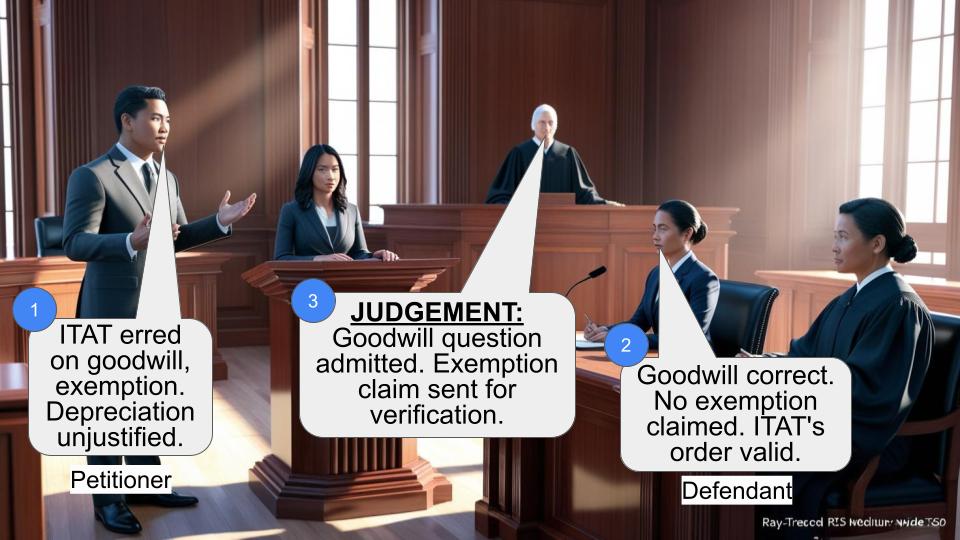
This case involves the Commissioner of Income Tax (appellant) versus Rhodoen Silk Mills (P) Ltd. (respondent). The dispute centered around the tax treatment of the sale of machinery from one of the company's units. The Income Tax Appellate Tribunal ruled in favor of the assessee (Rhodoen Silk Mills), and the High Court upheld this decision, dismissing the appeal by the revenue department.
Get the full picture - access the original judgement of the court order here
Case Name:
Commissioner of Income Tax Vs Rhodoen Silk Mills (P) Ltd. (High Court of Punjab and Haryana)
ITA No. 566 of 2007(O&M)
Date: 19 February 2008
Key Takeaways:
1. The sale of some assets from a block doesn't necessarily mean the entire block ceases to exist.
2. Depreciation can be claimed on the written down value (WDV) of a block of assets even if some assets are sold, as long as the block remains intact.
3. Section 41(2) (of Income Tax Act, 1961) is not applicable when the block of assets continues to exist.
Issue:
Was the Income Tax Appellate Tribunal legally justified in ignoring clause (b) of section 41(2) (of Income Tax Act, 1961) when machinery from an independent unit was sold, despite depreciation being allowed under section 32 (of Income Tax Act, 1961)?
Facts:
1. Rhodoen Silk Mills filed a tax return for the assessment year 1998-99, declaring a total income of Rs.16,83,090.
2. The Assessing Officer completed the assessment, increasing the total income to Rs.39,37,200.
3. An addition of Rs.25,76,119 was made by treating the difference between the sale price of machinery (Rs.29,80,000) and its written down value (Rs. 4,11,881) as taxable under Section 41(2) (of Income Tax Act, 1961).
4. The assessee appealed, and the Commissioner of Income Tax (Appeals) deleted the addition.
5. The Income Tax Appellate Tribunal upheld the CIT(A)'s decision.
Arguments:
Revenue's Argument:
- The entire machinery of unit no. 1 was sold, and the excess of sale consideration over the written down value should be taxed as business income under Section 41(2) (of Income Tax Act, 1961).
- As per Section 50(2) (of Income Tax Act, 1961), the block of assets ceased to exist upon the sale of the entire machinery of unit no. 1.
Assessee's Argument (implied from the judgment):
- The block of assets continued to exist as there were both additions and sales during the year.
- The provisions of Section 41(2) (of Income Tax Act, 1961) were not applicable as the entire block was not sold.
Key Legal Precedents:
The judgment doesn't explicitly mention any specific legal precedents. However, it relies heavily on the interpretation of Sections 32(1), 41(2), and 50 of the Income Tax Act, 1961.
Judgement:
1. The High Court upheld the Tribunal's decision, finding no infirmity in its order.
2. The court agreed that the block of assets (Plant and Machinery) remained intact despite the sale of some assets.
3. It was noted that there were both additions (Rs.75,33,668) and sales (Rs.29,80,000) in the block of assets during the year.
4. The court concluded that Section 32(1) (of Income Tax Act, 1961) was correctly applied, and depreciation was rightly claimed on the written down value of the block of assets.
5. The appeal by the revenue department was dismissed as no substantial question of law arose for determination.
FAQs:
Q1: What is a "block of assets" in this context?
A1: A block of assets refers to a group of similar types of assets (in this case, plant and machinery) that are treated as a single unit for depreciation purposes under the Income Tax Act.
Q2: Why wasn't Section 41(2) (of Income Tax Act, 1961) applicable in this case?
A2: Section 41(2) (of Income Tax Act, 1961) wasn't applicable because the entire block of assets wasn't sold. There were both additions and sales within the block, and the block as a whole continued to exist.
Q3: What would have happened if the entire block of assets had been sold?
A3: If the entire block had been sold, Section 50(2) (of Income Tax Act, 1961) might have applied, potentially leading to different tax implications.
Q4: How does this judgment affect businesses?
A4: This judgment clarifies that businesses can continue to claim depreciation on a block of assets even if some assets within that block are sold, as long as the block as a whole remains intact.
Q5: What's the significance of the written down value (WDV) in this case?
A5: The WDV is crucial for calculating depreciation. In this case, it was used to determine that the block of assets continued to exist and that depreciation could still be claimed on the remaining value.

1. The revenue has filed this appeal under Section 260 (of Income Tax Act, 1961) A of the Income Tax Act, 1961( for short “the Act” ) against the order of the Income Tax Appellate Tribunal, Chandigarh Bench 'A' , Chandigarh, passed in ITA No. 282/Chandi/2002 dated 5.8.2005 for the assessment year 1998-99 raising the following substantial question of law:
“ Whether on the facts and law, the Hon'ble Income Tax Appellate Tribunal was legally justified to ignore clause(b) of section 41(2) (of Income Tax Act, 1961) of I. T. Act, when the entire machinery of an independent unit no.1 as owned and used by the respondent for business and depreciation allowed to it u/s 32 (of Income Tax Act, 1961) of I. T. Act, was sold in the previous year.?”
2. The respondent assess is a company which filed its return of income tax for the assessment year 1998-99 on 30.11.1998 declaring total income of Rs.16,83,090/-. The assessment was completed on 29.3.2001 under Section 143(3) (of Income Tax Act, 1961) on a total income of Rs.39,37,200/-. While completing the assessment, the Assessing Officer made an addition of RS. 2576119/- by treating the difference between the sale price of Rs.29,80,000/- of entire machinery installed at unit no.1 of the factory premises of the respondent company and the written down value of the said machinery as on 1.4.1997 at Rs.411811/-by invoking the provisions of Section 41(2) (of Income Tax Act, 1961) read-with amended provisions of Section 50 (of Income Tax Act, 1961) and 50 (of Income Tax Act, 1961) A of the Act.
3. The assessee filed an appeal before the Commissioner of Income Tax against the order of the Assessing Officer dated 29.3.2001. The Commissioner of Income Tax ( Appeals ), Ludhiana vide his order dated 25.1.2002 allowed the appeal of the assessee and deleted the addition of Rs.25,76,119/- by holding that :-
1.Section 41(2) (of Income Tax Act, 1961) was not applicable to the facts of this case as it was applicable only to Plant and Machinery engaged in generation and distribution of power.
2. Effect of the insertion of Section 50-A (of Income Tax Act, 1961) of I. T. Act, was to make special provisions for computation of the cost of acquisition in the case of depreciable assets referred to in Section 32(1)(i) (of Income Tax Act, 1961).
3. Section 50 (of Income Tax Act, 1961) was not applicable to the facts of the case as the block of the assets existed at the opening as well as at the closing of the financial year.
4. Feeling aggrieved by the aforesaid order, the revenue filed an appeal before the Income Tax ( Appeals ) Tribunal Chandigarh . The said appeal has been dismissed by the Tribunal as it did not find any infirmity in the order of the Ld. CIT(A) vide its order dated 5.8.2005.
5. Sh. Sanjeev Bansal, learned counsel appearing for the appellant-revenue has argued that the entire machinery, owned by the respondent and used for independent business of unit no.1 in respect of which depreciation was claimed was sold in the previous year. Accordingly, the excess amount of sale consideration of the machinery over the written down value was considered as profit chargeable to tax under the head “ Business Income” within the meaning of clause (b) of Section 41(2) (of Income Tax Act, 1961) of I. T. Act, on sale of machinery on which depreciation was claimed at the rate of 12.50% under clause (i) of Sub section (1) of Section 32 (of Income Tax Act, 1961) of I. T. Act.
It was also argued by him that the entire machinery of unit no.1 as owned by the respondent was sold during the year and therefore, as per the provisions of Section 50(2) (of Income Tax Act, 1961), the block of assets ceased to exist.
6. We have heard learned counsel for the revenue and perused the impugned order.
7. In the present case, after noticing the provisions of Section 2(11) (of Income Tax Act, 1961) for the period, the Tribunal has given a finding of fact that block of assets was intact and the same did not cease to exist. From the facts of the case, the Tribunal has found that in the present case, Plant and Machinery was block of assets and all the assets of similar nature had been shown under this head and as per depreciation chart filed by the assessee opening balance in Plant and Machinery as on 1.4.1997 was Rs.4,11,881.11 Ps. In this block of assets there was an addition of Rs.75, 33, 668/- and the sale was at Rs.29,80,000/-. Thus, the total cost as on 31.3.98 was Rs.49,57,549.11 Ps. And after providing depreciation at the rate of 12% amounting to Rs.6,19,693.11ps, written down value as on 31.3.1998 remained at Rs. 43,37,856 /-. Thus, it was found by the Tribunal that the Plant and Machinery had not been sold totally. There was addition as well as sale but the Plant and Machinery as a whole remained in existence and therefore, it cannot be said that the block of assets under the head “ Plant and Machinery” was sold and the difference was chargeable to tax.
8. On the basis of this finding, the Tribunal found that depreciation was claimed under the provisions of Section 32(1) (of Income Tax Act, 1961) as prescribed. Thus, the Tribunal found no infirmity in the order of the Commissioner, Income Tax ( Appeals ) and dismissed the appeal filed by the revenue.
9. There is no material on the record of the case to arrive at a different finding of fact than the one given by the Tribunal regarding the existence of block of assets in the present case. There is also no evidence on the record that the entire Plant and Machinery of unit no.1 has been sold and the purchase of Rs.75,33,668/- of new machinery have been made for the unit no.2. From the facts it is clear that there was addition as well as sale but the Plant and Machinery as a whole remained in existence. Thus, the provisions of Section 32(1) (of Income Tax Act, 1961) were rightly made applicable in the present case and the depreciation had been correctly claimed on the written down value merged after making the adjustment of addition and sale in the block of assets.
10. Thus , we find no infirmity in the orders of the Tribunal and no substantial question of law arises in this appeal for the determination of this Court. Hence, this appeal is dismissed.
( Rakesh Kumar Garg)
Judge
( Satish Kumar Mittal)
Judge
February 19, 2008
×
Similar Ripples
Questions
Court Upholds Depreciation Claim on Block of Assets, Rejects Tax on Partial Sale
Write your CommentSimilar Posts


Generic
- Reportdata/4801.pdf
