


Court Upholds Income Addition Based on Assessee's Admission



Full News
Court Upholds Income Addition Based on Assessee's Admission
Court Upholds Income Addition Based on Assessee's Admission
In the case of Navdeep Dhingra vs. Commissioner of Income Tax, the High Court upheld the addition of income based on the assessee's admission during a survey. The court ruled that the belated retraction of the admission, without substantial evidence of coercion, could not benefit the assessee. The appeal was dismissed, affirming the decisions of the Income Tax Appellate Tribunal (ITAT) and the Commissioner of Income Tax (Appeals) (CIT(A)).
Get the full picture - access the original judgement of the court order here.
Case Name:
Navdeep Dhingra vs. Commissioner of Income Tax (High Court of Punjab and Harayana)
ITA No. 178 of 2013
Key Takeaways
- Admissions as Evidence:
Admissions made by an assessee during a survey are substantial evidence and can be used against them if not retracted immediately or within a reasonable time.
- Onus of Proof:
The burden of proving concealment of income lies with the revenue. However, voluntary admissions by the assessee can significantly support the revenue's case.
- Retraction of Admissions:
Retractions must be timely and supported by valid reasons. Belated retractions without substantial evidence of coercion or pressure are not considered valid.
- Court's Decision:
The court dismissed the appeal, supporting the revenue's reliance on the assessee's admissions and rejecting the claim of coercion due to the delayed retraction.
Issue
Can admissions made during a survey form the sole basis for income addition, and can retracted admissions still be used to infer additional income?
Facts
- Survey and Admission:
A survey was conducted on January 18, 2006, at the business premises of M/s Oscar Remedies Pvt. Ltd., where the assessee, a director, admitted to additional income of ₹30 lakhs for unaccounted investments and ₹50 lakhs for excess cash and unaccounted investments in building and machinery.
- Written Admission:
The assessee followed up with a written admission on January 19, 2006.
- Return Filing:
The assessee filed a return on March 31, 2007, without including the admitted additional income.
- Retraction:
The assessee retracted the admissions on December 4, 2008, nearly two years later, claiming coercion and pressure.
Arguments
- Assessee's Argument:
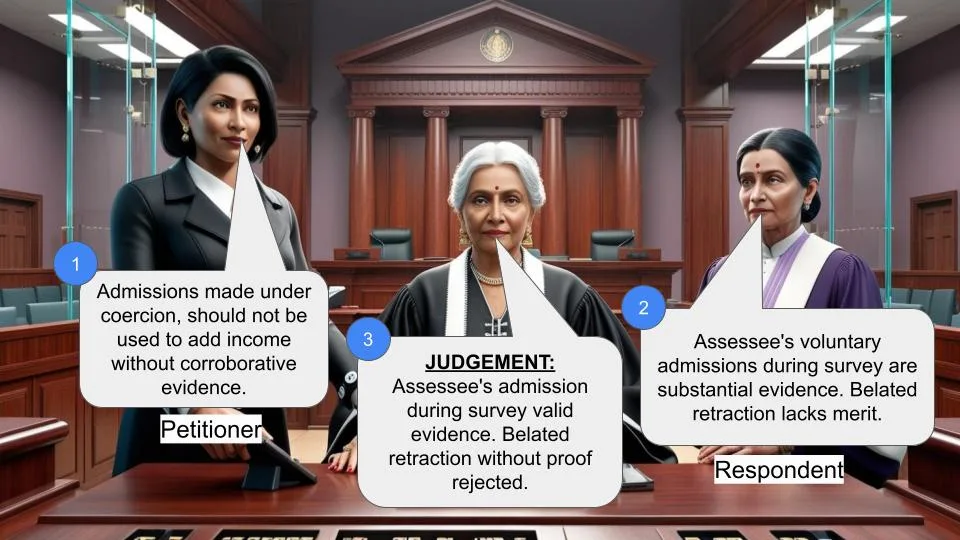
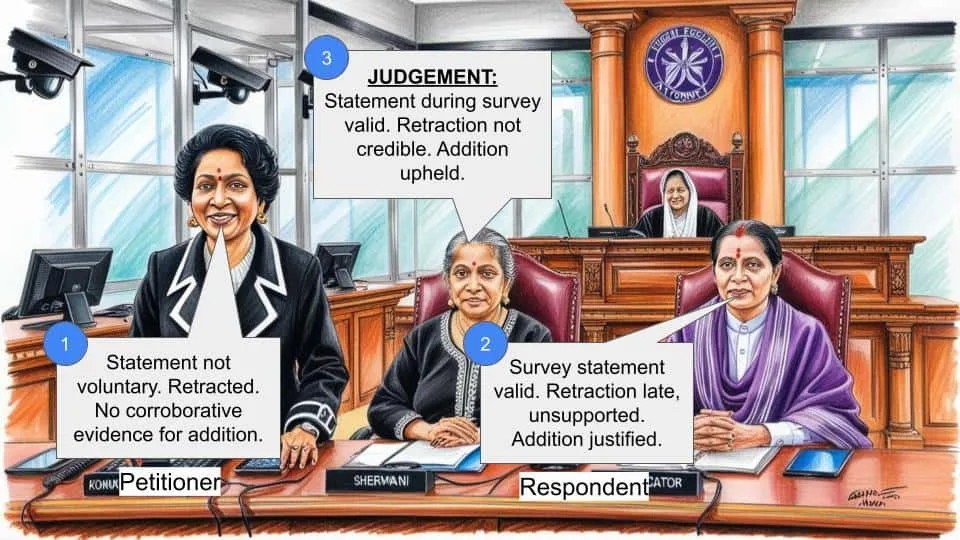
The assessee argued that the retracted admissions could not form the basis for income addition without corroborative evidence. The retraction was due to coercion and pressure during the survey.
- Revenue's Argument:
The revenue contended that the admissions were voluntary and not retracted in a timely manner. The belated retraction lacked substantial evidence of coercion, making the admissions valid for income addition.
Key Legal Precedents
- Section 133A (of Income Tax Act, 1961):
This section allows for surveys to collect information for income tax purposes.
- Admissions as Evidence:
The court emphasized that admissions are the best evidence of a fact within the personal knowledge of an assessee and can be used against them if not retracted immediately or within a reasonable time.
Judgement
The court dismissed the appeal, ruling that the revenue did not err in relying on the assessee's admissions. The belated retraction without substantial evidence of coercion did not benefit the assessee. The decisions of the ITAT and CIT(A) were affirmed, and the additional income was included in the assessee's income.
FAQs
Q1: Can admissions made during a survey be used as evidence?
A1: Yes, admissions made during a survey are substantial evidence and can be used against the assessee if not retracted immediately or within a reasonable time.
Q2: What happens if an admission is retracted?
A2: Retractions must be timely and supported by valid reasons. Belated retractions without substantial evidence of coercion or pressure are not considered valid.
Q3: What was the court's decision in this case?
A3: The court dismissed the appeal, supporting the revenue's reliance on the assessee's admissions and rejecting the claim of coercion due to the delayed retraction.
Q4: What is the significance of this case?
A4: This case highlights the importance of timely retraction of admissions and the substantial weight given to voluntary admissions in income tax assessments.

The appellant-assessee is before us challenging order dated 31.07.2012 passed by the Income Tax Appellate Tribunal, (hereinafter referred to as 'the ITAT'), Chandigarh, Bench 'A', order passed by the Commissioner of Income Tax(Appeals) (hereinafter referred to as 'the CIT(A)') as well as the assessment orders.
During a survey, under Section 133A (of Income Tax Act, 1961) (hereinafter referred to as 'the Act') on the business premises of M/s Oscar Remedies Pvt. Ltd., on 18.01.2006, the assessee who is admittedly a Director, declared additional income of 30 lacs relatable to unaccounted investment towards construction of the premises of M/s Oscar Remedies Pvt. Ltd. This apart, the assessee declared an additional amount of `50 lacs attributable to excess cash, unaccounted investment in building and unaccounted investment in machinery relating to the company. After the survey, the assessee filed a return on 31.03.2007 declaring an income of 1,99,872/-. The return was processed and eventuality in scrutiny proceedings initiated after serving notices under Section 143(2) (of Income Tax Act, 1961) and 142(1) of the Act and after appropriating requisite information namely, the account books vide order dated 26.12.2008, the assessee's statements, the assessment was concluded by adding `30 lacs to the income of the assessee. Aggrieved by this order, the assessee filed an appeal, which was dismissed by the CIT(A). The assessee thereafter filed an appeal before the ITAT which was also dismissed.
Counsel for the assessee submits that as admittedly the appellant retracted his admissions, the retracted admissions/statement could not form the basis of additions without any corroborative evidence. Counsel for the assessee draws attention to Office Note (Annexure-A6) dated 26.12.2008, wherein, the Deputy Commissioner of Income Tax has recorded that no other incriminating document except the slip pad has been recovered by the revenue. Counsel for the assessee submits that though an admission is the best evidence of a fact but where an admission is made under coercion and pressure and is retracted, the revenue cannot place reliance upon such an admission and must, therefore, look for other evidence to prove its case. The absence of any other evidence renders the impugned orders which are based upon retracted statements made by the assessee null and void. Counsel for the revenue submits that admissions made by the assessee were recorded on 18.01.2006, during a search. The assessee thereafter addressed a letter dated 19.01.2006 making further admissions. The assessee retracted these admissions, on 04.12.2008 almost two years after the admissions and then also a few weeks before the passing of the assessment order on 26.12.2008. The retractions being highly belated and without reference to any material that could raise an inference that the statements were coerced or made under pressure, the statements have been rightly relied by the revenue while making additions. Counsel for the revenue also submits that general allegations of coercion or pressure, cannot enure to the benefit of an assessee particularly where the retraction is belated. We have heard counsel for the parties, perused the impugned orders.
A survey under Section 133(A) (of Income Tax Act, 1961) was conducted on 18.01.2006. The assessee, who is the Director of M/s Oscar Remedies Pvt. Ltd., declared an additional income of `50 lacs on behalf of the company and `30 lacs on his own behalf. The assessee made the following admissions on 18.01.2006 which read as follows :-
“Ques.19. It has come to our notice there is some construction is going on at Kala Amb in Himachal Pradesh.
Ans. Construction is going on at Kala Amb. I am instating a unit for manufacturing of medicines at Kala Amb (H.P.). Separate books for the unit are being maintained.
Ques.20. I am showing you a slip pad of Neelgagan in which few entries pertaining to Kala Amb appears. Please explain the same. As per page 1 to 5 the total of amounts appearing in these pages comes to Rs. 30 lacs. Explain these entries and sources thereof.
Ans. This amount was used by me for construction of building at kala Amb. This is my individual income and the same will be added in my income from my salary and interest for the F.Y. 2005-06. This surrender is made to buy mental peace and is made voluntarily, without any pressure and is subject to no penal action. Separate letter for surrender is being submitted.” The admissions were followed by a letter dated 19.01.2006, which reads as follows :-
“During the course of survey operation at the premises of Oscar Remedies (P) Ltd. certain documents relating to construction at Kala Amb factory premises have been found. I hereby, offer to surrender a sum of Rs. 30,00,000/- as additional income for Financial Year 2005-06 as my income. The amount was used for construction of factory building. This surrender has been made voluntarily subject to no penal action.”
The assessee filed a return of income, for assessment year 2006-07 without reflecting the additional income of Rs.30 lacs admitted in his statement dated 18.01.2006 and letter dated 19.01.2006. The assessing officer, therefore, asked the assessee to explain this discrepancy in the return. The assessee filed a reply on 04.12.2006 retracting the admissions. The retractions read as follows: -
“3. The statement of the assessee allegedly available on record was obtained employing coercion by the survey team and does not relate to the business activities of the deponent;
4. That the 'slip pad' was got prepared by the survey team from the assessee exerting pressure. The slip paid contains imaginary figures and do not have any nexus with the business activities and do not represent either income or investment of the deponent.”
The assessing officer after taking into consideration admissions made by the assessee on 18.01.2006 and 19.01.2006 held that as no plea was raised with respect to force or coercion, at the time of the survey, at the time of filing the return or during pendency of assessment proceedings, the belated retraction does not detract from the voluntary nature of the admissions and, therefore, proceeded to include the admitted amount in the income of the assessee and frame assessment on 26.12.2008. Aggrieved by this order, the assessee filed an appeal. The CIT(A), dismissed the appeal. The ITAT has also dismissed the assessee's appeal and as a consequence, affirmed the opinion recorded by the assessing officer. The assessee has framed four substantial questions of law but in essence the questions that arise for adjudication and regarding which arguments have been addressed are: -
1. Whether admissions made during a survey can form the sole basis for making additions?
2. Whether retracted admissions can form the basis of an inference enabling an assessing officer to add income to the income of an assessee?
The onus to prove concealment of income lies upon the revenue. Admissions are an integral part of assessments and as they are the best evidence of a fact, within the personal knowledge of an assessee may if the admission is voluntary and not extracted by coercion or force, be read against an assessee. The relevance of an admission admits to another exception namely if the admission is retracted within reasonable time and by assigning valid reasons. A perusal of the impugned orders reveals that the assessee made an admission, on 18.01.2006 and followed it up by a written admission on 19.01.2006 but while filing his return did not retract the admission. At no stage of the survey or assessment proceedings except at its fag end on 4.12.2008 i.e. almost two years after the admissions and a few weeks before finalisation of the assessment, did the assessee raise a plea that he was coerced and forced into making admissions. The belated retracting of the admissions on 04.12.2008, nearly two years after the admissions and then also without any facts to support the allegation of coercion or pressure, cannot enure to the benefit of the assessee. An admission is substantial evidence of a fact, within the special knowledge of an assessee and if not retracted immediately or within reasonable time is substantive evidence of a fact and may be read against an assessee. We, therefore, answer the above questions against the assessee and as we find no reason to hold that the revenue has erred in relying upon admissions made by the assessee, dismiss the appeal.
(RAJIVE BHALLA)
JUDGE
(B.S. WALIA)
JUDGE
January 20, 2015.
×
Similar Ripples
Questions
Court Upholds Income Addition Based on Assessee's Admission
Write your CommentSimilar Posts

Generic
- Reportdata/4095.pdf
