


Full News

Court Upholds No Tax on Notional Interest for Interest-Free Loans to Sister Concerns
Court Upholds No Tax on Notional Interest for Interest-Free Loans to Sister Concerns
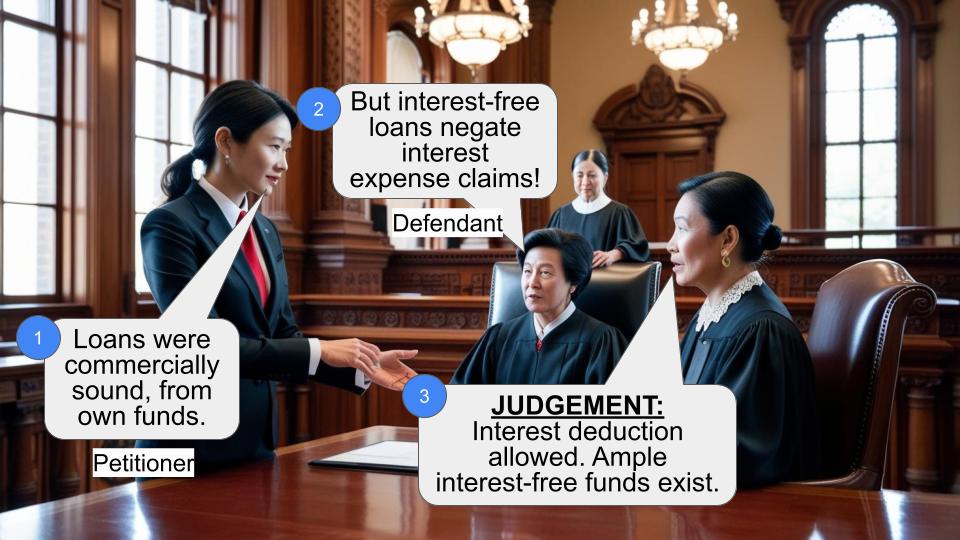
This case involves the Commissioner of Income Tax-I (the appellant) challenging a decision made by the Income Tax Appellate Tribunal regarding Arihant Avenue & Credit Ltd. (the assessee). The dispute centered around whether notional interest income should be added to the assessee's taxable income for interest-free loans given to sister concerns. The High Court dismissed the appeal, affirming the Tribunal's decision that no such addition was warranted.
Case Name**: COMMISSIONER OF INCOME TAX-I VS ARIHANT AVENUE & CREDIT LTD.
**Key Takeaways**:
1. Interest-free loans to sister concerns do not generate notional interest income for tax purposes.
2. The principle of taxing actual income, not hypothetical income, was reinforced.
3. The court emphasized the importance of substance over form in determining taxable income.
**Issue**:
Should notional interest income be added to the assessee's taxable income for interest-free loans given to sister concerns?
**Facts**:
1. Arihant Avenue & Credit Ltd. provided interest-free loans totaling Rs. 329.64 lakhs to its sister concerns.
2. The Assessing Officer added Rs. 39,86,000/- as notional interest income to the assessee's taxable income for the assessment year 2005-06.
3. The addition was based on the auditor's comments that no interest was charged on the advances.
4. The assessee explained that these were interest-free loans from inception and provided supporting documents.
**Arguments**:
Appellant (Revenue):
- The assessee understated interest income in the accounting year 2004-05.
- Income should be accounted for on an accrual basis, justifying the addition of notional interest.
Assessee:
- The advances were interest-free loans from the beginning.
- No interest was ever charged or received on these loans.
- Provided audit reports and account copies to support their claim.
**Key Legal Precedents**:
1. CIT vs. Shoorji Vallabhdas & Co. (46 ITR 144) - Supreme Court
2. B & A Plantations Industries Ltd. vs. CIT (242 ITR 22) - Gauhati High Court
Both cases established that where no interest is charged on interest-free loans to sister concerns, there is no income to be charged as notional income on an accrual basis.
**Judgement**:
The High Court dismissed the appeal, upholding the Tribunal's decision. Key points:
1. The court agreed with the CIT(A) and Tribunal's reliance on the Gauhati High Court decision.
2. It emphasized that income tax is levied on actual income, not hypothetical income.
3. The court stated, "Where income has not resulted at all, there is obviously neither accrual nor receipt of income, even though an entry to that effect might, in certain circumstances, have been made in the books of account."
**FAQs**:
1. Q: What was the main issue in this case?
A: The main issue was whether notional interest should be added to taxable income for interest-free loans given to sister concerns.
2. Q: Why did the court rule in favor of the assessee?
A: The court ruled in favor of the assessee because no actual interest was charged or received on the loans, and tax should be levied on real income, not hypothetical income.
3. Q: What precedents did the court rely on?
A: The court relied on CIT vs. Shoorji Vallabhdas & Co. and B & A Plantations Industries Ltd. vs. CIT.
4. Q: Does this mean companies can avoid tax by giving interest-free loans?
A: This judgment doesn't encourage tax avoidance. It simply states that when no interest is actually charged or received, there's no basis for taxing notional interest.
5. Q: What's the significance of this judgment for businesses?
A: This judgment reinforces the principle that taxation is based on actual income, providing clarity for businesses that offer interest-free loans to related entities.

This appeal under section 260A (of Income Tax Act, 1961), preferred by the Revenue is directed against order dated 30.09.2012 of the Income Tax Appellate Tribunal, Ahmedabad Bench `A', in Income Tax Appeal No.3075 of 2010.
1.1 The appellant has proposed the following question as a substantial question of law:
“Whether the Appellate Tribunal has substantially erred in deleting the addition of Rs.39,86,000/- on account of interest income on advance made by the assessee to its sister concern?”
2. We heard learned senior counsel Mr. M.R. Bhatt assisted by Mrs. Mauna M. Bhatt, learned counsel for the appellant.
3. The issue relates to the addition of Rs.39,86,000/- made by the Assessing Officer on account of interest towards advance made by the assessee to its sister concern. According to the Assessing Officer, the assessee had understated the interest income in the accounting year 2004-05. Therefore, while assessing the income for the corresponding assessment year 2005-06, by assessment order dated 21.12.2009, the Assessing Officer made the addition.
3.1 The said addition was made on the basis of auditor's comments in the audit report that no interest was charged by the assessee on the total advances of Rs.329.64 lakhs. As per the opinion of the Assessing Officer,the assessee should have accounted for the income and expenditure on accrual basis, and therefore, he added the amount as notional interest. The explanation of the assessee was that the advances of Rs.329.64 lakhs were interest free loans and that no interest was charged on those advances right from the inception. The assessee produced the copies of audit reports for the earlier three years and the copies of accounts of the parties to whom the advances were made, in order to substantiate its explanation.
3.2 In the appeal, the CIT(A) held in favour of the assessee, by recording his findings in the order dated 19.08.2010 as under:
“5. ... the appellant, on it's own volition, has not charged any interest on the total deposits made to the five sister concerns, amounting to Rs.3,29,64,266/-. It is not the A.O.'s case that appellant has borrowed the funds and interest bearing funds have been advanced to the five sister concerns, without charging interest. The appellant has not claimed any interest in its profit and loss account. In such situations, the notional interest income of Rs.39,86,000/- could not be brought to tax. The addition of Rs.39,86,000/- is deleted.”
3.3 The order of the CIT(A) was carried in appeal by the Department before the Income Tax Appellate Tribunal, which came to be dismissed as per the impugned order. The Tribunal confirmed the order of the CIT(A) andheld,
“6. ... We find that the learned CIT(A) has followed the decision of the Hon'ble Supreme Court in the case of CIT vs. Shoorji Vallabhdas & Co. [46 ITR 144], as well as the decision of the Hon'ble Gauhati High Court in the case of B& a Plantations Industries Ltd. vs. CIT [242 ITR 22], wherein it has been held that where no interest is charged on interest free loans to sister concerns, there is no income to be charged as notional income on accrual basis. In addition to these precedents, further it has been observed that it was not the case of the Revenue that interest bearing borrowed money was given as interest-free advance to those parties. In view of this, we do not find any infirmity or illegality in the order of the learned CIT(A). We uphold the order of the learned CIT(A).”
4. Both the CIT(A) as well as the Tribunal relied on the decision of Gauhati High Court in B & A Plantations Industries Ltd. vs. CIT (242 ITR 22) for the principle that where no interest was charged on the interest free loans to sister concerns, there is no income to be charged as notional income on accrual basis. The Apex Court in CIT vs. Surji Vallabhdas & Co. (46 ITR 144) explained the point as under, “Income-tax is levy on income. No doubt, the Income-tax Act takes into account two points of time at which the liability to tax is attracted, viz., the accrual of the income or its receipt; but the substance of the matter is the income. If income does not result at all, there cannot be a tax, even though in book-keeping, an entry is made about a “hypothetical income”, which does not materialize. Where income has, in fact, been received and is subsequently given up in such circumstances that it remains the income of the recipient, even though given up, the tax may be payable. Where,however, the income can be said not to have resulted at all, there is obviously neither accrual nor receipt of income, even though an entry to that effect might, in certain circumstances, have been made in the books of account”
4.1 In view of the above, the Tribunal did not commit any error in dismissing the appeal of the Revenue and upholding the deletion of the addition in question. The present appeal is devoid of merits. No substantial question of law arises for consideration of this court.
5. Accordingly, the appeal is dismissed.
(V.M. SAHAI, J.)
(N.V. ANJARIA, J.)
×
Similar Ripples
Questions
Court Upholds No Tax on Notional Interest for Interest-Free Loans to Sister Concerns
Write your CommentSimilar Posts


Generic
- Reportdata/5554.pdf
