


Court Upholds R&D Expenditure Deduction, Rejecting Narrow Interpretation of Tax…


Full News
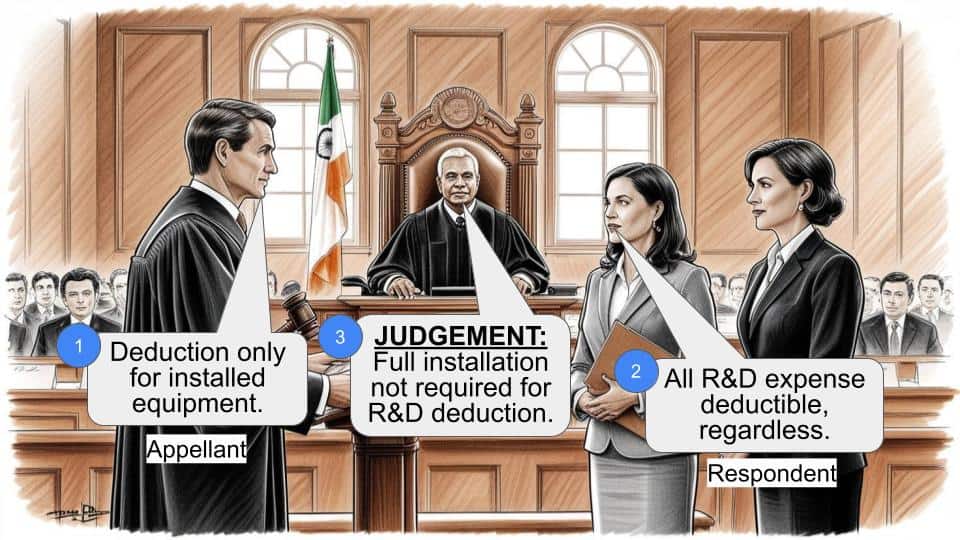
Court Upholds R&D Expenditure Deduction, Rejecting Narrow Interpretation of Tax Law
Court Upholds R&D Expenditure Deduction, Rejecting Narrow Interpretation of Tax Law
This case involves a dispute between the Commissioner of Income Tax (LTU) and Biocon Ltd. regarding the eligibility for weighted deduction under Section 35(2AB) (of Income Tax Act, 1961) for research and development (R&D) expenditures. The High Court ruled in favor of Biocon Ltd., affirming that the entire expenditure incurred for R&D facilities should be allowed for weighted deduction, even if some machinery was not fully installed by the end of the financial year.
Get the full picture - access the original judgement of the court order here
Case Name:
Commissioner of Income Tax (LTU) Vs Biocon Ltd. (High Court of Karnataka)
ITA No.435 of 2014
Date: 1st June 2015
Key Takeaways:
1. The court emphasized a plain reading interpretation of tax laws.
2. R&D expenditures can qualify for deduction even if equipment isn't fully installed by year-end.
3. The judgment supports a broader interpretation of Section 35(2AB) (of Income Tax Act, 1961) to encourage R&D investments.
Issue:
Is Biocon Ltd. entitled to claim weighted deduction under Section 35(2AB) (of Income Tax Act, 1961) for the entire expenditure incurred on R&D facilities, including machinery not fully installed by the end of the financial year?
Facts:
1. Biocon Ltd. is engaged in manufacturing enzymes and pharmaceutical ingredients.
2. The case pertains to the assessment year 2003-04.
3. Biocon incurred capital expenditure of Rs.7,82,25,431/- on machinery for R&D.
4. This amount included Rs.2,72,59,589/- for three items of machinery.
5. The Assessing Officer noted these three items were not installed and commissioned by year-end.
6. An installation certificate was issued on 31.3.2004 by Mr. Virupaksha, evidencing that three scientific machines were installed.
Arguments:
Assessing Officer:
- Claimed that the three items of machinery not installed and commissioned by year-end don't qualify for weighted deduction under Section 35(2AB) (of Income Tax Act, 1961).
- Argued that such expenditure doesn't amount to expenditure incurred during that period.
Biocon Ltd.:
- Contended that the entire R&D expenditure should be allowed for weighted deduction.
- Argued that the law doesn't require machinery to be installed and commissioned before the end of the financial year.
Key Legal Precedents:
The judgment doesn't mention specific legal precedents but emphasizes the importance of plain and simple interpretation of statutory provisions.
Judgement:
1. The High Court ruled in favor of Biocon Ltd.
2. It held that Section 35(2AB) (of Income Tax Act, 1961) requires:
a) Development of facilities
b) Incurring of expenditure by the assessee
c) Approval of facility by the prescribed authority (DSIR)
d) Allowance of weighted deduction on the expenditure incurred
3. The court stated that the provision doesn't suggest or imply that machinery must be installed and commissioned before the end of the relevant previous year.
4. It concluded that the entire expenditure incurred for R&D should be allowed for weighted deduction under Section 35(2AB) (of Income Tax Act, 1961).
FAQs:
Q1: What is the significance of this judgment for companies investing in R&D?
A1: This judgment allows companies to claim weighted deductions on R&D expenditures even if equipment isn't fully installed by year-end, potentially encouraging more R&D investments.
Q2: Does this mean companies can claim deductions for any R&D-related purchase, regardless of its status?
A2: Not exactly. The expenditure must still be for developing R&D facilities and approved by the prescribed authority (DSIR). The judgment mainly clarifies that full installation by year-end isn't a requirement.
Q3: How does this judgment impact the interpretation of tax laws?
A3: It emphasizes the importance of plain reading and interpretation of tax laws, discouraging the addition of conditions not explicitly stated in the statute.
Q4: What is a "weighted deduction" in this context?
A4: A weighted deduction allows taxpayers to deduct more than 100% of certain expenses from their taxable income. In this case, it applies to approved R&D expenditures under Section 35(2AB) (of Income Tax Act, 1961).
Q5: Does this judgment apply to all types of business expenditures?
A5: No, this judgment specifically pertains to R&D expenditures under Section 35(2AB) (of Income Tax Act, 1961). Other types of business expenditures may have different rules and interpretations.

The assessee is engaged in the business of manufacture of enzymes and pharmaceutical ingredients. The matter pertains to return of income for the assessment year 2003-04. The records reveal that during the relevant assessment year, the assessee has incurred certain expenditure on capital towards cost of machinery for a sum of Rs.7,82,25,431/-. The assessing Officer noticed that the said amount included a sum of Rs.2,72,59,589/- incurred towards three items of machinery. The assessing Officer also noticed that the said three items of machinery have not been installed and commissioned and therefore the assessee is not entitled for weighted deduction under Section 35(2AB) (of Income Tax Act, 1961) (‘Act’ for short) and hence held that such expenditure does not amount to expenditure incurred during that period. The Commissioner of Income Tax (Appeals), Bangalore as well as the Income Tax Appellate Tribunal disagreed with the said conclusion reached by the assessing Officer and have held that the assessing Officer is not justified in not allowing weighted deduction under Section 35(2AB) (of Income Tax Act, 1961), inasmuch as the words which are not provided in the statute are sought to be read into, by the assessing Officer.
2. We do not find any ground to disagree with the conclusion reached by the Commissioner of Income Tax (Appeals) and the appellate Tribunal. What Section 35(2AB) (of Income Tax Act, 1961) speaks of is (a) development of facilities; (b) incurring of expenditure by the assessee for development of such facilities; (c) approval of facility by the prescribed authority, which is ‘DSIR’; and (d) allowance of weighted deduction on the expenditure so incurred by the assessee.
3. On plain reading of the said provision makes it amply clear that the assessee has to develop facility by incurring expenditure for scientific research and he will have to file application before the prescribed authority, who after following the proper procedure, will allow the application or otherwise and the assessee would be entitled for weighted deduction in respect of all expenditure so incurred. The provision nowhere suggests or implies that machinery is required to be installed and commissioned before the expiry of the relevant previous year. The provision postulates approval of ‘R & D’ facility, which implies that a development facility shall be in existence, which in turn, presupposes that the assessee must have incurred expenditure in this behalf. The appellate Tribunal has rightly concluded that in case if the interpretation of the assessing Officer is accepted, it creates absurdity in the provision, inasmuch as the words which are not provided in the statute are to be read into, which is against the settled proposition of law with regard to plain and simple meaning of the provision. The plain and homogenous reading of the provisions would suggest that the entire expenditure incurred in respect of ‘R & D’ has to be allowed for weighted deduction under Section 35(2AB) (of Income Tax Act, 1961).
Even on facts, it has been found by the assessing Officer that an installation certificate had been issued on 31.3.2004 by one Mr.Virupaksha (concerned officer) evidencing that three scientific machines were installed.
Hence, we do not find any ground to interfere with the orders passed by the Income Tax Appellate Tribunal and no substantial question of law is involved in this appeal.
Accordingly, appeal fails and same stands dismissed.
Sd/-
JUDGE
Sd/-
JUDGE
×
Similar Ripples
Questions
Court Upholds R&D Expenditure Deduction, Rejecting Narrow Interpretation of Tax Law
Write your CommentSimilar Posts


Generic
- Reportdata/3719.pdf
