


Full News
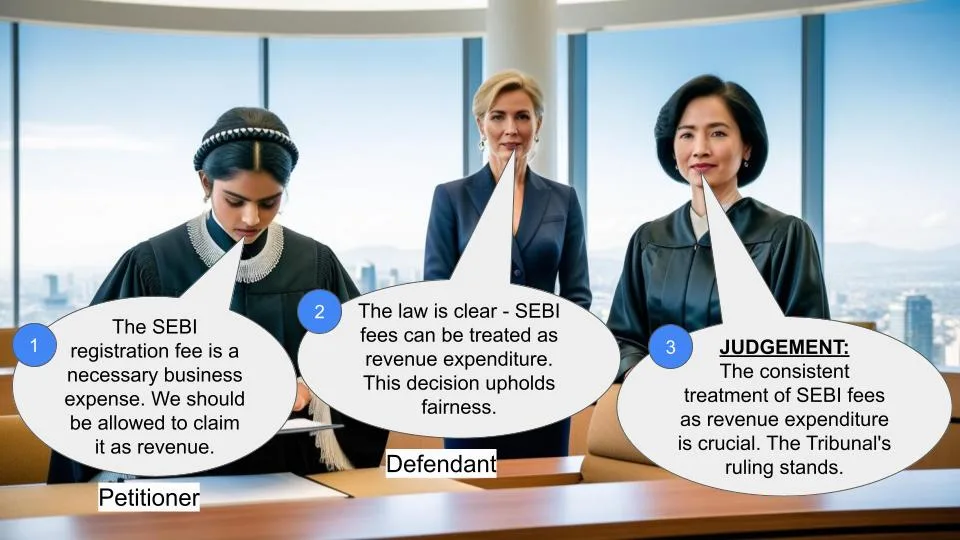
Court Upholds SEBI Registration Fee as Revenue Expenditure for Assessees
Court Upholds SEBI Registration Fee as Revenue Expenditure for Assessees
This case involves appeals by the revenue department against orders of the Income Tax Appellate Tribunal (ITAT) that allowed assessees to treat fees paid to the Securities and Exchange Board of India (SEBI) as revenue expenditure. The High Court dismissed the appeals, ruling in favor of the assessees and confirming that SEBI registration fees can be claimed as revenue expenditure.
Get the full picture - access the original judgement of the court order here
Case Name:
Commissioner of Income Tax-I Vs Joint Ventures of MCL & MMCL (AOP) (High Court of Gujarat)
Tax Appeal No.832 of 2007 & 833 of 2007
Date: 24 December 2014
Key Takeaways
1. SEBI registration fees paid by assessees can be treated as revenue expenditure for tax purposes.
2. The court emphasized the importance of consistent treatment across similarly situated assessees.
3. The decision aligns with previous rulings on the matter, reinforcing the legal precedent.
Issue
Whether the fee paid to the Securities & Exchange Board of India (SEBI) by the assessees should be allowed as revenue expenditure for income tax purposes?
Facts
1. The case involves two appeals (Tax Appeal No.832 of 2007 and Tax Appeal No.833 of 2007) arising from a common order of the Income Tax Appellate Tribunal, Ahmedabad.
2. In Tax Appeal No.832 of 2007, the assessee had filed a return for the Assessment Year 1996-97, declaring a total income of Rs.20,35,000/-.
3. The Assessing Officer disallowed the registration fee paid to SEBI as capital expenditure.
4. The assessee appealed to the Commissioner of Income Tax (Appeals), who partly allowed the appeal.
5. The assessee then appealed to the ITAT, which allowed the appeal in favor of the assessee.
Arguments
1. Revenue's Argument:
The appellant-revenue contended that the Tribunal erred in allowing the appeals of the assessees and in deleting the disallowance. They argued that the Tribunal wrongly relied on previous decisions.
2. Assessee's Argument:
The respondent-assessee supported the Tribunal's order, arguing that the question was already settled by a Karnataka High Court decision in the case of Commissioner of Income-Tax and Another v. Vysya Bank Ltd.
Key Legal Precedents
1. DCIT v. Core Health Care Ltd. 251 ITR 61
2. Market Creator Ltd. Baroda v. ACIT in ITA No.5029/Ahd/1996
3. Commissioner of Income-Tax and Another v. Vysya Bank Ltd., reported in [2009] 313 ITR
Judgement
The High Court dismissed the appeals, ruling in favor of the assessees. The court held that:
1. The Tribunal was right in allowing the fee paid to SEBI as revenue expenditure.
2. The court relied on the Karnataka High Court decision in Commissioner of Income-Tax and Another v. Vysya Bank Ltd.
3. The court emphasized that if the Revenue had been treating similar deposits by other assessees as revenue expenditure, there was no reason for different treatment in this case.
FAQs
Q1: What was the main issue in this case?
A1: The main issue was whether the fee paid to SEBI by the assessees should be treated as revenue expenditure for income tax purposes.
Q2: Why did the court rule in favor of the assessees?
A2: The court ruled in favor of the assessees because it found that similar deposits made by other assessees had been consistently treated as revenue expenditure by the Revenue department. The court saw no reason for different treatment in this case.
Q3: What precedent does this case set?
A3: This case reinforces the precedent that SEBI registration fees paid by assessees can be treated as revenue expenditure for tax purposes, ensuring consistent treatment across similarly situated assessees.
Q4: How might this decision impact other assessees?
A4: This decision may benefit other assessees who have paid SEBI registration fees, as they can now claim these fees as revenue expenditure, potentially reducing their taxable income.
Q5: What principle of tax law does this case highlight?
A5: This case highlights the principle of consistency in tax treatment. It emphasizes that similarly situated taxpayers should receive similar treatment from tax authorities.

1. Both these appeals arise from the common order of the Income Tax Appellate Tribunal, Ahmedabad, therefore, they are being head and decided by this common judgment.
2. By way of these appeals, the appellant- revenue has challenged the common order dated 24.03.2006, passed by the Income Tax Appellate Tribunal, Ahmedabad (for short “the Tribunal”) in ITA Nos. 1641 and 1642/Ahd/2001, whereby the appeals preferred by the assessees were allowed by the Tribunal.
3. The facts as well as the question of law of both these appeals are similar, therefore, we discuss the facts of Tax Appeal No.832 of 2007 for our convenience.
4. The facts, in brief, are that the assessee had filed its return for the Assessment Year 1996-97 on 30.10.1996, declared total income of Rs.20,35,000/-. Thereafter, the return was processed under Section 143(1)(a) (of Income Tax Act, 1961). The Assessing Officer, after scrutiny, passed order under Section 143(3) (of Income Tax Act, 1961) and the amount of registration fee paid to SEBI was disallowed as capital expenditure. Against the said order, the assessee filed an appeal before the Commissioner of Income Tax (Appeals). The CIT(A) partly allowed the said appeal. Being aggrieved and dissatisfied by the said order, the assessee filed an appeal before the Tribunal. The Tribunal vide impugned order dated 24.03.2006 allowed the appeal of the assessee. Hence, these appeals are filed at the instance of the assessess.
5. While admitting Tax Appeal No.832 of 2007 on 12.12.2007, the Court had formulated the following substantial question of law:-
“Whether, on the facts and circumstances of the case, the Appellate Tribunal was right in law in allowing the fee of Rs.1,00,000/- paid to the Securities & Exchange Board of INdia (SEBI)as revenue expenditure ?”
6. While admitting Tax Appeal No.833 of 2007 on 12.12.2007,the Court had formulated the following substantial question of law:-
“Whether, on the facts and circumstances of the case, the Appellate Tribunal was right in law in allowing the fee of Rs.2,50,00,000/- paid to the Securities & Exchange Board of India (SEBI)as revenue expenditure ?”
7. Learned advocate for the appellant- revenue has submitted that the Tribunal has committed error in allowing the appeals of the assessees and in deleting the disallowance. It is the contention of learned advocate for the appellant-revenue that while deciding the appeals the Tribunal has wrongly relied on the decision of this Court in the case of DCIT v. Core Health Care Ltd. 251 ITR 61 and the decision of the Tribunal in the case of Market Creator Ltd. Baroda v. ACIT in ITA No.5029/Ahd/1996. Therefore, he urged that this Court may allow these appeals and answer the question raised in these appeals in favour of the revenue and against the assessee.
8. Learned advocate for th respondent- assssee has supported the order of the Tribunal and contended that the question raised in these appeals is already concluded by the Karnataka High Court in the case of Commissioner of Income- Tax and Another v. Vysya Bank Ltd., reported in [2009] 313 ITR. Therefore, learned advocate for the respondent-assessee has urged that in view of the above decision the present appeals deserve to be dismissed.
9. We have heard learned advocate for both the parties and perused the material on record. We have also perused the decision relied on by the learned advocate for th respondent-assesse and find that the question of law involved in these appeals is already concluded in favour of the assessee and against the revenue. In paragraph Nos. 3 to 6 of the said decision, the Court has observed as under:-
“ 3. We have accordingly heard learned counsel for the parties.
4. At the outset, learned counsel Sri S.Parthasarthi, appearing for the assessee made a statement at the Bar that on enquiries being made by him, it has been found that the aforesaid sum of Rs.5,00,000 deposited by other banking companies with SEBI has throughout been treated as revenue expenditure. It has also been contended that this would go to show that the assessee has not been accorded the same treatment, which has been accorded to other similarly situated assessees. Thus, a case of discrimination was tried to be putforth before us.
5. Even though we had granted time to learned counsel for the appellants to ascertain this statement of fact made by learned counsel for the assessee, but he was not able to gather necessary information nor was in a position to controvert the statement made by learned counsel for the assessee.
6. In light of the statement made at the Bar by learned counsel for the respondent, we find that there is no merit or substance in this appeal. If the Revenue had been treating the amount of Rs. 5,00,000deposited by the similarly situated assessees with SEBI as revenue expenditure, then there is no reason why a different treatment should be meted out to the present assessee. In light of the foregoing discussion, we are of the opinion that there is no substance in this appeal.
10. Since the issue involved in these appeals is already concluded by the above decision, no elaborate reasons are required to be assigned by this Court. In that view of the matter, we are of the considered opinion that the present appeals deserve to be dismissed and the same is accordingly dismissed. The question of law raised in these appeals is answered in favour of the assessee and against the revenue.
Accordingly, we hold that the Tribunal was right in allowing the fee paid to the Securities & Exchange Board of India (SEBI) as revenue expenditure .
(K.S.JHAVERI, J.)
(K.J.THAKER, J)
×
Similar Ripples
Questions
Court Upholds SEBI Registration Fee as Revenue Expenditure for Assessees
Write your CommentSimilar Posts

Generic
- Reportdata/4190.pdf
