


Full News
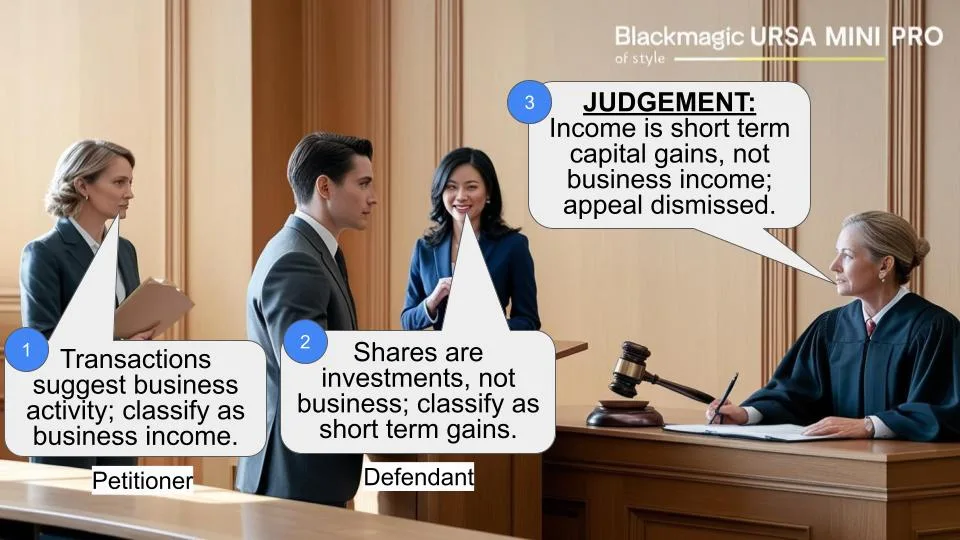
“Court Upholds Short Term Capital Gains Over Business Income Classification”
“Court Upholds Short Term Capital Gains Over Business Income Classification”
In this case, the court had to decide whether the income from share transactions by the assessee should be classified as ‘business income’ or ‘short term capital gains’. The court upheld the decision of the Commissioner of Income Tax (Appeals) and the Tribunal, which classified the income as ‘short term capital gains’, rejecting the Revenue’s appeal to treat it as ‘business income’.
Get the full picture - access the original judgement of the court order here
Case Name
Commissioner of Income Tax vs. Datta Mahendra Shah (High Court of Bombay)
Income Tax Appeal No. 1601 of 2013
Date: 9th September 2015
Key Takeaways
- The court confirmed that the classification of income from share transactions as ‘short term capital gains’ was appropriate.
- The decision emphasized the importance of consistent treatment of similar cases by the Income Tax Department.
- The court found no substantial question of law to warrant a different classification.
Issue
Should the income from share transactions be classified as ‘business income’ or ‘short term capital gains’?
Facts
- The respondent, Datta Mahendra Shah, a senior citizen, reported income from share transactions as ‘short term capital gains’.
- The Assessing Officer initially classified this income as ‘business income’, citing factors like the number of companies involved, short holding periods, and speculative transactions.
- The Commissioner of Income Tax (Appeals) and the Tribunal both upheld the classification as ‘short term capital gains’, noting the respondent’s consistent treatment of shares as investments and not stock-in-trade.
Arguments
- Revenue’s Argument: The income should be classified as ‘business income’ due to the nature and volume of transactions.
- Assessee’s Argument: The transactions were investments, not business activities, and should be classified as ‘short term capital gains’.
Key Legal Precedents
- The court referred to the Central Board of Direct Taxes (CBDT) circular which provides guidelines for distinguishing between shares held as stock-in-trade and as investments.
- The case of the respondent’s son, Jai Mahendra Shah, was cited, where similar transactions were classified as ‘short term capital gains’.
Judgement
The court dismissed the Revenue’s appeal, affirming the decision of the CIT (A) and the Tribunal. It concluded that the classification as ‘short term capital gains’ was appropriate and that there was no substantial question of law to justify a different classification.
FAQs
Q: Why was the income not classified as ‘business income’?
A: The court found that the transactions were consistent with investment activities rather than business activities, based on factors like holding periods and the nature of transactions.
Q: What was the significance of the CBDT circular in this case?
A: The CBDT circular provided guidelines that helped determine whether shares were held as investments or stock-in-trade, supporting the classification as ‘short term capital gains’.
Q: How did the case of the respondent’s son influence this decision?
A: The court noted that the facts in both cases were identical, and the previous decision to classify the son’s income as ‘short term capital gains’ supported a consistent approach.

1. This appeal under Section 260 (of Income Tax Act, 1961)A of the Income Tax Act,1961 (the Act) challenges the order dated 27th February,2013 passed by the Income Tax Appellate Tribunal (the Tribunal). The Assessment Year involved is Assessment Year 2008-09.
2. The Revenue urges the following question of law for our consideration:
“Whether on the facts and in the circumstances of the case and in law, the Tribunal was justified in upholding the Commissioner of Income Tax (Appeal)'s order and treating the Gains from Share Transactions as Short Term Capital Gain whereas it was to be taxed under the head “Business Income” ?”
3. The respondentassessee is a senior citizen having income on account of capital gains, business income and income from other sources. The Assessing Officer was of the view that the amount claimed as short term capital gains of Rs.9.25 crores was in fact business income and has tobe taxed accordingly. This view was inter alia taken on the basis of the following:
(a) that the assessee dealt with the shares of more than 60 companies during the year;
(b) holding period of shares in 30% of the cases was less than 30 days;
(c) there are five speculative transactions during the year; and
(d) dividend income received was meager compared to capital gains.
In the result, by the assessment order dated 27 December 2010 passed under Section 143(3) (of Income Tax Act, 1961) it was held that the respondent – assessee was a dealer in shares to the extent it claimed income under the head 'short term capital gains' and was subjected to tax under the head 'business income'.
4. In appeal, the Commissioner of Income Tax (Appeals) (CIT (A)) on consideration of the following facts:
(a) respondent – assessee has been an investor in shares and has consistently treated its entire investment in shares as “investment in shares” & not “stockintrade”;
(b) the income earned on sale of shares was offered as short term capital gains even when losses were suffered in a particular year;
(c) dealing in 35 scrips, involving 59 transactions for the entire year could not be considered for high volume so as to be classified as trading income;
(d) the respondent had earned 75% of the income as short term capital gains by holding shares for more than nine months;
(e) no transfer in shares was done by the respondent – assessee for over 75% of working days during the year;
(f) 56% of the Short term capital gains during the year resulted from the shares held during the earlier assessment year as a part of the opening investment on 1 April 2007.
(g) the respondent had not resorted to churning of shares or repetitive transactions in shares of the same company.
(h) for the earlier Assessment Years i.e. AY 200506 and AY 2006 07, the Assessing Officer had, in the proceedings under Section 143(3) (of Income Tax Act, 1961), accepted the stand of the respondent assessee and taxed the profit earned on purchase and sale of shares as short term capital gains;
(i) dividend Income earned was over Rs.8.50 lakhs;
(j) the respondent – assessee had not borrowed any funds but has used her own funds for the purpose of investment in shares;
(k) Besides all transactions were delivery based transactions; and
(l) the speculation loss to which the Assessing Officer has made reference was in fact not so, but happened as a result of punching error.
On consideration of the above facts, the CIT (A) concluded that compliance on the part of the respondent – assessee in terms of Instruction No.1827 dated 31 August 1989 issued by the Central Board of Direct Taxes laying down the tests for distinguishing the shares held in stockintrade and shares held as an investment, the shares held by the respondent – assessee was investment. Thus allowed the appeal of the respondent – assessee and held the income to be treated as short term capital gains.
5. On further appeal by the Revenue, the Tribunal after recording the aforesaid finding of the CIT (A) came to the conclusion that the finding of the CIT (A) calls for no interference. Besides, the impugned order also records the fact that the Coordinate Bench of the Tribunal in the case of the respondentassessee's son one Jai Mahendra Shah had held the gain arising from purchase and sale of the shares is taxable under the head 'short term capital gains' and not as a 'business income'. The impugned order further holds that the facts being identical in that case to one under consideration. Thus in view of the above the impugned order dismisses the revenue's appeal.
6. As we noticed that the Tribunal in the impugned order has relied upon its earlier order dated 31 August 2012 passed in the case of respondentassessee's son on identical facts, we had by order dated 19 August 2015 directed the Revenue to place on record whether or not any appeal has been preferred against the order of the Tribunal dated 31 August 2012 in the case of respondentassessee's son. This was because the impugned order has followed the order dated 31 August 2012 of a Co- ordinate Bench in the case of respondent's son on identical facts.
7. Mr.Malhotra, learned Counsel appearing for the Revenue filed an affidavit dated 8 September 2015 of Shri.Ramnath Prabhakar Murkunde, Assistant Commissioner of Income Tax. It inter alia states that no appeal has been filed against the order of the Tribunal dated 31 August 2012 passed by the Tribunal in the case of respondentassessee's son. In paragraphs 7, 8 and 9 of the Affidavit he states as under:
“7. I say that in the case of Shri.Jay Mahendra Shah for AY 200809, ... .... .... .... .... I say that the then CIT- 11, Mumbai had not recommended appeal to the Honourable High Court and the then CCITI, Mumbai accepted the said recommendation and the said decision was accepted.
8. I say that the order dated 27/02/2013 of the Honourable Tribunal in the case of Smt.Datta Mahendra Shah for AY 200809 was perused by the then CIT16, Mumbai and the said CIT had recommended appeal to the Hon.High Court by holding that the Honourable Tribunal was bound to consider each case on its own merits and that the case of Shri.Jay Mahendra Shah and that of Smt.Datta Mahendra Shah were not identical and no due consideration of the appeal by revenue was given by the Honourable Tribunal. I say that the then CCITIX, Mumbai agreed with the recommendation of the then CIT16, Mumbai and the appeal to Hon. High Court was accordingly made.
9. I say that different officers at different times were concerned in taking decisions of filing of appeal to the Hon.High Court in the case of Shri.Jay Mahendra Shah and that of Smt.Datta Mahendra Shah and that the said officers held different jurisdictions.”
8. Mr.Malhotra, learned Counsel for the Revenue submits that the impugned order by the Tribunal as well as the order of CIT (A) have viewed the facts from one perspective while the Assessing Officer on the same facts viewed them from a different perspective to conclude that the short term capital gains in respect of respondentassessee has to be taxed as business income. In these circumstances, this appeal ought to be admitted. He further relies upon the affidavit dated 8 September 2015 of the Assessing Officer to state that the decision of the Tribunal in the case of respondent'assessee's son dated 31 August 2012 from which no appeal has been preferred, should not in any way impact the decision taken in respect of the present appeal.
9. We find that the CIT (A) in his order has considered all the facts including the stand taken by the Revenue as found in the Assessing Officer's order. On examination of all the facts it has inter alia come to the conclusion that the activities carried out by the respondent assessee cannot be classified under the head 'business income' but more appropriately as claimed by the respondent assessee under the head 'short term capital gains'. This is particularly so on application of CBDT circular. This finding of fact by the CIT (A) has been upheld on examination by the Tribunal. In view of the concurrent finding of fact arrived at by the CIT (A) and the Tribunal, according to us, no substantial question of law would arise to warrant admission of the question as proposed. It is to be noted that even according to the Revenue, there can be difference of opinion on the appreciation of facts. If that be so, the CIT (A) and the Tribunal has taken a particular view which is not shown to be perverse or arbitrary in the context of the facts. The view taken is a possible view on the facts and therefore, calls for no interference. Thus we see no reason to entertain the question as proposed.
10. Before closing we would make a reference of affidavit dated 8 September 2015 of Shri.R.P.Murkunde, Assistant Commissioner of Income Tax. It points out that a decision was taken not to file an appeal from the order dated 31 August 2012 of the Tribunal in the case of the respondent assessee's son but a decision was taken to file an appeal in case of the impugned order as the facts are not identical. However, no particulars have been set out as to what facts are different from the order which is passed in the case of respondent assessee's son and the respondent –assessee, particularly, when the Tribunal has observed that the facts in both the cases are identical. The decision taken on the basis that the facts are not identical must be after recording the circumstances which evidence the difference of facts in two cases and must be so mentioned in the affidavit. The further contention that the officers of the Department who took the decision to file an appeal in this case were different from the officers who have taken decision not to file appeal in the case of respondent assessee's son, is no reason not to adopt a consistent stand in identical matters. The Income Tax Department functions as one unit and its stand in identical matters cannot be different merely because the officers dealing with the two files are different. In any case, if there are substantive reasons in facts or in law to take a different view the same should be set out in the affidavit and the explanation that a different view was taken because the officers who took the two decisions were different, is no justification.
11. In the above view for all the above reasons, we see no cause to interfere with the impugned order. Accordingly, the appeal is dismissed.
No order as to costs.
(G.S.KULKARNI, J.) (M.S.SANKLECHA, J.)
CERTIFICATE
Certified to be true and correct copy of the original signed Judgment/ Order.
×
Similar Ripples
Questions
“Court Upholds Short Term Capital Gains Over Business Income Classification”
Write your CommentSimilar Posts

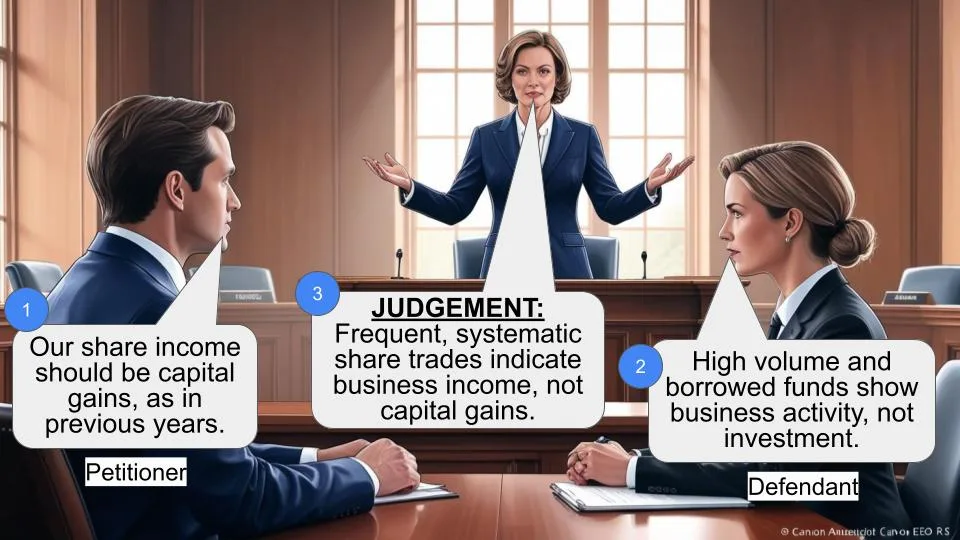
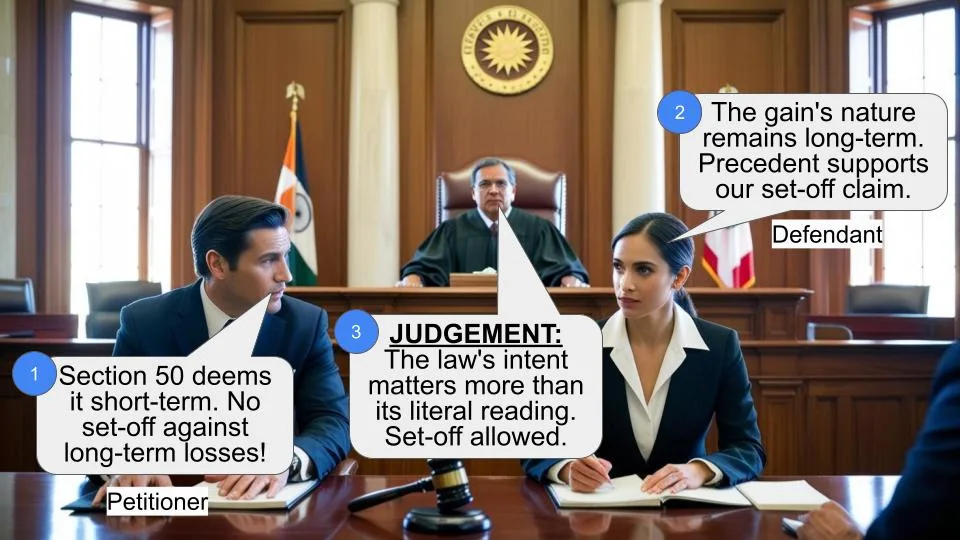
Generic
- Reportdata/3453.pdf
