


Capital Gains Set-Off: Tribunal Upholds Assessee’s Right








Full News
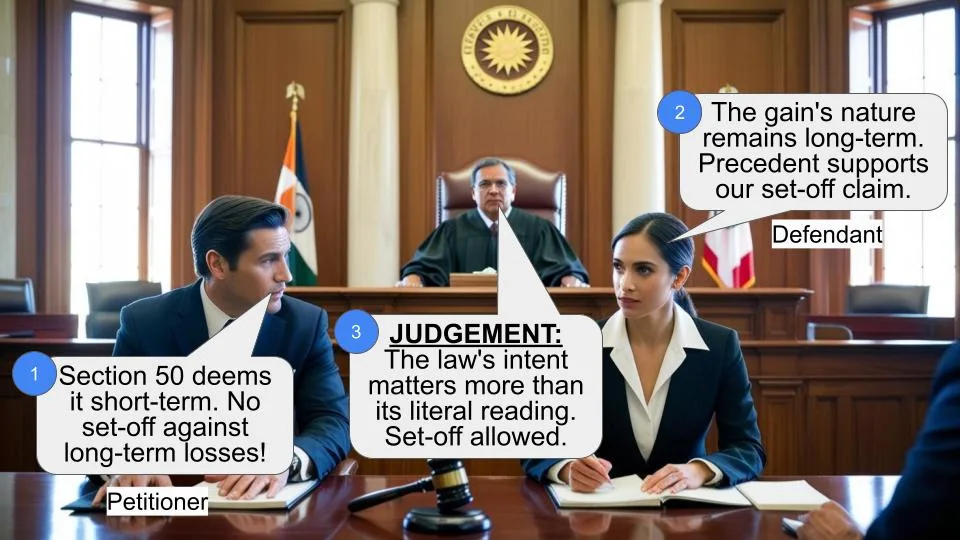
Capital Gains Set-Off: Tribunal Upholds Assessee’s Right
Capital Gains Set-Off: Tribunal Upholds Assessee’s Right
In the case of “Commissioner of Income Tax vs Parrys (Eastern) § Ltd.,” the court addressed whether capital gains from the sale of depreciable assets could be set off against long-term capital losses. The court upheld the Tribunal’s decision allowing the set-off, siding with the respondent-assessee.
Get the full picture - access the original judgement of the court order here
Case Name
Commissioner of Income Tax vs Parrys (Eastern) Pvt. Ltd. (High Court of Bombay)
Income Tax Appeal No. 2220 of 2013
Date: 18th February 2016
Key Takeaways
- The court confirmed that capital gains from depreciable assets, deemed short-term under Section 50 (of Income Tax Act, 1961), can be set off against long-term capital losses.
- The decision relied on the precedent set by “CIT v/s ACE Builders§Ltd” and “Komac Investments and Finance Pvt Ltd v/s Income Tax Officer.”
- The ruling clarifies the interpretation of Sections 50 and 74 of the Income Tax Act, 1961, emphasizing that the character of capital gains remains long-term for set-off purposes.
Issue
Can capital gains from the sale of depreciable assets, deemed short-term under Section 50 (of Income Tax Act, 1961), be set off against long-term capital losses under Section 74 (of Income Tax Act, 1961)?
Facts
- The respondent-assessee disclosed a deemed short-term capital gain of Rs.7.12 Crores from the sale of depreciable assets.
- The Assessing Officer disallowed the set-off against long-term capital losses, citing Section 74 (of Income Tax Act, 1961).
- The Commissioner of Income Tax (Appeals) allowed the set-off, referencing a prior court decision.
- The Tribunal upheld this decision, leading to the current appeal by the Revenue.
Arguments
- Revenue’s Argument: The Revenue argued that Section 74 (of Income Tax Act, 1961) prohibits setting off long-term capital losses against short-term capital gains.
- Assessee’s Argument: The assessee contended that the character of the capital gain remains long-term for set-off purposes, as supported by previous court decisions.
Key Legal Precedents
- CIT v/s ACE Builders§Ltd: This case established that the deeming fiction under Section 50 (of Income Tax Act, 1961) is limited to computation and does not alter the character of the gain for set-off purposes.
- Komac Investments and Finance Pvt Ltd v/s Income Tax Officer: Supported the view that the character of the gain remains long-term, allowing set-off against long-term losses.
Judgement
The court dismissed the Revenue’s appeal, affirming the Tribunal’s decision. It held that the capital gain, although deemed short-term under Section 50 (of Income Tax Act, 1961), retains its long-term character for set-off purposes under Section 74 (of Income Tax Act, 1961). The court found no substantial question of law to consider further.
FAQs
Q: What was the main legal question in this case?
A: Whether capital gains from depreciable assets, deemed short-term, can be set off against long-term capital losses.
Q: What sections of the Income Tax Act were central to this case?
A: Sections 50 and 74 of the Income Tax Act, 1961.
Q: What was the court’s decision?
A: The court upheld the Tribunal’s decision, allowing the set-off of capital gains against long-term losses.
Q: Why is this case significant?
A: It clarifies the interpretation of capital gains set-off rules, impacting how similar cases may be judged in the future.

1. This Appeal under Section 260-A (of Income Tax Act, 1961), 1961 (“Act”) challenges the order dated 13th February, 2013 passed by the Income Tax Appellate Tribunal (the Tribunal). The Assessment Year involved is A. Y. 2005-2006.
2 The Appellant urges the following questions of law, for our consideration:-
(1): Whether on the facts and in the circumstances of the case and in law, the Tribunal was justified in law in holding that capital gain arising from transfer of depreciable assets was liable to be set off against brought forward Long Term Capital Loss without appreciating that under section 50 (of Income Tax Act, 1961) such capital gain is treated as Short Term Capital Gain?
(2):Whether on the facts and in the circumstances of the case and in law the Tribunal was justified in law in holding that capital gain arising from transfer of depreciable assets was liable to be set off against brought forward Long Term Capital Loss without appreciating that according to Section 74 (of Income Tax Act, 1961) Long Term Capital Loss cannot be set off against the Short Term Capital Gain?
3 The respondent-assessee had for the subject assessment year inter alia disclosed an amount of Rs.7.12 Crores as deemed short term capital gain under Section 50 (of Income Tax Act, 1961). This deemed short term capital gain arose on account of the sale of depreciable assets. This deemed short term capital gain was set off against brought forward long term capital losses and unabsorbed depreciation. The Assessing Officer by his order dated 8th October, 2009 passed under Section 143(3) (of Income Tax Act, 1961) held that in view of Section 74 (of Income Tax Act, 1961), such set off on short term capital gain against the long term capital gain is not permitted. Thus, disallowed the set off of brought forward long term capital loss and unabsorbed depreciation against the deemed short term capital gain of Rs.7.12 Crores.
4 In appeal, the Commissioner of Income Tax(Appeals) ('CIT[A]') allowed the respondent's appeal holding that the issue stand concluded by the decision of this Court in the case of CIT v/s ACE Builders(P)Ltd reported in 281 ITR 210. On further appeal by the Revenue, the Tribunal by the impugned order upheld the order passed by the CIT(A). This by placing reliance upon the decision of this Court in the case of ACE Builders(P)Ltd(supra) and by following its own order in the case of Komac Investments and Finance Pvt Ltd v/s Income Tax Officer reported in 132 ITD 290.
5 Mr. Kotangale, learned counsel for the Revenue submits that in view of the clear mandate of Section 74 (of Income Tax Act, 1961), no set off of the carry forward long term capital loss against the deemed short term capital gain under Section 50 (of Income Tax Act, 1961) is permissible. In the above view, it is submitted that the appeal does raise substantial question of law and merits admission.
6 We find that the issue stands concluded by the decision of this Court in ACE Builders(P)Ltd(supra) in favour of the Respondent-Assessee. Moreover, the impugned order relies upon the order of the Tribunal in Komac Investments and Finance Pvt Ltd(supra) to dismiss the Revenue's appeal before it. The deeming fiction under Section 50 (of Income Tax Act, 1961) is restricted only to the mode of computation of capital gains contained in Sections 48 and 49 of the Act. It does not change the character of the capital gain from that of being a long term capital gain into a short term capital gain for purpose other than Section 50 (of Income Tax Act, 1961). Thus, the respondent - assessee was entitled to claim set off as the amount of Rs.7.12 Crores arising out of sale of depreciable assets which are admittedly on sale of assets held for a period to which long term capital gain apply. Thus for purposes of Section 74 (of Income Tax Act, 1961), the deemed short term capital gain continues to be long term capital gain. Moreover, it appears that the Revenue has accepted the decision the Tribunal in Komac Investments and Finance Pvt Ltd(supra), as our attention has not been drawn to any appeal being filed from that order.
7 In view of the above, the questions of law as framed stand concluded against the Revenue-appellant and in favour of Respondent-assessee by the decision of this Court in ACE Builders(P)Ltd (supra). Therefore, no substantial questions of law arise for consideration.
8 Accordingly, the appeal is dismissed. No order as to costs.
( B. P. COLABAWALLA, J.) (M. S. SANKLECHA, J.)
×
Similar Ripples
Questions
Capital Gains Set-Off: Tribunal Upholds Assessee’s Right
Write your CommentSimilar Posts

Generic
- Reportdata/3070.pdf
