


Court Upholds Tax Deduction Calculation Method for Export Profits


Full News
Court Upholds Tax Deduction Calculation Method for Export Profits
Court Upholds Tax Deduction Calculation Method for Export Profits
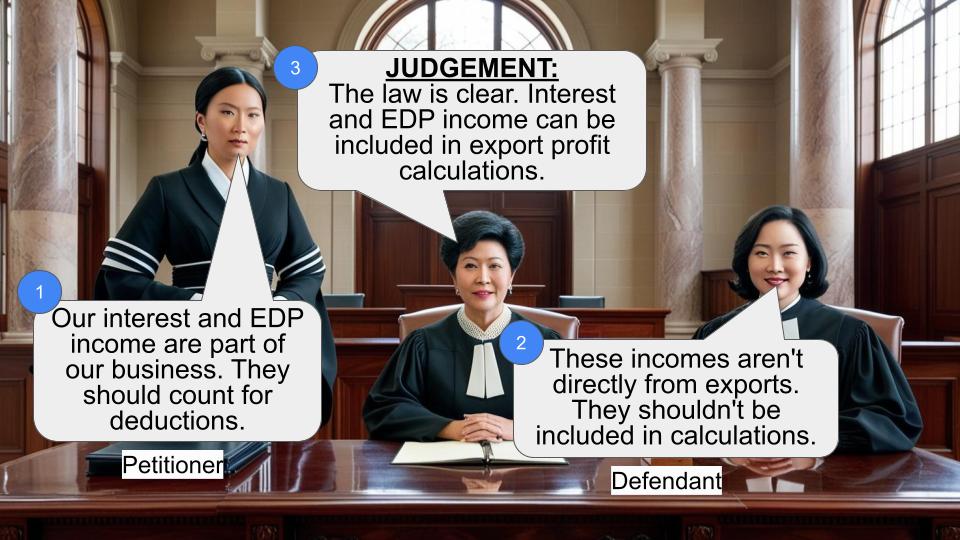
This case involves High Polymer Labs Ltd., an exporting company, and the Income Tax Department. The dispute centered around the calculation of deductions under Section 80HHC (of Income Tax Act, 1961), specifically regarding the treatment of interest income and EDP (Electronic Data Processing) receipts. The court ruled in favor of the assessee (High Polymer Labs Ltd.), affirming that certain incomes can be considered for deduction calculations under Explanation (baa) to Section 80HHC (of Income Tax Act, 1961).
Case Name**: CIT vs High Polymer Labs Ltd. (High Court)
**Key Takeaways**:
1. Only 90% of the net amount of receipts included in profits is deductible under Section 80HHC (of Income Tax Act, 1961).
2. Interest income and EDP receipts can be considered for deduction calculations if they're part of business income.
3. The court's interpretation of Explanation (baa) to Section 80HHC (of Income Tax Act, 1961) provides clarity on how to calculate deductions for export-oriented businesses.
**Issue**:
Was the Income Tax Appellate Tribunal correct in allowing the assessee to reduce interest paid on bank overdrafts from interest received on FDRs, and in including profit from EDP receipts while calculating deductions under Section 80HHC (of Income Tax Act, 1961)?
**Facts**:
1. High Polymer Labs Ltd. is a company engaged in exports.
2. For the assessment year 1996-97, they claimed deduction under Section 80HHC (of Income Tax Act, 1961).
3. The company included interest earned on FDRs (used to obtain credit facilities for exports) and EDP receipts from group companies in their income derived from exports.
4. The Assessing Officer initially disallowed these inclusions, reducing the deduction from Rs. 60,83,721 to Rs. 56,98,703.
5. The case went through appeals, reaching the High Court.
**Arguments**:
Assessee (High Polymer Labs Ltd.):
- Interest income from FDRs and EDP receipts should be considered as business income for deduction calculations.
- These incomes are related to their export business and should be included in the computation under Section 80HHC (of Income Tax Act, 1961).
Income Tax Department:
- These incomes are not directly derived from exports and should not be included in the deduction calculation.
- The income should be treated as "income from other sources" rather than business income.
**Key Legal Precedents**:
1. ACG Associated Capsules Pvt. Ltd. vs. Commissioner of Income Tax, Central-IV, Mumbai (2012) 3 SCC 321: This case provided interpretation of Explanation (baa) to Section 80HHC (of Income Tax Act, 1961), clarifying how to calculate deductions.
2. Distributors (Baroda) (P) Ltd. vs. Union of India (1986) 1 SCC 43: This earlier decision by a constitution bench was referenced in the ACG Associated Capsules case.
**Judgement**:
The court ruled in favor of the assessee, High Polymer Labs Ltd. Key points of the judgment include:
1. The interest earned on FDRs and EDP receipts are assessable under the head 'income from business', not 'income from other sources'.
2. While these incomes are not directly derived from exports, they can be considered for calculation of deductions under Explanation (baa) to Section 80HHC (of Income Tax Act, 1961).
3. Only 90% of the net amount of any receipt mentioned in clause (1) of Explanation (baa) that is actually included in the profits should be deducted for determining "profits of the business" under Section 80HHC (of Income Tax Act, 1961).
4. The court affirmed the Income Tax Appellate Tribunal's decision, allowing the assessee to reduce interest paid on bank overdrafts from interest received on FDRs and include profit from EDP receipts in the deduction calculation.
**FAQs**:
1. Q: What is Section 80HHC (of Income Tax Act, 1961)?
A: Section 80HHC (of Income Tax Act, 1961) provides for deductions on profits earned from the export of goods or merchandise.
2. Q: How does this judgment affect export-oriented businesses?
A: It clarifies how to calculate deductions under Section 80HHC (of Income Tax Act, 1961), potentially allowing businesses to include certain types of income in their deduction calculations.
3. Q: What are EDP receipts?
A: In this case, EDP (Electronic Data Processing) receipts refer to income received from group companies for the use of computers and office equipment.
4. Q: Does this mean all interest income can be included in export profit calculations?
A: Not necessarily. The judgment specifies that only income assessable under 'income from business' and related to the export business can be considered.
5. Q: How is the 90% rule applied in deduction calculations?
A: 90% of the net amount of qualifying receipts (after deducting related expenses) that are included in business profits should be deducted when calculating the profits eligible for deduction under Section 80HHC (of Income Tax Act, 1961).

In this appeal which pertains to assessment year 1996-97, the following two substantial questions of law were framed vide order dated 22.08.2006 :
“1) Whether the Income Tax Appellate Tribunal was correct in law in holding that the assessee is entitled to reduce interest paid by it on bank overdrafts from the interest received on FDRs while calculating deductions under Section 80HHC (of Income Tax Act, 1961) read with Explanation (baa) of the Income Tax Act, 1961.
2) Whether the Income Tax Appellate Tribunal was correct in law in holding that profit from the sale of EDP receipts under the duty remission scheme cannot be excluded from the profits of business as per Explanation (baa) for purposes of computing the deductions under Section 80HHC (of Income Tax Act, 1961).”
2. High Polymer Labs Ltd., the respondent-assessee is a company, which is engaged in exports. For the assessment year in question they had claimed deduction under Section 80HHC (of Income Tax Act, 1961) and for the purpose of computation had included (i) interest earned on FDRs which had been deposited with the bank to obtain credit facilities for the purpose of export and (ii) receipts from group companies/firms for use of computers called EDP receipts as income derived from exports.
3. The Assessing Officer did not treat the two receipts as income derived from exports and re-computed the deduction under Section 80HHC (of Income Tax Act, 1961), which got reduced from Rs.60,83,721/- to Rs.56,98,703/-.
4. The aforesaid finding recorded by the Assessing Officer were affirmed in the first appeal by the Commissioner of Income Tax (Appeals). The Commissioner of Income Tax (Appeals) further held that the income by way of interest was not income derived from exports and even netting of interest income for the purpose of Explanation (baa) to Section 80HHC (of Income Tax Act, 1961) was not permissible. He held that EDP receipts cannot form part of business income and should be treated as „income from other sources‟.
5. On further appeal, the Tribunal has held that the two incomes have to be taken into consideration for the purpose of Explanation (baa) to Section 80HHC (of Income Tax Act, 1961). Finding recorded is that the interest earned on FDR, which was placed with the bank for the purpose of export trade were assessable under the head „income from business‟. With regard to the EDP income also it has been held that this income was chargeable under the head „income from business‟ as the group companies had utilized computers and office equipment belonging to the respondent-assessee.
6. Thus, both interest income and income from EDP it has been held are assessable under the head „income from business‟ and not under the head „income from other sources‟. To this extent, finding of the Tribunal is clear and lucid.
7. There is no doubt that the two incomes are not derived from exports but this aspect is not required to be examined by us. The assessee has also accepted the said position. The only question, raised is whether these two incomes can be taken into consideration while applying Explanation (baa) to Section 80HHC (of Income Tax Act, 1961). The issue is no longer in dispute and has been answered in the case of ACG Associated Capsules Pvt. Ltd. Vs. Commissioner of Income Tax, Central-IV, Mumbai (2012) 3 SCC 321. In this decision, it has been held :-
“11. Before we deal with the contentions of learned counsel for the parties, we may extract Explanation (baa) to Section 80HHC (of Income Tax Act, 1961) :
“Explanation.- For the purposes of this section,- (baa) “profits of the business” means the profits of the business as computed under the head „Profits and Gains of Business or Profession‟ as reduced by-
(1) ninety per cent of any sum referred to in clauses (iii-a), (iii-b), (iii-c), (iii-d) and (iii-e) of Section 28 (of Income Tax Act, 1961) or of any receipts by way of brokerage, commission, interest, rent, charges or any other receipt of a similar nature included in such profits; and
(2) the profits of any branch, office, warehouse or any other establishment of the assessee situate outside India;”
12. Explanation (baa) extracted above states that “profits of the business” means the profits of the business as computed under the head “Profits and Gains of Business or Profession” as reduced by the receipts of the nature mentioned in clauses (1) and (2) of the Explanation (baa). Thus, profits of the business of an assessee will have to be first computed under the head “Profits and Gains of Business or Profession” in accordance with provisions of Section 28 (of Income Tax Act, 1961) to 44-D of the Act. In the computation of such profits of business, all receipts of income which are chargeable as profits and gains of business under Section 28 (of Income Tax Act, 1961) will have to be included. Similarly, in computation of such profits of business, different expenses which are allowable under Sections 30 (of Income Tax Act, 1961) to 44-D have to be allowed as expenses. After including such receipts of income and after deducting such expenses, the total of the net receipts are profits of the business of the assessee computed under the head “Profits and Gains of Business or Profession” from which deductions are to made under clauses (1) and (2) of Explanation (baa).
13. Under Clause (1) of Explanation (baa), ninety per cent of any receipts by way of brokerage, commission, interest, rent, charges or any other receipt of a similar nature included in any such profits are to be deducted from the profits of the business as computed under the head “Profits and Gains of Business or Profession”. The expression “included any such profits” in clause (1) of the Explanation (baa) would mean only such receipts by way of brokerage, commission, interest, rent, charges or any other receipt which are included in the profits of the business as computed under the head “Profits and Gains of Business or Profession”. Therefore, if any quantum of the receipts by way of brokerage, commission, interest, rent, charges or any other receipt of a similar nature is allowed as expenses under Sections 30 (of Income Tax Act, 1961) to 44-D of the Act and is not included in the profits of business as computed under the head “Profits and Gains of Business or Profession”, ninety per cent of such quantum of receipts cannot be reduced under Clause (1) of Explanation (baa) from the profits of the business. In other words, only ninety per cent of the net amount of any receipt of the nature mentioned in clause (1) which is actually included in the profits of the assessee is to be deducted from the profits of the assessee for determining “profits of the business” of the assessee under Explanation (baa) to Section 80-HHC (of Income Tax Act, 1961).”
8. The Supreme Court in this case also referred to the earlier decision of the constitution bench in Distributors (Baroda) (P) Ltd. Vs. Union of India (1986) 1 SCC 43 and thereafter observed in para 16 and 17 as follows :
“16. Similarly, Explanation (baa) has to be construed on its own language and as per the plain natural meaning of the words used in Explanation (baa), the words “receipts by way of brokerage, commission, interest, rent, charges or any other receipt of a similar nature included in such profits” will not only refer to the nature of receipts but also the quantum of receipts included in the profits of the business as computed under the head “Profits and Gains of Business or Profession” referred to in the first part of the Explanation (baa). Accordingly, if any quantum of any receipt of the nature mentioned in clause (1) of Explanation (baa) has not been included in the profits of business of an assessee as computed under the head “Profits and Gains of Business or Profession”, ninety per cent of such quantum of the receipt cannot be deducted under Explanation (baa) to Section 80-HHC (of Income Tax Act, 1961).
17. If we now apply Explanation (baa) as interpreted by us in this judgment to the facts of the case before us, if the rent or interest is a receipt chargeable as profits and gains of business and chargeable to tax under Section 28 (of Income Tax Act, 1961), and if any quantum of the rent or interest of the assessee is allowable as an expense in accordance with Sections 30 to 44-D of the Act and is not to be included in the profits of the business of the assessee as computed under the head “Profits and Gains of Business or Profession”, ninety per cent of such quantum of the receipt of rent or interest will not be deducted under clause (1) of Explanation (baa) to Section 80-HHC (of Income Tax Act, 1961). In other words, ninety per cent of not the gross rent or gross interest but only the net interest or net rent, which has been included in the profits of business of the assessee as computed under the head “Profits and Gains of Business or Profession”, is to be deducted under clause (1) of Explanation (baa) to Section 80-HHC (of Income Tax Act, 1961) for determining the profits of the business.”
9. In view of the aforesaid position, the questions of law mentioned above are answered in affirmative, in favour of the assessee and against the Revenue. The appeal is disposed of. No order as to costs.
SANJIV KHANNA, J.
R.V.EASWAR, J.
APRIL 19, 2012
×
Questions
Court Upholds Tax Deduction Calculation Method for Export Profits
Write your CommentSimilar Posts



Generic
- Reportdata/5909.pdf
