


Court Upholds Tax Disallowance: Assessing Officer's Satisfaction Deemed Suffici…


Full News
Court Upholds Tax Disallowance: Assessing Officer's Satisfaction Deemed Sufficient
Court Upholds Tax Disallowance: Assessing Officer's Satisfaction Deemed Sufficient
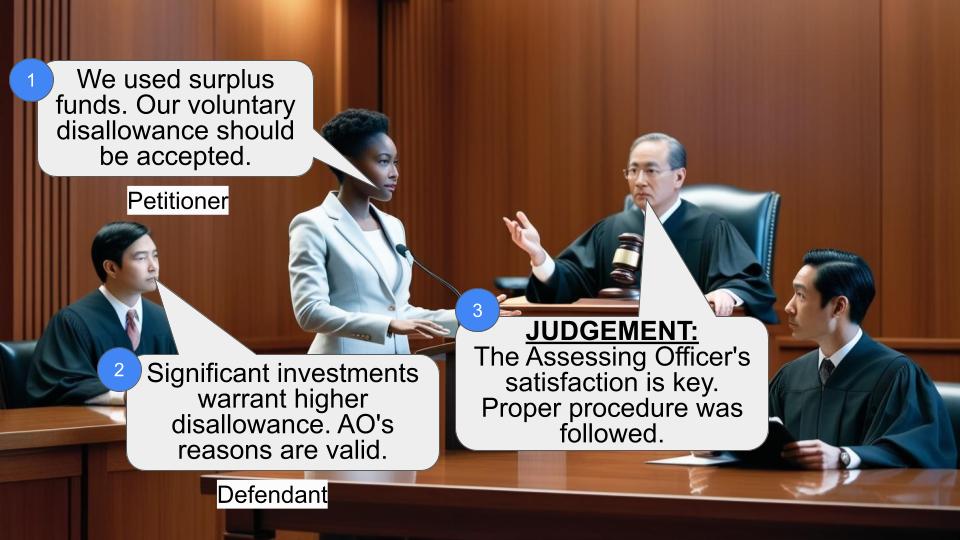
This case is about a company called M/S.FLSMIDTH PVT. LTD. that was fighting against the Deputy Commissioner of Income Tax. The main issue was about how much money should be disallowed under a specific tax rule (Section 14A (of Income Tax Act, 1961)). The court ended up siding with the tax department, saying that the Assessing Officer had done their job properly in deciding how much to disallow.
Get the full picture - access the original judgement of the court order here
Case Name:
M/s.Flsmidth Pvt. Ltd Vs Deputy Commissioner of Income Tax (High Court of Madras)
Tax Case Appeal No.431 of 2018
Date: 22nd July 2020
Key Takeaways:
1. The Assessing Officer's satisfaction regarding tax disallowance is crucial and must be based on the assessee's accounts.
2. The court emphasized the importance of following proper procedures under Section 14A(2) (of Income Tax Act, 1961).
3. Voluntary disallowance by a company doesn't automatically mean the tax department has to accept it.
Issue:
The main question here was: Did the Income Tax Appellate Tribunal make the right call in confirming the Assessing Officer's disallowance under Section 14A (of Income Tax Act, 1961), even though the company had voluntarily disallowed some amount?
Facts:
- M/S.FLSMIDTH PVT. LTD. is a manufacturing company.
- For the 2009-10 assessment year, they filed a return showing a total income of Rs.2,00,46,53,580/-.
- They had investments in shares and mutual funds worth Rs.1,32,39,84,480/- and earned dividend income of Rs.11,48,08,342/-.
- The company voluntarily disallowed Rs.1,44,000/- as expenses for earning this exempt income.
- The Assessing Officer wasn't satisfied with this and increased the disallowance to Rs.52,72,554/-.
Arguments:
The company's side:
- They said they only used surplus funds for investments, so they didn't incur much expense.
- They argued that the Assessing Officer didn't properly record why he wasn't satisfied with their voluntary disallowance.
The tax department's side:
- They said the company's investments were significant, and more expenses should be attributed to earning that income.
- They argued that the Assessing Officer did record proper reasons for not accepting the company's calculation.
Key Legal Precedents:
The judgment mentions several important cases, including:
1. Maxopp Investment Ltd. Vs. CIT, New Delhi [(2018) 402 ITR 640]
2. Godrej & Boyce Manufacturing Co. Ltd. Vs. DCIT [(2017) 81 Taxmann.com 111]
3. PCIT-3, Mumbai Vs. Reliance Capital Asset Management Ltd. [(2018) 400 ITR 217]
4. PCIT-2 Vs. Bombay Stock Exchange Ltd. [(2020) 113 Taxmann. Com 303]
These cases were discussed in relation to how an Assessing Officer should record their satisfaction before applying Rule 8D (of Income Tax Rules, 1962).
Judgement:
The court sided with the tax department. They said:
1. The Assessing Officer did record proper reasons for not accepting the company's voluntary disallowance.
2. The Officer considered the company's accounts and explanation before deciding to apply Rule 8D (of Income Tax Rules, 1962).
3. The court found that the Assessing Officer followed the correct procedure under Section 14A(2) (of Income Tax Act, 1961).
FAQs:
1. Q: What's the significance of Section 14A (of Income Tax Act, 1961)?
A: It's about disallowing expenses related to income that's not taxable.
2. Q: Why didn't the court accept the company's voluntary disallowance?
A: The court felt that the Assessing Officer had valid reasons to believe the voluntary disallowance was too low.
3. Q: What's Rule 8D (of Income Tax Rules, 1962) all about?
A: It's a method for calculating how much expense should be disallowed under Section 14A (of Income Tax Act, 1961) when the tax officer isn't satisfied with the assessee's calculation.
4. Q: Does this mean companies can't decide how much to voluntarily disallow?
A: They can, but the tax department has the right to question it if they think it's not enough.
5. Q: What's the main lesson for companies from this judgment?
A: Companies should be prepared to justify their calculations for voluntary disallowances, as the tax department can scrutinize and potentially increase them.

We have heard Ms.Sri Niranjani, learned counsel and Mr.G.Baskar, learned counsel appearing for the appellant – assessee and Mr.Karthik Ranganathan, learned Senior Standing Counsel assisted by Mr.S. Rajesh, learned Junior Standing Counsel appearing for the respondent – Revenue.
2. This appeal by the Revenue under Section 260A (of Income Tax Act, 1961), 1951 (for short, the Act) is directed against the order dated 20.3.2018 made in ITA.No.2087/Chny/2017 on the file of the Income Tax Appellate Tribunal, Chennai ‘D’ Bench (for brevity, the Tribunal) for the assessment year 2009-10.
3. The appeal has been admitted on 10.8.2018 on the following substantial question of law :
“Whether, on facts and in the circumstances of the case, the Income Tax Appellate Tribunal was right in law in confirming the disallowance made by the Assessing Officer under Section 14A (of Income Tax Act, 1961) in the absence of any cogent satisfaction for disregarding the voluntary disallowance made by the appellant ?
4. The assessee, which is a manufacturing company, filed its return of income on 30.9.2009 for the assessment year 2009-10 admitting a total income of Rs.2,00,46,53,580/-. The return was processed under Section 143(1) (of Income Tax Act, 1961). Subsequently, a revised return was filed on 28.3.2011 declaring a total income of Rs.2,02,56,55,520/- and the same was processed on 31.3.2012. A demand of Rs.91,86,31,420/- was raised. In the meanwhile, the case was selected for scrutiny and a notice under Section 143(2) (of Income Tax Act, 1961) dated 23.8.2010 was issued to the assessee.
5. The Assessing Officer, among other issues, considered the disallowance under Section 14A (of Income Tax Act, 1961) read with Rule 8D (of Income Tax Rules, 1962) (for short, the Rules). The assessee held investments in shares and mutual funds to the tune of Rs.1,32,39,84,480/- and earned a dividend income to the tune of Rs.11,48,08,342/- from such investments and claimed the entire amount as exempt. The assessee, on their own accord, debited an amount of Rs.1,44,000/- as expenditure for earning the exempt income, which was disallowed under Section 14A (of Income Tax Act, 1961) in the income computation statement.
6. The Assessing Officer, noting the quantum of investments held by the assessee and the dividend income earned from such investments, was, prima facie, not satisfied with the working provided by the assessee for arriving at the disallowance under Section 14A (of Income Tax Act, 1961). Therefore, a show cause notice was issued to the assessee calling upon them to explain as to why Rule 8D (of Income Tax Rules, 1962) should not be invoked to compute the expense attributable for earning exempt income. The assessee, vide letter dated 18.12.2012, stated that the dividend income was earned from investments in mutual funds, which were made from the surplus funds available with the company, that only salary cost of personnel involved in buying and selling of mutual funds amounting to Rs.1,44,000/- was incurred for earning such dividend income and that therefore, the same was disallowed under Section 14A (of Income Tax Act, 1961).
7. The Assessing Officer was not convinced with the explanation offered by the assessee and held that a portion of managerial remuneration and directors’ remuneration should also be attributed towards the dividend earning activity by the assessee. Accordingly, Rule 8D (of Income Tax Rules, 1962) was pressed into service and a disallowance of Rs.52,72,554/- was made.
8. Aggrieved by the order of assessment dated 27.3.2013, the assessee preferred an appeal before the Commissioner of Income Tax (Appeals)-9, Chennai-34 [hereinafter called the CIT(A)]. The assessee contended that Section 14A (of Income Tax Act, 1961) read with Rule 8D (of Income Tax Rules, 1962) had no application to the assessee’s case, that what were invested were surplus funds generated from the business activity of the assessee and that the assessee had not incurred any other cost apart from the amounts specified in the return filed. The CIT(A) was not convinced with the contentions advanced by the assessee and accordingly dismissed the appeal by order dated 30.5.2017 and confirmed the findings of the Assessing Officer. With regard to other issues, the appeal filed by the assessee was partly allowed, as against which, the Revenue filed an appeal before the Tribunal. In that, the assessee filed a cross objection with regard to disallowance under Section 14A (of Income Tax Act, 1961).
9. The Tribunal considered the submissions of the assessee and found that the disallowance as computed by the Assessing Officer by applying the formula under Rule 8D(2)(iii) (of Income Tax Rules, 1962) did not call for any interference. Ultimately, both the appeal filed by the Revenue as well as the cross objection filed by the assessee stood dismissed by the impugned order dated 20.3.2018. As against the order of dismissal, the assessee alone is before us.
10. The questions to be decided by us in this appeal are as to whether the disallowance made by the Assessing Officer was proper and as to whether the assessee was right in contending that there were no cogent reasons recorded by the Assessing Officer with regard to his satisfaction as to the correctness of the voluntary disallowance made by the assessee.
11. Both the learned counsel appearing for the assessee have drawn the attention of this Court to the findings recorded by the Assessing Officer, the CIT(A) and the Tribunal and submit that the satisfaction of the Assessing Officer has to be objectively arrived at on the basis of the accounts and after considering all the relevant facts and circumstances. The method prescribed under Rule 8D (of Income Tax Rules, 1962) would be applicable only when the claim made by the assessee, in respect of the expenditure, which is relatable to the earning of income and which does not form part of the total income under the Act, is found to be incorrect.
12. It is further submitted by the learned counsel for the assessee that the non satisfaction with the disallowance offered by the assessee has to be arrived at on the basis of the accounts submitted by the assessee. It is also submitted that in the instant case, all that the Assessing Officer had done is a guess work and he did not record a conclusion as to why he was not satisfied with the disallowance offered by the assessee.
13. In support of their contention, the learned counsel for the assessee have relied upon the decisions
(i) of the Hon’ble Supreme Court in the case of Maxopp Investment Ltd. Vs. CIT, New Delhi [reported in (2018) 402 ITR 640];
(ii) of the Hon’ble Supreme Court in the case of Godrej & Boyce Manufacturing Co. Ltd. Vs. DCIT [reported in (2017) 81 Taxmann.com 111];
(iii) of the Bombay High Court in the case of PCIT-3, Mumbai Vs. Reliance Capital Asset Management Ltd. [reported in (2018) 400 ITR 217]; and
(iv) of the Bombay High Court in the case of PCIT-2 Vs. Bombay Stock Exchange Ltd. [reported in (2020) 113 Taxmann. Com 303].
14. Therefore, it is submitted by both the learned counsel for the assessee that concurrently all the three authorities erroneously applied the provisions of Rule 8D (of Income Tax Rules, 1962) without recording satisfaction, which is mandated under Section 14A(2) (of Income Tax Act, 1961). They, while explaining the nature of transaction done by the assessee, have referred to the statement of accounts and submitted that the surplus funds available with the assessee are being invested in mutual funds and the expenditure incurred has been rightly arrived at and nothing more was incurred by the assessee. It is further submitted that the Assessing Officer committed an error, which goes to the root of the matter and prayed for setting aside the order passed by the Tribunal as well as the Authorities below.
15. Per contra, Mr.Karthik Ranganathan, learned Senior Standing Counsel assisted by Mr.S.Rajesh, learned Junior Standing Counsel appearing for the Revenue submits that the satisfaction should be recorded by the Assessing Officer in terms of Section 14A(2) (of Income Tax Act, 1961) in regard to the assets of the assessee and with regard to the correctness of the claim made by the assessee in respect of such expenditure in relation to income, which does not form part of total income.
16. To explain the subtle difference between satisfaction to be recorded by the Assessing Officer under Section 14A(2) (of Income Tax Act, 1961) and satisfaction to be recorded under Section 145(3) (of Income Tax Act, 1961) as quite distinct, Section 145(3) (of Income Tax Act, 1961) is referred to. It is submitted by the learned Senior Standing Counsel appearing for the Revenue that the decisions relied upon by the learned counsel appearing for the assessee would not apply to the facts of the case, because, in those cases, the Assessing Officer straight away resorted to the computation machinery provided under Rule 8D (of Income Tax Rules, 1962) without recording satisfaction under Section 14A(2) (of Income Tax Act, 1961) whereas in the case on hand, the Assessing Officer recorded satisfaction, which has been confirmed by the CIT(A) as well as the Tribunal and therefore, there is no error in the decision making process by the Assessing Officer or the decision itself. With the above submissions, the learned Senior Standing Counsel appearing for the Revenue has prayed for sustaining the decision of the Tribunal and answering the question against the assessee.
17. We have carefully considered the submissions of the learned counsel on either side.
18. Now, what we are required to examine is as to whether such a satisfaction has been arrived at by the Assessing Officer having regard to the suo motu disallowance claimed by the assessee in the context of its accounts. Further, what we will have to examine is the factual position.
19. As noticed above, the assessee was issued a show cause notice calling upon them to explain as to why the provisions of Rule 8D (of Income Tax Rules, 1962) should not be invoked to compute the expenses attributable for earning exempt income. While issuing the show cause notice, the Assessing Officer, prima facie, recorded his dis-satisfaction,which is evident from a reading of the assessment order wherein the Assessing Officer stated that he was not satisfied with the quantum of expenses claimed by the assessee as attributable for earning exempt income.
20. In other words, issuance of show cause notice calling upon the assessee to explain pre-supposes a prima facie opinion formed by the Assessing Officer with regard to the accounts of the assessee.
Therefore, once a show cause notice is issued, the assessee is informed about the prima facie view of the Assessing Officer. However, the Assessing Officer cannot have a closed mind while issuing a show cause notice. The assessee rightly understood the prima facie opinion formed by the Assessing Officer with regard to the expenses claimed by the assessee attributable for earning exempt income and precisely for such a reason, the assessee submitted a reply dated 18.12.2012. In the said reply, the assessee took a stand that they incurred expenses of Rs.1,44,000/- being cost of personnel involved in buying and selling of mutual funds.
21. The Assessing Officer examined the said submission of the assessee having regard to the accounts of the assessee and rejected the stand taken by the assessee. The reasons are contained in paragraph 5.3 of the impugned order, which we quote for easy reference, as hereunder :
“The assessee’s submissions were carefully considered. Though the assessee is not in the business of making investments in shares, the assessee keeps more than 1/3rd of its assets in the form of investments. As seen from the balance sheet as on 31.3.2009, the total value of assets is Rs.514,25,32,150/-, out of which, investments are held to the tune of Rs.132,39,84,480/-. Considering the volume of investments held by the assessee and the amount of exempted income earned out of it and the management skill required to maintain such investment portfolio, the quantum of expenditure computed by the assessee is not acceptable. Further, the assessee incurs routine expenditure to maintain its establishment and towards administration, a portion of which can be attributed towards the activity of earning dividend. The assessee also incurs managerial remuneration and claims the whole of the same as an expenditure. The managerial staff and the directors are involved in making decisions on investments. Such being the case, a portion of this managerial remuneration and directors remuneration should also be attributed towards the dividend earning activity by the assessee.”
22. The Assessing Officer noted the details, which obviously have been culled out from the books of accounts and other records placed by the assessee namely that (i) the assessee was not in the business of investment in shares; (ii) more than 1/3rd assets of the assessee were in the form of investments; and (iii) the total value of assets was Rs.514,25,32,150/-, from which, the investments were to the tune of Rs.132,39,84,480/-. Thus, taking note of the volume of investments held by the assessee and the amount of exempt income earned, the Assessing Officer came to the conclusion that managerial skill is required to maintain such investment portfolio and that the quantum of expenditure computed by the assessee was not acceptable. Further, the Assessing Officer examined the materials placed before him and pointed out that the assessee incurred routine expenditure to maintain its establishment and towards administration, a portion of which could be attributed towards the activity of earning of dividend.
23. The Assessing Officer noted that the assessee also incurred managerial remuneration and claimed whole of the same as an expenditure. Therefore, he concluded that a portion of the managerial remuneration and directors’ remuneration should also be attributed towards dividend earning activity by the assessee. Thus, in our considered view, the Assessing Officer recorded his satisfaction having regard to the accounts of the assessee.
24. Obviously, we cannot expect the Assessing Officer to write a judgment. The correctness of the findings of the Assessing Officer was tested by the CIT(A). The assessee argued that the mutual funds were entirely managed by the fund managers, that only a minimum management was required by the investor and that the assessee made a rational estimate of time spent and other related administration cost in the management of the investments and accordingly made a voluntary disallowance of Rs.1,44,000/-. The CIT(A), after pointing out that as per the working given by the assessee, the time spent in a year was 3 days, 9 days and 17 days for senior, manager and subordinates respectively. But, the assessee did not even enclose the profit and loss account to verify the salary cost was correctly taken. Further, the CIT(A) noted that the disallowance of Rs.1,44,000/- was meagre when compared to dividend income earned by the assessee on the investment.
25. Further, the CIT(A) considered as to whether the Assessing Officer recorded reasons before invoking the procedure under Rule 8D (of Income Tax Rules, 1962) and found that the Assessing Officer recorded reasons. Further, the decision of the Punjab and Haryana High Court cited by the assessee in the case of CIT Vs. Hero Cycles Ltd. [reported in 189 Taxman 50] was distinguished; so also the decision of the Chennai Bench of the Tribunal of in the case of Allied Investments Housing P. Ltd. Vs. DCIT [ITA.No.305/Mds/2013] and it was held that the Assessing Officer recorded reasons and the sum disallowed in comparison to the investment was not adequate.
26. The other decisions of the Delhi Bench of the Tribunal in the case of Minda Investments Ltd. Vs. DCIT [ITA.No.4046/Del/ 2009] and in the case of DCIT Vs. Jindal Photo Ltd. [ITA.No. 814/2011] were also distinguished. By referring to the decision of the Chennai Bench of the Tribunal in the case of Visual Graphics Computer Services India (P) Ltd. [reported in (2012) 21 Taxmann.com 145], the CIT(A) held that no income was gratuitous, that every income was earned after incurring certain expense and that a reasonable portion of management expenditure should be attributed to earning of dividend income. The CIT(A) also referred to the decision of the Chennai Bench of the Tribunal in the case of Southern Petrochemical Industries Vs. DCIT [reported in 93 TTJ (Chennai) 161] wherein it was held that the investment decisions were very strategic decisions, in which, top management was involved and that therefore, proportionate management expenses were required to be deducted while computing the exempt income from dividend. A reference was also made to the decision of the Mumbai Bench of the Tribunal in the case of ACIT-10(1) Vs. Citi Corp Finance (India) Ltd. [ITA.No.5832/Mum/2003 (AY 2000-01) dated 27.11.2006]. With these reasons, the CIT(A) affirmed the view taken by the Assessing Officer.
27. The assessee, in their cross objections filed before the Tribunal, reiterated their earlier stand that the Assessing Officer nowhere recorded satisfaction and that the disallowance made was not sufficient.
28. The correctness of such a stand was independently tested by the Tribunal. We find from the impugned order that the assessee filed a calculation sheet as to how they computed Rs.1,44,000/-. After referring to the same, the Tribunal pointed out that there was nothing available on record to show as to how the assessee estimated the time spent per day by a senior manager as five minutes and manager as fifteen minutes for managing to the tune of Rs.1,32,39,84,480/-. The Tribunal noted that the salary cost mentioned in the tabulated statement was only an approximation without any scientific basis. Further, noting the decision in the case of Godrej & Boyce Manufacturing Company Ltd., the Tribunal held that the Assessing Officer recorded satisfaction.
29. As mentioned above, in the preceding paragraph, we held that the Assessing Officer considered the explanation offered by the assessee vide letter dated 18.12.2012 and recorded his satisfaction as to how the disallowance voluntarily made by the assessee was not acceptable. Hence, we find that the Assessing Officer had rightly followed the procedure under Section 14A(2) (of Income Tax Act, 1961) and only thereafter, recorded his dis-satisfaction on the correctness of the claim made by the assessee and having regard to the accounts of the assessee, proceeded to follow the procedure under Rule 8D (of Income Tax Rules, 1962). Hence, we find that there is full compliance of what is required to be done by the Assessing Officer as pointed out by the Hon’ble Supreme Court in the case of Maxopp Investment Ltd. For the above reasons, we hold that the assessee has not made out a case for interference in the order passed by the Tribunal.
30. Accordingly, the above tax case appeal is dismissed. The substantial question of law framed is answered against the assessee. No costs.
T.S.SIVAGNANAM, J
AND
V.BHAVANI SUBBAROYAN, J
×
Similar Ripples
Questions
Court Upholds Tax Disallowance: Assessing Officer's Satisfaction Deemed Sufficient
Write your CommentSimilar Posts


Generic
- Reportdata/6214.pdf
