


Court Upholds Tax Disallowance, Orders Partial Deduction for Paid Interest


Full News
Court Upholds Tax Disallowance, Orders Partial Deduction for Paid Interest
Court Upholds Tax Disallowance, Orders Partial Deduction for Paid Interest
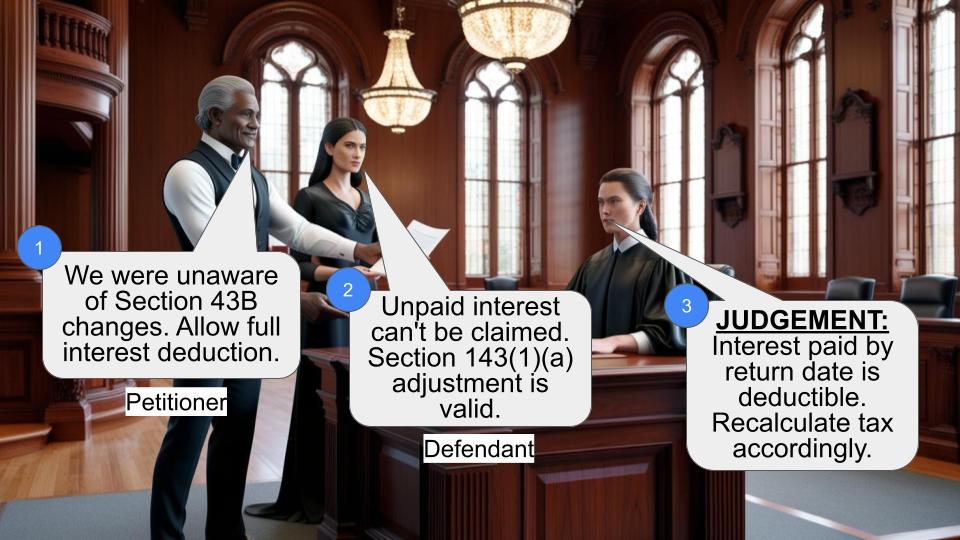
This case involves a dispute between the Commissioner of Income Tax and Mayflower Hotels (P) Ltd. The main issue was the disallowance of interest deduction under Section 43B (of Income Tax Act, 1961). The court partially allowed the appeal, upholding the tax authority's right to disallow unpaid interest but directing them to allow deduction for interest paid by the return filing date.
Get the full picture - access the original judgement of the court order here
Case Name:
Commissioner of Income Tax Vs Mayflower Hotels (P) Ltd (High Court of Kerala)
ITA. No. 128 of 2001
Date: 30th January 2008
Key Takeaways:
1. The Assessing Officer (AO) can make prima facie adjustments under Section 143(1)(a) (of Income Tax Act, 1961) for disallowances under Section 43B (of Income Tax Act, 1961).
2. Interest payable to financial institutions must be actually paid to claim deduction under Section 43B (of Income Tax Act, 1961).
3. Partial deduction is allowed for interest paid up to the date of filing the tax return.
4. Additional tax under Section 143(1A) (of Income Tax Act, 1961) should be recalculated based on the allowed deduction.
Issue:
Was the Assessing Officer justified in disallowing interest not paid to a financial institution under Section 43B (of Income Tax Act, 1961) in proceedings under Section 143(1)(a) (of Income Tax Act, 1961), and if so, to what extent?
Facts:
1. Mayflower Hotels (P) Ltd. claimed a deduction of Rs.16,60,165/- for interest payable to KSIDC in their tax return.
2. The amount was not paid due to an installment facility granted by KSIDC.
3. The Assessing Officer disallowed the claim under Section 43B (of Income Tax Act, 1961) and issued proceedings under Section 143(1)(a) (of Income Tax Act, 1961).
4. The assessee's rectification application under Section 154 (of Income Tax Act, 1961) was dismissed.
5. The first appellate authority allowed the assessee's appeal, which was upheld by the Tribunal.
6. The department filed this appeal against the Tribunal's order.
Arguments:
Department's Argument:
- The proceedings under Section 143(1)(a) (of Income Tax Act, 1961) were justified based on the decision in COMMISSIONER OF INCOME TAX V. SITARAM TEXTILES LTD.
Assessee's Arguments:
- The financial institution (KSIDC) was only covered under Section 43B (of Income Tax Act, 1961) from 1.4.1991, and the assessee was unaware of this provision.
- Part payment was made on 25.6.1991, which should qualify for deduction under the proviso to Section 43B (of Income Tax Act, 1961).
Key Legal Precedents:
COMMISSIONER OF INCOME TAX V. SITARAM TEXTILES LTD. (2001) 248 ITR 139 - This case supported the department's position that proceedings under Section 143(1)(a) (of Income Tax Act, 1961) were justified for disallowances under Section 43B (of Income Tax Act, 1961).
Judgement:
1. The court partially allowed the appeal, reversing the Tribunal's order.
2. The Assessing Officer was justified in initiating proceedings under Section 143(1)(a) (of Income Tax Act, 1961) to disallow expenditure under Section 43B (of Income Tax Act, 1961).
3. However, the court directed the officer to allow deduction for interest paid up to the date of filing the return.
4. The additional tax liability under Section 143(1A) (of Income Tax Act, 1961) was to be recalculated based on the allowed deduction.
FAQs:
Q1: What was the main issue in this case?
A1: The main issue was whether the Assessing Officer could disallow interest deduction under Section 43B (of Income Tax Act, 1961) through proceedings under Section 143(1)(a) (of Income Tax Act, 1961), and to what extent this disallowance was justified.
Q2: Why was the interest deduction initially disallowed?
A2: The interest was not paid to KSIDC (a financial institution) due to an installment facility, making it ineligible for deduction under Section 43B (of Income Tax Act, 1961).
Q3: What was the court's final decision?
A3: The court partially allowed the appeal, upholding the tax authority's right to disallow unpaid interest but directing them to allow deduction for interest paid by the return filing date.
Q4: How does this judgment affect the calculation of additional tax?
A4: The additional tax under Section 143(1A) (of Income Tax Act, 1961) must be recalculated based on the allowed deduction for interest paid up to the return filing date.
Q5: What precedent did this case rely on?
A5: The case relied on COMMISSIONER OF INCOME TAX V. SITARAM TEXTILES LTD. (2001) 248 ITR 139, which supported the use of Section 143(1)(a) (of Income Tax Act, 1961) for disallowances under Section 43B (of Income Tax Act, 1961).

1. The appeal is filed against Annexure-C order of the Tribunal whereunder the Tribunal has cancelled the intimation issued under Section 143(1)(a) (of Income Tax Act, 1961) including the demand of additional tax under Section 143(1A) (of Income Tax Act, 1961). In the return filed even though the assessee claimed deduction of Rs.16,60,165/- towards interest payable to KSIDC, it is made clear that the amount was not paid on account of instalment facility granted by KSIDC. Consequently the claim was not allowable by virtue of Section 43B (of Income Tax Act, 1961). The assessee does not dispute this position. Since the claim was prima facie inadmissible by virtue of operation of Section 43B (of Income Tax Act, 1961), the Assessing Officer issued proceedings under Section 143(1)(a) (of Income Tax Act, 1961) computing tax liability including additional tax payable under Section 143(1A) (of Income Tax Act, 1961). Even though rectification application was filed against this under Section 154 (of Income Tax Act, 1961), the same was dismissed by the officer. Appeal filed, however, was allowed by the first appellate authority and the second appeal filed by the department was also dismissed by the Tribunal. It is against this order of the Tribunal that the department has filed this appeal.
We have heard Standing Counsel appearing for the department-appellant and counsel appearing for the respondent-assessee.
2. Counsel for the appellant referred to decision of this court in COMMISSIONER OF INCOME TAX V. SITARAM TEXTILES LTD.
(2001) 248 ITR 139 and contended that proceedings initiated under Section 143(1)(a) (of Income Tax Act, 1961) is perfectly justified. We find that the decision squarely applies to the facts of this case because in the proceedings under Section 143(1)(a) (of Income Tax Act, 1961) the Officer has only disallowed expenditure under Section 43B (of Income Tax Act, 1961). Consequently the assessee is liable to pay additional tax under Section 143(1A) (of Income Tax Act, 1961). Counsel for the respondent-assessee submitted that the financial institution involved in this case is covered under Section 43B (of Income Tax Act, 1961) only with effect from 1.4.1991. According to him, even though the amendment applies for this year also, the assessee was not aware of the provision. Counsel for the assessee also submitted that in the assessee's own statement, part payment made on 25.6.1991 was mentioned and the payment so made qualifies for deduction even under proviso to Section 43B (of Income Tax Act, 1961). We find force in this contention and, therefore, we feel the Assessing Officer should have rectified the proceedings issued under Section 143(1)(a) (of Income Tax Act, 1961) by limiting the addition to the extent of the amount not paid till the due date for filing the return. The appeal is therefore partly allowed reversing the order of the Tribunal, but with direction to the officer to allow deduction to the extent of interest paid as on date of filing the return and to rework additional tax liability under Section 143(1A) (of Income Tax Act, 1961).
C.N.RAMACHANDRAN NAIR
Judge
T.R.RAMACHANDRAN NAIR
Judge
×
Questions
Court Upholds Tax Disallowance, Orders Partial Deduction for Paid Interest
Write your CommentSimilar Posts


Generic
- Reportdata/4925.pdf
