Court Upholds Tax Refund Adjustment, Dismisses Corporation’s Writ Petition


Full News
Court Upholds Tax Refund Adjustment, Dismisses Corporation’s Writ Petition
Court Upholds Tax Refund Adjustment, Dismisses Corporation’s Writ Petition
The Kerala High Court dismissed a writ petition filed by Kerala State Beverages (M&M) Corporation Ltd. challenging the Income Tax Department’s decision to adjust their tax refunds against outstanding tax demands. The court upheld the department’s action, citing the legal provision for set-off under the Income Tax Act.
Get the full picture - access the original judgement of the court order here
Case Name
Kerala State Beverages (M&M) Corporation Limited Vs Joint Commissioner of Income Tax & Another (High Court of Kerala)
WP(C).No. 18723 of 2016 (M)
Date: 27th June 2016
Key Takeaways
- The Income Tax Department has the power to adjust refunds against outstanding tax demands under Section 245 (of Income Tax Act, 1961).
- Procedural irregularities in the adjustment process may not invalidate the action if the underlying legal basis is sound.
- Stay orders by appellate authorities that acknowledge such adjustments are generally upheld by higher courts.
Issue
Was the Income Tax Department’s adjustment of the petitioner’s tax refunds against outstanding tax demands legal and valid, despite alleged procedural irregularities?
Facts
- Kerala State Beverages (M&M) Corporation Ltd. filed tax returns for the assessment year 2012-13, declaring an income of Rs.80,94,44,360/-
- The assessing officer completed a scrutiny assessment on 30/01/2015, raising a demand of Rs.340,93,85,170/- for the assessment year 2012-13
- On 03/02/2015, the department informed the petitioner about adjusting refunds from assessment years 2007-08 to 2011-12 against the 2012-13 demand
- The total refund amount for 2007-08 to 2011-12 was Rs.223,57,34,050/-
- The petitioner appealed against the assessment order and filed a stay petition
- The stay petition was disposed of, giving effect to the adjustment and staying the outstanding demand of Rs.105.79 Crores
Arguments
Petitioner’s Arguments:
- The stay order (Ext.P7) granting stay after adjusting the refund is illegal
- The petitioner should be allowed to pay only 15% of the demand as per the Finance Act, 2016
- The adjustment orders (Ext.P10 series) were never served on the petitioner before Ext.P2 notice
Respondent’s Arguments:
- The outstanding demand arose from disallowing the petitioner’s claim for deduction of surcharge on sales tax and turnover tax
- Departmental appeals against favorable orders for the petitioner are pending before the High Court
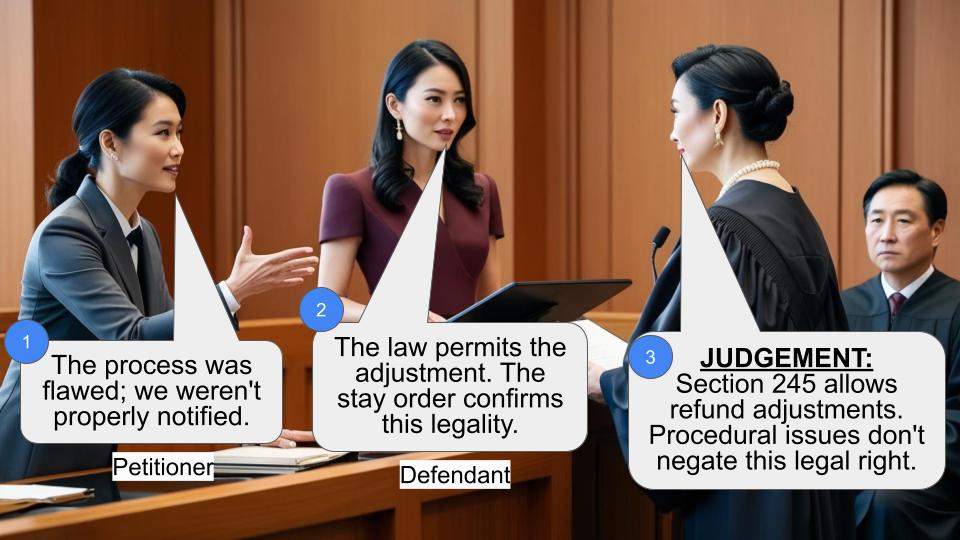
- Section 245 (of Income Tax Act, 1961) allows the assessing officer to set off refunds against payable amounts
Key Legal Precedents
The judgment doesn’t explicitly cite any case laws. However, it heavily relies on Section 245 (of Income Tax Act, 1961), which provides for the set-off of refunds against tax remaining payable
Judgement
- The court dismissed the writ petition
- It held that the Joint Commissioner’s stay order (Ext.P7) acknowledging the adjustments was not infirm
- The court recognized that while there might have been procedural irregularities, it doesn’t invalidate the department’s action of adjusting the refunds
- The provision allowing stay on payment of 15% of the demand doesn’t apply when the department has the right to set off under Section 245 (of Income Tax Act, 1961)
FAQs
Q: Why did the court dismiss the petition despite procedural irregularities?
A: The court prioritized the legal basis for the adjustment (Section 245 (of Income Tax Act, 1961)) over procedural issues, considering that the appellate authority had already acknowledged the adjustments.
Q: Can the Income Tax Department adjust refunds without prior notice?
A: While prior notice is ideal, the court’s decision suggests that the department’s power to adjust refunds under Section 245 (of Income Tax Act, 1961) can be upheld even if there are some procedural lapses.
Q: Does the 15% payment rule for obtaining a stay always apply?
A: No, the court clarified that this rule may not apply when the department has the right to set off refunds against demands under Section 245 (of Income Tax Act, 1961).
Q: What options does Kerala State Beverages Corporation have now?
A: The corporation might consider appealing to a higher court if they believe there are grounds to challenge this decision. They may also need to pursue their ongoing appeals against the original tax demands.
Q: How does this judgment affect other taxpayers?
A: This judgment reinforces the Income Tax Department’s power to adjust refunds against demands. It suggests that courts may uphold such adjustments even if there are minor procedural irregularities.

1. This writ petition is filed by the Kerala State Beverages (M & M) Corporation Ltd. challenging Ext.P7 and for a direction to the respondent to grant refund of the amount adjusted as per Ext.P2 letter.
2. The short facts involved in the writ petition would disclose that the petitioner, being an assessee before the 1st respondent under the Income Tax Act, 1961 (hereinafter referred to as 'the IT Act') filed returns for the assessment year 2012-13 admitting income of Rs.80,94,44,360/-. The assessing officer had accepted the return. However, the matter was taken for scrutiny and assessment was completed as per order dated 30/01/2015 under Section 143(3) (of Income Tax Act, 1961). Ext.P1 is the said order. A letter dated 03/02/2015 was issued to the petitioner by which petitioner was informed that the refund for the assessment year 2007-08 to 2011-12 is proposed to be adjusted against the demand for Rs.340,93,85,170/- raised in the assessment year 2012-13. The total amount of refunds determined pertaining to the assessment years from 2007-08 to 2011-12 is Rs.223,57,34,050/-. The petitioner preferred an appeal against Ext.P1 order and a stay petition was also filed. The stay petition was disposed by Ext.P7 order by giving effect to the adjustment and staying the outstanding demand of Rs.105.79 Crores. Petitioner, by letter dated 20/02/2016, requested the Joint Commissioner of Income Tax to refund an amount of Rs.223.57 Crores due to them over a period of time. It is stated that they have no liability in view of the orders of the Commissioner of Income Tax (Appeals) and the Income Tax Appellate Tribunal. Since no action has been taken in the matter, this writ petition is filed.
3. Petitioner submits that the order Ext.P7 granting stay of recovery of tax after adjusting the refund is illegal. The amount payable in terms of Ext.P2 is liable to be paid to the petitioner. As per Finance Act, 2016, a provision has been incorporated by which it is open for the petitioner to move an application for stay of collection of tax on remitting 15% of the demand. The maximum that can be levied is only 15% and therefore, when the petitioner had made a request for such adjustment, it ought to have been permitted.
4. A statement is filed by the learned Standing Counsel on behalf of the respondents inter alia stating that the outstanding demand of Rs.340.93 Crores arose on account of the disallowance of the petitioner's claim for deduction of surcharge on sales tax and turnover tax. The refunds in respect of the respective assessment years have arisen on account of deletion of similar disallowances for the earlier assessment years. It is stated that the order passed by the Appellate Tribunal have not become final and departmental appeals are pending before this Court. Further reference is made to Section 245 (of Income Tax Act, 1961) wherein power is available to the assessing officer to set off the amount to be refunded against any amount remaining payable under the Act. It is submitted that when such a power had been exercised, the petitioner cannot legally sustain a claim for payment of the amount.
5. Petitioner had filed a reply stating that, it was on receipt of Ext.P2 order by which the petitioner came to know about the refund orders. However, petitioner was served with copies of the orders dated 06/02/2015 wherein the 1st respondent had suo motu adjusted the money refundable to the petitioner against the dues in Ext.P1. Ext.P10 series are the orders passed. It is contended that Ext.P2 cannot be said to be a notice for the purpose of setting off refund against dues.
6. Heard learned counsel for the petitioner and the learned counsel appearing for the respondents.
7. The main contention urged by the learned counsel for the petitioner is that before issuing Ext.P2, no orders had been served on the petitioner by which the refund had been adjusted. In fact, the main challenge in the writ petition is against Ext.P7, which is an order passed by the Joint Commissioner of Income Tax while considering an application for stay. Stay has been granted on condition of the adjustments already made. When the appellate authority had taken such a view in the matter, I do not think that there will be any justification on the part of this Court in setting aside the said order, as no infirmity can be pointed out to the said order.
8. Learned counsel for the petitioner, however, would submit that Ext.P10 series have never been served on the petitioner and it was preceded by Ext.P2 notice dated 3/2/2015. It might be correct to say that Ext.P2 ought to have been issued after the order dated 06/02/2015, which is produced as Ext.P10 series. But the fact remains that once Ext.P10 series had been issued and the appellate authority had taken cognizance of the said fact while granting stay, a direction to refund the amount, as claimed, is not sustainable. As rightly pointed out by the learned counsel for the petitioner, under normal circumstances, stay could be obtained by remitting 15% of the amount demanded. But the said provision may not apply when a right to set off is available to the Department in terms of Section 245 (of Income Tax Act, 1961) which reads as under:
“245. Set off of refunds against tax remaining payable.
Where under any of the provisions of this Act, a refund is found to be due to any person, the Assessing Officer, Deputy Commissioner (Appeals), Commissioner (Appeals) or Chief Commissioner or Commissioner, as the case may be, may, in lieu of payment of the refund, set off the amount to be refunded or any part of that amount, against the sum, if any, remaining payable under this Act by the person to whom the refund is due, after giving an intimation in writing to such person of the action proposed to be taken under this section.”
9. True that, at the time when Ext.P1 order was passed on 30/01/2015, the refund order was not in existence and it came into effect only on 06/02/2015. However, merely for the reason that there is some irregularity in the procedure adopted by the Department, I do not think that any direction can be issued, as prayed for.
Writ petition is, hence, dismissed.
(sd/-)
(A.M.SHAFFIQUE, JUDGE)
×