


Court Upholds Taxpayer's Explanation for Unexplained Credits, Dismisses Tax Dep…


Full News
Court Upholds Taxpayer's Explanation for Unexplained Credits, Dismisses Tax Department's Appeal
Court Upholds Taxpayer's Explanation for Unexplained Credits, Dismisses Tax Department's Appeal
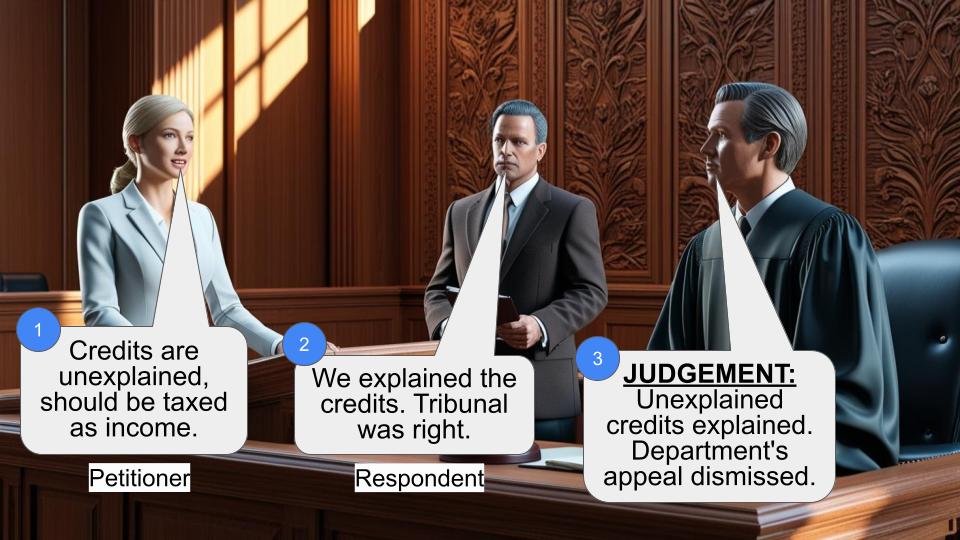
This case involves a dispute between the Income Tax Department and Shanti Enterprise, a partnership firm. The department challenged unexplained credits of Rs.1,45,00,000 in the firm's accounts. The Income Tax Appellate Tribunal ruled in favor of the assessee (Shanti Enterprise), and the High Court upheld this decision, dismissing the department's appeal.
Get the full picture - access the original judgement of the court order here
Case Name:
Income Tax Officer vs. Shanti Enterprise (High Court of Gujarat)
Tax Appeal No. 485 of 2008
Date: 10th June 2016
Key Takeaways:
1. The burden of proof for unexplained credits lies initially with the assessee, but once discharged, it shifts to the tax department.
2. Receiving funds through banking channels with proper documentation can be considered as discharging the initial burden of proof.
3. The assessee is not required to prove the source of credits beyond a reasonable explanation.
4. An unsatisfactory explanation does not automatically result in deeming the amounts as the assessee's income.
Issue:
Whether the Income Tax Appellate Tribunal was correct in deleting the addition of Rs.1,45,00,000 made by the Assessing Officer on account of unexplained credits in the names of 19 creditors?
Facts:
1. Shanti Enterprise, a partnership firm, filed a nil income tax return for the Assessment Year 2000-01.
2. The Assessing Officer reopened the assessment and determined the firm's income at Rs. 1,45,00,000.
3. The firm had received deposits totaling Rs. 1,55,50,000 from 23 persons on July 20, 1999.
4. These deposits were related to a joint venture project with M/s Siddharth Corporation for developing land allotted by Surat Municipal Corporation.
5. The assessee appealed to the CIT(A), who partly allowed the appeal in favor of the assessee.
6. The Income Tax Appellate Tribunal dismissed the department's appeal, leading to the present case in the High Court.
Arguments:
Department's Argument:
- The deposits were not genuine and should be considered as the assessee's undisclosed income.
- The Assessing Officer had given elaborate reasons for initiating proceedings against the assessee.
Assessee's Argument:
- The deposits were genuine and received through banking channels.
- All depositors, except one, were income tax assessees with PAN numbers.
- The assessee had provided explanations for each deposit and submitted necessary documentation.
Key Legal Precedents:
1. Deputy Commissioner of Income Tax v. Rohini Builders (256 ITR 360): This case established that when amounts are received by account payee cheques, the initial burden of proving the credits is discharged. The court held that the assessee need not prove the source of credits, and an unsatisfactory explanation doesn't automatically result in deeming the amounts as the assessee's income.
Judgement:
The High Court dismissed the tax department's appeal and ruled in favor of the assessee. The court agreed with the Tribunal's observations that:
1. Most depositors were income tax assessees with PAN numbers.
2. Deposits were received through banking channels.
3. The assessee provided explanations and documentation for each deposit.
4. There was no evidence that the assessee had earned any income during the year in question.
The court concluded that the assessee had discharged its burden of proof, and the Tribunal's decision was just and proper.
FAQs:
1. Q: What was the main issue in this case?
A: The main issue was whether the unexplained credits of Rs. 1,45,00,000 in the assessee's accounts should be considered as undisclosed income.
2. Q: Why did the court rule in favor of the assessee?
A: The court ruled in favor of the assessee because they had provided sufficient explanation and documentation for the deposits, and most depositors were income tax assessees with PAN numbers.
3. Q: What is the significance of this judgment for taxpayers?
A: This judgment reinforces that taxpayers need only provide a reasonable explanation for credits, not prove the source beyond doubt. It also emphasizes the importance of maintaining proper documentation and using banking channels for transactions.
4. Q: Does this mean all unexplained credits will be accepted by the tax department?
A: No, each case will be judged on its merits. This judgment provides guidance on what constitutes a reasonable explanation and discharge of the burden of proof.
5. Q: What steps can taxpayers take to avoid similar disputes?
A: Taxpayers should maintain proper documentation, use banking channels for transactions, and be prepared to provide reasonable explanations for all credits in their accounts.

1. By filing this appeal, the revenue has challenged the order dated 15.6.2007 passed by the Income Tax Appellate Tribunal, Ahmedabad, in ITA No.3573/Ahd/2004, whereby the Tribunal allowed the appeal filed by the assessee and dismissed the appeal filed by the revenue.
2. The assessee is a partnership firm engaged in construction of textile market known as “Millenium Market”.
The assessee filed return of income on 19.10.2000 for the Assessment Year 2000-01 declaring 'nil' income. Said return was processed under Section 143(1) (of Income Tax Act, 1961), 1961 (for short, “the Act”). Thereafter, the Assessing Officer, issued notice under Section 148 (of Income Tax Act, 1961) for reopening assessment. After the return was filed, notice under Section 143(2) (of Income Tax Act, 1961) was issued and, thereafter notice under Section 142(1) (of Income Tax Act, 1961) was also issued. In response to the said notice, the representative of the assessee attended the hearing before the Assessing Officer from time to time and submitted details, which were called for by the Assessing Officer. The Assessing Officer, after considering the details submitted on behalf of the assessee and determined total income of the assessee at Rs.1,45,00,000/- vide order dated 29.4.2004. The Assessing Officer also directed initiation of penalty proceedings to levy penalty under Section 271(1)(c) (of Income Tax Act, 1961).
3. Being aggrieved by the said order dated 29.4.2004, the assessee preferred an appeal before the CIT (A), which was partly allowed vide order dated 29.04.2004 in favour of the assessee.
4. Feeling aggrieved by order of CIT (A) deleting the addition of Rs.1,45,00,000/- made by Assessing Officer, the assessee preferred an appeal before the Income Tax Appellate Tribunal being ITA No.3573/Ahd/2004.
5. By order dated 15.6.2007, Tribunal dismissed the appeal filed by the revenue. Therefore, present appeal is preferred by the department.
6. At the time of admitting present appeal, this Court has framed following question of law:-
“Whether, on the facts and in the circumstances of the case and in law, the Income Tax Appellate Tribunal is right in deleting the addition made by the Assessing Officer on account of unexplained credits of Rs.1,45,00,000/- in the names of 19 creditors?”
7. From the record, it emerges that during the course of assessment proceedings for the Assessment Year 2000-2001, it was noticed that the assessee had shown receipts from booking deposit, out of which Rs.1,55,50,000/- had been received from the following persons:-
Sr. No.
Name of the person Amount in Rs.
Date of deposit
1. Ashoka Diamond 5,75,000 20.07.1999
2. Bhartibhai Vaghjibhai Vora 6,00,000 20.07.1999
3. Bhanwarlal K. Nama 5,55,000 20.07.1999
4. Bharat Gems 5,30,000 20.07.1999
5. Chinubhai R. Shah 6,00,000 20.07.1999
6. Chunilal B. Savalia 5,00,000 20.07.1999
7. Chandrakant C. Soni 5,50,000 20.07.1999
8. Dhara Gems 5,00,000 20.07.1999
9. Ganesh N. Prajapati 5,60,000 20.07.1999
10. Heena Diamond 5,00,000 20.07.1999
11. Hirabhai Dalichand Patel 5,60,000 20.07.1999
12. Jaysukh S. Mehta 5,50,000 20.07.1999
13. Jayantilal T. Mehta 5,90,000 20.07.1999
14. Jayantibhai Kalubhai Patel 55000 20.07.1999
15. Jignesh M. Doshi 5,50,000 20.07.1999
16. K.P.Diamond 5,70,000 20.07.1999
17. Kailshbhai Tulsibhai Patel 5,30,000 20.07.1999
18. Manisha Synthetics 35,00,000 20.07.1999
19. Mahendra Chandulal Doshi 5,00,000 20.07.1999
20. Pravinbhai DhanjibhaiKubadia 5,50,000 20.07.1999
21. Rameshbhai B. Patel 5,50,000 20.07.1999
22. Rahul Gems 5,50,000 20.07.1999
23. S.P.Enterprise 5,50,000 20.07.1999
Total 1,55,50,000
8. Aforesaid entries were not found to be genuine and, therefore, the Assessing Officer directed to issue demand notice and challan and to charge interest under Section 234B (of Income Tax Act, 1961). He also directed to issue penalty notice under Section 271(1)(c) (of Income Tax Act, 1961).
9. Mr.Sudhir Mehta, learned counsel for the appellant contended that amount which has been referred to in the table given above is the source of income of the assessee and, therefore, the Assessing Officer, after giving elaborate reasons, directed to initiate the proceedings as above. He also submitted that the Assessing Officer has discussed the evidence with regard to all these 23 entries, therefore, the Tribunal could not have passed the impugned order in favour of the assessee.
10. Mr.R.K.Patel, learned advocate for the respondent- assessee supported the impugned order and submitted that the Tribunal has not committed any error while passing the impugned order.
11. We have heard both the learned counsel and perused the record. We have also gone through the impugned order. The Tribunal has observed that all the aforesaid 23 persons, except Shri Kailashbhai Tulsibhai Patel, from whom deposits were received are the income tax assessees. They are having PAN numbers. The amounts have been received through the banking channels. Copies of accounts of each depositor were duly filed. The assessee has duly explained in respect of each of the depositors and the circumstances under which deposits were received by the assessee. The deposited money represents the amounts towards booking received initially through M/s.Siddharth Corporation along with which the assessee has engaged in joint venture of developing the project on the land which was allotted from Surat Municipal Corporation. This is an admitted fact that the assessee has not carried out any business during the year under consideration. No evidence on record has been brought that the assessee had earned income during the year. It is rightly found by the tribunal that the assessee has duly discharged its burden of proof. In the case of Deputy Commissioner of Income Tax v. Rohini Builders reported in 256 ITR 360, amounts were received by the assessee by account payee cheques and initial burden of proving the credits was discharged. It is held that the assessee need not prove the source of the credits and the fact that the explanation was not satisfactory would not automatically result in deeming amounts as income of the assessee. Therefore, in our view, the view taken by the Tribunal is just and proper and it is not required to be interfered with. In that view of the matter, question posed for our consideration is answered in favour of the assessee and against the department. Accordingly, this Tax Appeal is dismissed.
Sd/-
(K.S.JHAVERI, J.)
Sd/-
(G.R.UDHWANI, J.)
×
Questions
Court Upholds Taxpayer's Explanation for Unexplained Credits, Dismisses Tax Department's Appeal
Write your CommentSimilar Posts


Generic
- Reportdata/2780.pdf
