


Full News

Court Upholds TNMM as Most Appropriate Method for Transfer Pricing in Marketing Support Services Case
Court Upholds TNMM as Most Appropriate Method for Transfer Pricing in Marketing Support Services Case
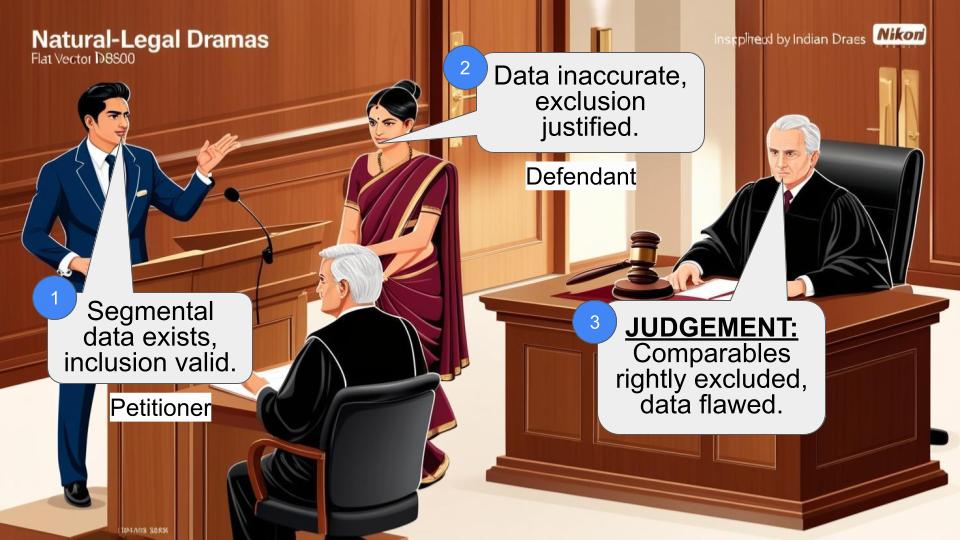
This case involves the Commissioner of Income Tax challenging a decision by the Income Tax Appellate Tribunal (ITAT) regarding the transfer pricing method used by Marubeni India Pvt. Ltd. for its international transactions. The ITAT had ruled that the Transactional Net Margin Method (TNMM) was the most appropriate method for determining the arm's length price. The High Court dismissed the revenue's appeal, affirming the ITAT's decision.
Get the full picture - access the original judgement of the court order here
Case Name:
Commissioner of Income Tax Vs Marubeni India Pvt. Ltd. (High Court of Delhi)
ITA 94/2015
Date: 23rd April 2015
Key Takeaways:
1. TNMM was upheld as the most appropriate method for transfer pricing in this case.
2. The court emphasized the importance of substantiating claims of significant risks and unique intangibles in transfer pricing cases.
3. The decision highlights the need for a fact-based analysis rather than relying on general assumptions in transfer pricing disputes.
Issue:
Was the ITAT correct in holding that the Transactional Net Margin Method (TNMM) was the most appropriate method for transfer pricing determination in the assessee's international transaction regarding "provision of agency and marketing support services"?
Facts:
- Marubeni India Pvt. Ltd. is a wholly owned subsidiary of Marubeni Corporation, Japan.
- The company provides agency services for its parent company and other group companies globally.
- For the Assessment Year 2008-09, the company reported five international transactions.
- The dispute centered on one transaction: provision of Agency and marketing support services, amounting to ₹32.18 crores.
- The assessee used TNMM as the most appropriate method, reporting a profit rate of 16.87%.
- The Transfer Pricing Officer (TPO) rejected TNMM and applied the Profit Split Method (PSM), proposing an adjustment of ₹30.14 crores.
Arguments:
Assessee's arguments:
- TNMM is the most appropriate method for their business model.
- The company bears limited risks and performs basic agency functions.
Revenue's arguments:
- The assessee assumed significant risks and was crucial in AEs' business decisions.
- The company developed unique intangibles benefiting the AEs.
- PSM is more appropriate given the assessee's functional profile.
Key Legal Precedents:
1. M/s Li & Fung India Pvt. Ltd. v. CIT (2014) 361 ITR 85 (Del): This case, which reversed an earlier ITAT decision, was crucial in the court's reasoning. It emphasized the need for substantiated evidence of risk assumption and intangible development in transfer pricing cases.
2. Li & Fung (India) Pvt. Ltd. v. DCIT (2012) 143 TTJ (Delhi) 201: This ITAT decision, which was later reversed by the High Court, had initially influenced the TPO's decision to apply PSM.
Judgement:
The High Court dismissed the revenue's appeal and upheld the ITAT's decision. Key points of the judgment include:
- The TPO's conclusion that the assessee assumed significant risks and used unique intangibles was not substantiated by evidence.
- The court agreed with the ITAT that the assessee's risk was limited and minimal with least capital employed.
- The court found that the TPO's findings were largely based on general observations without specific evidence.
- The High Court concluded that the ITAT's decision to use TNMM and order a fresh determination of ALP based on TNMM was reasonable and did not warrant interference.
FAQs:
1. Q: What is the significance of this judgment for transfer pricing cases?
A: This judgment emphasizes the importance of substantiating claims of risk assumption and intangible development in transfer pricing cases, rather than relying on general assumptions.
2. Q: Why did the court prefer TNMM over PSM in this case?
A: The court found that there was insufficient evidence to support the claim that the assessee assumed significant risks or developed unique intangibles, which are typically required for applying PSM.
3. Q: What does this mean for companies providing agency and marketing support services to foreign parent companies?
A: Such companies may find it easier to justify the use of TNMM for transfer pricing, especially if they can demonstrate limited risk and capital employment.
4. Q: How does this judgment impact the application of the Profit Split Method in transfer pricing cases?
A: The judgment sets a higher bar for applying PSM, requiring clear evidence of significant risk assumption and unique intangible development by the assessee.
5. Q: What should companies take away from this judgment regarding their transfer pricing documentation?
A: Companies should ensure they have robust documentation that clearly outlines their functional profile, risks assumed, and any intangibles developed, to support their chosen transfer pricing method.

1. The revenue, in this appeal, questions a decision of the Income Tax Appellate tribunal (ITAT) in ITA No. 5397/Del/2012 dated 03-06-2014. It is argued that the impugned order erred in holding that the Transactional Net Margin Method (“TNMM”) was the most appropriate method for transfer pricing determination in arriving at the arm’s length price (ALP) to bench mark the assessee/respondent’s international transaction regarding
“provision of agency and marketing support services” for AY 2008-09. This court had issued notice under Section 260-A (of Income Tax Act, 1961), 1961 (“the Act”) and heard counsel for the parties.
2. The brief facts of the case are that the assessee is a wholly owned subsidiary of Marubeni Corporation, Japan ("MCJ"). It provides agency services on behalf of MCJ and other group companies across the globe; liaises between departments of MCJ group companies and their suppliers/customers in India. The assessee also co-ordinates import and export of goods and services; inter alia it is independently engaged in trading. For AY 2008-09, five international transactions were reported by it. The controversy in this appeal is with respect to one international transaction, i.e. provision of Agency and marketing support services. The assessee was compensated `32,18,11,018/- during the assessment year. It selected the Transactional Net Margin Method (TNMM) as the most appropriate method with the Profit Level Indicator (PLI) of OP/OC and reported a profit rate of 16.87% in respect of its international transactions, with the same PLI of OP/OC of certain unrelated comparables at 13.81% on the basis of multiple years' data. The assessee claimed that its international transactions were at arm's length price (ALP) falling within +/- 5% range.
3. The TPO, by his order noted that the assessee provided some crucial services to its Associates Enterprises (AEs) which formed the basis of sourcing activities carried out by the AEs from or to India. The TPO held that the assessee's functions to its AEs were not only confined to providing marketing support services but also in arranging for feasibility studies, industry analysis and project evaluation for potential projects identified by the AEs. It was held that besides providing agency support and acting in the capacity of liaising agent for various AEs, the assessee helped them to make conscious sale and purchase decisions. The TPO noticed that the assessee made sizeable investments in exploring and analyzing the Indian market. Its contention that it bore limited risk, performing basic functions of agency, were not accepted by the TPO, who held that its functions were critical in assuming significant risk and using both its tangibles and intangibles created over a period of time. It was held that the assessee developed several unique intangibles which gave advantage to its AEs though the cost incurred for their development and use was not taken into consideration in receiving compensation. It was also held that the assessee performed all the critical functions in the process of rendering services to its AEs by assuming significant risks. The TPO therefore held that the assessee was inadequately compensated by its AEs and the Profit Split Method (PSM) had to be applied for determining the ALP of the international transactions under this segment. In reaching this conclusion, the TPO relied on an order passed by the Delhi Bench of the ITAT in M/s Li & Fung (India) Pvt. Ltd. v. DCIT (2012) 143 TTJ (Delhi) 201. It was held that since the assessee developed and made available its supply chain and human intangibles to its AEs for conducting their business in India and also did majority of crucial and critical functions on their behalf, the assessee was required to be compensated in the total profits on FOB value of the goods transacted by foreign AEs. Relying on M/s Li & Fung India Pvt. Ltd. (supra), where a ratio of 80:20 was applied, the TPO applied a ratio of 70:30 in favour of the assessee by holding that 70% of the total profit earned by its AEs from the goods traded from or to India should have been given to the assessee. He considered total volume of trading transactions of MCJ group on global basis at `4,35,000 crores and odd; worked out OP/OC of the MCJ group on global level at 1.78%; determined FOB value of goods outsourced from India at ` 24,208 crores; applied ratio at 1.78% on such FOB value to determine the total operating profits attributable to Indian turnover at `43.05 crores; and thereafter determined the assessee's 70% share in such profits at ` 30.14 crores. The TPO thus proposed transfer pricing adjustment at ` 30.14 crores. In the alternative approach, he proceeded to benchmark the assessee's international transactions under TNMM by treating it as a commission agent. Nine comparables were chosen giving an arithmetic mean margin of profit at 42.13% on cost. An adjustment of `30.14 crores on the basis of PSM was applied by relying on the Tribunal’s order in M/s Li & Fung (supra).
4. The assessee unsuccessfully objected to the addition, before the Dispute Resolution Panel (DRP) against the draft order passed by the Assessing Officer. The DRP approved the application of PSM by relying on the decision of the Tribunal in the case of M/s Li & Fung (supra). Aggrieved by the addition of ` 30.14 crores, the assessee approached the ITAT.
5. By the impugned order, the ITAT noticed that there was no dispute on any international transaction other than that of `Provision of Agency and marketing support services' to the tune of ` 32.18 crores. The ITAT noted the supply transactions structure of the assessee’s business on the basis of materials on record, given to the TPO by letter dt. 5.10.2011 inter alia, containing a chart. The chart/table showed three types of parties involved in each transaction, viz., Customer/Vendor from India, AEs and the assessee. The assessee acted as a mediator between its AEs and customer/vendor from India. The facts showed that on the one hand, the responsibilities of AEs extended to contracting, pricing, sourcing, scheduling, procuring, inventory management, logistics, marketing, credit management, quality and compliance of global laws etc.; those of the vendors/customer from India extend to contracting, pricing, scheduling, negotiating, inventory etc. On the other hand, the assessee was acting as a mediator between the AEs and the vendors/customers and responsible for supplying marketing information, liaising with vendors and coordination. The ITAT held that the assessee’s risk was limited and minimal with least capital employed, as opposed to the TPO’s findings that it (the assessee) performed all the crucial functions on behalf of the AEs. The TPO, held the ITAT, did not dispute any of these facts or the Table and instead baselessly observed that the assessee undertook all the critical functions of its AEs. This finding was unsubstantiated especially with regard to any specific functions performed by the assessee. The TPO did not elaborate any critical function except saying that the assessee was also engaged in arranging for feasibility studies, industry analysis, and project evaluation for potential projects identified by its AEs.
6. It was held that the ITAT’s order in Li and Fung (supra) influenced the decision (of the TPO) that the assessee should get 70% share in the overall profits of the transactions carried out by the AEs which have source or destination in India. This was not based on any material or evidence. The use by the assessee of its intangible assets vis-à-vis international transactions was not proved; likewise no document showed the risk assumed or that its task was anything “beyond mediating between the AEs and customers/vendors in India”. The assessee only supplied information to the AEs and mediated between them and Indian enterprises in the transactions arranged independently between them. There was, as a result, no question of its assuming higher risk or using its highly valued intangibles. The ITAT held that the TPO repeatedly reiterated that the assessee played a crucial role in the transactions between AEs and Indian parties by using valuable intangibles which has benefited the group as a whole, but never substantiated those conclusions. On the basis of its appreciation of the facts and the decision of this Court in M/s Li & Fung India Pvt. Ltd. v. CIT (2014) 361 ITR 85 (Del) (which reversed the decision in Li & Fung, by the ITAT, relied on by the TPO) the ITAT held that:
“8. Considering the entirety of the facts and circumstances prevailing in the present case, we find that the findings returned by the TPO - the assessee assuming substantial risks; doing critical functions for its AEs; and allowing the user of its highly- valued intangibles to such AEs - are all in air without any bedrock. Further, the conclusion drawn by the authorities in applying the PSM by basing their finding on the strength of the order of the Tribunal in the case of M/s Li & Fung (supra) cannot be sustained because of its reversal by the Hon'ble Delhi High Court. Ergo, we set aside the impugned order in making the transfer pricing adjustment of Rs.30.14 crore.” The ITAT lastly concluded that there was no reference to the names of comparables in the TPO's order while working out the alternative, PSM and that “the TPO embarked upon the PSM throughout the length and breadth of his order. The alternative approach of TNMM was not given any serious consideration. Even there is no discussion about the comparables chosen by the assessee and how they were acceptable or not. Under such circumstances, we are of the considered opinion that the ends of justice would meet adequately if the impugned order is set aside and the matter is restored to the TPO/Assessing Officer for a fresh determination of the ALP of the disputed international transactions of `Provision of Agency and marketing support services' amounting to Rs.32.18 crore. We order accordingly. Needless to say, the assessee will be allowed a reasonable opportunity of being heard in such de novo determination of the ALP.”
7. It is contended by Ms. Suruchi Agarwal on behalf of the revenue that the ITAT fell into error in holding that the TNMM was the most appropriate method and rejecting the PSM adopted by TPO and confirmed by the DRP. Stating that the assessee had assumed significant risks and was the crucial decision maker in respect of its AEs’ business functioning and commercial decisions, it was urged that the lower authorities correctly surmised that these went into significantly contributing to the profits and income of the AEs. It was also argued that the ITAT should not have been influenced by the decision of this Court in Li Fung, which was rendered in the peculiar circumstances whereby the figures provided by that assessee were never challenged and the TP exercise was accepted.
8. It was next argued that the ITAT erred in holding that FOB value of the goods sourced from India should be taken as the cost base for the purpose of computing ALP to benchmark the international transaction in respect of agency and marketing support services. It was argued that the assessee’s submission on its business model, in the larger supply chain of “Sogo Shosha” Group of Companies, and the erroneous assumption that it was engaged in providing sourcing support services to AEs should not have been accepted at face value. Counsel argued that the TPO correctly held that the assessee was not compensated on account of location savings, a benefit which accrued to its AEs. Lastly, it was urged that the TPO held that the assessee’s functional profile was that of a "Trader" in the related party segment, rather than the actual functional profile of a "service provider". All these went into making the PSM as the most appropriate method.
9. The TPO, in his order, after discussing the rival contentions and further elaborately noticing various decisions, recorded practically no reasons why the TNMM was not appropriate. His allusion to development of “unique intangibles” or assumption of significant risks was not based on any logic, much less materials. That order was an incantation of the statute and conditions spelt out in the rules. To hold that the PSM should be applied, it was stated that:
“The assessee has submitted its reply on 05.10.2011 towards the use of Profit Split Method. The main contentions of the assessee is that the key conditions in which profit split method can be applied is when both parties to the transaction are making significant contribution to the transactions, or that the operations of both the parties are highly integrated. The assessee has also quoted from rule 10B(1)(d) (of Income Tax Rules, 1962) and para 2.109 of OECD Transfer Pricing Guidelines.
7.3 The argument of the Assessee is not tenable in view of the fact that the Assessee is creating unique intangibles which have given an advantage to the AE in the form of the low cost of the product, quality of the product and enhanced the profitability of the AE. These intangibles have increased profit potential of the AE though cost for development and use of intangibles was not taken for computations of routine markup earned by the appellant. The reply of the assessee is without any basis. As mentioned in the preceding paragraphs, assessee is doing a lot of functions relating to trading activities. It has gained unique knowledge of people, processes and has used this knowledge to help its AE thrive. Such an issue came up before the Hon'ble ITAT in the case of a sourcing company, M/s. Li & Fung (India) Pvt. Ltd., vs DCIT, Circle 4 (1), New Delhi in ITA No.5156/De1./2010 for AY 2006-07, whereby Hon'ble ITAT has held that ********
In view of the above, it is therefore, held that the assessee has actually developed and used the supply chain and human intangible. The assessee is providing all critical functions and the majority of work related to these exports is performed by assessee itself. Associate enterprise had no capacity to execute the work on its own. The critical and all crucial work is done by assessee himself. It has further been held by the Hon'ble ITAT that the AE is paying back to the assessee only on the basis of cost plus mark up. Such an arrangement cannot be said at arm's length. In the considered view of Hon'ble ITAT, since the majority and crucial services are rendered by assessee, the distribution of compensation received by AE at certain percentage of the FOB value of the exports between the assessee and the associated enterprise should be in the ratio of 80 : 20. The assessee must get 80% of the total receipt by AE from the ultimate purchasers. The ratio of judgment squarely applies to the facts of the case of the assessee. In view of the above mentioned fact that majority and crucial services rendered by assessee, the Assessee is not being compensated on an arm's length basis. Accordingly, the distribution of compensation, received by AE on the FOB value of the goods sourced from India, between the assessee and the associated enterprise should be in the ratio of 70 : 30. The assessee must get 70% of the profit earned from the goods sourced from India. The assessee has raised a point that in the show cause notice, while calculating the operating profit of AE, certain non operating income was not deducted from the OP. The same is found to be valid and the calculation is corrected, while doing the final calculation. Based on the above discussion, the arm's compensation of the assessee shall be computed as per Profit Split Method...”
10. This Court in Li & Fung (supra) discussed why a similar approach was contrary to law:
“42. Moreover, there is considerable merit in the submission that the (finding of the) lower authorities, including the Tribunal, misdirected themselves in holding that LFIL assumed substantial risk. Whilst this court would neither state that LFIL performed functions with a limited risk component, as it does not engage itself in manufacturing of garments (which is LFIL's stance), apart from the broad assumptions made by the Revenue, no material on record testifies to that fact such that it can be the basis for an arm's length price adjustment. Indeed, LFIL has neither made investment in the plant, inventory, working capital, etc., nor does it claim to have any expertise in the manufacture of garments. More importantly, and given no material to the contrary, LFIL does not bear the enterprise risk for manufacture and export of garments. LFIL's functional and risk profile thus is entirely different and has nothing to do with the manufacture and export of garments by unrelated third party vendors. Simply put, LFIL renders support services in relation to the exports, which are manufactured independently. Thus, attributing the costs of such third party manufacture, when LFIL does not engage in that activity, and more importantly, when those costs are clearly not LFIL's costs, but those of third parties, is clearly impermissible. A contrary conclusion would amount to treating it (the appellant) as the vendor/exporters partner in their manufacturing business—a completely unwarranted inference.
43. Indeed, having done the work, LFIL has developed experience and expertise which the Tribunal has held to be human capital and supply chain intangibles. But such description does not in any way reveal how the appellant bears any risk— either enterprise or economic. LFIL's remuneration on a cost plus mark-up of 5 per cent represents the functions performed, assets utilized and risks assumed by it. Further, the Transfer Pricing Officer's determination that LFIL bore significant risks is not borne out from the records. In transactions in which LFIL was a party, it did not bear any financial risk. To the contrary, its costs towards establishment, transportation, salaries, etc., were fully reimbursed and it was insulated from any economic or financial downside to any particular transaction. In other words, its remuneration was based entirely on the costs borne by it. In essence, it is a low risk contract service provider exclusively rendering sourcing support to the associated enterprise. It does not bear any significant operational risks for its functions, rendered to the third party vendor/ customers. Rather, it is the associated enterprise that undertakes substantial functions and in fact assumes enterprise risks, such as market risk, credit risk, etc. It also bears the letter of credit associated charges and other expenses.”
11. In the present case, there is no controversy with respect to four out of the five transactions. The TPO discarded TNMM as the most appropriate method, holding that the assessee assumed significant risks, and relied on unique intangibles thus resulting in higher profits of the AE which should be attributed to it. In a given case, concededly this can be argued if the facts can logically support such a conclusion. However, the revenue cannot merely state that significant risks, such as credit, operational, manpower and other risks were borne or that the assessee’s business was subjected to fluctuations. It merely mediated between the AEs and customers/vendors in India. Furthermore, it only supplied information to the AEs and mediated between them and Indian enterprises in the transactions arranged independently between them. The observations that the AE’s decisions were taken by the assessee is a general one, unsupported by any independent material; it is anecdotal and based on the TPO’s belief, rather than objective fact based analysis. There was, as a result, no question of its assuming higher risk or using its highly valued intangibles. This court also concurs with the ITAT’s finding that the assessee’s risk was limited and minimal with least capital employed, and that the TPO’s findings that it (the assessee) performed all the crucial functions on behalf of the AEs was not proved. The TPO did not dispute the facts given by the assessee and held without foundation that it undertook all the critical functions of its AEs. This finding was unsubstantiated and generally made; the TPO never elaborated any critical function or decision of the assessee inuring to the AEs except saying that the assessee was engaged in arranging for feasibility studies, industry analysis, and project evaluation for potential projects identified by its AEs. It is quite evident that the TPO based his findings and conclusions on the decision of the ITAT in Li Fung (supra), which was subsequently reversed by this Court.
12. Resultantly, we hold that the ITAT’s conclusion that the TNMM was the most appropriate method and that the TPO had to make a fresh determination of the ALP of the disputed international transactions of `Provision of Agency and marketing support services' amounting to ` 32.18 crores based on the TNMM is reasonable, not calling for interference; no substantial question of law arises for consideration, for the above reasons and additionally, in view of the previous decision of this court in Li & Fung (supra). The appeal therefore fails and is dismissed.
S. RAVINDRA BHAT
(JUDGE)
R.K. GAUBA
(JUDGE)
APRIL 23, 2015
×
Similar Ripples
Questions
Court Upholds TNMM as Most Appropriate Method for Transfer Pricing in Marketing Support Services Case
Write your CommentSimilar Posts


Generic
- Reportdata/3814.pdf
