Court upholds transfer of tax assessments, citing reasonable disclosure of reas…


Full News
Court upholds transfer of tax assessments, citing reasonable disclosure of reasons
Court upholds transfer of tax assessments, citing reasonable disclosure of reasons
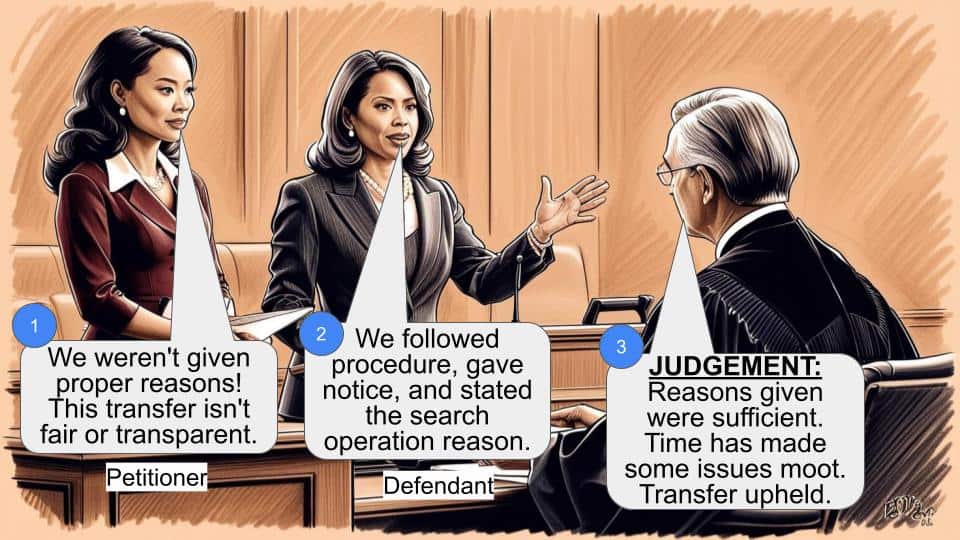
A case where some taxpayers (the petitioners) challenged the transfer of their tax assessments to a different jurisdiction. They argued that proper reasons weren't given for the transfer. The court, however, disagreed and upheld the transfer orders, saying that enough information was provided in the initial notices.
Get the full picture - access the original judgement of the court order here
Case Name:
Santosh Devi Kothari & Ors. Vs Commissioner of Income Tax (High Court of Madras)
Writ Petition Nos.17112 to 17117 of 2005 & WMP.Nos.18584 to 18589 of 2005
Date: 3rd August 2016
Key Takeaways:
- The court emphasized that reasons for transferring tax assessments don’t need to be elaborate, but should be clear enough for the assessee to understand.
- The passage of time (11 years in this case) can make some legal questions academic or less relevant.
- The court reinforced that the extent and manner of hearing and reasons depend on the facts of each case.
Issue:
The main question here was: Did the tax authorities provide sufficient reasons when transferring the petitioners’ tax assessments to a different jurisdiction?
Facts:
- The petitioners’ tax assessments were transferred to the jurisdiction of the Deputy Commissioner of Income Tax, Central Circle-II, Coimbatore.
- The tax department sent notices about this proposed transfer.
- The petitioners submitted objections to these transfers.
- The transfers were related to a search and seizure operation conducted on M/s. Ravindra Agency and M/s. Kothari Finance in Erode.
- The petitioners filed these writ petitions back in 2005, but they only came up for hearing in 2015 - that’s a whole decade later!
Arguments:
The petitioners said:
- Hey, you didn’t give us proper reasons for transferring our cases!
- They cited a Supreme Court case (Ajantha Industries Vs. C.B.D.T.) saying that giving reasons is super important and not just a formality.
The tax department said:
- We followed all the rules in Section 127 (of Income Tax Act, 1961).
- We gave you guys a chance to object, which you did.
- The reason for transfer was clearly mentioned in the notices - it was because of that search and seizure operation.
Key Legal Precedents:
- Ajantha Industries Vs. C.B.D.T. [1976 1 SCC 1001]: This case emphasized the importance of recording and communicating reasons for transfers under Section 127 (of Income Tax Act, 1961).
- Devidas Vs. Union of India [1993 200 ITR 697 (Bombay)]: This case discussed whether an assessee is entitled to a hearing and reasoned order when their transfer application is rejected. The court said that while Section 127 (of Income Tax Act, 1961) talks about suo motu transfers, the power can be triggered by either the assessee or the Revenue.
- Other cases mentioned but not extensively discussed: Kanji Mal and Sons Vs. CIT [1982 138 ITR 391], Devi Dayal Marwah Vs. CIT [1964 52 ITR 829], and Autofin Ltd. Vs. CIT [1977 106 ITR 638].
Judgement:
The court basically said, “Look, the tax department did okay here.” Here’s why:
- The notices mentioned the search and seizure operations as the reason for transfer. That’s enough info for the petitioners to understand and respond to.
- The petitioners understood well enough to submit objections, so they can’t claim they were in the dark.
- While ideally, the final transfer orders should have addressed why the objections were rejected, the court felt this issue had become less relevant due to the passage of time (11 years!).
- The court upheld the transfer orders but gave the tax department the green light to proceed according to law.
FAQs:
Q: Does the tax department need to give detailed reasons for transferring assessments?
A: Not necessarily. The reasons should be clear enough for the assessee to understand, but they don’t need to be elaborate.
Q: Can taxpayers challenge the transfer of their assessments?
A: Yes, they can submit objections, and the tax authorities should consider these objections.
Q: What’s the significance of Section 127 (of Income Tax Act, 1961)?
A: It gives tax authorities the power to transfer cases between different jurisdictions, primarily for administrative convenience.
Q: Does the passage of time affect legal challenges?
A: It can. In this case, the 11-year gap made some issues less relevant in the court’s eyes.
Q: What should taxpayers do if they receive a transfer notice?
A: They should carefully review the reasons given and submit their objections if they disagree with the transfer.

Heard both.
2. In all these writ petitions, the prayer is identical, in as much as the petitioners questioned transferring their assessment to the jurisdiction of the Deputy Commissioner of Income Tax, Central Circle-II, Coimbatore.
3. The learned counsel for the petitioners submitted that each of the petitioners were put on notice by the respondent against the proposed transfer and all of them submitted their objections and that the impugned orders have been questioned on the ground that reasons have not been furnished to the petitioners as mandated in terms of the law laid down by the Hon'ble Supreme Court in the case of Ajantha Industries Vs. C.B.D.T. [reported in 1976 1 SCC 1001].
4. The learned counsel for the petitioners, by referring to paragraphs 10, 11 and 13 of the said judgment, submitted that the requirement of recording of reasons under Section 127(1) (of Income Tax Act, 1961) (hereinafter referred to as the Act) is a mandatory direction under the law and non communication thereof is not saved by showing that the reasons exist in the file although not communicated to the assessee. It was further submitted that the Hon'ble Apex Court, in the said judgment, held that recording of reasons and disclosure thereof is not a mere formality.
Therefore, it was also submitted by the learned counsel for the petitioners that the stand taken by the respondent in paragraph 7 of the counter affidavits is contrary to the law laid down by the Hon'ble Supreme Court in the said case.
5. The learned Standing Counsel appearing for the respondent sought to sustain the impugned orders by contending that the same have been passed by scrupulously following the provisions of Section 127 (of Income Tax Act, 1961),that the petitioners also submitted their objections and that the reason was clearly stipulated in the notices.
6. In reply to the said submission, the learned counsel for the petitioners would submit that if that it is the case, then the notice itself is an empty formality, as the respondent pre-decided the issue.
7. After hearing the learned counsel on either side and perusing the materials available on record, the first thing this Court wishes to point out is that the writ petitions, which were filed in the year 2005, were listed for hearing in the year 2015 i.e. after about 11 years and the parties on either side were unable to report as to the present state of affairs. The counter affidavits filed in the writ petitions were sworn to by Commissioner of Income Tax-II, Coimbatore on 31.8.2015. Therefore, at this juncture, this Court has not been informed as to the present state of affairs. Be that as it may, the correctness of the impugned proceedings has to be tested.
8. It is worthwhile to refer to the scope of the relevant provision viz. Section 127 (of Income Tax Act, 1961), which reads as follows :
"127. Power of transfer cases:-
(1) The Director General or Chief Commissioner or Commissioner may, after giving the assessee a reasonable opportunity of being heard in the matter, wherever it is possible to do so, and after recording his reasons for doing so, transfer any case from one or more Assessing Officers subordinate to him (whether with or without concurrent jurisdiction) to any other Assessing Officer or Assessing Officers (whether with or without concurrent jurisdiction) also subordinate to him.
(2) Where the Assessing Officer or Assessing Officers from whom the case is to be transferred and the Assessing Officer or Assessing Officers to whom the case is to be transferred are not subordinate to the same Director General or Chief Commissioner or Commissioner,-
(a) where the Directors General or Chief Commissioners or Commissioners,. to whom such Assessing Officers are subordinate are in agreement, then the Director General or Chief Commissioner or Commissioner from whose jurisdiction the case is to be transferred may, after giving the assessee a reasonable opportunity of being heard in the matter, wherever it is possible to do so, and after recording his reasons for doing so, pass the order;
(b) where the Directors General or Chief Commissioners or Commissioners aforesaid are not in agreement, the order transferring the case may, similarly, be passed by the Board or any such Director General or Chief Commissioner or Commissioner as the Board may, by notification in the Official Gazette, authorise in this behalf.
(3) Nothing in Sub-Section (1) or Sub- Section (2) shall be deemed to require any such opportunity to be given where the transfer is from any Assessing Officer or Assessing Officers (whether with or without concurrent jurisdiction) to any other Assessing Officer or Assessing Officers (whether with or without concurrent jurisdiction) and the offices of all such officers are situated in the same city, locality or place.
(4) The transfer of a case under Sub-Section (1) or Sub-Section (2) may be made at any stage of the proceedings, and shall not render necessary the re- issue of any notice already issued by the Assessing Officer or Assessing Officers from whom the case is transferred.
Explanation.- In Section 120 (of Income Tax Act, 1961) and this Section, the word" case", in relation to any person whose name is specified in any order or direction issued thereunder, means all proceedings under this Act in respect of any year which may be pending on the date of such order or direction or which may have been completed on or before such date, and includes also all proceedings under this Act which may be commenced after the date of such order or direction in respect of any year.]"
9. On a reading of the above provision, it is seen that the object, for which, such provision was enacted is for the purpose of administrative convenience. The said provision does not empower the Assessing Officer to transfer a case from his jurisdiction to that of nature and even when the Director General or the Chief Commissioner or the Commissioner, exercising such power, can transfer any case after recording his reasons for doing so. For the purpose of recording reasons, it is obvious that the Commissioner has to consider the circumstances involved in each case.
10. Now, let us come to the contentions of the learned counsel for the petitioner.
11. The sheet anchor of the learned counsel for the petitioners is that the reasons for transfer have not been notified.
12. However, this submission is not tenable for the simple reason that the notices state that the purpose for transfer is consequent upon a search and seizure operation in the case of M/s.Ravindra Agency, Karungulapalayam, Erode/M/s.Kothari Finance, Erode. Thus, the reason, though not elaborate, has been stated in the notices dated 15.9.2004 and the petitioners/assessees have understood the scope of the notices and that is why they submitted their objections raising a contention that the search and seizure operations conducted in those places would have no impact on the assessments to be made. Therefore, I am of the view that these are not cases wherein it can be concluded that reasons have not been furnished,when the notices themselves disclose the reason, for which, the petitioners also gave their objections.
13. A useful reference could be made to the decision in the case of Devidas Vs. Union of India [reported in (1993) 200 ITR 697 (Bombay)]. The question which fell for consideration, in the said case, was whether an assessee under the Act was entitled to a reasonable opportunity of hearing against a reasoned order, when his application, calling in question the jurisdiction of an Assessing Officer and for transfer of a case to the other Assessing Officer, is rejected.
14. In the decision in Devidas Vs. Union of India, the Revenue, in defence of the impugned order, stated that a statute can, in appropriate cases, exclude the principle of natural justice, since the assessee has no legal right of being assessed by any particular Assessing Officer; that Section 127 (of Income Tax Act, 1961) restricts the obligation of hearing and passing a speaking order only when the case is to be transferred suo motu; that Section 127 (of Income Tax Act, 1961) excludes, by necessary implication, an opportunity of hearing, when there is refusal to transfer and that in any case, perusal of the contents of an application made by the petitioner and the enquiry report obtained from the Assessing Officer is sufficient compliance with the principles of natural justice.
15. After taking note of the observations made by the Delhi High Court in the the decision in the case of Kanji Mal and Sons Vs. CIT [reported in (1982) 138 ITR 391], in the decision in the case of Devi Dayal Marwah Vs. CIT [reported in (1964) 52 ITR 829] and in the decision in the case of Autofin Ltd. Vs. CIT [reported in 1977 (106) ITR 638], it was held by the Bombay High Court that it is true that Section 127 (of Income Tax Act, 1961) refers to suo motu jurisdiction, but it is settled law that such jurisdiction can be triggered either by an assessee or by the Revenue and the power is conferred to remedy any injustice and it is always open to bring to notice any error, illegality or injustice. On examining the impugned order, which was subject matter of the said case, it was held to be vitiated because of absence of hearing and recording of reasons. However, it was further held that no hard and fast rule can be laid down about the extent and manner of hearing and reasons to be recorded and all depends upon the facts and circumstances on each case. Therefore, the High Court of Bombay, though culled out the legal position, observed that there can be no hard and fast rule and the extent and manner of hearing and reasons depend on the facts and circumstances of each case.
16. In respect of other submissions, which would have an impact on the assessment to be made, this Court refrains from making any reference to the same and this Court does not propose to go into the factual contentions raised by the petitioners and the averments set out in this regard in the counter affidavits. Ultimately, while upholding the validity of the impugned orders, this Court grants liberty to the respondent to proceed in accordance with law.
17. The learned counsel for the petitioners submitted that the impugned notifications transferring the cases, after receipt of the objections,do not disclose as to why the objections raised by the petitioners did not find favour with the respondent.
18. Under normal circumstances, this Court would have adjudicated this issue. But, by a lapse of time of more than 11 years, this Court is of the view that this question has become academic. That apart, the impugned proceedings are only notifications and these notifications are after an order, which came to be passed by the Authority concerned. Therefore, at this distance of time, this Court is not inclined to give any liberty to the petitioners to challenge the order, which had been passed by such Authority prior to the impugned notifications.
T.S.SIVAGNANAM,J RS
19. The writ petitions are accordingly disposed of. No costs. Consequently, the above WMPs are closed.
03.8.2016
Internet : Yes
To
Commissioner of Income Tax II, Coimbatore.
WP.Nos.17112 to 17117 of 2005& WMP.Nos.18584 to 18589 of 2005
×