


Court Upholds Tribunal's Decision on Old Bottle Purchases and Sales Promotion E…





Full News
Court Upholds Tribunal's Decision on Old Bottle Purchases and Sales Promotion Expenses
Court Upholds Tribunal's Decision on Old Bottle Purchases and Sales Promotion Expenses
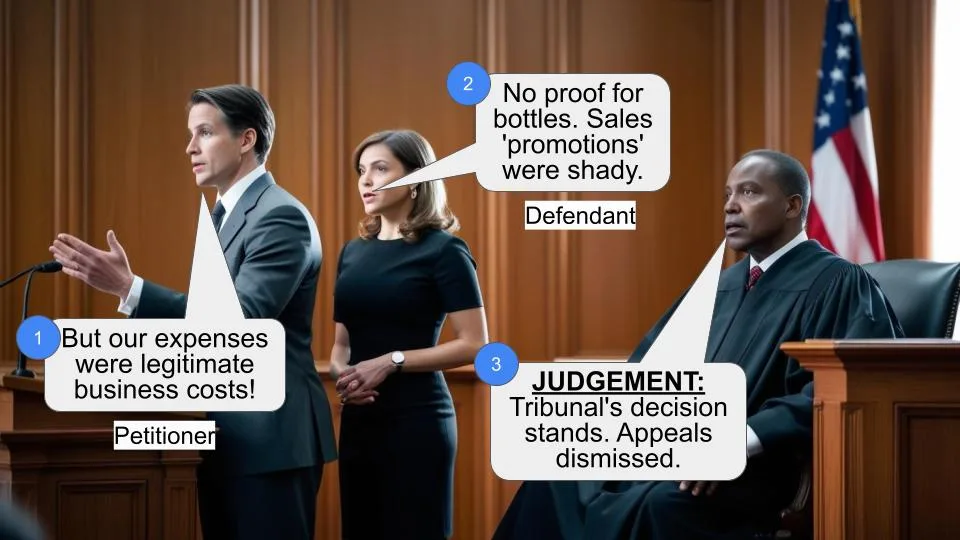
This case involves Empee Distilleries Limited (the assessee) appealing against an order by the Income Tax Appellate Tribunal regarding the assessment year 2005-06. The main issues were the genuineness of old bottle purchases and the allowability of sales promotion expenses. The High Court dismissed the appeal, upholding the Tribunal's decision.
Get the full picture - access the original judgement of the court order here
Case Name:
Empee Distilleries Limited vs Assistant Commissioner of Income Tax (High Court of Madras)
Tax Case(A) Nos.164 & 165 of 2012
Date: 8th August 2012
Key Takeaways:
1. Section 40A(3) (of Income Tax Act, 1961) can only be applied to genuine transactions.
2. When expenditure is not genuine, the entire amount should be disallowed.
3. Claims for business expenses must be substantiated with proper documentation.
4. Courts are reluctant to interfere with concurrent findings of fact by lower authorities.
Issue:
1. Whether the Tribunal was correct in remitting the issue of old bottle purchases for re-examination?
2. Whether the Tribunal was correct in sustaining the disallowance of sales promotion expenses?
Facts:
1. Empee Distilleries Limited is engaged in manufacturing Indian Made Foreign Liquor (IMFL).
2. For the assessment year 2005-06, the company claimed expenses for purchasing old bottles and sales promotion.
3. The Assessing Officer disallowed Rs. 12,52,19,585 for old bottle purchases and Rs. 1,00,02,150 for sales promotion expenses.
4. The company appealed to the Commissioner of Income Tax (Appeals), who partly allowed the appeal.
5. Both the assessee and the Revenue filed appeals before the Income Tax Appellate Tribunal.
6. The Tribunal partly allowed both appeals, leading to the present case before the High Court.
Arguments:
Assessee's arguments:
1. The purchase of old bottles was genuine and supported by production results certified by local government authorities.
2. Sales promotion expenses were legitimate and paid to brokers and middlemen to promote brands.
Revenue's arguments:
1. The assessee failed to prove the existence of parties from whom old bottles were purchased.
2. Sales promotion expenses were actually bribes paid to TASMAC employees and not allowable under section 37(1) (of Income Tax Act, 1961).
Key Legal Precedents:
1. Deep Chandra Junaja Vs. Lajwanti Kathuria ((2008) 8 SCC 497): The Supreme Court held that interference in concurrent findings of fact is unwarranted.
2. Ghisalal Vs. Dhapubai (2011) 2 SCC 298: The Supreme Court held that unless a finding is ex facie perverse, interference is not called for.
Judgement:
1. On the issue of old bottle purchases, the High Court found no error in the Tribunal's order remitting the matter back to the Assessing Officer for re-examination.
2. Regarding sales promotion expenses, the High Court upheld the concurrent findings of the lower authorities disallowing the claim due to lack of proper substantiation.
3. The High Court dismissed the Tax Case Appeals, finding no grounds to interfere with the Tribunal's order.
FAQs:
1. Q: What is the significance of section 40A(3) (of Income Tax Act, 1961) in this case?
A: Section 40A(3) (of Income Tax Act, 1961) can only be applied to genuine transactions. The Tribunal held that when the expenditure itself is not genuine, the whole amount should be disallowed.
2. Q: Why were the sales promotion expenses disallowed?
A: The expenses were disallowed because the assessee failed to provide proper documentation, including names and addresses of the recipients, to substantiate the claim.
3. Q: What principle did the High Court apply in not interfering with the Tribunal's decision?
A: The High Court followed the principle that concurrent findings of fact by lower authorities should not be interfered with unless they are ex facie perverse.
4. Q: What does this judgment mean for businesses claiming expenses?
A: This judgment emphasizes the importance of maintaining proper documentation and being able to substantiate claims for business expenses, especially when dealing with cash transactions or payments to third parties.
5. Q: How does this case impact the interpretation of section 37(1) (of Income Tax Act, 1961)?
A: The case reinforces that expenses claimed under section 37(1) (of Income Tax Act, 1961) must be legitimate business expenses and not disguised payments that could be considered as bribes or illegal gratification.

1. The tax case appeals have been filed against the common order dated 16.12.2011 passed by the Income Tax Appellate Tribunal, "A" Bench, Chennai in I.T.A.No.1876/MDS/2010 and I.T.A.No.61/MDS/2011 respectively for the assessment year 2005-06.
2. The brief facts leading to the filing of the above tax case appeals are as follows:
The assessee company is engaged in the business of manufacture of Indian Made Foreign Liquor (IMFL). It filed its return of income for the assessment year 2005-06 on 31.10.2005 admitting a total income of Rs.57,33,742/-. After the case was processed under section 143(1) (of Income Tax Act, 1961), it was taken up for scrutiny and notice under section 143(2) (of Income Tax Act, 1961) was issued to the assessee. Pursuant to the same, the assessee furnished all the details required by the Assessing Officer. The Assessing Officer, after verifying the details filed by the assessee, passed the assessment order under section 143(3) (of Income Tax Act, 1961) on 28.12.2007 disallowing a sum of Rs.12,52,19,585/- claimed by the assessee towards purchase of old bottles; a sum of Rs.1,00,02,150/- towards sales incentive and a sum of Rs.11,52,361/- towards deduction under section 80G (of Income Tax Act, 1961). Challenging the said order of assessment, the assessee filed an appeal before the Commissioner of Income Tax (Appeals) III, Chennai, who partly allowed the appeal. Aggrieved by the said order, the assessee filed I.T.A.No.1876/Mds/2010 and the Revenue filed I.T.A.No.61/Mds/2011 respectively before the Income Tax Appellate Tribunal, "A" Bench, Chennai. The Tribunal partly allowed both the appeals. Challenging the said order, the assessee has filed the present Tax Case Appeals.
3. The assessee has raised the following substantial questions of law for consideration:
"1. Whether the Appellate Tribunal is correct in law in remitting the issue of the claim for deduction of purchase of old bottles for re-examination by the appellant with irrelevant / inappropriate directions, especially without questioning the certificate of production results issued by the competent authority of the local Government, which in turn proved the fact of purchase of old bottles for manufacture of IMFL?
2. Whether the Appellate Tribunal is correct in law in sustaining the disallowance of claim of sales promotion expenses on the wrong assumption of facts especially, incurring of such expenditure on TASMAC employees, thereby clearly demonstrating the perversity in the order passed in this regard?"
4. As far as the first question of law is concerned, it is seen from the materials available on record that, during the relevant assessment year, the assessee company, which is engaged in the business of manufacture of Indian Made Foreign Liquor, claimed a sum of Rs.6,38,82,966/- towards purchase of old bottles from local parties and a sum of Rs.6,99,23,820/- from CST parties. The assessee was asked to furnish confirmation with regard to the suppliers of old bottles along with their postal addresses, amount of purchase, date of purchase, mode of payment, etc., on or before 16.11.2007 The assessee issued letters under section 133(6) of the Income Tax Act, 1961 to the parties calling for the said details. On various occasions, the assessee requested the Assessing Officer to extend the time already granted to furnish the said details. Out of the nineteen letters issued to the suppliers, only four of them confirmed; three letters were returned unserved and twelve suppliers did not confirm the transactions, though they received letters. On the basis of the above materials available, the Assessing Officer, found that the onus is on the assessee to prove that it had transactions with other parties and that the assessee had failed to prove the existence of the parties from whom old bottles were purchased. On the basis of the above findings, the Assessing Officer treated the purchases made from fifteen parties amounting to Rs.12,52,19,585/- as not genuine and added the same to the total income of the assessee for the relevant assessment year. In the first appeal, the Commissioner of Income Tax (Appeals), on consideration of the materials available, found that the assessee had been meeting its requirement of old bottles by making payments in cash; however, to circumvent the provisions of section 40A(3) (of Income Tax Act, 1961), the assessee had been resorting to issue of account payee cheques in the name of bogus parties; getting back the same in cash; using the said cash to purchase old bottles and therefore, the provisions of section 40A(3) (of Income Tax Act, 1961) would come into operation. The Commissioner also found that the said section covers all payments, including payments for stock-in-trade or raw materials; payment made for goods purchased on credit; by requiring payments to be made through account payee cheques, it is possible to verify the genuineness of the transactions made, thereby mitigating the risk of evasion and that the said provision had been circumvented by the assessee by resorting to various methods. On the basis of the above findings, the Commissioner held that the purchases made by the assessee should be treated as cash purchases and as provided for under section 40A(3) (of Income Tax Act, 1961), 20% of purchases should be disallowed in addition to the disallowance of 10% based on the order of Tribunal in respect of the assessee's case for earlier years. Accordingly, the Commissioner, while sustaining the total disallowance to the extent of Rs.3,09,58,287/-, partly allowed the appeal. The Tribunal held that the provisions of section 40A(3) (of Income Tax Act, 1961) can be invoked only when the transactions were admitted as genuine and that, when the expenditure itself was not genuine, the whole of the expenditure had to be disallowed. The Tribunal also held that, if the expenditure was genuine and the same had been incurred in violation of the provisions of the said section, only then disallowance could be made by applying the provisions of the said section. The Tribunal further held that the Commissioner, having accepted that transactions with nine parties were not genuine, ought not to have applied the provisions of section 40A(3) (of Income Tax Act, 1961). Accordingly, the Tribunal, while cancelling the findings rendered by the Commissioner in respect of the said issue, directed the Assessing Officer to determine the cost of old bottles, after taking into consideration the cost of new bottles, as the assessee itself in its letter dated 10.12.2007, addressed to the Assessing Officer, had admitted that secondhand bottles were purchased.
5. As far as the second question of law is concerned, the assessee claimed a sum of Rs.1,00,02,150/- as expenditure towards sales promotion. During the course of assessment proceedings, the assessee was asked to furnish details regarding the payments made. The assessee also furnished the vouchers and monthly statements submitted by the assessee's employees. On verification of the same, it was found that the amounts debited were paid to the employees of the assessee. On further verification, it was discovered that the employees, who had received the amounts, had submitted monthly statements along with list of persons, to whom the amounts were paid. The Assessing Officer found that, in support of the payments, self-made vouchers were prepared and the vouchers did not contain the address or designation of the persons to whom the amounts were paid. Though the assessee claimed that the said payments were made to brokers and other middlemen as incentives to promote brands, yet, the Assessing Officer disallowed the same relying upon the Explanation to section 37(1) (of Income Tax Act, 1961) on the ground that the said payments were bribe paid to TASMAC employees. The Commissioner of Income Tax (Appeals) also, disagreed with the claim made by the assessee to treat the said amount of Rs.1,00,02,150/- spent by the assessee as expenditure incurred by the assessee towards sales promotion, in view of the fact that the Assessing Officer had clearly stated that the said amount was paid directly to employees of TASMAC and therefore the claim of the assessee that the same was paid to middlemen or brokers, could not be accepted. As rightly pointed out by the Commissioner, nothing prevented the assessee to furnish the names and designation of the persons to whom payments were made. Therefore, in the absence of any proof with regard to the payments made, the Commissioner held that the said payments would fall within the purview of the Explanation to section 37 (of Income Tax Act, 1961). Though it was contended before the Tribunal on behalf of the assessee that said payments were made by the assessee's employees to the workers of TASMAC outlets, yet, the Tribunal held that TASMAC employees are not Government employees. The Tribunal also held that the assessee had not given the names and addresses of the persons to whom payments were made and just because the assessee claimed that payments were made to TASMAC employees through assessee's employees, it was not possible to hold that the said expenditure was an allowable expenditure and that the assessee is bound to identify the persons to whom payments were made. The Tribunal also held that the assessee was not able to substantiate the payments made to TASMAC employees and therefore the said expenditure had been rightly disallowed by the Assessing Officer and confirmed by the Commissioner of Income Tax (Appeals). On the basis of the above materials, the Tribunal partly allowed the respective appeals.
6. It is clear from the above materials available on record that, as far as the issue regarding purchase of old bottles by the assessee is concerned, by notice dated 17.10.2007, the assessee was asked to furnish the confirmation from all its suppliers. On several occasions, the assessee sought time to furnish such confirmation. Despite that, the assessee did not furnish the same. But however, the assessee had submitted a letter dated 15.11.2007 stating that the assessee was not able to furnish the same. Even thereafter, time was granted till 26.12.2007 and on that date, it was represented before the Assessing Officer on behalf of the assessee that the assessee was not able to furnish the confirmation of accounts from old bottle suppliers. A perusal of the ledger accounts submitted by the assessee in respect of purchase of old bottles from both local and CST parties had revealed that totally fourteen parties had supplied old bottles within the State of Tamil Nadu and five parties had supplied from outside Tamil Nadu. Out of those nineteen suppliers, letters had been sent only to four of them and out of the remaining fifteen parties, notice sent to three of them had remained unserved and twelve parties had not furnished the information sought for. Based on the above materials, the Assessing Officer had held that the assessee had failed to discharge the onus to prove the existence of the parties with whom the assessee had transactions. The Commissioner of Income Tax (A) had held that purchases made by the assessee should be treated as cash purchases as provided for under section 40A(3) (of Income Tax Act, 1961). However, the Tribunal had held that the Commissioner, having accepted that transactions with nine parties were not genuine, ought not to have applied the provisions of section 40A(3) (of Income Tax Act, 1961). Accordingly, the Tribunal cancelled the findings rendered by the Commissioner in respect of the said issue and remitted the matter back to the Assessing Officer with specific directions. On re-appreciation of the entire materials available on record, we do not find that the Tribunal had committed any error in passing the said order. Therefore, we are not inclined to interfere with the same.
7. As far as the claim made by the assessee towards sales promotion is concerned, it is seen from the materials available on record that the assessee had submitted that payments were made by its employees to TASMAC employees. It is seen that, in support of the payments, self-made vouchers had been prepared and the vouchers did not contain the address or designation of the persons to whom payments were made. Though the assessee had claimed that the said payments were made to brokers and other middlemen as incentives to promote brands, yet, the Assessing Officer had disallowed the said claim relying upon the Explanation to section 37(1) (of Income Tax Act, 1961) stating that the said payments were bribe paid to TASMAC employees and that the assessee was not able to substantiate the said claim by producing any evidence. The Commissioner of Income Tax (A) as well as the Tribunal had concurred with the said finding rendered by the Assessing Officer. Therefore, sitting in appeal, we are not inclined to interfere with the said concurrent finding of fact rendered by the authorities below. The Hon'ble Supreme Court of India, in the case reported in Deep Chandra Junaja Vs. Lajwanti Kathuria ((2008) 8 SCC 497) had held that interference in the concurrent finding of fact is unwarranted. In another case reported in Ghisalal Vs. Dhapubai (2011) 2 SCC 298, the Supreme Court had held that, unless the finding is ex facie perverse, interference is not called for. On the facts of this case, we find that the concurrent finding of fact rendered by the authorities below on the second issue does not appear to be ex facie perverse, calling for any interference at the hands of this court.
8. For the reasons stated above, we find no ground to interfere with the order under challenge. Consequently, we are not inclined to entertain the Tax Case Appeals and they are accordingly dismissed at the admission stage itself. No costs.
(EDRJ) (MVJ)
08.08.2012
Index:Yes
Internet:Yes
To
1.The Assistant Commissioner of Income Tax Company Circle II(1), Chennai - 34
2.The Deputy Commissioner of Income Tax Company Circle II(1), Chennai 34
ELIPE DHARMA RAO, J.
M.VENUGOPAL, J.
×
Similar Ripples
Questions
Court Upholds Tribunal's Decision on Old Bottle Purchases and Sales Promotion Expenses
Write your CommentSimilar Posts
Generic
- Reportdata/5578.pdf
