


"Cross-Examination Crucial in Tax Dispute: Assessee’s Burden to Prove"




Full News
"Cross-Examination Crucial in Tax Dispute: Assessee’s Burden to Prove"
"Cross-Examination Crucial in Tax Dispute: Assessee’s Burden to Prove"
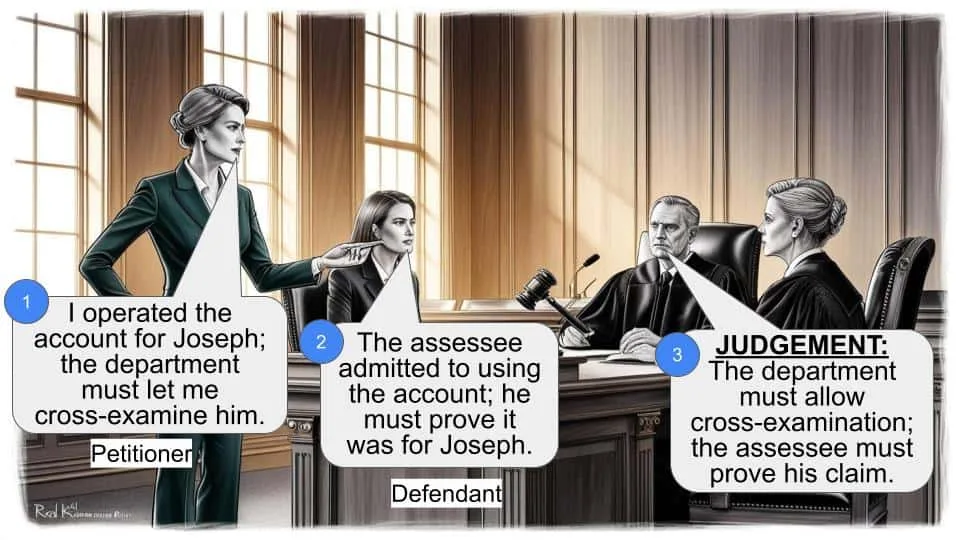
This case involves a dispute between an assessee and the tax department, where the department based its proceedings on a third-party statement. The court emphasized the necessity for the department to provide the third party for cross-examination and clarified the burden of proof lies with the department. However, the assessee admitted to operating a bank account, shifting the burden to him to prove he acted on behalf of the account holder.
Get the full picture - access the original judgement of the court order here
Case Name:
Jose Kuruvinakunnel Vs Commissioner of Income Tax (High Court of Kerala)
ITA. No. 149 of 2014
Date: 8th June 2015
Key Takeaways:
- The department must make third parties available for cross-examination when their statements are used against an assessee.
- The burden of proof initially lies with the department but can shift to the assessee if they admit to certain actions.
- The court highlighted the importance of not taxing the same income twice.
Issue
Does the tax department need to provide a third party for cross-examination when their statement is used against an assessee, and who bears the burden of proof?
Facts
The case revolves around the tax assessment of an individual who operated a bank account belonging to his brother-in-law, Sri Francis Joseph. The department initiated proceedings based on Joseph’s statement, which claimed the assessee used the account. The assessee admitted to operating the account but claimed it was on behalf of Joseph.
Arguments
- Assessee’s Argument: The department should have made Francis Joseph available for cross-examination. The same income was assessed in Joseph’s name, so it should not be taxed again in the assessee’s name.
- Department’s Argument: The addition to the assessee’s income was legal, as he admitted to operating the account. The burden to prove he acted on behalf of Joseph was on the assessee.
Key Legal Precedents
- P.S. Abdul Majeed v. Agricultural Income Tax and Sales Tax Officer and others [209 ITR 821]: Establishes the need for cross-examination of third parties in tax proceedings.
- Commissioner of Income Tax v. K.Chinnathamban [292 ITR 682] (SC): Discusses the depositor’s responsibility to explain bank deposits.
- Income Tax Officer, A Ward, Lucknow v. Bachu Lal Kapoor Kewal Ram [60 ITR 74]: Highlights that the same income cannot be taxed twice.
Judgement
The court ruled that while the department should provide third parties for cross-examination, the burden to prove the operation of the account on behalf of another lies with the assessee. The court directed the assessing officer to reconsider the Rs.3,00,000 addition, considering the final assessment order against Francis Joseph.
FAQs
Q1: Why is cross-examination important in this case?
A1: Cross-examination allows the assessee to challenge the credibility of the third-party statement used against them.
Q2: Who has the burden of proof in tax disputes?
A2: Initially, the department must prove allegations, but if the assessee admits to certain actions, the burden shifts to them to prove their claims.
Q3: Can the same income be taxed twice?
A3: No, the principle is that income should be assessed in the hands of the right person and not taxed twice.

1. These appeals are filed by the assessee challenging the order of the
Income Tax Appellate Tribunal, Cochin Bench in I.T.A.Nos.429, 431, 432 &
430 of 2005. Since issues raised are common, these appeals were heard
together and are disposed of by this common judgment treating ITA
149/14 as the leading case.
2. In these appeals, the relevant assessment years are 1996-1997 to
2000-2001, and in I.T.A.149/14 the assessee is challenging the additions
made on three counts. First one is deposit of Rs.3,00,000/- in the bank
account of one Sri.Francis Joseph, the brother-in-law of the assessee. The
second one is the unexplained credit of Rs.5,60,000/- in the capital account
of the firm Hotel Mayura of which the assessee is a partner and the third
one is relating to a loan of Rs.4,00,000/- taken by the assessee from one
Mr.George Joseph.
3. In so far as the addition of deposit of Rs.3,00,000/- in the bank
account of Mr.Francis Joseph is concerned, facts show that Sri.Francis
Joseph is the brother-in-law of the assessee. Sri.Francis Joseph had
given a statement to the DDIT (Inv) that he had opened S.B.Account
No.3075 in his name at the Federal Bank, Poovarani Branch and that he
had made initial deposits aggregating to Rs.2,00,000/-, which was
withdrawn by him. According to the Mr.Francis Joseph, thereafter all
other transactions in the account were operated by the assessee herein
using blank cheque leaves signed and given by him. On the basis of this
information, the assessment officer collected materials from the bank
and after considering the explanation offered by the assessee in
response to the notice issued to him, Rs.3,00,000/- was added to the
income of the assessee during the assessment year in question. This
addition was confirmed by the Commissioner of Income Tax Appeals
and the Tribunal.
4. Learned counsel for the assessee contended before us that
when the Department proceeded to initiate action on the basis of the
statement of Sri.Francis Joseph, Department should have made available
Sri.Francis Joseph for cross examination and that it was entirely upto
the Department to prove the allegations against him. Counsel also
referred us to Annexure G, an order of assessment in the name of
Sri.Francis Joseph, where according to him the very same amount was
assessed in the name of Sri.Francis Joseph himself. Therefore, according
to the counsel, the addition of this Rs.3,00,000/- to his income cannot
be sustained. This contention now raised by the counsel for the
assessee was refuted by the learned counsel for the Revenue and
according to him, the addition made was perfectly legal.
5. We have considered the rival submissions made. It is true that
as held in the judgment in P.S.Abdul Majeed v. Agricultural Income
Tax and Sales Tax Officer and others [209 ITR 821] when the
Department is proceeding against an assessee on the basis of the
statement of a third party, it is necessary that the Department should
make available that third party for cross examination and the burden to
prove the allegation is also on the Department. However, in so far as
this case is concerned, though the proceedings were originated on the
basis of the statement of Sri.Francis Joseph, after collecting the details
and records from the Bank, all such details were put to the assessee for
his explanation. The assessee thereupon admitted that he operated the
bank account of Sri.Francis Joseph, but according to him, such operation
of the bank account was on behalf of Sri.Francis Joseph and for his
benefit only. According to him, it was therefore that the bank
documents, such as cheque leaves and pay in slips, etc. contained his
signature.
6. This therefore shows that the fact that the assessee had
operated the bank account of Sri.Francis Joseph, was admitted by the
assessee himself. If that be so, the further question that remained was
whether he was acting for and on behalf of Sri.Francis Joseph as claimed
by him. The burden to prove a factual assertion made is upon the
person makes the assertion. Therefore, the burden to prove that he was
acting on behalf of Sri.Francis Joseph was not on the Department, but on
the assessee himself. When the burden is on the assessee to prove the
aforesaid factual question, it was the assessee's burden to make
available Sri.Francis Joseph for cross examination. In this context, we
should also record that the assessing officer had repeatedly issued
summons to Sri.Francis Joseph, and that though he stood by his
statement, he declined to appear for cross examination for one reason
or the other. This was despite the fact that the burden was that of the
assessee to produce him for examination. Therefore, in the facts of this
case, we are unable to find fault with the Department for not making
available Sri.Francis Joseph for cross examination.
7. In so far as the judgment of the Apex Court in Commissioner of
Income Tax v. K.Chinnathamban [292 ITR 682] (SC), relied on by the
counsel for the assessee is concerned, it is true that the principle laid
down in the judgment is that when proceedings are initiated based on
the bank deposit, it is for the depositor to explain the same. However,
that logic cannot be imported into the facts of this case for the simple
reason that the assessee himself has admitted of having operated the
bank account, though allegedly on behalf of the account holder. In such
a case, it is for the assessee who has operated the account to offer the
explanation and prove his case and not the deposit holder.
8. However, the contention of the assessee that by Annexure G
assessment order, Sri.Francis Joseph himself was assessed to income tax
for the year 1997-98, merits consideration. That assessment order also
makes reference to the aforesaid bank account in the name of
Sri.Francis Joseph and the amounts available therein. According to the
assessee, Annexure G assessment order has also become final.
9. Learned counsel for the assessee has placed reliance on the
judgment of the Apex Court in Income Tax Officer, A Ward, Lucknow v.
Bachu Lal Kapoor Kewal Ram [60 ITR 74] and submitted that the Act
does not envisage taxation on the same income twice over. The
principle that assessment should be in the hands of the right person and
that there cannot two assessments for the same income, are too well
settled. Therefore, if, as contended by the counsel for the assessee,
Annexure G assessment order has become final against Sri.Francis
Joseph, the very same amount cannot again be assessed in the name of
the assessee also.
10. We find that this issue was neither raised nor considered by
the assessing officer nor was this issue properly dealt with by the
Tribunal. Since, prima facie, there is force in what is argued, this is an
issue that needs to be considered by the Assessing Officer, who will
reconsider the liability of the assessee on this account, duly adverting to
Annexure G order in the name of Sri.Francis Joseph and with notice to
the assessee.
11. Second issue that arises for consideration is regarding the
deposit of Rs.5,60,000/- in the name of the assessee in the capital
account of the firm Hotel Mariya, of which he is a partner. Though this
addition was confirmed by the Appellate Commissioner and the
Tribunal, contention raised by the counsel for the appellant is that when
Rs.5,60,000/- was shown to the credit of the assessee in the accounts of
the firm, it is for the firm to explain such a credit and the assessee
cannot be called upon to explain the same. In support of this
contention, he placed reliance of a judgment in Commissioner of
Income Tax v. Shiv Shakti Timbers [229 ITR 505]. However, as rightly
contended by the learned Standing Counsel for the Department,
Rs.5,60,000/- was shown as the deposit made by the assessee in the
capital account of the firm and this amount was not reflected in the cash
flow statement filed by him before the assessing officer. This, therefore,
shows that Rs.5,60,000/- deposited by him in his capital account is an
unexplained investment made by the assessee attracting Section 69 (of Income Tax Act, 1961) of
the Income Tax Act. Facts being so, we do not find any illegality in the
order of the Tribunal confirming the said addition.
12. The third addition that is complained of is Rs.4,00,000/-
allegedly borrowed by the assessee from one George Joseph. According
to the learned counsel for the assessee, Sri.George Joseph in his
statement has explained source of this Rs.4,00,000/- by pointing out
that Rs.3,00,000/- was availed by him as loan from a bank and
Rs.1,00,000/- was from his personal savings. According to the learned
counsel, George Joseph is having substantial landed properties and
agricultural income and therefore, he having explained the source of the
amount advanced to the assessee, the addition ought not have been
made.
13. He also contended that the assessing officer himself and the
Tribunal having come to a conclusion that the assessee is not
maintaining books of accounts, the addition could not have been made
under Section 68 (of Income Tax Act, 1961). To support this contention,
counsel referred us to Commissioner of Income Tax v. Shiv Shakti
Timbers [229 ITR 505].
14. However, the statement of Sri.George Joseph itself show that a
part of the amount was borrowed by him from the bank and the
remaining part was from his personal savings. Despite this claim made,
he did not produce any evidence to substantiate it. Further, as rightly
indicated by the Tribunal, it is too improbable and against human
nature that a person who has borrowed money on interest, would lend
it without levying interest on the same. Therefore, we are unable to
accept the case of the counsel that the explanation of Sri.George Joseph
should have been accepted as the proof of source of the amount
advanced and that the addition should not have made.
15. It is true that Section 68 (of Income Tax Act, 1961) talks about books of accounts and it
is also true that in so far as this case is concerned, the assessee was not
maintaining books of accounts. It is on this basis that the counsel
contended that Section 68 (of Income Tax Act, 1961) could not have been invoked. We are unable
to agree. If this logic is accepted, it will be possible for any defaulting
assessee to escape from the payment of tax. In our view, Tribunal was
perfectly justified in its' finding that in case of this nature the cash flow
statement could be treated as the account of the assessee. Therefore, in
such circumstances, we cannot accept the case of the assessee. Issues
raised being common, the above findings would answer the contentions
raised in the remaining appeals also.
16. In the result, we dispose of these appeals setting aside the
addition made based on the deposit of Rs.3,00,000/- in the bank
account of Sri.Francis Joseph and direct that the assessing officer shall
reconsider that issue duly adverting to Annexure G order of assessment
issued to Sri.Francis Joseph for the assessment year 1997-98.
In all other respects, the orders will stand confirmed.
SD/-
ANTONY DOMINIC
JUDGE
SD/-
SHAJI P. CHALY
JUDGE
×
Similar Ripples
Questions
"Cross-Examination Crucial in Tax Dispute: Assessee’s Burden to Prove"
Write your CommentSimilar Posts
Generic
- Reportdata/3709.pdf
